Negotiate Insurance Cash Settlements: 7 Pro Tips 2026
August 07, 2026
Written by Taylor Bezek
Share


You do not have to accept the first dollar amount your insurer offers — a fair property settlement is negotiated, not given. Depreciation is negotiable, independent repair estimates carry real weight, and laws in many states prohibit insurers from lowballing you into litigation. These seven tactics show property owners how to counter a low valuation with documented evidence and secure the cash settlement the policy actually owes.
Key Takeaways
- First offers are a starting point: you do not have to accept the insurer’s initial dollar figure — fair settlements are reached by challenging the valuation with documented evidence.
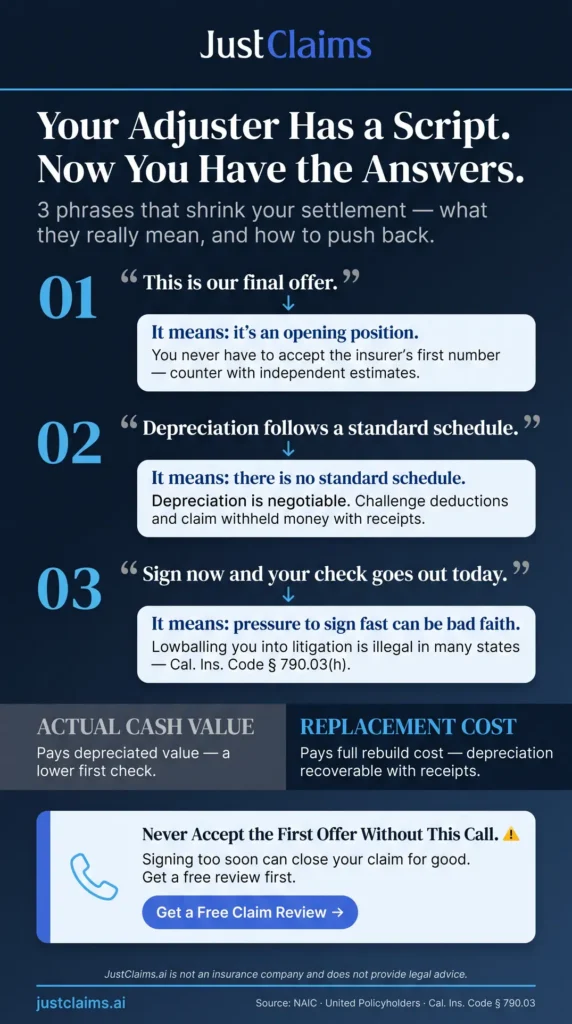
- ACV definition: Actual Cash Value coverage pays repair or replacement costs based on current value, factoring in depreciation.
- RCV requirement: Replacement Cost Value policies typically require submitting receipts after replacing items to claim withheld depreciation.
- Bad faith tactics: Lowballing or forcing litigation to delay payment on a clearly covered claim constitutes bad faith in many states.
Tip 1: Know Your Policy — Actual Cash Value vs. Replacement Cost
Actual Cash Value (ACV) coverage pays the cost to repair or replace property based on its current value, which factors in age and wear and tear, also known as depreciation [1]. In contrast, Replacement Cost Value (RCV) coverage pays the cost to repair or replace damaged property using materials of a like kind and quality [1]. With RCV, the insurer generally pays the actual cash value first; once the item is repaired or replaced and receipts are submitted, the insurer reimburses the difference — known as recoverable depreciation [2].
Tips 2–4: The Evidence That Supports Your Valuation
Because initial offers often fall short of the actual repair costs, gathering comprehensive evidence is your primary tool for challenging the adjuster’s valuation. ACV vs RCV is where most cash settlements are won or lost.
Tip 2: Photographic and Video Documentation
Claimants should document all losses with photos and video before removing any debris or belongings, and make a written list of the damages and lost items, to build a compelling claim file [3].
Tip 3: Independent Repair Estimates
Property owners should always get independent rebuilding and repair estimates from reputable professionals — you do not have to accept the insurance company’s contractor or estimate, and you should not accept a settlement based on the insurer’s estimates without getting at least two of your own [4].
Tip 4: Itemized Lists, Receipts, and Records
Keeping an itemized list of damaged and lost items, saving damaged property for inspection when practical, and holding onto receipts for repairs and replacements provides the documentation needed to demonstrate the true scope of the loss [3][5].
Tips 5–7: Negotiation Tactics — Depreciation, the First Offer, and Bad Faith Leverage
Once your evidence is compiled to counter the initial valuation, applying strategic negotiation tactics becomes necessary to secure a fair cash settlement. When talks stall entirely, you can invoke appraisal clause rights under your policy and force a binding valuation.
Tip 5: Negotiate the Depreciation
When dealing with an ACV policy, property owners often need to negotiate with the insurer to apply less depreciation on major items in order to maximize their cash settlement — depreciation is subjective and negotiable, with no official schedule or set standard [5][6]. To collect the full amount under a Replacement Cost policy, policyholders typically must first replace the items and submit receipts to the insurer to claim the withheld depreciation balance [2][5].
Tip 6: Counter the Initial Valuation
You do not have to accept the dollar amounts the insurer offers: challenging the figure with independent estimates and standing firm on documented value is a normal, expected part of reaching a fair settlement [7]. Rejecting the initial offer opens the door for negotiation, potentially leading to a higher settlement [7].
Tip 7: Identify Bad Faith Practices
Many states outlaw specific unfair claims settlement practices. California’s Insurance Code, for example, prohibits insurers from failing to attempt in good faith to effectuate prompt, fair, and equitable settlements of claims in which liability has become reasonably clear — and from compelling policyholders to institute litigation by offering substantially less than the amounts ultimately recovered [8]. Persistent lowballing or deliberate delay on a clearly covered claim can therefore carry legal consequences for the carrier, not just negotiation risk for you. Independent insurance appraisals put a competing number on the table.
If the Carrier Still Won’t Move: The Escalation Ladder
8. Demand the Itemized Breakdown
Carriers often provide a lump-sum figure or a summary that hides how they arrived at the total. Request a detailed, itemized breakdown of how the initial settlement was calculated [9]. Compare it line by line against your independent estimates — missing line items and under-scoped repairs are exactly where negotiations are won [4].
9. Keep a Communication Log
Verbal promises from adjusters hold no weight unless they are documented. Record the name and title of every representative you speak with, the date and time, and the specific details discussed [11]. If the carrier later changes its explanation for a denial or misses deadlines, that written record becomes evidence.
10. Read Every Check Before You Cash It
Depositing a settlement check without confirming whether it is an undisputed advance or a final release can close the door on future negotiations. Read both sides of every check and draft for words like “full” or “final settlement” before cashing it [4].
11. Escalate: Public Adjuster, Then the Department of Insurance
If negotiations stall, a licensed public adjuster represents the policyholder’s interests exclusively — a fiduciary duty distinct from the company adjuster, who represents the insurer [12] [13]. And if the carrier’s conduct crosses into unfair practices, file a complaint with your state department of insurance: consumer-assistance programs investigate complaints and, in some states, have recovered millions of dollars in restitution for policyholders [10].
Frequently Asked Questions
What is the difference between ACV and RCV policies?
Actual Cash Value policies calculate your payout by taking the replacement cost and subtracting depreciation based on the item’s age and condition. Replacement Cost Value policies, on the other hand, cover the full cost of buying a new item of similar quality without deducting for wear and tear [1][2].
Why should property owners reject the first settlement offer?
Initial proposals from carriers are opening positions, not final determinations — you do not have to accept the dollar amounts the insurer offers, and you can challenge the figure with independent estimates and real-world contractor quotes [7]. Declining the preliminary figure initiates the negotiation process, which can lead to a more accurate final payout [4][7].
How can I prove the value of my damaged property?
Building a strong file means documenting all damage with photos and video before cleanup, keeping an itemized list of lost items, and obtaining at least two independent repair estimates from reputable contractors — you never have to accept a settlement based solely on the insurer’s own estimate [3][4].
What constitutes bad faith in an insurance negotiation?
State unfair-claims-practice laws prohibit carriers from refusing to attempt prompt, good-faith settlement of clearly covered claims, and from forcing policyholders into litigation by offering substantially less than a claim is worth [8]. Documented lowballing or deliberate delay can expose the carrier to bad-faith liability under statutes such as California Insurance Code § 790.03 [8].
Should I file a complaint with my state insurance department?
If the carrier is delaying, lowballing, or refusing to explain its valuation — and direct negotiation plus a public adjuster have not moved it — yes. State departments of insurance investigate consumer complaints and can push carriers toward proper claim handling; Arizona’s program alone recovered more than $10 million in restitution for consumers in a single year [10]. A complaint is leverage, not a last resort.
How to Protect Your Settlement Rights
Securing a fair cash payout requires treating the claims process as a formal negotiation rather than accepting the carrier’s initial assessment [7]. By understanding the depreciation mechanics of your specific policy and compiling independent repair estimates, property owners can effectively challenge undervalued offers [4][6]. Recognizing unfair claims practices — such as deliberate delays or lowball offers designed to force litigation — provides additional leverage to demand the compensation owed under the policy [8]. Upload your claim documents to JustClaims to see in minutes if your insurer missed coverage you’re owed.
This content is for informational purposes only and does not constitute legal or insurance advice. Coverage decisions depend on the specific terms, conditions, and exclusions of each policy and the laws of the applicable jurisdiction; policyholders and contractors should consult with a qualified professional for advice on their particular situation.
Sources
[1] National Association of Insurance Commissioners — What’s the Difference Between Actual Cash Value Coverage and Replacement Cost Coverage?: https://content.naic.org/article/whats-difference-between-actual-cash-value-coverage-and-replacement-cost-coverage
[2] North Carolina Department of Insurance — Actual Cash Value vs. Replacement Cost Value: https://www.ncdoi.gov/consumers/homeowners-insurance/actual-cash-value-vs-replacement-cost-value
[3] National Association of Insurance Commissioners — Navigating the Claims Process: Recover & Rebuild: https://content.naic.org/article/consumer-insight-navigating-claims-process-recover-rebuild
[4] United Policyholders — Insurance Recovery Tips for the Dwelling Part of Your Claim: https://uphelp.org/claim-guidance-publications/insurance-recovery-tips-for-the-dwelling-part-of-your-claim/
[5] United Policyholders — 10 Tips for Settling the Contents (Personal Property) Portion of Your Claim: https://uphelp.org/claim-guidance-publications/10-tips-for-settling-the-contents-portion-of-your-claim/
[6] United Policyholders — Depreciation Basics: https://uphelp.org/claim-guidance-publications/depreciation-basics/
[7] United Policyholders — Frequently Asked Questions About Homeowners Insurance Claims in Texas: https://uphelp.org/claim-guidance-publications/frequently-asked-questions-about-homeowners-insurance-claims-in-texas/
[8] California Legislative Information — California Insurance Code § 790.03 (Unfair Practices): https://leginfo.legislature.ca.gov/faces/codes_displaySection.xhtml?lawCode=INS§ionNum=790.03
[9] Texas Department of Insurance — Steps to Getting Your Home or Car Insurance Claim Paid: https://www.tdi.texas.gov/tips/getting-your-insurance-claim-paid.html
[10] Arizona Department of Insurance and Financial Institutions — DIFI Consumer Assistance Results: Over $10 Million Restitution Provided to Arizona: https://difi.az.gov/announcementnews/difi-consumer-assistance-results-over-10-million-restitution-provided-arizona
[11] United Policyholders — Speak UP: How to Communicate With Your Insurance Company: https://uphelp.org/claim-guidance-publications/speak-up-how-to-communicate-with-your-insurance-company/
[12] Texas Legislature — Texas Insurance Code Chapter 4102 (Public Insurance Adjusters): https://statutes.capitol.texas.gov/Docs/IN/htm/IN.4102.htm
[13] Texas Department of Insurance — Home Insurance Glossary: https://www.tdi.texas.gov/consumer/home-insurance-glossary.html

Taylor Bezek

As the General Manager at JustClaims, Taylor Bezek brings over a decade of experience managing complex residential, commercial, and large-loss claims. A licensed Public Adjuster in TX (#2125659), FL (#W455048), CO (#769172), and 10 additional states, Taylor founded his own firm before joining JustClaims to scale a tech-forward solution for the insured. He is committed to combining industry expertise with AI to enhance speed, clarity, and outcomes for every policyholder. Taylor's mission is to modernize the public adjusting profession and ensure owners get exactly what they are entitled to.