Smoke and Fire Damage Insurance Claims: Steps to Full Recovery
October 09, 2026
Written by Taylor Bezek
Share


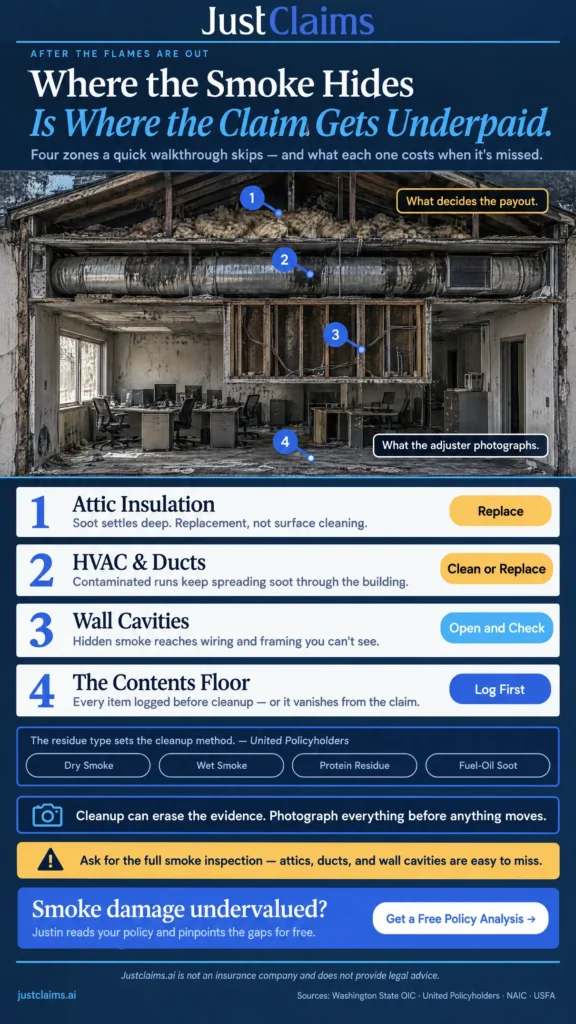
Smoke can settle into attics, ducts, and wall cavities long after the flames are out, and United Policyholders warns that relying only on the insurer’s adjuster is rarely sufficient for a serious loss. For commercial property owners, the contamination you cannot see is where disputes tend to start.
Key Takeaways
- Entry rule: Do not enter a fire-damaged building unless the fire department says it is safe.
- Inspection timing (Washington only): An insurer should inspect the damage within 30 days of the claim being filed.
- Residue types: Adjusters evaluate dry smoke, wet smoke, protein residue, and fuel or oil residue.
- Claim duration: United Policyholders advises keeping a partial-loss fire claim open for at least six months.
- Texas public adjuster fee ceiling: Public adjusters can charge up to 10% of the total amount the insurer will pay.
- Outside expertise: Qualified outside professionals are “almost always necessary” in addition to the insurer’s adjuster inspection.
Immediate Steps After a Fire: Safety and Documentation
Confirm the Building Is Safe
Federal fire guidance advises against entering a damaged structure unless the fire department says it is safe [1]. After the all-clear, the EPA advises selecting a NIOSH-approved respirator marked “N95” or “P100” when working around ash [2].
Items that were not burned may still be ruined by smoke or left soggy with water, so do not throw anything away until the adjuster has completed the inspection [1] [3]. The same keep-everything rule drives wildfire smoke claims: our Fort Collins wildfire insurance claims guide shows how smoke-ruined items stay on the record until the inspection is done.
Notify the Insurer and Track Every Expense
Contact your insurer right away and ask what to do first [1]. Save every receipt for fire-related spending. The insurer may need them, and they can also support loss claims on a tax return [1]. Hotel and meal receipts belong in the same file, because they are what make additional living expenses reimbursable after a fire.
Timing rules vary by state. In Washington, an insurer should inspect within 30 days of the claim being filed, and it may use photos or a virtual inspection instead of sending an adjuster [4]. In that state you may choose your own contractor or hire a licensed public adjuster [4].
Secure the Property Without Erasing Evidence
Once it is safe to return, you can make emergency repairs yourself, such as plywood over broken windows or tarps over a damaged roof. Keep the receipts for the materials [4]. Be ready to give the insurer receipts, photos, and other documentation, and keep copies of everything [4]. Before going beyond emergency repairs, read up on what to expect at the insurance adjuster inspection, because permanent fixes made before that visit can erase the evidence your claim depends on.
Before removing any debris or belongings, photograph or video the damage and make a list of damaged and lost items [5].
Understanding Policy Coverage for Smoke and Soot
Because invisible smoke damage is where claims tend to be disputed, you need to know which coverage grants respond to it. The guidance below comes from a state regulator writing for general policyholders. Commercial forms vary, so confirm each point against your own policy language.
What Smoke Coverage Typically Pays
Standard property policies typically cover sudden and accidental smoke damage, including ash, from sources such as kitchen fires or a neighbor’s fire. Covered costs include cleaning, deodorizing, and repairs, plus temporary living costs when the premises are unsafe [3]. Smoke damage generally falls under the same coverage as fire damage, through three protections [3]:
- Dwelling or structure coverage: pays to fix or rebuild walls, ceilings, and the HVAC system.
- Personal property coverage: pays to clean, repair, or replace contents such as furniture and electronics.
- Loss-of-use coverage: pays for temporary housing and food while the property is unlivable during cleanup and repairs.
Exclusions That Can Reduce a Payment
Standard policies exclude wear and tear, because they cover sudden accidents rather than ongoing issues such as chimney maintenance. They also exclude long-term nicotine damage from indoor tobacco smoking, and damage from neglect of the building and heating systems [3].
Why Residue Type Matters
Adjusters examine the type of residue to help judge the extent of damage [3]:
- Dry smoke: powdery, from fast-burning fires.
- Wet smoke: sticky and smearing, from smoldering plastics or rubber, often causing permanent staining and strong odors.
- Protein residue: from burnt food, leaving an invisible or amber film.
- Fuel or oil residue: from furnace puff backs.
How to Document Hidden Smoke Damage
Because overlooked smoke damage is the central risk in a partial-loss claim, your documentation has to reach what a visual walkthrough misses. United Policyholders lists hidden damage (water, smoke, ash, mold, air quality, ducts) as a main risk and advises you to document everything damaged or destroyed and file a timely claim [6].
Bring in Qualified Specialists
A property with no obvious damage may still have been affected by extreme heat, smoke, or fire retardant [6]. United Policyholders recommends licensed, experienced contractors and structural engineers for damage and repair costs. It also recommends a Certified Industrial Hygienist for air quality testing, in addition to the insurer’s adjuster [6].
If there is a dispute, you can pay for an independent specialist’s report, because insurers prefer “objective” assessments [6].
Inspect Every System and Cavity
A thorough inspection should cover the roof (ember damage), stucco, siding and concrete, windows, plumbing and heating systems including ducts, and interior walls and framing [6].
A contractor may need to open walls to check framing for damage or mold [6]. If the insurer refuses to pay for proper inspections, ask again in writing and remind it of its legal duty to investigate all damage, including hidden damage [6].
The Washington regulator also advises requesting a full smoke inspection covering attics, crawl spaces, insulation, and the HVAC system [3].
Keep the Claim Open and Build the Record
United Policyholders advises having the entire HVAC system professionally cleaned. It also advises keeping the claim open for at least six months and filing supplemental claims, because some damage, such as dying plants, may not appear right away [6]. Its sample documentation includes a Smoke Contamination and Damage Report, an Air Quality/Industrial Hygienist Report, and an Asbestos, Lead and Mold Inspection Report [6].
For contents, the NAIC tells policyholders to take photos or video and make a list of damaged and lost items, and to have a home inventory ready when reporting the loss [5].
Working With Adjusters and Public Adjusters
Since the insurer’s own adjuster may not capture hidden smoke damage, it helps to understand whom each adjuster actually represents.
Who Each Adjuster Represents
Company adjusters are employees of the insurer, and independent adjusters are hired by the insurer on contract. Both represent the insurer’s interests and charge you no fee [7].
A public adjuster works for you and is paid by you, through a contract fee or a percentage of the settlement [7]. Many states require public adjusters to be licensed, and some states restrict what they may do, so check your state’s rules [5].
What Public Adjusters Can Charge
Fee rules are state-specific:
- Texas: fees can reach 10% of the total amount the insurer will pay, and the percentage can apply to the whole settlement rather than only the disputed portion [8]. If the insurer offers $100,000 and you dispute $20,000, the adjuster could charge $10,000. You may still owe that fee if the insurer does not raise its offer [8].
- Florida: fees are limited to 10% of the claim payment for one year after a declared state of emergency, and to 20% after that [9].
- California: fees are negotiable, but state law requires a written contract that discloses the compensation, including the percentage and the base to which the percentage applies [10].
Contract Terms Worth Checking
You are not required to hire a public adjuster, and insurance policies do not cover their fees [7]. Because the fee percentage can apply to the entire settlement rather than only the disputed amount, confirm the base in writing before you sign [8].
In California, public adjusters cannot solicit business while the loss is underway, or between 6 p.m. and 8 a.m. unless the policyholder requests contact [10]. Illinois allows cancellation by certified mail within 5 business days of signing [7].
Common Pitfalls to Avoid
These pitfalls tend to weaken the very documentation that supports hidden-damage recovery.
Cleaning or Discarding Too Early
Photograph and video smoke damage before cleaning anything. Note odors, soot, staining, and affected contents, and do not throw anything away until the adjuster has finished the inspection [3].
Accepting a Narrow First Inspection
Smoke damage can be progressive. If odors or residue appear after the inspection, you can ask the insurer for a reinspection [3]. Accepting a narrow first inspection leaves hidden areas unexamined.
Accepting Cleaning Shortcuts
United Policyholders notes that disputes often arise over cleaning versus replacing smoke-exposed items. If a reputable cleaner says an item cannot be cleaned, or it still smells after professional cleaning, replace it and seek reimbursement [6]. Reject shortcuts such as being told to wipe surfaces yourself [6].
Relying Only on the Insurer’s Adjuster
United Policyholders calls sole reliance on the insurer’s adjuster “rarely sufficient” and lists adjuster delays, improper repair methods, and matching disputes among the common hazards [6]. Also check the exclusions for wear and tear, long-term nicotine damage, and neglect before you assume a loss is covered [3].
Frequently Asked Questions
Is smoke damage covered under the same claim as fire damage?
In most cases, smoke damage is handled under the same coverage as fire damage. That coverage generally includes structure, contents, and loss-of-use protections [3]. Your own policy language controls, so confirm how it treats smoke and soot.
Should I clean up before the adjuster arrives?
Hold off on cleaning and discarding items until the adjuster has finished the inspection. Photos and video taken beforehand document the damage and the items affected [3] [5].
Do I need a public adjuster for a smoke claim?
No. Illinois regulators state that policyholders are not required to hire one, and policies do not reimburse the fee [7]. Because the percentage can apply to the entire settlement rather than only the disputed portion, compare fee structures and get the fee base in writing before you sign [8] [10].
What if smoke damage shows up after the inspection ends?
You can request a reinspection if odors or residue appear later, since smoke damage can be progressive [3]. United Policyholders also recommends keeping the claim open for at least six months and filing supplemental claims when needed [6].
How to Close Your Smoke Claim Gaps
Smoke claims can be undervalued when the first inspection misses hidden areas. Document before cleanup, bring in independent specialists, and keep the claim open so that late-emerging contamination can still be added [6] [3]. Then upload your policy for a free coverage-gap analysis — Justin’s AI-powered review checks your policy language for the gaps that are easy to miss in Business Interruption and Law & Ordinance coverage, so you know what to claim before you settle.
This content is for informational purposes only and does not constitute legal or insurance advice. Coverage decisions depend on the specific terms, conditions, and exclusions of each policy and the laws of the applicable jurisdiction; policyholders and contractors should consult with a qualified professional for advice on their particular situation.
Sources
[1] After the Fire (FA-46) — U.S. Fire Administration (FEMA)
[2] Protect Yourself from Ash — U.S. Environmental Protection Agency
[4] Steps to Take After Home Damage or a Loss — Washington State Office of the Insurance Commissioner
[5] Assignment of Benefits: Consumer Beware — National Association of Insurance Commissioners
[6] Insurance Claim Tips for Partial Loss Fires — United Policyholders
[7] Public Adjusters — Illinois Department of Insurance
[9] Public Adjusters — Florida Department of Financial Services

Taylor Bezek

As the General Manager at JustClaims, Taylor Bezek brings over a decade of experience managing complex residential, commercial, and large-loss claims. A licensed Public Adjuster in TX (#2125659), FL (#W455048), CO (#769172), and 10 additional states, Taylor founded his own firm before joining JustClaims to scale a tech-forward solution for the insured. He is committed to combining industry expertise with AI to enhance speed, clarity, and outcomes for every policyholder. Taylor's mission is to modernize the public adjusting profession and ensure owners get exactly what they are entitled to.