Fort Collins Wildfire Insurance Claims 2026: Northern Colorado’s Growing Fire Risk
September 16, 2026
Written by Taylor Bezek
Share


Fort Collins property owners face some of the highest wildfire exposure in Colorado, and when fire, smoke, or ash damage does hit, claims are frequently settled below what policies actually owe. Larimer County has been ranked one of the most hazardous counties in Colorado for wildfire (Boulder County ranks higher, 97% vs. Larimer’s 94%, per U.S. Forest Service Wildfire Risk to Communities data), and post-fire insurance disputes in the state show a consistent pattern of underpayment on both structural and smoke-related losses.
Key Takeaways
- County risk ranking: Larimer County has been ranked one of the most hazardous counties in Colorado for wildfire (Boulder County ranks higher, 97% vs. Larimer’s 94%, per U.S. Forest Service Wildfire Risk to Communities data), per Larimer County’s official emergency management resources.
- Community-level exposure: Fort Collins has, on average, greater wildfire likelihood than 86% of communities in the U.S.
- Underpayment pattern: A Federal Reserve Bank of Philadelphia working paper found that almost 40% of post-wildfire insurance claims in California were underpaid relative to replacement cost.
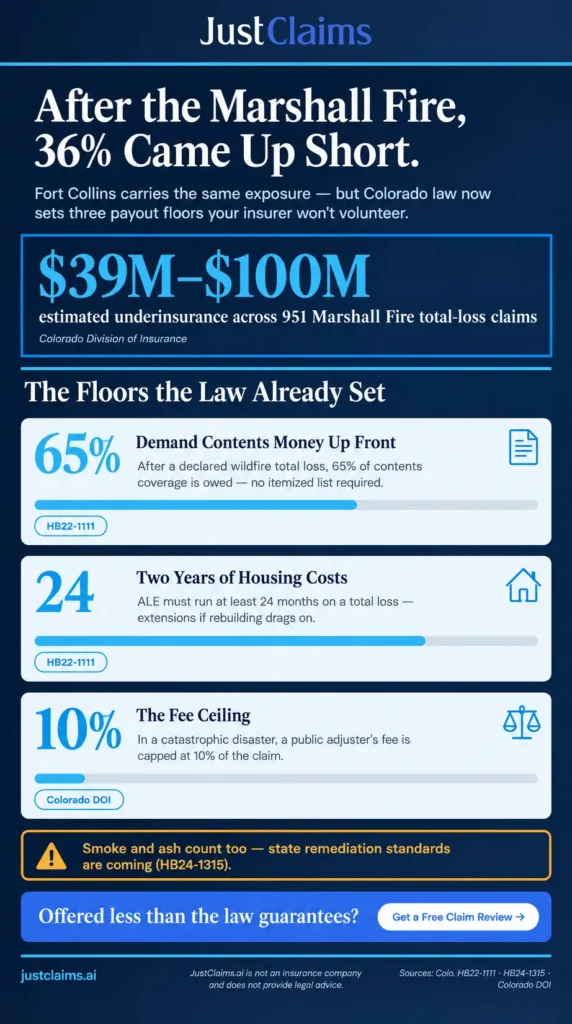
- Contents payout rule: Colorado insurers must offer at least 65% of total contents coverage without a detailed inventory after a declared wildfire total loss.
- ALE minimum: Colorado law requires at least 24 months of Additional Living Expense coverage for a total loss in a Governor-declared wildfire disaster.
- Public adjuster fee cap: For catastrophic disasters, public adjusters in Colorado can charge up to 10% of the claim.
Fort Collins’ Wildfire Exposure and Why April Marks Peak Season
Fort Collins sits at the edge of a Wildland-Urban Interface that Larimer County’s own emergency managers describe as one of a significant natural hazards facing the region, driven by extensive foothill forests, grasslands, and continued residential growth pressing into fire-prone terrain [5].
On a community level, Fort Collins carries a greater wildfire likelihood than 86% of communities assessed nationwide under the Wildfire Risk to Communities tool [1], and Larimer County as a whole faces a risk level higher than 94% of counties in the United States [2].
Larimer County’s official resiliency and recovery resources go further, identifying the county as one of the most hazardous counties in Colorado for wildfire (Boulder County ranks higher, 97% vs. Larimer’s 94%, per U.S. Forest Service Wildfire Risk to Communities data) [3][14]. This exposure is not isolated. The Colorado State Forest Service’s 2023 Colorado Wildfire Risk Assessment update found more than 1 million Coloradans live in areas carrying moderate to very high wildfire risk statewide [4].
For property owners near Fort Collins’ foothills, early spring is a period local emergency managers watch closely: dry grass and wildland fuels from the prior season have not yet greened up, conditions that historically coincide with a rise in fire activity before summer moisture arrives. The 2026 Colorado wildfire forecast tracks that seasonal pattern county by county. Property owners in this zone should treat policy review as a seasonal task, not a one-time purchase decision, given how the risk profile compounds year over year.
Smoke, Ash, and Partial-Loss Claims: Where Carriers Underpay Most
Because Larimer County’s wildfire exposure ranks among the highest in the state, how carriers handle smoke and ash damage claims often determines whether Fort Collins property owners recover fully or absorb losses that a policy was designed to cover. Underpayment is not a hypothetical risk.
A Federal Reserve Bank of Philadelphia working paper examining California wildfire claims found that almost 40% of settlements came in lower than the replacement costs that should have defined coverage limits [6].
Smoke and ash losses are especially prone to dispute because Colorado currently has no uniform standard for the inspection, testing, and remediation of homes affected by wildfire smoke infiltration. Under House Bill 24-1315, the Colorado Division of Insurance must conduct — or contract with a third party to conduct — a study of existing practices for remediating homes damaged by smoke, soot, ash, and other contaminants, and must recommend uniform standards for that remediation, reporting its findings and recommendations to the General Assembly by January 1, 2026 [7].
Colorado’s Division of Insurance treats smoke damage, water damage, and electrical or heat-related interior damage as “other losses” distinct from a structural total loss, meaning property owners may need to pursue these categories separately from the main claim after a declared wildfire disaster [8].
Property owners facing a partial-loss claim should document smoke odor, ash residue, and HVAC contamination independently rather than relying solely on an adjuster’s initial assessment.
Total Loss vs. Partial Loss: Understanding Your Settlement Path
Because settlement rules differ sharply depending on how a claim is categorized, Fort Collins property owners need to know which path their loss falls under before signing off on any offer. Colorado law sets specific minimums for both scenarios in a Governor-declared wildfire disaster.
| Rule | Requirement |
|---|---|
| Contents payout without inventory (total loss) | At least 65% of total contents coverage [8] |
| Remaining contents payout with full inventory | Up to 35% [8] |
| ALE minimum duration (total loss) | At least 24 months, extendable twice by six months [8] |
| Partial loss — insurer request for more information | Within 30 days of inventory submission [8] |
| Partial loss — payment of undisputed items | Within 30 days of receiving the inventory [8] |
| ACV-to-RCV depreciation claim window | Within 365 days after ALE coverage expires, or 36 months after the first ACV payment, whichever is greater, if property is replaced [9] |
For partial losses, once a property owner submits an inventory of damaged or destroyed contents, the insurer must request any additional needed information within 30 days and pay undisputed, insured items within 30 days of receiving that inventory [8].
Actual Cash Value settlements reflect depreciated value at the time of loss, while Replacement Cost Value covers the cost to replace an item new — property owners can often recover the depreciation difference if they complete the replacement within 365 days after ALE coverage expires, or 36 months after the first ACV payment, whichever is greater [9].
Underinsurance risk is well documented in Colorado’s wildfire history. After the Marshall Fire, the Colorado Division of Insurance analyzed 951 total-loss claims out of 1,084 total losses reported by Boulder County, representing $1.02 billion in incurred claims. That underinsurance gap is what Colorado’s wildfire total loss settlement rules were strengthened to address. At a $250 per-square-foot rebuild cost assumption, the analysis found 36% of policies (344) were underinsured, with total underinsurance estimated between $39 million and $100 million depending on rebuild-cost assumptions [10].
Fort Collins property owners can use this history as a prompt to re-verify their dwelling coverage limits against current local rebuild costs rather than assuming a policy purchased years ago still matches replacement value today.
Additional Living Expenses After a Wildfire Evacuation
Because a mandatory evacuation can happen with little warning in Larimer County’s fire-prone foothills, knowing what Additional Living Expense (ALE) coverage actually pays for matters as much as knowing the structural claim rules. In a Governor-declared wildfire disaster, Colorado law requires insurers to provide at least 24 months of ALE coverage for a total loss, with an option to extend twice by six months each [8]. ALE may pay for temporary housing and extra living costs such as hotel stays, meals, and laundry incurred while a property owner is displaced [8].
Most Colorado policies reimburse the difference between additional living expenses and a policyholder’s normal living expenses, and this reimbursement may be subject to a deductible — property owners should save every receipt tied to expenses that could later be reimbursed [8].
Larimer County Emergency Management, citing the Rocky Mountain Insurance Information Association, notes that a mandatory evacuation typically triggers ALE coverage under most standard policies, and evacuated residents should retain receipts because out-of-pocket costs during a mandatory evacuation are generally reimbursable [11].
If a policy document itself is unavailable during an evacuation, property insurance companies in Colorado are required to provide a copy of the policy within 3 business days of a request, which can help displaced residents confirm ALE terms before submitting expense claims [8].
When to Bring In a Public Adjuster
Because smoke, ash, and underinsurance disputes can drag on for months or years, some Fort Collins property owners consider hiring outside help to manage the claim process. The Colorado Division of Insurance is clear that property owners are not required to hire a public adjuster after a wildfire, but if they choose to, they should verify the adjuster is licensed and reputable, check references, and where possible select a Colorado-based adjuster [12].
If you’re weighing that decision after a wildfire loss, a licensed Fort Collins public adjuster can review your claim and damage estimate before you commit to a fee agreement.
Public adjusters work on behalf of the policyholder, not the insurer, and typically charge a percentage of the claim amount under a signed contract — that fee is separate from, and not deducted out of, the amount the insurer pays [12].
For catastrophic disasters specifically, public adjusters can charge up to 10% of the claim, and property owners should confirm the adjuster’s licensing and bonding under Colorado Insurance Regulation 1-2-19 before signing anything [13].
A public adjuster’s role is limited to helping with the insurance claim process and preparing damage estimates; unlike a general contractor, a public adjuster cannot perform repairs or rebuild work [13]. Property owners can verify any adjuster’s license directly with the Colorado Division of Insurance at 303-894-7490 or 800-930-3745 before entering into a fee agreement [12].
Frequently Asked Questions
Why is Fort Collins considered high risk for wildfire compared to other Colorado cities?
Fort Collins borders foothill terrain in Larimer County, which official county emergency management resources identify as one of the most hazardous counties in Colorado for wildfire (Boulder County ranks higher, 97% vs. Larimer’s 94%, per U.S. Forest Service Wildfire Risk to Communities data). Community-level assessments also show Fort Collins carries greater wildfire likelihood than the large majority of U.S. Communities evaluated, driven by dense wildland fuels and a growing wildland-urban interface.
What happens if my Fort Collins property is a total loss from wildfire?
If a Governor declares the fire a disaster and your home is a total loss, Colorado law requires your insurer to offer at least the specified percentage of your total contents coverage without a full inventory, with the remaining amount available if you complete one. Insurers must also provide a minimum period of Additional Living Expense coverage, with the option to extend it in additional increments.
Can I still get reimbursed for hotel and meal costs during a mandatory evacuation even if my home isn’t damaged?
Yes — a mandatory evacuation itself generally triggers Additional Living Expense coverage under most standard policies, separate from whether structural damage ultimately occurs. Keep every receipt for hotel stays, meals, and other extra costs, since reimbursement is based on the documented difference between your evacuation expenses and your normal cost of living.
How long do smoke and ash damage claims typically take to resolve in Colorado?
Resolution times vary widely because Colorado currently has no uniform standard for the inspection, testing, and remediation of wildfire smoke damage, which often creates disputes between insurers and policyholders over what counts as adequate cleanup. Under House Bill 24-1315, the Division of Insurance was required to study existing remediation practices and recommend uniform standards, with findings due to the General Assembly by January 1, 2026.
Do I need a public adjuster to file a wildfire claim in Fort Collins?
No, hiring a public adjuster is optional, and the Colorado Division of Insurance encourages property owners to weigh the cost against the complexity of their claim before deciding. If you do hire one, confirm their license with the Division and understand that their fee — capped at a set percentage for catastrophic disasters — is paid separately from your settlement.
How to Protect Your Fire Claim Settlement
Fort Collins’ position at the edge of one of Colorado’s most hazardous wildfire counties means the question is not whether a claim dispute could happen, but how prepared a property owner is when it does. The clearest risk points sit in the same places state data keeps showing up: smoke and ash damage that lacks a standardized remediation benchmark, total-loss settlements that can fall short of true rebuild cost, and Additional Living Expense claims that go unreimbursed simply because receipts weren’t saved.
Reviewing your dwelling coverage against current local rebuild costs, keeping every evacuation-related receipt, and understanding the distinct rules for total loss versus partial loss claims are steps every Fort Collins property owner can take before April’s fire risk climbs again.
If you’ve already received a settlement offer you’re unsure about, upload your claim documents to Justin to see in minutes if your insurer missed coverage you’re owed.
This content is for informational purposes only and does not constitute legal or insurance advice. Coverage decisions depend on the specific terms, conditions, and exclusions of each policy and the laws of the applicable jurisdiction; policyholders and contractors should consult with a qualified professional for advice on their particular situation.
Sources
[1] Wildfire Likelihood in Fort Collins, CO — Wildfire Risk to Communities (USDA Forest Service)
[2] Wildfire Risk in Larimer County, CO — Wildfire Risk to Communities (USDA Forest Service)
[3] Fire Resources — Larimer County Resiliency & Recovery
[4] 1 Million Coloradans Live in Areas with Elevated Risk of Wildfire — Colorado State Forest Service
[5] Mitigating Against Hazards: Wildfires — Larimer County Emergency Management
[6] California Wildfires, Property Damage, and Mortgage Repayment — Federal Reserve Bank of Philadelphia
[7] HB24-1315: Study on Remediation of Property Damaged by Fire — Colorado General Assembly
[10] Division of Insurance Releases Initial Estimates of Underinsurance — Colorado Division of Insurance
[11] Tips for Evacuees — Larimer County Emergency Management
[13] Are You Disaster Ready? — Colorado Division of Insurance
[14] Wildfire Risk in Boulder County, CO — Wildfire Risk to Communities (USDA Forest Service)

Taylor Bezek

As the General Manager at JustClaims, Taylor Bezek brings over a decade of experience managing complex residential, commercial, and large-loss claims. A licensed Public Adjuster in TX (#2125659), FL (#W455048), CO (#769172), and 10 additional states, Taylor founded his own firm before joining JustClaims to scale a tech-forward solution for the insured. He is committed to combining industry expertise with AI to enhance speed, clarity, and outcomes for every policyholder. Taylor's mission is to modernize the public adjusting profession and ensure owners get exactly what they are entitled to.