What Is an MGA in Insurance? Who Controls Your Claim

November 02, 2026
Written by Stephane Elias
Share


A managing general agent (MGA) is an intermediary that acts for the insurer under delegated authority, not for the buyer. Under the NAIC model law, an MGA’s acts are treated as the acts of the insurer it represents. That makes it important to know who holds claims authority before you report a loss: the contract, not the letterhead, decides where notice goes and who can approve payment.
Key Takeaways
- Definition: An MGA manages an insurer’s business as its agent, produces at least 5% of policyholder surplus in premium, and adjusts or pays claims above $10,000 per claim or negotiates reinsurance.
- Legal effect of MGA acts: Under the NAIC Managing General Agents Act model law, the acts of the MGA are considered the acts of the insurer on whose behalf it acts — in states that have adopted the model.
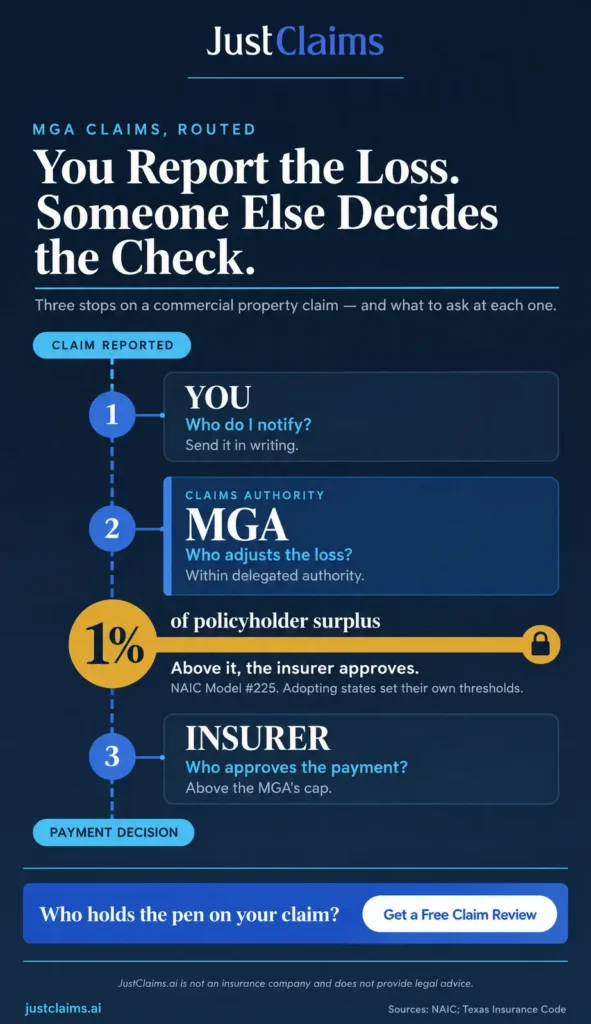
- Claims ceiling: Without the insurer’s prior approval, an MGA may not pay or commit the insurer to pay a claim above a specified amount, which may not exceed 1% of the insurer’s policyholder surplus.
- Claim file ownership: Where the contract lets an MGA settle claims, the model act requires that all claim files be the joint property of the insurer and the MGA.
- What the contract controls: A written MGA contract must set out each party’s responsibilities and, where applicable, claims settlement, underwriting, premium volume limits and agent appointments.
- State variation: Texas asks the insurer to state on the appointment form whether an MGA’s settlement authority exceeds $25,000 on any one claim.
What an MGA Does, and How It Differs From a Broker
An MGA’s role is set by state law and by its contract with the insurer. Texas defines an MGA as a person, firm or corporation with supervisory responsibility for an insurer’s local agency and field operations, or one authorized by an insurer to accept or process policies produced and sold by other agents [1]. That authority can extend to agency balances, loss adjustment and appointing agents [1]. California defines a broker differently: a person who, for compensation and on behalf of another person, transacts insurance other than life, disability or health with, but not on behalf of, an insurer [2]. That difference determines who you call after a loss.
Binding Authority and Legal Effect
Under the NAIC Managing General Agents Act model law, the acts of the MGA are considered to be the acts of the insurer on whose behalf it is acting — the same section that allows regulators to examine an MGA as if it were the insurer [3]. The written contract between the insurer and the MGA sets out the responsibilities of each party and, where both share a function, specifies the division of those responsibilities [3]. Texas requires a written contract that also addresses reports, records and auditing and, if applicable, claims settlement, underwriting, premium volume limits and agent appointments [1].
Model acts are not self-executing — the model text still carries bracketed placeholders for each state’s licensing statute. They apply where a state has adopted them, and adopting states change the thresholds. The two regimes answer the same questions differently:
| Item | NAIC Model #225 [3] | Texas, ch. 4053 [1] |
|---|---|---|
| Payment above the MGA’s authority | Insurer approval required above a set amount; that amount may not exceed 1% of policyholder surplus | Insurer must disclose whether settlement authority exceeds $25,000 per claim |
| What makes an entity an MGA | Manages an insurer’s business as its agent, plus 5% of policyholder surplus in premium and claims over $10,000 or reinsurance | Supervisory control of an insurer’s agency operations, or authority to process policies sold by other agents |
The number that governs your claim is the one in your state’s statute and in the MGA contract — not the number you read online.
MGAs Are Not the Same as Surplus Lines
An MGA describes a distribution and authority structure. Surplus lines describes a market: non-admitted specialized insurers covering risks not available within the admitted market [4]. The two questions are independent. An MGA-managed policy can sit with an admitted carrier, and surplus lines status turns on the insurer’s admission, not on who places the business. For the surplus lines side, see our non-admitted insurers guide.
How the Structure Affects a Claim
Because MGA authority shapes how a claim is reported and decided, the effects show up mostly at claim time. What the structure gives you:
- Acts attributed to the insurer. The MGA acts as the insurer’s agent, and the model law treats its acts as the insurer’s acts [3].
- Defined scope in writing. The contract can grant claims settlement, underwriting and agent appointment authority, subject to premium volume limits [1].
- A shared claim file. Where the MGA settles claims, claim files are the joint property of the insurer and the MGA [3].
Where it creates friction:
- Authority limits. Settlement authority is capped, and payments above the cap need the insurer’s approval [3].
- Unclear reporting paths. Whether you report to the MGA or the carrier depends on the scope of authority in the MGA contract [1].
The 4 Steps in the MGA Claims Process
Because the MGA’s claim-related actions can be attributed to the carrier, each step below is about confirming who has authority and keeping a record of what was said.
1. Confirm Who Holds Claims Authority
Start with three places in your own file: the producer or agent block on the declarations page, the notice-of-claim address in the policy, and the letterhead on your most recent claims correspondence. Check all three before you assume the carrier is handling the file. The written MGA contract controls the scope of delegated claims authority, so if the policy is unclear, ask in writing which entity will adjust the loss [1][3]. Licensing gives you a second reference point: Texas generally requires an MGA to hold a license under Chapter 4053 before it acts for an insurer [1].
2. Give Written Notice to the Right Parties
Send notice in writing, using the channel the policy specifies. If there is any doubt, copy both the MGA and the carrier. Where an MGA handles claims, the model act requires it to report the claim to the insurer in a timely manner [3], so ask for confirmation that the report was made. Keep a dated record of every submission. A written record helps show when notice was given, which matters if a late-notice argument arises later.
3. Document the Loss and the Valuation
Assemble photographs, repair estimates, inventories and operating records. Because claim files may be jointly held by the MGA and the carrier [3], assume that anything you submit can be seen by both. Check how the building and contents are valued, because the policy’s valuation basis sets the starting point for what the claim pays. Check two coverages in particular:
- Business Interruption: the covered period, the income calculation and any extended period of indemnity.
- Law & Ordinance: whether the policy responds to code-upgrade costs when damaged property must be rebuilt to current standards.
4. Review the Evaluation and Respond in Writing
When the MGA or carrier issues a coverage position or estimate, compare it line by line against your documentation. Ask for the basis of any reduction in writing. If the evaluation falls inside the MGA’s settlement authority, the decision may come from the MGA directly. If it falls outside, ask who has authority to approve it [1][3]. If the file stalls anyway, our guide to what a public adjuster does explains what an outside advocate can and cannot do.
Tips for Faster Settlements
Settlement speed often depends on how quickly the right decision-maker can act on a complete file. These practices support that:
- Ask for the claims contact structure up front. Request the name of the adjuster, the supervising entity and the escalation path.
- Use one written channel. Follow phone calls with an email summary so the record shows what was communicated.
- Submit organized documentation. Index your photos, invoices and financial records so the reviewer does not have to ask for them again.
- Ask whether the claim is within the MGA’s authority. If a payment or dispute may exceed the MGA’s settlement authority [3], ask early how it will be escalated.
- Request undisputed amounts. Where part of a loss is not contested, ask in writing whether that portion can be paid while the rest is reviewed.
- Calendar every policy deadline. Proof-of-loss and suit-limitation provisions vary by policy and by state law, so confirm them in your own contract.
Frequently Asked Questions
What does MGA stand for in insurance?
Managing general agent. In an MGA arrangement the carrier remains the insurer, and the MGA acts as its agent under a written contract [1][3]. It is a role in the distribution chain, not a type of coverage.
Does an MGA have the authority to approve or deny my commercial property claim?
It depends on the delegation in the MGA contract. Some MGAs handle claims within the authority the contract grants, while others only route claims to the carrier [1][3].
Are an MGA’s decisions binding on the insurance carrier?
Under the NAIC model law, the acts of an MGA are treated as the acts of the insurer it represents. A decision made within the MGA’s delegated authority is, under that standard, an act of the insurer [3].
Who can see the documents I submit on an MGA-managed claim?
Where the contract permits the MGA to settle claims, the model act requires that all claim files be the joint property of the insurer and the MGA. You should assume your submissions may be reviewed by both organizations [3].
Is an MGA the same as a surplus lines insurer?
No. An MGA is an intermediary that acts for an insurer under a written contract [1]. Surplus lines describes non-admitted insurers covering risks not available in the admitted market [4]. A policy may involve one, both or neither, which is covered further in our non-admitted insurers guide.
How to Protect Your Commercial Claim Value
Knowing whether your MGA or your carrier holds claims authority is the first step toward a well-documented commercial property claim. Confirm the reporting path, keep written records and test the valuation before you accept an estimate.
Get a free commercial property policy review with Justin and have an expert team, accelerated by AI, flag potential coverage gaps in Business Interruption and Law & Ordinance before you respond to the carrier’s estimate.
This content is for informational purposes only and does not constitute legal or insurance advice. Coverage decisions depend on the specific terms, conditions, and exclusions of each policy and the laws of the applicable jurisdiction; policyholders and contractors should consult with a qualified professional for advice on their particular situation. Public adjuster disclosure: This article was prepared for review by a licensed public adjuster. Public adjuster licensing requirements, permitted fees and claim-handling rules vary by state, and a public adjuster cannot guarantee any particular claim outcome or settlement amount. Verify any adjuster’s license with your state insurance regulator before signing an agreement.
Sources
[1] Texas Insurance Code, Chapter 4053 — Managing General Agents — Texas Legislature
[2] California Insurance Code § 33 — Definition of Insurance Broker — California Legislative Information
[3] Managing General Agents Act, Model #225 — National Association of Insurance Commissioners
[4] Surplus Lines — National Association of Insurance Commissioners

Stephane Elias

A seasoned insurance professional with nearly a decade of experience, Stephane Elias is currently serving as a Senior Claims Professional and Public Adjuster with JustClaims. Throughout his career, Stephane has represented policyholders through leading public adjusting firms and served as a loss consultant for law firms specializing in insurance litigation, giving him extensive expertise in complex property insurance claims. A licensed public adjuster in TX (#2645032), FL (#W564547), and six other states, he specializes in commercial and residential property claims, claims management, appraisals, mediation, and strategic partnerships. Stephane is passionate about helping policyholders overcome delayed, denied, and underpaid insurance claims, ensuring they receive the full recovery they’re entitled to under their policy.