Open Peril Insurance Claims: How All-Risk Coverage Works in 2026

November 02, 2026
Written by Taylor Bezek
Share


An open peril policy covers every cause of loss the policy does not explicitly exclude, but a claim can still lose value through valuation errors and misread exclusions. For a commercial property owner, the difference between open peril and named peril shapes who has to prove what after a loss — and how much of the claim actually gets paid.
Key Takeaways
- What open peril means: Coverage applies to all perils except those explicitly excluded in the policy.
- What named peril means: Coverage applies only to the perils listed in the policy.
- Mixed policies: One policy can cover the building on an open peril basis and contents on a named peril basis.
- Replacement cost: Pays the cost to rebuild or repair using materials of similar kind and quality.
- Actual cash value: Values the loss based on the property’s age and wear and tear.
- Commonly excluded perils: Flood, mold, sewer backups, wear and tear, and earthquakes often appear on exclusion lists.
Open Peril vs. Named Peril: How the Coverage Triggers Differ
The NAIC, the national association of state insurance regulators, explains that property coverage can be written for all perils except those explicitly excluded (open peril), or only for the perils named in the policy [1]. That distinction determines where a claim dispute begins. Under named peril coverage, the question is whether the cause of loss appears on the list. Under open peril coverage, the question is whether an exclusion applies.
| Feature | Open Peril (All-Risk) | Named Peril |
|---|---|---|
| What is covered | All perils except those explicitly excluded | Only perils listed in the policy |
| Where to read first | The exclusions and limitations | The list of covered perils |
| Typical dispute | Whether an exclusion truly applies | Whether the cause of loss is on the list |
The burden pattern in this table is a general framework; state law and policy wording can change the allocation, as the burden section below explains.
A single policy can mix both bases. The NAIC’s industry data definitions describe the HO-7 form (mobile or manufactured home) as covering the structure on an open perils basis and personal property on a named perils basis. The HO-1 (Basic) and HO-2 (Broad) forms cover named perils only [2].
These forms are residential, but they show how coverage bases can differ within one policy. Commercial forms vary by carrier and endorsement, so review the specific form on your policy rather than assuming it is open peril throughout.
Common Open Peril Exclusions That Reduce Claims
Because open peril coverage shifts the dispute to the exclusions, that section is where a claim can lose value. Reading it closely is the first step toward recovering what the policy allows.
Wear and Tear
If an insurer attributes damage to age or deterioration rather than a covered event, the claim may be paid at a reduced amount. The NAIC describes actual cash value as the value of the property considering its age and wear and tear [3]. Photographs, maintenance records and inspection reports that show a sudden covered event can support the position that the damage was not gradual.
Flood and Water-Related Perils
The Texas Department of Insurance notes that all-risk policies usually do not cover floods, sewer backups, or mold removal [4]. A loss that involves water may therefore be split between covered and excluded causes. Documenting the source and sequence of the water intrusion matters.
Earthquake and Earth Movement
Earthquake is another exclusion that policies commonly list [4]. Confirm the exact wording and any exceptions in your policy, because the scope of an earth movement exclusion varies by form.
Sublimits Inside Open Peril Coverage
Broad coverage can still carry caps. The NAIC’s consumer guide explains that a scheduled personal property endorsement covers items such as jewelry, furs, stamps, coins, firearms, computers and antiques whose value may be greater than the normal limits in a homeowners policy [3]. Scheduling an item lists it separately and covers it above the standard limit. For more on how caps interact with broad grants, see our guide to sublimits in insurance.
How Burden of Proof Works in an Open Peril Dispute
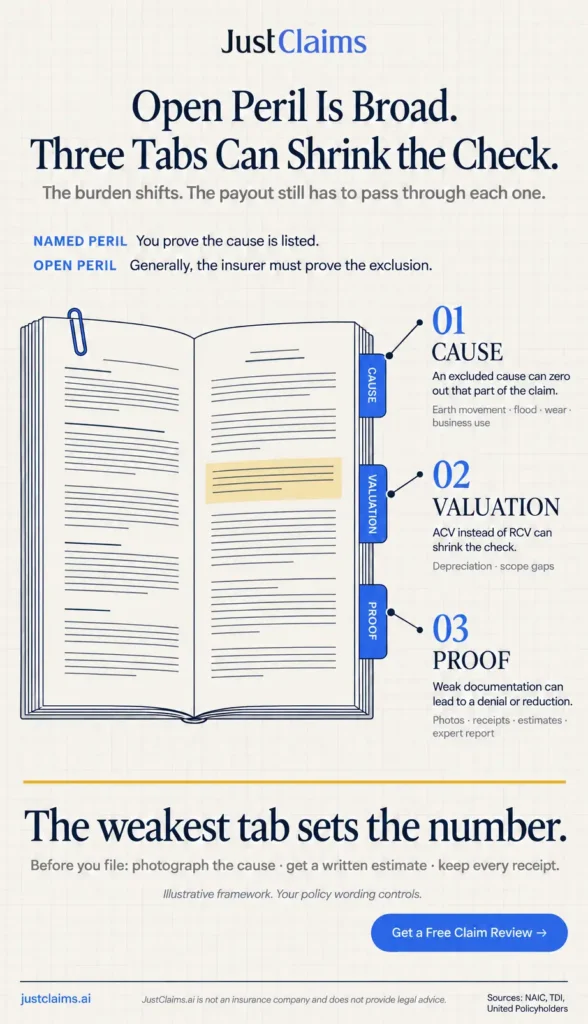
The exclusion-focused structure above is why the burden of proof matters. United Policyholders explains that under an all-risk policy, once the insured proves a direct physical loss, the insurer has the burden of proving what portion of the loss was caused by a specifically excluded event or cause [5]. Under a named peril policy, coverage turns on whether the cause of loss is one of the listed perils [4].
State law and policy wording can change that allocation, so confirm how your state treats it before relying on the general framework.
In practice, the denial letter should identify the exclusion relied upon. Washington’s insurance regulation, for example, bars an insurer from denying a claim on the grounds of a specific policy provision, condition, or exclusion unless the denial references that provision [6]. Rules vary by state, so check your state’s claim-handling regulation.
Identifying Covered Losses Within Open Peril Language
Open peril language is only as valuable as the loss items matched to it. The following steps help show where a covered loss may sit inside the policy.
1. Match each damaged item to a coverage grant. List every component of the loss and tie it to the grant that applies, such as building, equipment or inventory.
2. Check valuation basis. Replacement cost is the cost to rebuild or repair using materials of similar kind and quality [3]. Actual cash value is the value of the property considering its age and wear and tear, and the NAIC notes it often does not pay enough to fully repair or replace the damage [3]. A mistaken valuation basis changes what the claim pays.
3. Review business income. Homeowners insurance is not designed to cover most business uses of the home, though some policies might cover some business uses at least partially [3]. If you run a business from the property, confirm whether your policy or an endorsement includes business income coverage.
4. Review Law & Ordinance. Code-required upgrades may need a separate ordinance or law endorsement. The NAIC explains that an ordinance or law endorsement pays the extra expense to rebuild in compliance with building codes and other ordinances or laws that didn’t exist when the home was originally built [3]. Confirm whether your policy includes this coverage and what limit applies.
5. Test sublimits and scheduled items. Determine whether a cap applies and whether an item was scheduled [3].
6. Check your appraisal and dispute rights. If you and the insurer disagree about the value of the claim, the NAIC advises checking your policy for an appraisal clause [3]. For the step-by-step process, see our guide to invoking the appraisal clause.
Common Denial Reasons and How to Respond
When an open peril claim is denied or underpaid, read the letter for which issue it raises. Each of the common issues below has a documentary response.
- Exclusion cited: Request the specific provision in writing. Compare its wording to the actual cause of loss. The Texas Department of Insurance notes that all-risk policies usually do not cover floods, sewer backups, or mold removal [4]. A single loss can involve both covered and excluded causes.
- Wear and tear or deterioration: Submit maintenance history, prior inspection records and evidence of a sudden event.
- Depreciation applied: Check whether the policy pays on replacement cost or actual cash value. Actual cash value considers the property’s age and wear and tear; replacement cost is the cost to rebuild or repair with materials of similar kind and quality [3].
- Sublimit applied: Confirm whether the item was scheduled or the sublimit applies to that category [3].
- Named peril treatment of contents: Some forms, such as the HO-7, cover personal property on a named perils basis [2]. Verify how your policy treats contents.
If the carrier does not move, review the policy’s dispute provisions and your state’s insurance department complaint process. Rules, deadlines and appraisal procedures vary by state, so consult a licensed professional.
Frequently Asked Questions
What is open peril insurance?
Open peril, often called all-risk, covers any cause of loss unless the policy explicitly excludes it [1]. The policy’s exclusions section therefore defines the limits of coverage, rather than a list of named events.
How is named peril coverage different?
A named peril policy pays only when the loss is caused by a peril written into the policy [1]. If the cause is not on the list, the claim generally falls outside coverage.
Does open peril cover everything?
No. Policies exclude certain causes, and the Texas Department of Insurance notes that all-risk policies usually do not cover floods, sewer backups, or mold removal [4]. Sublimits and valuation terms can also reduce what a covered loss actually pays [3].
Does open peril change who has to prove what?
In general, the policyholder shows a direct physical loss, and the insurer then has the burden of proving that a specific exclusion applies [5]. The exact allocation depends on state law and the policy wording, so confirm it with a qualified professional.
Should I choose replacement cost or actual cash value?
Replacement cost is the cost to rebuild or repair with materials of similar kind and quality; actual cash value is the value of the property considering its age and wear and tear, and the NAIC notes it often does not pay enough to fully repair or replace the damage [3]. The better fit depends on your property and budget, and the choice affects any later claim.
What to Do Before You Submit Your Claim
Open peril coverage rewards careful documentation, because the exclusions, valuation basis and sublimits determine what a covered loss actually pays. Before you file or respond to a denial, match every loss item to a coverage grant, confirm the valuation basis and read each exclusion the carrier cites. Rules vary by state, and nothing here promises a particular settlement.
Upload your policy to get a free AI-powered policy review with Justin and flag potential business income and ordinance or law gaps in your open peril language.
This content is for informational purposes only and does not constitute legal or insurance advice. Coverage decisions depend on the specific terms, conditions, and exclusions of each policy and the laws of the applicable jurisdiction; policyholders and contractors should consult with a qualified professional for advice on their particular situation.
Sources
[1] Homeowners Insurance — National Association of Insurance Commissioners
[2] Homeowners (HO) Policy Form Definitions — National Association of Insurance Commissioners
[3] A Consumer’s Guide to Home Insurance — National Association of Insurance Commissioners
[4] Home Insurance Policies: All Risk or Named Peril — Texas Department of Insurance
[5] Amicus Project Update: March 2009 — United Policyholders
[6] WAC 284-30-380: Settlement Standards for All Insurers — Washington Administrative Code
Taylor Bezek

As the General Manager at JustClaims, Taylor Bezek brings over a decade of experience managing complex residential, commercial, and large-loss claims. A licensed Public Adjuster in TX (#2125659), FL (#W455048), CO (#769172), and 10 additional states, Taylor founded his own firm before joining JustClaims to scale a tech-forward solution for the insured. He is committed to combining industry expertise with AI to enhance speed, clarity, and outcomes for every policyholder. Taylor's mission is to modernize the public adjusting profession and ensure owners get exactly what they are entitled to.