Insurance Claim Denial: How to Fight Deny, Defend, Delay
November 04, 2026
Written by Taylor Bezek
Share


A commercial property insurance claim denial can turn on a valuation error that carries through the building estimate, the business income calculation, and the code-upgrade scope. Deny-and-defend positions are harder to maintain when the policyholder documents the loss and tests the denial against the policy language. Regulators are also focused on how insurers use AI in claims decisions, including whether humans remain in the loop. Knowing how a denial is built is the first step toward challenging it.
Key Takeaways
- Regulatory guidance: NAIC members adopted the Model Bulletin on the Use of Artificial Intelligence Systems by Insurers on December 4, 2023.
- Documentation exposure: The bulletin describes the documentation a state Department of Insurance may request during an investigation or examination.
- State adoption: As of November 2026, Illinois, Nevada, Maryland, Delaware, Wisconsin and Pennsylvania are among the states that have adopted the NAIC AI model bulletin.
- Claims-practice standards: The NAIC’s model act lists inadequate investigation, unreasonable delay, and low offers among the practices regulators may treat as unfair claims settlement practices.
- Coverage checks: Business income and ordinance or law coverage are two areas where a commercial claim can understate the loss.
- Pennsylvania rule: Pennsylvania requires consumer-facing insurer decisions or actions supported by AI to comply with the Unfair Insurance Practices Act and the state’s Unfair Claims Settlement Practices regulations.
What the Deny, Defend, Delay Strategy Is and How It Works
“Deny, defend, delay” describes a pattern: a carrier rejects a claim or undervalues it, defends that position against pushback, and time pressure can wear down the policyholder. For a commercial property owner, the pressure is financial. Every month without a settlement can mean vacant space, rent concessions owed to tenants, and repair costs carried on the owner’s balance sheet.
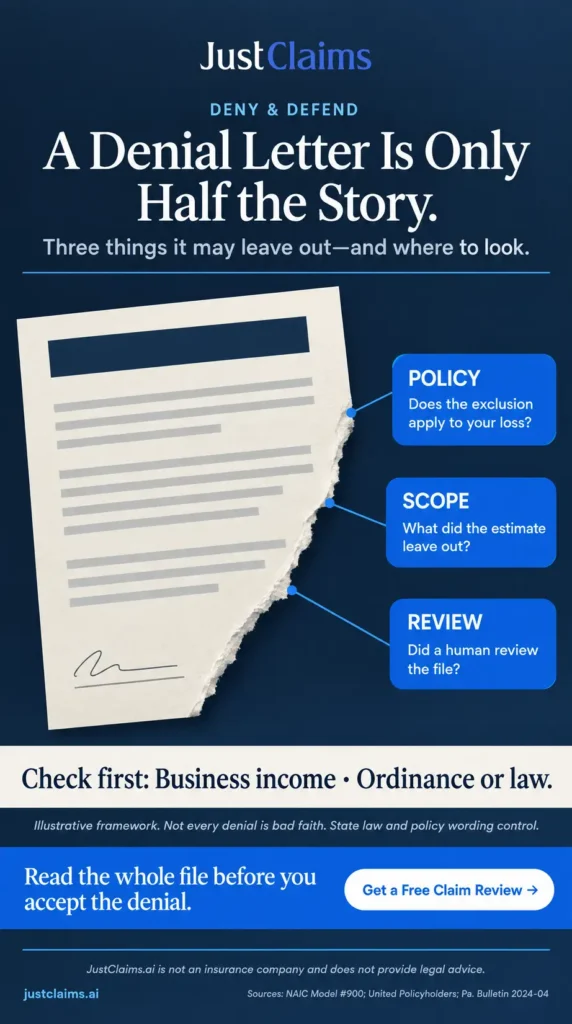
A denial letter that cites an exclusion, a valuation dispute, or a missing document can end a claim if no one tests it against the policy language. A first-pass review may not test how the policy language applies to the specific loss; that is the work a denial response has to do.
This tactic is not the same as a legal bad faith claim. Deny-and-defend describes carrier behavior during the claim. Bad faith is a legal conclusion that depends on state law and the facts of the file. For the legal side, see our guide to bad faith insurance claims.
Signs Your Insurer May Be Acting in Bad Faith
The earlier a denial is tested, the more options the policyholder keeps. None of these signs alone establishes bad faith, but together they can support the position that a claim is being mishandled.
Investigation Red Flags
The NAIC’s model Unfair Claims Settlement Practices Act lists refusing to pay a claim without a reasonable investigation, failing to adopt and implement reasonable investigation and settlement standards, and unreasonably delaying a claim among the practices states may treat as unfair claims settlement practices [1]. Warning signs include:
- No inspection, or an inspection that skips the damaged areas you reported.
- Engineer or contractor reports submitted by you that go unaddressed in the carrier’s response.
- A denial that cites an exclusion without explaining how it applies to your loss [1].
AI-Driven Decision Red Flags
Insurers use AI in claims handling, including tools that can estimate repair costs or assess damage from photos and historical data [2]. State regulators oversee that use, and the NAIC has said insurers remain responsible for complying with insurance laws and that human oversight remains an important part of insurance decision-making [2]. If a denial arrives quickly, uses generic language, or cannot be tied to a named reviewer, you can ask who reviewed the file and on what basis. That question is worth documenting either way.
Delay and Low-Ball Offer Patterns
Repeated requests for documents you have already supplied, shifting adjusters, and unexplained silence are delay signals. The NAIC model lists unreasonably delaying a claim by requiring duplicate proof-of-loss information among the practices states may treat as unfair claims settlement practices, and it lists compelling a policyholder to sue by offering substantially less than the amount ultimately recovered as another [1]. Rotating adjusters are a documented problem in property claims [3]. A below-scope offer can show up as an estimate that undercounts business income loss [4], omits code-required upgrades [5], or applies depreciation without explaining the basis. Keep a dated log of each contact, because the pattern across the file matters more than any single event.
Policy Arguments That Counter Common Denial Defenses
Because deny-and-defend positions rest on policy language, a policy-based response is usually the place to start. Two coverage areas are worth checking line by line on a commercial loss: business income and ordinance or law.
Business Interruption Gaps
Business income claims turn on a defensible calculation of lost earnings, expenses that continue, and the period of interruption—the reasonable time needed to resume business [4]. The carrier’s calculation may use a shorter interruption period than the policy supports, leave extra expense out, or project sales from the wrong baseline [4]. Compare the carrier’s figures against your financial records and the policy’s definitions, line by line.
Law & Ordinance Gaps
Ordinance or law coverage addresses the added cost of rebuilding to current code [5]. It can be included in the policy, added by endorsement, or expressly excluded, and it is usually shown as a percentage of the building limit [5]. Confirm whether your policy includes it, what sublimit applies, and whether the estimate reflects code-driven scope.
Using AI-Assisted Policy Analysis
Policyholders can use AI-assisted tools to compare a denial letter, the policy form, and the supporting documents. The goal is to flag inconsistencies, overlooked endorsements, and coverage gaps for a licensed professional to verify. Human review remains necessary, since policy interpretation depends on state law and the exact wording of the contract [2].
Steps to Take After a Commercial Claim Denial
A structured response can keep a denial from becoming the final word. These steps support your position without assuming any particular outcome.
- Request the denial in writing. Ask the carrier to identify the specific policy provisions and facts it relied on.
- Obtain the complete policy. Get all endorsements and forms, not just the declarations page.
- Document the loss independently. Photos, contractor estimates, and engineering reports help show what the carrier’s scope missed. Contractors who inspected the property can supply scope detail that supports your numbers.
- Ask whether a human decided. If automated tools may have been involved, ask who reviewed the file and on what basis. The NAIC has said human oversight remains an important part of insurance decision-making [2].
- Check regulatory resources. Several states have adopted the NAIC AI model bulletin [6]. The bulletin sets expectations for AI governance and advises insurers of documentation a state Department of Insurance may request during an investigation or examination.[7] For example, Pennsylvania’s notice requires consumer-facing AI-supported decisions to comply with the Unfair Insurance Practices Act and the state’s Unfair Claims Settlement Practices regulations [8].
- Keep a communication log. Record dates, names, and what was promised.
- Evaluate professional help. Most public adjusters work on contingency fees [3]. Confirm the fee terms in writing and verify the license. No professional can promise a particular result.
Frequently Asked Questions
What does “deny, defend, delay” mean in commercial property claims?
It refers to a carrier pattern of rejecting or undervaluing a claim and holding that position under challenge, while time pressure can erode the policyholder’s resolve. The pattern is a description of behavior, not a legal finding. Whether it amounts to bad faith depends on state law and the claim file.
Can an insurer use AI to deny my claim?
Insurers use AI in claims handling, including damage assessment and repair-cost estimates [2]. The NAIC has issued a model bulletin setting expectations for AI governance [7]. States including Pennsylvania have adopted it [6]. Pennsylvania also requires consumer-facing AI-supported decisions to comply with its Unfair Insurance Practices Act and Unfair Claims Settlement Practices regulations [8].
How do I know whether a real person reviewed my denial?
Ask the carrier in writing who evaluated the claim and what information they considered. The NAIC has said human oversight remains an important part of insurance decision-making [2]. A vague or generic response is worth noting in your file.
What is the difference between a denial tactic and a bad faith claim?
A denial tactic is how a carrier behaves while handling your claim. A bad faith claim is a legal action that argues that behavior violated the insurer’s duties under state law. The NAIC model lists refusing to pay without a reasonable investigation and failing to explain the basis for a denial among the practices states may treat as unfair claims settlement practices [1].
Does a public adjuster charge a contingency fee?
Most public adjusters work on contingency fees ranging from 5% to 15% of what the insurer pays [3]. Those fees are capped in some states and negotiable in all, and some adjusters use different fee structures. Review the contract carefully, confirm the license, and understand that no fee arrangement can promise a settlement amount.
What You Should Do After a Denial
A denial is harder to sustain when the policyholder answers it with a written explanation, independent documentation, and a close reading of the business income and ordinance or law provisions. Regulators continue to focus on insurer AI use, and several states have adopted the NAIC model bulletin [2][6]. Asking who made the decision and why is a reasonable part of that process. State law shapes your deadlines and remedies, so consult a qualified attorney or licensed public adjuster about your situation.
Upload your policy to start a free AI-assisted commercial property policy review with Justin, which flags potential business income and ordinance or law gaps.
This content is for informational purposes only and does not constitute legal or insurance advice. Coverage decisions depend on the specific terms, conditions, and exclusions of each policy and the laws of the applicable jurisdiction; policyholders and contractors should consult with a qualified professional for advice on their particular situation. Public adjuster disclosure: This article was prepared with review by a licensed public adjuster. Public adjuster licensing, fee rules, and permitted contingency arrangements vary by state, and no outcome or settlement amount is promised.
Sources
[1] Unfair Claims Settlement Practices Act, Model #900 — National Association of Insurance Commissioners
[2] Artificial Intelligence — National Association of Insurance Commissioners (updated Apr. 3, 2026)
[3] Making the Best Choice When Hiring a Public Adjuster — United Policyholders (updated Jan. 23, 2026)
[4] Business Income Insurance — United Policyholders (by Ronald J. Papa, SPPA; modified Oct. 23, 2020)
[5] Building Code, Ordinance or Law Compliance — United Policyholders (updated Mar. 25, 2026)
[7] NAIC Members Approve Model Bulletin on Use of AI by Insurers — NAIC (Dec. 4, 2023)

Taylor Bezek

As the General Manager at JustClaims, Taylor Bezek brings over a decade of experience managing complex residential, commercial, and large-loss claims. A licensed Public Adjuster in TX (#2125659), FL (#W455048), CO (#769172), and 10 additional states, Taylor founded his own firm before joining JustClaims to scale a tech-forward solution for the insured. He is committed to combining industry expertise with AI to enhance speed, clarity, and outcomes for every policyholder. Taylor's mission is to modernize the public adjusting profession and ensure owners get exactly what they are entitled to.