Inherent Vice in Insurance: Exclusion, Examples & Denial Guide

November 03, 2026
Written by Collin Corcoran
Share


Inherent vice is a policy exclusion for loss caused by a quality in the property that makes it damage or destroy itself. For commercial property owners, managers, and contractors, a denial citing that clause often turns on one question: did the property fail because of what it is, or because something happened to it? Knowing where that line sits can shape how a claim is documented before a loss occurs.
Key Takeaways
- What it is: A policy exclusion for loss caused by a quality in the property that makes it damage or destroy itself.
- Marine-law origin: The term appears in section 55(2)(c) of the UK Marine Insurance Act 1906.
- Early U.S. case: Chute v. North River Insurance Co. (Minn. 1927) denied coverage for a fire opal that cracked solely because of its own nature.
- Core legal principle: Insurance indemnifies against accidents that may happen, not events that must happen.
- When coverage can return: Ensuing-loss language can restore coverage when a covered external peril follows an internal defect.
- What helps a dispute: Evidence that an outside peril activated the weakness, plus the policy’s exact exclusion and ensuing-loss wording.
Inherent Vice Definition and Legal Origin
What the Exclusion Says
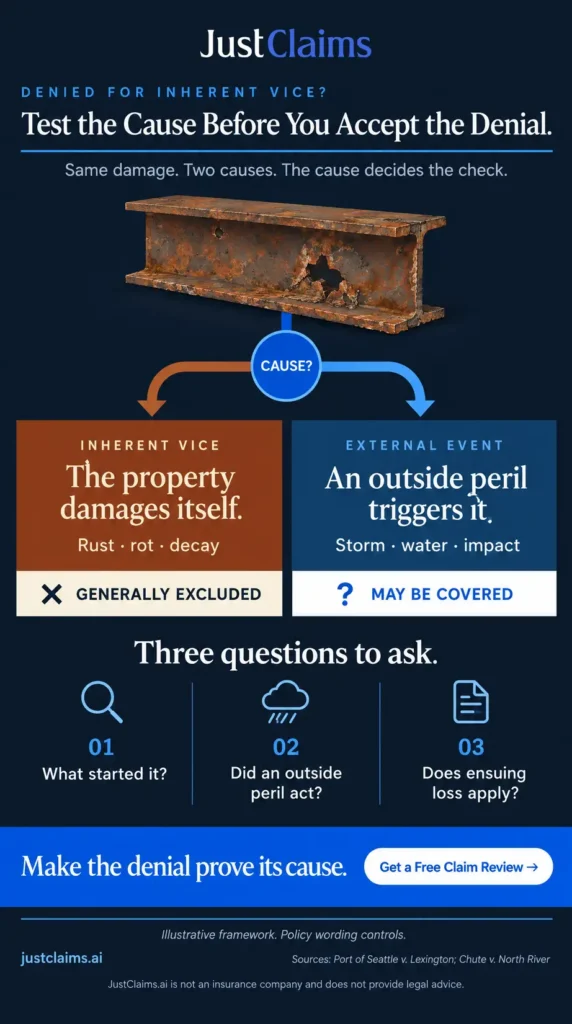
Inherent vice is a built-in weakness in an object or commodity that makes it likely to deteriorate or destroy itself. Courts have defined it as “any existing defects, diseases, decay or the inherent nature of the commodity which will cause it to deteriorate with a lapse of time,” and as a loss “entirely from internal decomposition or some quality which brings about its own injury or destruction” [1]. The commercial property form CP 10 30 captures the same idea: it excludes loss from “any quality in property that causes it to damage or destroy itself” [2].
Marine Insurance Roots
The term “inherent vice” (or “nature of the subject-matter insured”) appears in section 55(2)(c) of the UK Marine Insurance Act 1906. Unless the policy provides otherwise, the Act says the insurer is not liable for loss from “inherent vice or nature of the subject-matter insured” [3].
How U.S. Courts Carried the Doctrine Onto Land
In Chute v. North River Insurance Co., 172 Minn. 13, 214 N.W. 473 (Minn. 1927), the Minnesota Supreme Court held that an all-risk policy did not cover a fire opal that cracked solely because of its own inherent nature [4]. The complaint conceded that the crack “was due to an inherent vice in said opal and was not the result of outside force” [4]. The court reasoned that insurance protects against “accidents which may happen, not against events which must happen” [4].
Chute relied on marine-insurance precedent, citing Mellon v. Federal Insurance Co., and applied the same rule to a land-based all-risk policy [4]. The court also explained that insurers are not liable for property destroyed by its own inherent tendencies “unless these tendencies are made active and destructive, by a peril insured against” [4].
Common Examples of Inherent Vice: Rust, Self-Heating, and Decay
Because inherent vice disputes often turn on whether a loss came from the property’s own nature, concrete examples show where courts draw the line.
Rust and Corrosion
Rust and corrosion are the classic examples of self-deterioration. The commercial property form CP 10 30 excludes “rust, corrosion, decay, deterioration, hidden or latent defect, or any quality in property that causes it to damage or destroy itself” [2]. That wording makes rust a policy-level example of excluded self-deterioration, not just a judicial gloss.
Self-Heating and Spontaneous Combustion
Chute quoted a marine-insurance treatise for the same principle: the insurer is not liable for loss that “arises solely from a principle of decay or corruption inherent in the subject insured,” as when “fruit becomes rotten, or flour heats, or wine turns sour, not from external damage, but entirely from internal decomposition” [4]. The treatise’s example of flour that heats describes the same self-heating problem: the product deteriorates from an internal process, not from external damage.
Gradual Decay and Cracking
Courts have given fruit that rots, flour that heats, wine that sours, and opals that crack as examples [4]. The common thread is gradual change from within, not a sudden external event. The Port of Seattle court put it this way: inherent vice “does not relate to an extraneous cause but to a loss entirely from internal decomposition or some quality which brings about its own injury or destruction” [1].
The same principle reaches ordinary building materials. In State Farm Fire & Casualty Co. v. Volding, cited in Port of Seattle, rain entered the pores of bricks in a chimney and adjoining walls; when it froze, the bricks cracked, collapsed, and crumbled. The court held that the bricks’ porous condition was an inherent vice and that the actual cause of the loss was excludable [1].
Why Insurers Exclude Inherent Vice: Predictability Versus Risk
Insurers rely on this exclusion in denials because it rests on a basic rule: insurance covers risk, not certainty.
The Fortuity Requirement
The Arizona Supreme Court has defined a fortuitous loss as one that, “so far as the parties to the contract are aware, is dependent on chance,” adopting Restatement (First) of Contracts § 291 cmt. a [5]. The court said that forcing insurers to cover losses that are “certain or inevitable” would violate public policy and encourage fraud [5]. It also adopted a subjective test: a loss is non-fortuitous only when the insured knew, when coverage attached, that the loss-causing event had already occurred, was in progress, or was certain to occur because no material contingency remained [5]. That matters because damage from a defect the insured did not know about may still be fortuitous [5]. The court described its holding as consistent with the view of the majority of jurisdictions [5].
Maritime Line-Drawing
Chute explained that insurers do not cover loss caused by inherent vice or internal decay unless an external peril activates the weakness [4]. That “unless” is where many claim disputes begin: the exclusion is not a blanket bar if a covered peril made the tendency active and destructive.
How Inherent Vice Differs From External Damage
If a denial letter cites inherent vice, the dispute usually comes down to whether an outside cause acted on the property.
| Feature | Inherent vice | External damage |
|---|---|---|
| Origin of loss | Arises from the nature of the property itself [1] | Caused by an outside occurrence [1] |
| Fortuity | No fortuitous event; the property fails from its own tendencies [4] | A chance event that happens to the property [4] |
| Typical examples | Fruit that rots, flour that heats, wine that sours, opals that crack [4] | A covered peril acting on the property from outside [1] |
| Coverage outlook | Excluded under CP 10 30 [2] | May be covered, subject to policy terms and ensuing-loss language [1] |
What Can Restore Coverage
Some inherent vice exclusions come with an ensuing-loss provision. The clause in Port of Seattle excluded inherent vice, wear, tear, gradual deterioration, or depreciation, “unless loss by a peril not otherwise excluded ensues,” in which case the insurer was “liable only for such ensuing loss” [1]. The court explained that the exception applies when a specified uncovered event takes place and an otherwise covered loss follows: “The uncovered event itself, however, is never covered” [1]. In Chute, by contrast, the complaint conceded the crack came from an inherent vice and was not the result of outside force, so nothing triggered coverage [4].
Questions to Raise When a Denial Cites Inherent Vice
- Did an external peril activate the deterioration or make it destructive? [4]
- Does the policy contain ensuing-loss language that applies? [1]
- Did the insured know of the defect, which bears on the subjective fortuity test? [5]
- Does the denial quote the actual form wording of the exclusion? [1]
Losses that begin with water intrusion raise a different external-cause question, covered in our guide to Category 3 water damage.
Tips for Mitigating Loss Through Proper Storage
Because denials often turn on whether deterioration came from the goods or from an outside cause, contemporaneous storage records give you a baseline for the conditions the property was kept in. No record prevents a denial, but the right documents give you something concrete to compare against an insurer’s causation theory.
Control Temperature and Humidity
For sensitive materials and records, the Northeast Document Conservation Center recommends keeping public, staff, and combined-use spaces at about 64°F to 72°F and not above 75°F, with storage-only areas kept cooler [6]. It recommends monitoring temperature and relative humidity, starting with a simple thermohygrometer, because higher temperatures speed up chemical reactions and make materials deteriorate faster [6].
Match Storage Conditions to Product Type
OSHA describes refrigerated warehousing as “the storage of any temperature controlled product to maintain freshness and/or safety,” with temperatures “usually less than 50°F” [7]. For food safety, USDA advises that refrigerators be set to maintain 40°F or below [8].
Keep Continuous Temperature Logs
Continuous logs create a contemporaneous record of the conditions the property was kept in. They do not guarantee coverage, but they give you evidence to compare against an insurer’s causation theory. NEDCC treats environmental monitoring as a foundational part of preservation [6]. For temperature-sensitive inventory, the practical takeaway is the same: keep a record you can compare against the insurer’s theory.
Frequently Asked Questions
What is inherent vice in simple terms?
It is the tendency of an item to break down on its own, with no outside event involved [1]. The commercial property form CP 10 30 excludes losses from that kind of self-destruction [2].
Is rust covered under a commercial property policy?
The commercial property form CP 10 30 excludes “rust, corrosion, decay, deterioration, hidden or latent defect, or any quality in property that causes it to damage or destroy itself” [2]. If a covered peril then causes further damage, ensuing-loss wording may still apply, so review the exact form language [1].
Can a loss still be covered if the owner did not know about a defect?
Possibly. The Arizona Supreme Court adopted a subjective fortuity test: a loss is non-fortuitous only when the insured knew, when coverage attached, that the loss-causing event had occurred, was in progress, or was certain to occur [5]. Damage from a defect the insured did not know about may still be fortuitous [5]. Outcomes depend on the policy wording and the law of the applicable jurisdiction.
Why do insurers exclude losses that are bound to happen?
Insurance is built around chance events. The Arizona Supreme Court said that forcing insurers to cover losses that are “certain or inevitable” would violate public policy and encourage fraud [5]. The court also adopted the Restatement’s definition of a fortuitous event as one that, so far as the parties are aware, depends on chance [5].
Does good storage prevent an inherent vice denial?
No practice prevents a denial outright. Controlled storage and contemporaneous records give you evidence of the conditions the property was kept in, which can help you respond to an insurer’s causation theory. NEDCC recommends monitoring temperature and relative humidity as a foundational practice [6].
How to Dispute Your Inherent Vice Denial
Inherent vice denials depend on a causation argument, so your response should be built on the policy form, the loss timeline, and contemporaneous records. Ask whether an external peril activated the weakness, and whether ensuing-loss wording applies [4][1]. If the denial quotes the exclusion, compare that language to the actual form in your policy [1]. If the insurer says the defect was known or inevitable, the subjective fortuity standard is the frame to test that assertion [5]. If the dispute is about the amount of the loss rather than whether the exclusion applies, insurance claim appraisal services may be the better path.
Coverage disputes are fact-specific, and state law and policy wording vary. A licensed professional can advise on your situation. Not sure whether your policy contains an inherent vice exclusion or ensuing-loss wording? Upload your policy to Justin and find out in minutes. Justin flags potential coverage gaps and exclusion wording for review by the JustClaims team.
This content is for informational purposes only and does not constitute legal or insurance advice. Coverage decisions depend on the specific terms, conditions, and exclusions of each policy and the laws of the applicable jurisdiction; policyholders and contractors should consult with a qualified professional for advice on their particular situation. Public adjusters are licensed at the state level, and licensing requirements and permitted services vary; confirm any adjuster’s license with your state insurance regulator. No settlement outcome is promised or implied.
Sources
[1] Port of Seattle v. Lexington Insurance Co., 111 Wn. App. 901 (2002) — CourtListener / Free Law Project
[2] United States Fire Insurance Co. v. Kelman Bottles, Kelman Glass, LLC (W.D. Pa. Apr. 5, 2012) — Justia
[3] Marine Insurance Act 1906, s. 55(2)(c) — Legislation.gov.uk
[4] Chute v. North River Insurance Co., 172 Minn. 13, 214 N.W. 473 (1927) — CourtListener / Free Law Project
[5] Industrial Park Center, LLC v. Great Northern Insurance Co., No. CV-25-0330-CQ (Ariz. Sept. 1, 2026) — Arizona Supreme Court
[6] Temperature, Relative Humidity, Light, and Air Quality: Basic Guidelines for Preservation — Northeast Document Conservation Center
[7] Warehousing: Hazards and Solutions — Occupational Safety and Health Administration
[8] Refrigeration & Food Safety — USDA Food Safety and Inspection Service

Collin Corcoran

Experienced Public Adjuster and Property Claims Specialist, Collin is licensed in New York (#1603393), New Jersey (#3003700204), and Connecticut (#19820270). With 20+ years of hands-on construction and property damage experience, he specializes in residential and commercial claims, complex loss inspections, policy review, detailed estimating, and strategic negotiation. Collin’s background in construction, asset management, emergency response, and claims documentation allows him to accurately identify damage, understand repair requirements, and advocate effectively for policyholders. He works with homeowners, business owners, contractors, and insurance professionals to move claims forward with clarity, accuracy, and confidence. Collin is committed to transparency, technical precision, strong communication, and securing fair outcomes for policyholders.