Construction Site Collapse: 5 Causes & Insurance Coverage
November 04, 2026
Written by Stephane Elias
Share


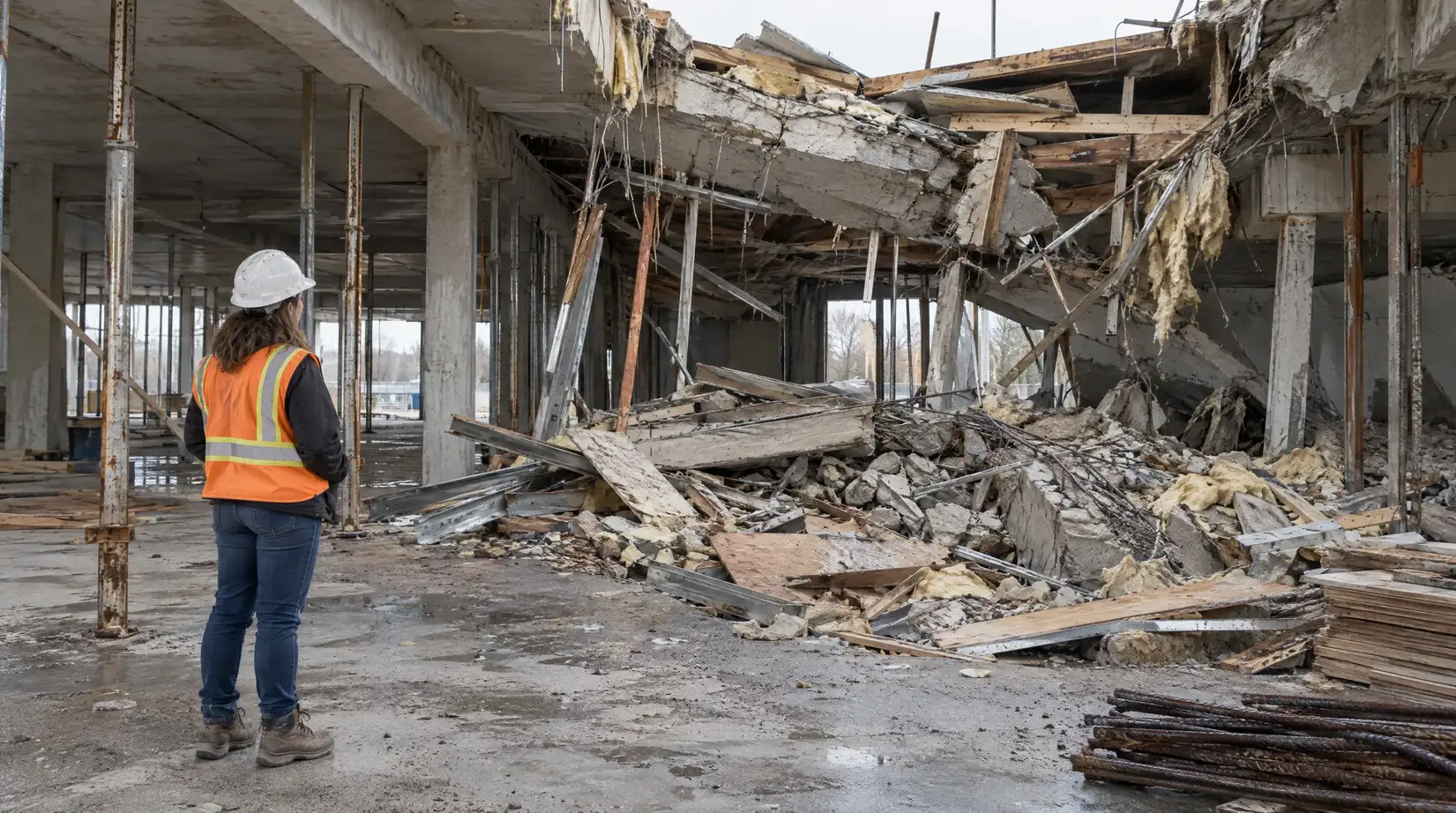
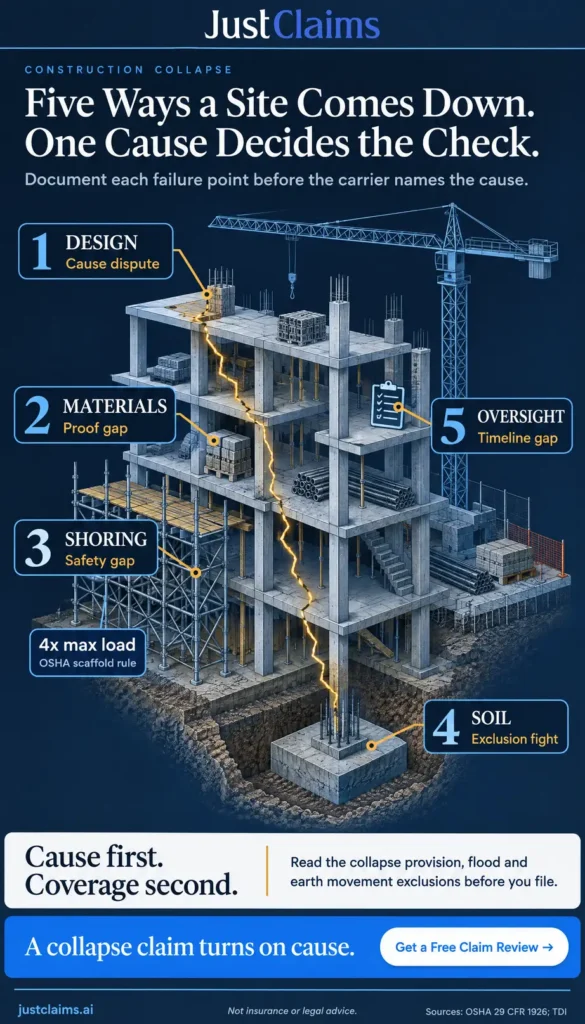
A construction site collapse—whether a building, temporary structure, or an excavation—can trace back to a handful of causes: design errors, weak materials, failed temporary structures, poor soil conditions, and gaps in oversight. OSHA’s scaffold standard generally requires each scaffold to support, without failure, its own weight and at least four times its maximum intended load. Whether a builder’s risk policy responds to a collapse depends on the exact policy wording.
Key Takeaways
- Scaffold load rule: OSHA generally requires each scaffold and component to support its own weight and at least four times the maximum intended load.
- Design requirement: A qualified person must design the scaffold, and it must be constructed and loaded in accordance with that design.
- Scaffold incident causes: In a BLS study cited by OSHA, 72% of injured scaffold workers attributed the accident to planking or supports giving way, slipping, or being struck by a falling object.
- Property coverage: Builder’s risk covers the project under construction and related materials and equipment. It is not liability coverage for third-party bodily injury.
- Collapse coverage: Treatment varies by policy form. Basic form commercial property policies usually cover a narrower list of causes; broad form policies add structural collapses. Flood and earth movement are commonly excluded.
- What to check: Read the collapse provision and the earth movement and flood exclusions before assuming a collapse loss is covered.
The 5 Causes of Construction Site Collapse Every Contractor Should Know
1. Engineering and Design Flaws
A load calculation that underestimates the loads a structure will carry, including construction-phase loads, can leave it without adequate capacity before it is finished. The error can propagate through members and connections that were sized for the wrong demand.
OSHA’s scaffold standard shows how directly regulators address design. Scaffolds must be designed by a qualified person and constructed and loaded in accordance with that design [1]. With limited exceptions, each scaffold and scaffold component must support, without failure, its own weight and at least four times the maximum intended load applied or transmitted to it [1]. For concrete structures, OSHA also prohibits construction loads unless the employer determines, based on information from a person qualified in structural design, that the structure or portion of the structure can support them [2].
If you rely on stamped drawings, keep the version history, the calculation packages, and any change orders. These records show who made which design decision.
2. Substandard Materials
Weak concrete, undersized or mislabeled steel, and poorly cured elements can reduce capacity below what the design assumed. Material problems can overlap with workmanship problems. Keep records that separate the two.
OSHA prohibits construction loads on a concrete structure unless the employer determines, based on information from a person qualified in structural design, that the structure can support the loads [2]. Keep mill certificates, concrete delivery tickets, and test reports for every pour and steel delivery. Those records let you trace the material that was actually installed, not just the material that was specified.
3. Temporary Structure Failure: Scaffolding and Shoring
Temporary structures carry heavy loads for short periods. They deserve the same engineering attention as permanent work. OSHA says scaffold incidents are often caused by planking or supports giving way, a worker slipping, missing fall protection, or a worker being struck by a falling object. OSHA also says compliance with its standards can prevent these incidents [3].
Scaffold standard requirements. As a general rule, Subpart L requires each scaffold and component to support its own weight and at least four times the maximum intended load [1]. OSHA’s 1996 final rule estimated that 9,750 of the 510,500 construction injuries and illnesses each year were scaffold-related [4].
Planking, supports, and formwork. A BLS study cited by OSHA found that 72% of injured scaffold workers attributed the accident to planking or supports giving way, slipping, or being struck by a falling object. Plank slippage was the most commonly cited cause [5]. OSHA’s formwork standard requires formwork to be designed, fabricated, erected, supported, braced, and maintained so it is capable of supporting without failure all vertical and lateral loads that may reasonably be anticipated to be applied to it. Drawings or plans for formwork, shoring equipment, working decks, and scaffolds must be available at the jobsite [6].
Photograph shoring and bracing before every load event.
4. Soil and Foundation Issues
Soil conditions can change how a foundation performs. Unexpected soil conditions, saturated ground, or movement beneath footings can destabilize a structure that was otherwise built to plan.
OSHA’s excavation standard requires protective systems to have the capacity to resist without failure all loads that are intended or could reasonably be expected to be applied or transmitted to them [7]. The same principle applies to the ground beneath a foundation: if the soil condition changes, the structure above it can move.
Coverage can turn on the same distinction. On commercial property policies, the Texas Department of Insurance notes that basic form policies usually cover a narrower list of causes, while broad form policies add structural collapses. Most policies exclude flood and earth movement [8].
Retain geotechnical reports, site drainage records, and weather logs. They help establish what caused the failure and which policy provisions apply.
5. Human Error and Lack of Oversight
Oversight is the last line of defense. OSHA requires a competent person to inspect scaffolds and scaffold components for visible defects before each work shift and after any occurrence that could affect the scaffold’s structural integrity [9]. The BLS study cited by OSHA found that 72% of injured scaffold workers attributed the accident to planking or supports giving way, slipping, or being struck by a falling object [5].
Inspection logs, daily reports, and sign-offs for temporary works show that oversight happened. They also show where it did not. Compliance records such as training documentation and scaffold inspection tags create a timeline if the cause of a failure is disputed.
How the Cause of a Collapse Shapes Builder’s Risk Coverage
Coverage depends on the cause of loss, so document the cause directly. Builder’s risk is property coverage for the project under construction. NAIC describes it as coverage for loss to buildings in the course of construction, including machinery and equipment used in the course of construction and materials incidental to construction [10]. It is not liability coverage: the D.C. Department of Licensing and Consumer Protection says builder’s risk “typically only provides protection to the buildings under construction and construction materials” and “will not provide protection for bodily injury” [11].
Treatment of collapse varies by policy form. On commercial property policies, the Texas Department of Insurance notes that basic form policies usually cover a narrower list of causes, while broad form policies add structural collapses. Most policies exclude flood and earth movement [8]. Read your builder’s risk collapse provision, the earth movement exclusion, and the flood exclusion before you assume a loss is covered. If a denial cites an exclusion, ask the carrier to identify the policy language and the factual basis it relied on.
Documenting a Collapse Claim Without Weakening Your Position
Coverage depends on the cause of loss, so your documentation should address cause directly.
- Design calculations and change orders
- Material certifications and test results
- Scaffold and shoring inspection logs
- Soil and geotechnical reports
- Daily reports and dated photographs of the site
Keep your own scope clear. Record what you built, what was in place at the time of failure, and what loss followed. For a broader view of how large-loss documentation is organized, see the guide on commercial fire claim large-loss documentation requirements. State law and policy terms govern what applies to your claim, so consult a qualified professional about your situation.
Frequently Asked Questions
What is a common cause of scaffold collapse?
A BLS study cited by OSHA found that 72% of injured scaffold workers attributed the accident to planking or supports giving way, slipping, or being struck by a falling object. Plank slippage was the most commonly cited cause [5]. OSHA also points to failing planking or supports, slips, missing fall protection, and falling objects as common causes of scaffold incidents [3].
Does builder’s risk insurance cover a construction collapse?
Treatment varies by policy form. On commercial property policies, the Texas Department of Insurance notes that basic form policies usually cover a narrower list of causes, while broad form policies add structural collapses. Most policies exclude flood and earth movement [8]. The policy wording controls the outcome.
Does builder’s risk cover third-party injury claims?
Builder’s risk is property coverage for the project itself. The D.C. Department of Licensing and Consumer Protection says it “typically only provides protection to the buildings under construction and construction materials” and “will not provide protection for bodily injury” [11]. Review your liability coverage separately for third-party claims.
What does OSHA require for scaffold design?
OSHA requires scaffolds to be designed by a qualified person and constructed and loaded in accordance with that design [1]. With limited exceptions, each scaffold and scaffold component must support, without failure, its own weight and at least four times the maximum intended load applied or transmitted to it [1].
How to Protect Your Scope After a Collapse
Collapse causes overlap, and more than one policy provision may apply. A strong response includes organized records that tie the failure to a specific cause and a specific policy provision. Preserve design files, material certifications, inspection logs, and soil reports. Ask for the carrier’s coverage position in writing. Outcomes vary by policy terms and state law, and no result can be predicted in advance.
If you need to know whether a collapse loss is covered, get a free commercial property policy review with Justin before you respond to the carrier.
This content is for informational purposes only and does not constitute legal or insurance advice. Coverage decisions depend on the specific terms, conditions, and exclusions of each policy and the laws of the applicable jurisdiction; policyholders and contractors should consult with a qualified professional for advice on their particular situation. Public adjusters must be licensed under state law, and requirements vary by state. Confirm any adjuster’s license status with your state insurance regulator before signing an agreement.
Sources
[1] 29 CFR 1926.451 — General Requirements for Scaffolds — OSHA
[2] 29 CFR 1926.701 — General Requirements for Concrete and Masonry Construction — OSHA
[3] Scaffolding — Construction — OSHA
[4] Safety Standards for Scaffolds Used in the Construction Industry — 1996 Final Rule — OSHA
[5] Safety Standards for Scaffolds Used in the Construction Industry — Training Summary — OSHA
[6] 29 CFR 1926.703 — Requirements for Cast-in-Place Concrete — OSHA
[7] 29 CFR 1926.652 — Requirements for Protective Systems — OSHA
[8] Commercial Property Insurance Guide — Texas Department of Insurance
[9] Scaffolding eTool — Frequently Asked Questions — OSHA

Stephane Elias

A seasoned insurance professional with nearly a decade of experience, Stephane Elias is currently serving as a Senior Claims Professional and Public Adjuster with JustClaims. Throughout his career, Stephane has represented policyholders through leading public adjusting firms and served as a loss consultant for law firms specializing in insurance litigation, giving him extensive expertise in complex property insurance claims. A licensed public adjuster in TX (#2645032), FL (#W564547), and six other states, he specializes in commercial and residential property claims, claims management, appraisals, mediation, and strategic partnerships. Stephane is passionate about helping policyholders overcome delayed, denied, and underpaid insurance claims, ensuring they receive the full recovery they’re entitled to under their policy.