SIU Insurance: What a Special Investigation Unit Does

October 30, 2026
Written by Taylor Bezek
Share


An SIU referral does not automatically mean wrongdoing; it means the claim needs additional review. For commercial property owners, how well the claim is documented often shapes how that review goes. Understanding what triggers an SIU, and how it works, helps you respond with confidence rather than alarm.
Key Takeaways
- What it is: A Special Investigation Unit (SIU) is a unit or division inside an insurer that is established to investigate suspected insurance fraud.
- What a referral means: A referral does not automatically mean wrongdoing; it means the claim needs additional review.
- Common trigger: An identifiable pattern in a claim history can suggest possible fraudulent activity.
- SIU vs. EUO: An SIU is a department; an examination under oath (EUO) is a sworn procedure an insurer may use during a claim.
- Delay benchmark: Kansas requires an insurer to complete a claim investigation within thirty days of notification unless it cannot reasonably be completed in that time.
- Update letters: The NAIC model regulation calls for a status letter 45 days after the initial notice, and every 45 days after that while the investigation continues.
What Is an SIU? Insurance Special Investigation Units Explained
A Special Investigation Unit is a unit or division inside an insurance company that is established to investigate suspected insurance fraud. [1] An SIU is a department. An examination under oath is one procedure an insurer may use during a claim. The two are related but not interchangeable, and knowing which one you are facing changes how you prepare.
State law shapes how these units are built. In New York, Insurance Law Section 409 and Regulation 95 require insurers to file a fraud-prevention plan with the Department of Financial Services (DFS), and the plan must provide for an SIU apart from any underwriting or claims units [2].
DFS guidance says the SIU should have its own budget line, and its investigators should not perform claims or underwriting work. Insurers may use an outside contractor but remain responsible for compliance [2]. Insurers must file an annual SIU report with DFS by March 15 [2]. New York also sets investigator qualifications, including five years of insurance claims or law enforcement investigation experience, or an associate’s or bachelor’s degree in criminal justice or a related field [2].
California imposes a similar duty. The majority of California licensed insurers are required to establish and maintain Special Investigative Units that identify and refer suspected insurance fraud, and each must submit an SIU annual compliance report to the Department of Insurance [3].
In practice, the work is document-heavy: forms, receipts, estimates, statements, and claim history. Insurers may run in-house SIUs or use outside contractors, and New York’s regulation requires contractors to cooperate with law enforcement. [2] Rules differ by state, so treat these examples as illustrations rather than a description of every jurisdiction.
Common Triggers for SIU Referral
Because a referral signals a need for closer review rather than a finding of fraud, knowing what prompts one helps you prepare before it happens. California’s SIU regulations define a red flag as facts, circumstances or events which, singly or in combination, support an inference that insurance fraud may have been committed [4]. The NAIC’s antifraud plan guideline lists the kinds of evidence that can support that inference [1]:
- Doctored, altered, or destroyed forms, receipts, or estimates
- Relevant discrepancies in written or oral statements, including examinations under oath
- Unusual policy activity
- An identifiable pattern in a claim history
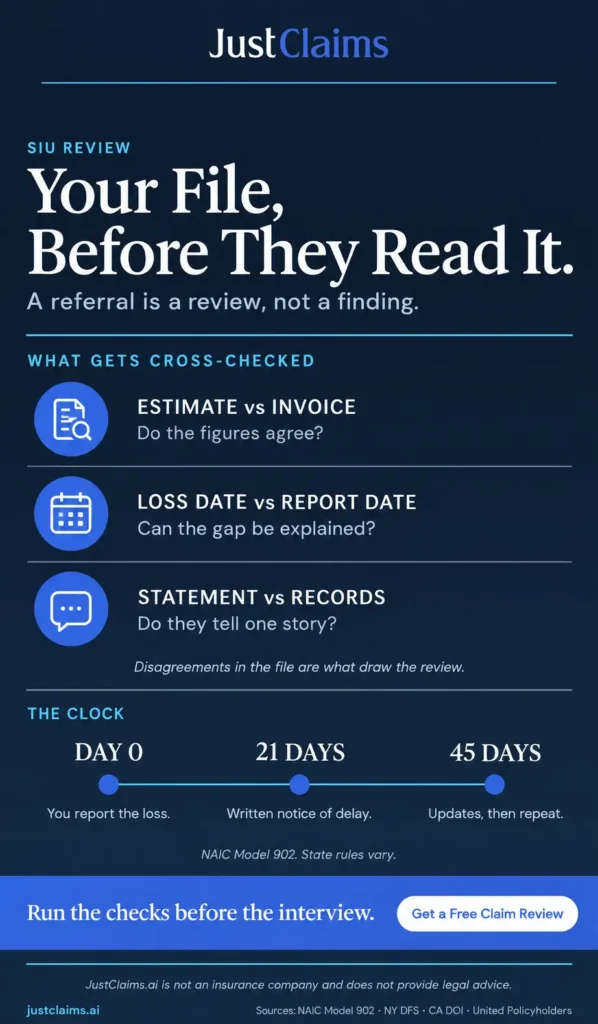
The common thread is not the size of the claim by itself. It is whether something in the file does not line up with something else in the file. A large loss with clean, consistent records is a documentation exercise. A smaller loss with an estimate that contradicts the invoice is a question.
Timing alone is not proof of anything. Delayed reporting is not automatically suspicious, since there are many legitimate reasons a loss may be reported late.
Documentation problems are another common trigger. The NAIC guideline points to doctored, altered, or destroyed receipts and estimates, and to discrepancies between what is written and what is said [1]. These problems are often clerical, but an insurer may read them as warning signs.
A complete first notice of loss, with dates, cause, and supporting records attached, gives the insurer less to clarify later.
How an SIU Investigation Works
Because the SIU process tests the documentation behind your claim, each stage rewards preparation.
Interviews and Recorded Statements
A recorded statement is the informal step. You are legally obligated to cooperate with reasonable requests for information from your insurer that relate to your claim, and you may be asked to give a recorded statement or sit for an examination under oath [5]. Review your records before you speak so your account matches your paperwork.
If the Review Leads to an Examination Under Oath
An EUO is the formal step: a sworn question-and-answer session the insurer may use to test a claim [6]. Our examination under oath guide covers how the procedure works, your rights, and the mistakes that can cost you. California, for example, limits what an EUO may cover: the insurer may seek only information relevant and reasonably necessary to the claim, and the insured may have counsel present and record it [7]. Before declining a request, speak with counsel: policy language and state law govern the consequences.
Investigative Tools and Property Review
An SIU is established to investigate suspected insurance fraud, and a claim can contain evidence of suspected fraud regardless of its payment status [1]. An altered estimate is one indicator regulators list [4]. Assume the file will be read against the property’s condition and your financial records, and keep the three consistent.
Documentation That Holds Up Under SIU Review
Because valuation and documentation errors on commercial claims are expensive to fix after the fact, the records behind each figure deserve attention before an SIU review begins. The claim file is what the review will test: the details, the documentation, and the evidence behind both [1]. Complete, organized records give the reviewer fewer gaps to chase.
Insurers screen submissions with technology. The NAIC notes that in claims, AI is used for accident image analysis and to estimate ultimate claim settlement values, along with fraud detection [8]. GAO has reported that insurers can digitally collect and automatically analyze claim evidence, and can use AI to verify the damage shown in photographs [9]. Submit original, unaltered files rather than screenshots or re-saved copies.
Practical steps for commercial property owners:
- Keep original photo and invoice files rather than screenshots or re-saved copies.
- Reconcile invoice dates, estimate line items, and described damage before submitting.
- Document Business Interruption and Law & Ordinance figures with supporting records, since those are areas where valuation gaps are easy to overlook.
- Keep a dated log of every communication with the adjuster and SIU.
After an investigation, the NAIC model regulation requires the insurer to affirm or deny liability within a reasonable time [10]. The outcome can be payment, denial, or a partial payment, depending on the evidence and the policy.
Legitimate Investigation vs. Bad Faith Delay
Because an SIU referral can lengthen a claim, policyholders need a standard for telling a legitimate review from an unreasonable delay.
What a Legitimate Review Looks Like
The NAIC Unfair Property/Casualty Claims Settlement Practices Model Regulation says an insurer needing more time on a first-party claim must notify the claimant within 21 days after receipt of proofs of loss, giving the reasons more time is needed. If the investigation is still incomplete, it must send a letter 45 days from that initial notice and every 45 days after that. A documented, communicated reason for an extended investigation marks a legitimate review [10].
States apply this standard with their own timelines. Rhode Island’s regulation mirrors the 21-day notice and the 45-day update letters [11]. Kansas requires an insurer to complete investigation of a claim within thirty days after notification unless the investigation cannot reasonably be completed in that time [12]. These rules give you a benchmark for judging whether a review has dragged on without justification. For state-by-state payment deadlines, see how long an insurance company has to pay a claim.
What Bad Faith Can Look Like
The NAIC Unfair Claims Settlement Practices Act model treats two things as unfair claims practices: failing to affirm or deny coverage within a reasonable time after completing the investigation, and not attempting in good faith to effectuate a prompt, fair, and equitable settlement once liability has become reasonably clear [13]. In California, for example, a bad faith claim requires two things: benefits due under the policy were withheld, and the withholding was unreasonable or without proper cause. Unreasonably delaying payments due is one recognized form [14].
A delay with a documented reason looks different from one with no explanation. Once liability is affirmed and the amount of a claim is determined and not in dispute, the NAIC model regulation calls for payment within thirty days [10]. Standards vary by state, so consult a qualified attorney about your jurisdiction.
Frequently Asked Questions
Does an SIU referral mean the insurer thinks I committed fraud?
No. A referral means the claim needs additional review, not that wrongdoing has been found [1]. Altered records, inconsistent statements, or an identifiable pattern in a claim history can all prompt one.
Is an SIU investigation the same as an examination under oath?
They are different things. The SIU is a unit established to investigate suspected insurance fraud, while an EUO is a sworn procedure an insurer may use to question a policyholder about a claim [1][6]. An SIU may rely on an EUO, but a policyholder can face an EUO request without any SIU involvement.
What can I do to reduce the chance of an SIU review?
Report promptly and cooperate with reasonable requests for information [5]. Submit organized records and original files, and make sure invoices and estimates match the damage you describe.
How long can an insurer take to investigate my claim?
It depends on your state. Kansas, for example, sets a thirty-day completion standard unless the investigation cannot reasonably finish in that time [12]. Under the NAIC model regulation, an insurer that needs longer must explain why and send periodic updates [10].
When does an investigation become bad faith?
Bad faith generally involves benefits withheld and a withholding that was unreasonable or without proper cause [14]. A documented reason for delay is treated differently from delay with no basis in the facts or the policy.
What You Should Do Before SIU Review
An SIU referral is a review, not a verdict, and your best protection is a claim file that stands up to scrutiny. Gather original files, reconcile every figure, and log each communication. Track the insurer’s written update obligations in your state, and consult counsel before agreeing to an EUO. Valuation gaps are easier to fix before the carrier finds them.
Upload your policy to Justin for a free AI coverage review to flag Business Interruption and Law & Ordinance exposure before the carrier raises it.
This content is for informational purposes only and does not constitute legal or insurance advice. Coverage decisions depend on the specific terms, conditions, and exclusions of each policy and the laws of the applicable jurisdiction, and outcomes vary; policyholders and contractors should consult with a qualified professional or attorney for advice on their particular situation. Public adjuster licensing requirements vary by state; confirm the license status of any public adjuster before signing a contract.
Sources
[1] Antifraud Plan Guideline (GDL-1690) — National Association of Insurance Commissioners
[3] SIU Compliance Review Program — California Department of Insurance
[4] Special Investigative Unit Regulations, 10 CCR §§ 2698.30–.43 — California Department of Insurance
[5] General Claim Tips — United Policyholders
[6] Examinations Under Oath (“EUO”) — United Policyholders
[7] California Insurance Code § 2071.1 — California Legislative Information
[8] Insurance Topics: Artificial Intelligence — National Association of Insurance Commissioners
[11] Unfair Property/Casualty Claims Settlement Practices — Rhode Island Department of State
[12] Kansas Administrative Regulation 40-1-34, Attachment 2 — Kansas Insurance Department
[14] CACI No. 2330, Implied Obligation of Good Faith and Fair Dealing — Judicial Council of California

Taylor Bezek

As the General Manager at JustClaims, Taylor Bezek brings over a decade of experience managing complex residential, commercial, and large-loss claims. A licensed Public Adjuster in TX (#2125659), FL (#W455048), CO (#769172), and 10 additional states, Taylor founded his own firm before joining JustClaims to scale a tech-forward solution for the insured. He is committed to combining industry expertise with AI to enhance speed, clarity, and outcomes for every policyholder. Taylor's mission is to modernize the public adjusting profession and ensure owners get exactly what they are entitled to.