DP3 Insurance Meaning: Coverage, Exclusions & Payouts
October 28, 2026
Written by Collin Corcoran
Share


Dwelling fire form DP-3 is the most comprehensive form in its series, and the form a landlord holds can shape how a rental claim is scoped, valued and paid. Contractors who know whether a policy covers named perils or open perils, and whether it pays replacement cost or actual cash value, can set expectations before the repair estimate is written. This guide compares DP-1 and DP-3 so you can read a rental policy accurately.
Key Takeaways
- What it is: DP3 is the special form and the most comprehensive dwelling fire form.
- Typical use: Dwelling fire policies are typically used for properties that are not the owner’s primary residence.
- DP-1 peril basis: DP-1 is a named perils policy.
- DP-3 peril basis: DP-3 covers the dwelling and other structures for all types of damage except named exclusions.
- Personal property: Contents are treated separately from the dwelling; under the DP-3 form summarized by the North Carolina Department of Insurance, they are covered on a named perils basis.
- Payout basis: State disclosure summaries list DP-1 dwelling coverage as actual cash value and DP-2 and DP-3 dwelling coverage as replacement cost.
- Loss of rent: DP-1, DP-2 and DP-3 can include loss of rent (fair rental value) coverage; the limit depends on the policy.
DP3 Defined: The Dwelling Fire Form for Rental Property
DP3 is the dwelling fire special form, written DP-3, and the top tier of a three-form series [1]. DP-1 is the basic form and DP-2 the broad form [1].
Dwelling fire policies are typically written for properties that are not the owner’s primary residence, such as rental properties, vacation homes and vacant homes [1]. For a contractor, that means the policy on a rental claim is usually the owner’s, not the tenant’s. The policy wording, not the owner’s assumptions, sets what repairs the carrier is likely to fund.
Open Perils vs Named Perils in Rental Claims
Because the form controls how a rental claim is valued, the first thing to read is whether the policy covers named perils or open perils. That choice can decide whether a storm, water or fire loss is covered at all.
DP-1: Named Perils
DP-1 is a named perils policy. It typically covers fire, lightning and internal explosion [1]. Extended coverage for perils such as windstorm, hail and smoke can be added when the declarations show an extended coverage premium; vandalism may also be available [1].
If a rental property has a basic form without extended coverage, a hail or wind loss may not be covered. Ask the owner for the declarations page and any endorsements before you scope the work.
DP-3: Open Perils
DP-3 is an open perils (all-risk) policy. The dwelling and other structures are covered for all types of damage except named exclusions [1]. The practical difference is where the question shifts: instead of asking whether the cause of loss is on a list, you ask whether an exclusion applies.
That shift matters on disputed claims. When a carrier denies part of a loss under an open perils form, the denial usually points to an exclusion or a policy condition. You and the owner can then test that reasoning against the policy language and your documentation.
What DP3 Covers and What It Excludes
Since open perils coverage turns on exclusions, a claim scope should be built around both what the form pays for and what it carves out. Four areas can come up on rental claims.
Dwelling and Other Structures
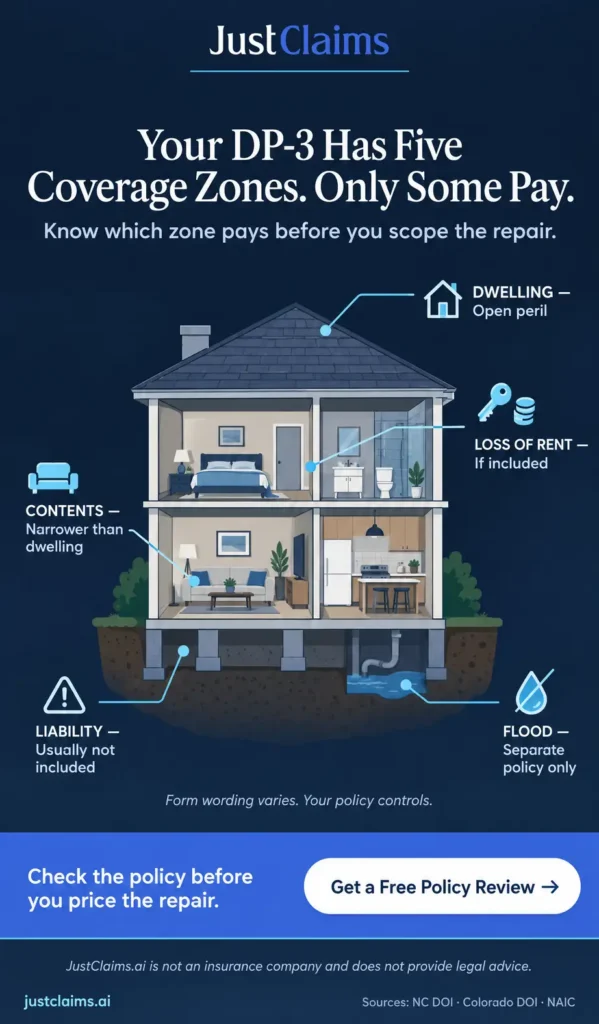
DP-3 covers the dwelling and other structures on an open perils basis [1]. Detached garages, sheds and fences may fall under that other-structures grant; the Colorado Division of Insurance summary defines other structures as buildings and structures not attached to the dwelling, such as fences, sheds and detached garages [2]. Limits and wording vary by policy.
Personal property inside the dwelling is different. Under the DP-3 form summarized by the North Carolina Department of Insurance, contents are covered on a named perils basis, not open perils [1]. Owner-supplied items such as appliances or furnishings in a furnished rental follow that narrower rule.
Loss of Rent
DP-1, DP-2 and DP-3 forms can include loss of rent (fair rental value) coverage; the Colorado Division of Insurance summary lists fair rental value as a coverage on all three forms [2]. Whether it is included, and at what limit, depends on the policy.
When a covered loss makes a unit unrentable, this coverage may help replace the income. The word “can” matters here, because it depends on the policy as written.
Contractors can support these claims by documenting the repair timeline and the date the unit could be re-occupied. A clear schedule gives the owner what is needed to show the length of the rental interruption.
Liability
Dwelling fire policies typically don’t include liability coverage [1]. Liability is easy to overlook, so ask whether it is bundled, added by endorsement or carried under a separate policy. A contractor who learns of a gap during a claim should say so early, because injury claims on rental property are a separate issue from physical damage.
Common Exclusions
Typical exclusions on DP-3 include [1]:
- Neglect
- Intentional loss
- Mold, rust, rot
- Constant or repeated leakage or seepage of water or steam
- Earth movement
- Wear and tear or deterioration
- Birds, rodents, insects or domestic animals
The Colorado Division of Insurance dwelling fire summary lists flooding among general exclusions and notes that flood insurance may be purchased through the National Flood Insurance Program [2]. Property owners should check the policy wording rather than assume. Because the leakage and wear-and-tear exclusions depend on chronology, dated photos and moisture readings can matter.
DP3 vs HO3: Rental Form vs Owner-Occupied Form
The same open perils concept can appear on different forms, so the occupancy of the building decides which form fits. Homeowners policies apply to most owner-occupied single-family dwellings [3], and HO3 is a homeowners form [4]. DP3 is a dwelling fire form, typically used when the owner does not make the property their primary residence [1].
Keep the tenant and landlord roles separate on every job:
- Landlord’s policy: A DP3 covers the owner’s dwelling and other structures [1].
- Tenant’s belongings: A tenant’s personal property is a separate matter. The renters insurance claim process explains how that works.
- Larger buildings: Multi-unit properties raise additional questions, covered in the guide to apartment building insurance coverage.
Eligibility is the other pain point. Dwelling fire forms are typically used for rentals, vacation homes and vacant homes [1]. An owner who converts a former residence into a rental, or leaves a unit vacant, should confirm the policy form still matches how the property is used. The Colorado Division of Insurance summary lists a substantial change in the use or occupancy of the premises among reasons an insurer may cancel or non-renew [2].
Why Replacement Cost Value Matters on DP3 Claims
In practice, payout basis (RCV vs. ACV) can affect repair-scope disagreements on rentals, so replacement cost value (RCV) is a benefit contractors should watch. The Colorado Division of Insurance summary lists DP-1 dwelling coverage as actual cash value and DP-2 and DP-3 dwelling coverage as replacement cost [2].
The North Carolina Department of Insurance adds that DP-1 claims are settled on an ACV basis, though RCV may be available for an additional cost [1]. Terms vary by insurer and state, so the policy itself is the final reference.
Those definitions matter at the estimate level: ACV deducts depreciation, while replacement cost does not [2]. That is where depreciation disputes on rental claims begin. For a contractor-facing walkthrough, see RCV vs. ACV: what contractors need to know. Practical steps include:
- Ask the owner whether the dwelling settles at RCV or ACV before you price the scope.
- Request a payment breakdown that shows depreciation and whether it is recoverable.
- Document the age and condition of damaged materials with dated photos.
- Use itemized estimates that match the carrier’s line items, so differences are easy to trace.
Frequently Asked Questions
What does DP3 mean in insurance?
DP3 is the dwelling fire special form, written DP-3. It is used for properties that are not the owner’s primary residence, such as rentals, vacation homes and vacant homes [1].
Is a DP3 policy open perils or named perils?
The dwelling and other structures are covered for all types of damage except those the policy specifically excludes. Personal property inside the dwelling is the exception, because it is covered only for the perils the policy lists [1].
How does a DP1 payout differ from a DP3 payout?
A DP1 typically pays actual cash value, which accounts for depreciation, though replacement cost may be available at extra cost [1]. DP-3 dwelling coverage settles on a replacement cost basis [2]. The policy controls.
Does a DP3 policy include liability coverage?
Dwelling fire policies typically leave out liability protection [1]. A landlord should ask the insurer whether it is added by endorsement or carried under a separate policy, and should not assume it is included.
Is a DP3 the same as a renters policy?
No. A DP3 covers the landlord’s building, while a tenant’s belongings are handled under a separate policy. The Colorado Division of Insurance dwelling fire summary notes that renters or tenants should consider purchasing a separate policy [2]. Keeping the two roles distinct helps avoid confusion when a loss affects both the owner and the occupant.
What to Check Before You Choose a Form
For an investment portfolio, the right form depends on how each property is used and how you want claims to be valued. A basic named perils form covers a shorter list of perils, so a hail or wind loss may fall outside it unless extended coverage was added [1]. An open perils form shifts the focus to exclusions such as wear and tear, mold and earth movement [1].
Before you choose, check four things for each property: the occupancy type, whether the dwelling settles at RCV or ACV, whether loss of rent is included, and whether liability is covered elsewhere [1][2]. If a claim payout falls short, compare the carrier’s scope and depreciation against the exact policy wording and your documentation. State law and insurer terms vary, and some situations call for a licensed professional.
Before you raise a shortfall with the carrier, get a free policy review from Justin. Upload the declarations page and repair scope to see how the policy language applies to the loss.
This content is for informational purposes only and does not constitute legal or insurance advice. Coverage decisions depend on the specific terms, conditions, and exclusions of each policy and the laws of the applicable jurisdiction; policyholders and contractors should consult with a qualified professional for advice on their particular situation. Public adjuster licensing requirements vary by state, and anyone negotiating a claim on a policyholder’s behalf should hold the license required where the property is located.
Sources
[1] Dwelling Policies — North Carolina Department of Insurance
[3] Homeowners Insurance — North Carolina Department of Insurance
[4] Industry Data Call Property HO Definitions — National Association of Insurance Commissioners

Collin Corcoran

Experienced Public Adjuster and Property Claims Specialist, Collin is licensed in New York (#1603393), New Jersey (#3003700204), and Connecticut (#19820270). With 20+ years of hands-on construction and property damage experience, he specializes in residential and commercial claims, complex loss inspections, policy review, detailed estimating, and strategic negotiation. Collin’s background in construction, asset management, emergency response, and claims documentation allows him to accurately identify damage, understand repair requirements, and advocate effectively for policyholders. He works with homeowners, business owners, contractors, and insurance professionals to move claims forward with clarity, accuracy, and confidence. Collin is committed to transparency, technical precision, strong communication, and securing fair outcomes for policyholders.