Difference in Conditions Insurance: How a DIC Policy Fills Coverage Gaps

October 27, 2026
Written by Stephane Elias
Share


Difference in conditions (DIC) insurance is a separate property policy that adds coverage for perils the primary policy excludes or limits, typically flood and earthquake. It does not replace the primary policy. It sits beside or above it, and the two forms have to be read together — because the gap you think is covered may still be excluded in the DIC’s own wording.
Key Takeaways
- What it is: A separate property form that adds coverage for perils the primary policy excludes or limits.
- Typical gaps: Flood, earthquake, and earth movement — the perils commercial property forms commonly leave out.
- How it is written: DIC can be written in the specialty (surplus lines) market, so terms can differ from a standard policy.
- How it responds: It applies when its perils, definitions, or conditions are broader than the primary’s, and it can respond as primary for a peril the primary does not insure.
- Deductibles: Earthquake deductibles usually run 10%–20% of the coverage limit, and a high deductible can exceed the damage.
- Main limitation: A DIC only closes the gaps it names. Its own exclusions still apply.
What a DIC Policy Is and How It Differs From All-Risk and Named-Peril Forms
A DIC policy is written to pick up perils the primary policy excludes or limits. Utah’s Insurance Department, in consumer guidance, describes DIC as including multiple perils such as earthquake, flood, mudslide, and earth movement, and notes that the policies it describes are typically written in the specialty lines market — also called surplus lines — whose products differ from a standard home or business policy [1]. That placement matters: a specialty-lines form can differ from a standard policy, and its own exclusions, exceptions, and limitations decide what it pays [1].
Whether a program calls the form a DIC policy or a DIC endorsement, the analysis is the same: read the DIC’s terms against the primary policy.
The Texas Department of Insurance (TDI) divides commercial property coverage into three levels [2]:
| Coverage level | What it covers |
|---|---|
| Basic form | A named list that usually includes fire, windstorm, hail, lightning, explosion, smoke, vandalism, sprinkler leakage, aircraft and vehicle collisions, riot, sinkholes, and volcanoes |
| Broad form | The basic causes plus leaking appliances, structural collapse, falling objects, and weight of ice, sleet, or snow |
| Special form | All causes of loss except those specifically listed; TDI notes most policies exclude flood, earth movement, war, nuclear disaster, wear and tear, and insects or vermin |
TDI’s consumer guidance also describes the same split as all-risk (open perils) versus named perils. All-risk policies cover any event the policy does not specifically exclude, and they usually do not cover flood or earthquake [3].
Where DIC Fits
A DIC form is not a replacement for the primary policy. In Sherwin-Williams Co. v. Insurance Co. of Pennsylvania, the U.S. Court of Appeals for the Sixth Circuit described a DIC policy as indicating that the insured maintains primary coverage under other policies, and as providing coverage only to the extent a loss is not covered by, or exceeds the limits of, the primary insurance [4]. The DIC clause at issue also stated that coverage “shall apply as primary insurance when a peril herein is not insured under a specific primary policy” [4].
The same policy limited DIC coverage to situations where the DIC’s perils, definitions, or conditions are “broader in meaning or scope than those of specific primary policies” [4]. In practice, that means the DIC has to be compared clause by clause with the primary form — not read as a generic add-on.
Common Perils a DIC Form Can Cover
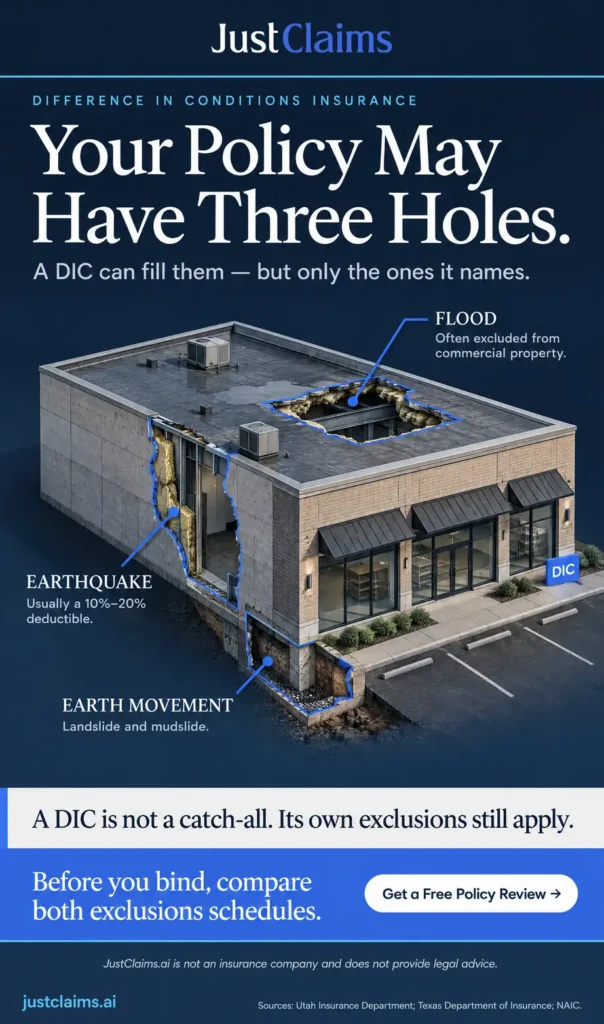
TDI’s commercial property guide says most policies exclude flood, earth movement, war, nuclear disaster, wear and tear, and insects or vermin [2]. The DIC form is where those exclusions are addressed, subject to the DIC’s own terms [1].
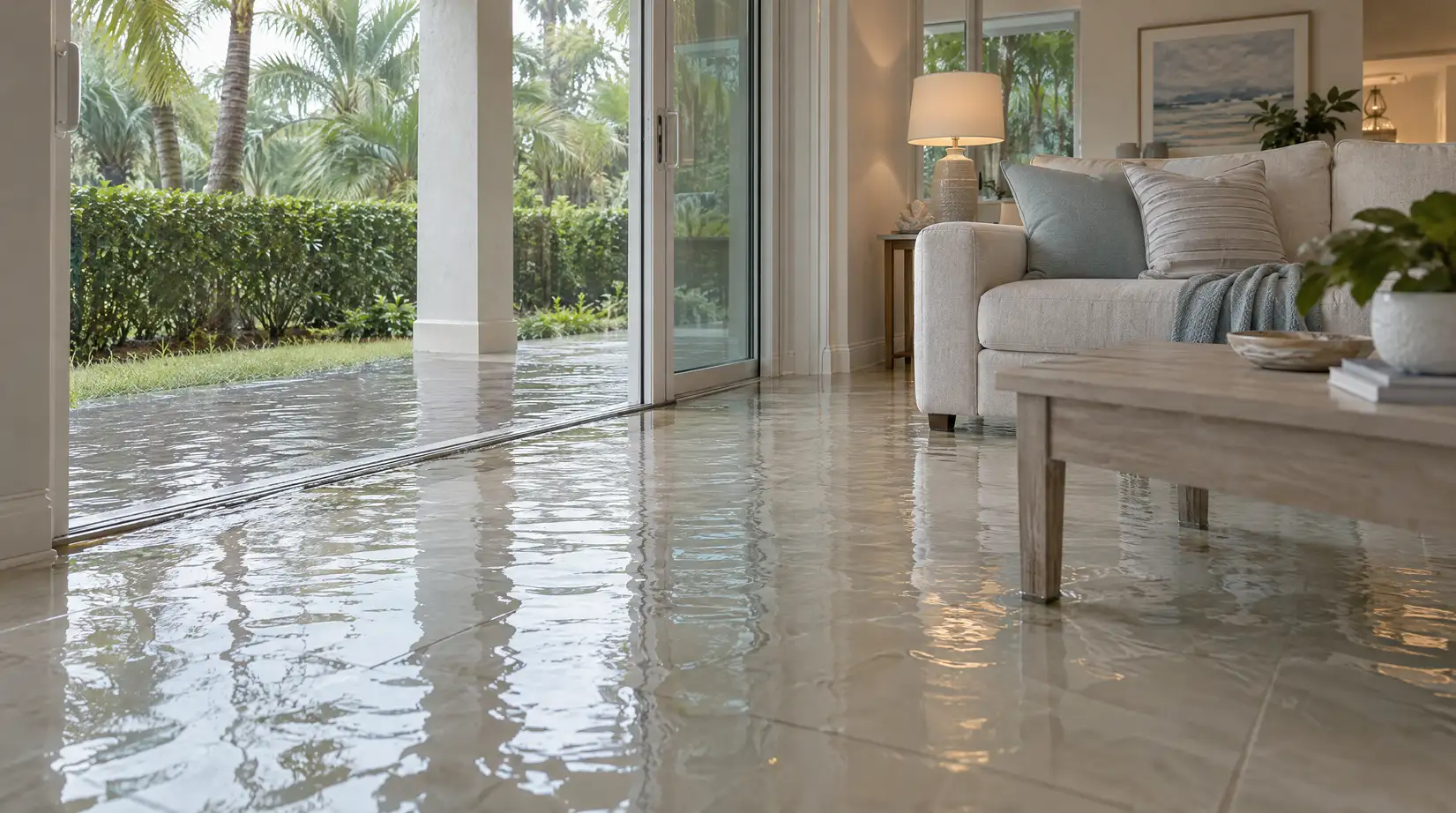
- Flood: Most commercial property policies do not cover flood. A separate flood policy is needed to be protected — from an insurer that writes it or from the National Flood Insurance Program — and there is a 30-day waiting period after purchase [2]. A DIC form can include flood as one of its covered perils [1]. For more on how flood limits work, see our guide to maximum flood insurance coverage.
- Earthquake: Homeowners and business policies do not cover earthquake damage [5], and a DIC form can add it [1]. Expect a percentage deductible rather than a flat dollar amount [5].
- Earth movement, landslide, and mudslide: Most commercial property policies exclude earth movement [2]. Utah’s regulator lists mudslide and earth movement among the perils DIC policies can include [1].
- Other excluded perils: Anything beyond the perils the DIC names depends on the form. Read the exclusions, exceptions, and limitations before you bind [1].
- Perils a basic form already covers: Not every gap needs a DIC. TDI notes that basic-form commercial policies usually cover sinkholes and volcanoes [2]. Check which form the primary policy actually uses.
How a DIC Policy Sits Beside or Above the Primary Policy
DIC is built on the primary policy’s terms. The form assumes other insurance is in place and responds only where the primary does not cover the loss or its limit is exhausted [4]. That is why the two documents have to be reviewed together.
Fills the Difference Without Overlap
The DIC warranty in Sherwin-Williams stated that coverage “will apply as contributing or excess insurance as respects loss arising from perils insured under such other policies,” while the DIC clause stated that coverage would apply as primary when a peril was not insured under a specific primary policy [4]. The label “DIC” did not decide the outcome; the form’s other-insurance wording did.
DIC vs. Excess Insurance
Excess insurance and DIC are not interchangeable. In the Sherwin-Williams form, the DIC clause stated that coverage would apply as primary for a peril no specific primary policy insured, while the warranty stated that it would apply as contributing or excess for perils insured under other policies [4]. Before binding, ask the broker which basis applies to each peril and get the answer in the form’s own language.
An Illustrative Example
Consider a manufacturer whose primary policy excludes earthquake and caps flood at $250,000. A DIC form adds a separate earthquake limit and a higher flood limit. Fire, wind, and theft stay with the primary. If the DIC also excludes a peril the owner assumed was covered, the program still has a hole — which is why the two exclusions schedules have to be compared side by side [4].
The figures above are illustrative and are not a statement of typical limits.
Key Exclusions to Watch For
Because the purpose is closing gaps, any exclusion that survives into the DIC form leaves a gap open.
- Inherited exclusions: A DIC is not a substitute for the primary policy. Its own exclusions, exceptions, and limitations apply [1].
- Perils the DIC does not name: Coverage depends on the perils listed in the DIC form, not on the fact that a peril is excluded upstream [1].
- Other-insurance wording: The DIC’s primary or excess language can change who pays first for a given peril [4].
- Deductibles and limits: The policy at issue stated that its limit was “in excess of the policy deductible” [4], so compare both figures with the values scheduled for each location. A deductible that is a percentage of the limit can be far larger than the flat deductible on the primary.
- Sublimits: Where the primary does include flood or earthquake, the sublimit may sit well below property value. Compare each sublimit with replacement cost, not with the policy’s total limit. Our guide to sublimits in insurance explains how those caps work.
Strategic Value for Multi-Location Businesses
For owners with several sites, the same exclusion can repeat at every location. The DIC clause in Sherwin-Williams limited coverage to situations where its perils, definitions, or conditions were broader than “those of specific primary policies,” and the warranty required every primary policy to be maintained in full force and effect [4]. That wording forces a location-by-location comparison rather than a single program-level assumption.
- Uniform coverage across locations: Because the test is whether the DIC is broader than each specific primary policy, a location with a narrower local form is where the DIC is designed to respond [4].
- A separate limit for a catastrophe peril: The policy at issue expressed its limit as a limit “in excess of the policy deductible” [4], which lets an owner schedule capacity for earthquake or flood separately from the primary.
- Placement can vary: Utah’s regulator notes DIC is typically written in the specialty (surplus lines) market, and those products differ from a standard policy [1].
- Not a substitute for local coverage: The warranty required all primary policies to be maintained in force [4], so confirm that each location has the primary policy the DIC expects to sit above.
How DIC Deductibles Work
The mechanics depend on the peril. Where a DIC form adds earthquake coverage, the deductible is usually 10%–20% of the coverage limit, and the National Association of Insurance Commissioners (NAIC) warns that a deductible can be so high that the damage never exceeds it [5]. NAIC’s own example: a $200,000 limit with a 10% deductible leaves $20,000 with the insured.
NAIC also notes that policies may carry separate deductibles for different coverage parts, and that all earthquake events within a 72-hour period are typically treated as one event [5]. Ask how the DIC calculates its deductible — per location, per event, or per coverage part — before you bind.
Frequently Asked Questions
What is a difference in conditions (DIC) policy?
A DIC policy is a separate property form that adds coverage for perils the primary policy excludes or limits, such as earthquake, flood, mudslide, and earth movement [1]. It can be written in the specialty (surplus lines) market, and its own exclusions and limitations still apply [1].
Is a DIC endorsement the same as a DIC policy?
The label varies by program. This guide uses “DIC policy” for the coverage form whether a program calls it a standalone policy or an endorsement. What matters is the form’s perils, exclusions, limits, and other-insurance wording [4].
Does a DIC replace my primary policy?
No. It assumes that the insured maintains primary coverage under other policies and responds only to the extent a loss is not covered by, or exceeds the limits of, that primary insurance [4].
Is DIC the same as excess insurance?
No. DIC wording can state that coverage applies as primary for a peril no specific primary policy insures, and as contributing or excess for perils insured elsewhere [4]. The other-insurance wording controls, not the label.
Does one DIC cover flood and earthquake together?
It depends on the form. Utah’s regulator describes DIC as including earthquake, flood, mudslide, and earth movement, but coverage is set by the form’s exclusions and limits [1]. Confirm in writing which perils the document names.
How is the DIC deductible calculated?
Where the DIC adds earthquake coverage, the deductible is usually a percentage of the coverage limit — commonly 10%–20% — rather than a flat dollar amount [5]. Policies may also carry separate deductibles for different coverage parts and may treat all earthquake events in a 72-hour period as one event [5].
How to Close Gaps in Your Property Coverage
Start with the primary policy’s exclusions, then read the DIC form against them. Confirm which perils each document names, how each limit and deductible is calculated, and whether the DIC responds as primary or excess for each peril [4]. A DIC only helps if its terms are actually broader than the primary policy for the peril you are worried about [4].
Get a free commercial property policy review to see how your exclusions, limits, and deductibles were actually written.
This content is for informational purposes only and does not constitute legal or insurance advice. Coverage decisions depend on the specific terms, conditions, and exclusions of each policy and the laws of the applicable jurisdiction; policyholders and contractors should consult with a qualified professional for advice on their particular situation. Byline and licensing disclosure: Reviewed from the perspective of a licensed public adjuster. Public adjuster licensing requirements and permitted activities vary by state. JustClaims is a technical claims-policy resource and does not act as an insurance broker or risk-placement advisor.
Sources
[1] Difference In Condition Policies — Utah Insurance Department
[2] Commercial property insurance guide (updated Dec. 9, 2025) — Texas Department of Insurance
[4] Sherwin-Williams Co. v. Insurance Co. of Pennsylvania, 105 F.3d 258 (6th Cir. 1997) — Justia

Stephane Elias

A seasoned insurance professional with nearly a decade of experience, Stephane Elias is currently serving as a Senior Claims Professional and Public Adjuster with JustClaims. Throughout his career, Stephane has represented policyholders through leading public adjusting firms and served as a loss consultant for law firms specializing in insurance litigation, giving him extensive expertise in complex property insurance claims. A licensed public adjuster in TX (#2645032), FL (#W564547), and six other states, he specializes in commercial and residential property claims, claims management, appraisals, mediation, and strategic partnerships. Stephane is passionate about helping policyholders overcome delayed, denied, and underpaid insurance claims, ensuring they receive the full recovery they’re entitled to under their policy.