AOP Deductible Guide: How All Other Perils Work 2026
October 26, 2026
Written by Taylor Bezek
Share


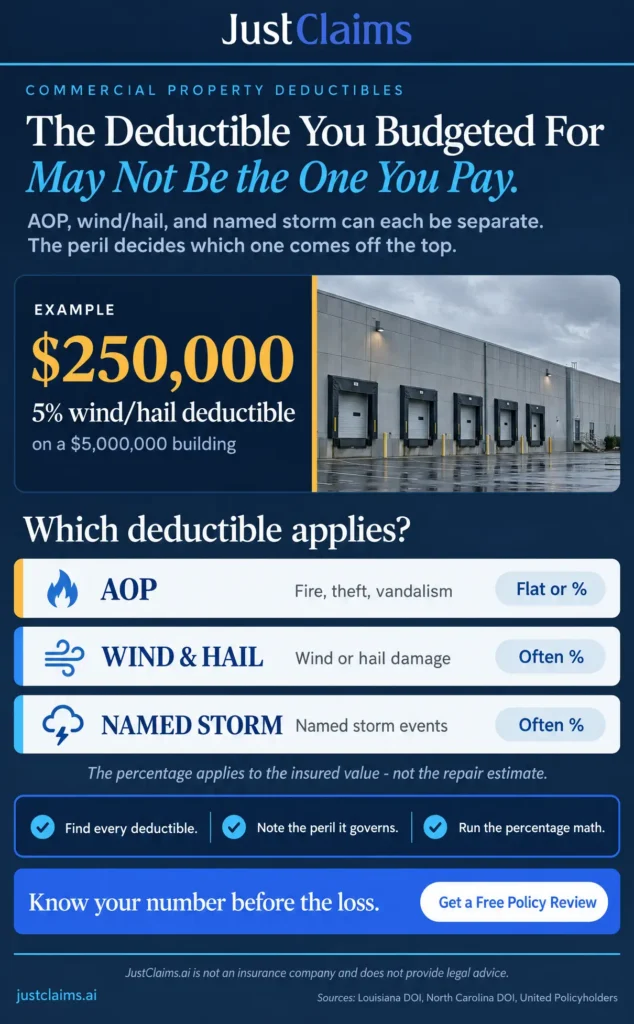
A 5% wind/hail deductible on a $5 million commercial building equals $250,000 out of pocket before the insurer pays the balance. The all other perils deductible (AOP) is the other entry on the same declarations page, and it applies to covered property losses that are not subject to a named-peril deductible. Knowing which deductible applies to which peril is one of the most practical steps a commercial property owner can take before a claim.
Key Takeaways
- What it is: AOP stands for All Other Perils and is listed as its own deductible entry, separate from wind/hail and named-storm deductibles.
- Separate wind/hail deductible: A commercial declarations page can list AOP, wind/hail, and named-storm deductibles as separate entries.
- Cost structure: Deductibles are either a flat dollar amount or a percentage of the insured value.
- Percentage example: A 5% wind/hail deductible on a $5 million building equals $250,000 out of pocket.
- Premium tradeoff: A higher deductible generally lowers the premium, but the savings are not guaranteed.
- What to check: Confirm every deductible and which peril it governs on your declarations page.
What an AOP Deductible Is
A deductible is the amount of repair or replacement cost the insured property owner is responsible for; the insurer owes the rest up to the policy limits [1]. On a commercial property declarations page, AOP stands for All Other Perils and appears as its own deductible entry, separate from Windstorm or Hail and Named Storm; a Louisiana Department of Insurance coverage disclosure form, for example, lists all three [2].
The policy lists deductibles by peril, and the applicable deductible is subtracted from the total claim; the insurer pays the balance subject to the coverage limits [2]. That structure is why the practical question after a loss is not how many deductibles the policy lists, but which one governs the damage. Reading the declarations page before a loss happens is far less costly than discovering the numbers afterward.
AOP vs. Special Deductibles: How the Hierarchy Works
Because your deductible structure decides how much of a loss you carry yourself, the first question after any loss is which deductible governs it. A wind/hail deductible applies to wind or hail damage [2][3]. A hurricane deductible is a separate deductible from all other perils, such as fire or vandalism [4]. The named-peril deductible governs that loss instead of AOP.
| Deductible Type | What It Applies To | Relationship to AOP |
|---|---|---|
| AOP | Covered property losses without a separate named-peril deductible | Applies when no named-peril deductible governs the loss |
| Wind/Hail | Wind or hail damage only | Governs that damage instead of AOP |
| Other named-peril deductible (e.g., named storm or hurricane) | The specific peril named in the policy | Applies in place of AOP when the policy includes it |
Sources for the table: [2][3][4]. For a deeper look at named-storm exposure, see our guide to the HOA hurricane deductible. This article stays focused on the AOP side of the structure.
How AOP Deductible Costs Are Calculated
Since the deductible determines your share of every covered loss, the way it is calculated matters as much as the headline number. Deductibles may be a flat dollar amount or a percentage of the insured value [1][5].
Flat Dollar Amount
A flat deductible is a fixed figure stated in the policy. It is predictable because it does not change with the value of the building [1].
Percentage of the Insured Limit
A percentage deductible is calculated on the insured value rather than a fixed dollar figure [3][6]. Applying that math to a commercial building: a 2% deductible on a $1 million insured value is $20,000; a 5% wind/hail deductible on a $5 million building is $250,000.
Percentage deductibles move with your insured values, so valuation accuracy has direct financial weight: because the percentage is applied to the insured limit, the dollar deductible rises as the limit rises [3][6]. For more on how limits and values interact, review our guide to insurance to value.
How the Deductible Reduces Your Payment
A deductible is subtracted from the total claim, and the insurer pays the balance subject to the applicable coverage limits [6]. The Louisiana form states the AOP and wind/hail deductibles per occurrence [2], so two separate occurrences in one policy year can mean two deductibles.
Choosing the Right Deductible Level
Because the deductible you select sets your out-of-pocket exposure on every claim, the choice is a financial decision, not a paperwork detail. A higher deductible generally lowers the premium [5][6]. United Policyholders cautions that once percentage and peril-specific deductibles are added, a high deductible is no longer a guaranteed money-saving trade [1].
Questions worth working through before renewal:
- Cash reserves: Could the business pay the applicable deductible within days of a loss without disrupting operations?
- Loss history: How often has the property had small claims that a higher deductible would have absorbed?
- Structure: Would a flat amount be more practical than a percentage, given the building’s insured limit? [3][6]
- Trigger: Which deductible would apply to each likely loss, and which peril triggers it? [2]
Treat the premium savings from a higher deductible as real only if the business can comfortably fund the larger out-of-pocket amount [1].
Common Claims Covered Under AOP
Losses such as fire, theft, or vandalism fall under AOP when the policy does not name a separate deductible for them [1][4]. If your policy has a separate wind/hail or named-storm deductible, that deductible applies to the loss instead [2][4]. Ask your carrier whether water damage carries its own deductible before you assume AOP applies.
A single loss can also involve Business Interruption and Law & Ordinance coverage, both of which can appear on the same commercial property declarations page [2]. Ask your carrier in writing how those coverages respond to the same loss, including any separate deductible, waiting period, or sublimit.
Frequently Asked Questions
What does AOP stand for in commercial property insurance?
AOP stands for All Other Perils. It appears as its own deductible entry, separate from Windstorm or Hail and Named Storm [2].
Does an AOP deductible apply to wind and hail damage?
Usually not, if your policy has a dedicated wind/hail deductible. A commercial declarations page can list AOP, Windstorm or Hail, and Named Storm as separate deductible entries [2]. A wind/hail deductible can be a percentage of the insured value and applies to wind or hail losses [3][6].
Is an AOP deductible a flat amount or a percentage?
It can be either. Deductibles may be a fixed dollar amount or a percentage of the insured value [1][5][6]. A percentage tied to a large building can produce a larger out-of-pocket amount than a flat figure [3][6].
Does a higher AOP deductible lower my premium?
Generally yes, but not automatically. A higher deductible generally lowers the premium [5][6], while United Policyholders notes that the savings are not guaranteed once percentage and peril-specific deductibles are added [1].
Where do I find my AOP deductible?
Look at the declarations page. Confirm every deductible, whether each is flat or a percentage, and which peril each one governs [1][2][3].
What You Should Review Before Renewal
Your 2026 policy review should start with the declarations page. Confirm every deductible, whether each is flat or a percentage, and which peril each one governs [1][2]. Then check that your insured values are current, because percentage deductibles are applied to the insured limit [3][6]. Finally, ask your carrier in writing how Business Interruption and Law & Ordinance coverage respond to the same loss, including any separate deductible, waiting period, or sublimit. A review done before a loss is far easier than one done after.
Get a free commercial property policy review with Justin to see how your deductible language, Business Interruption coverage, and Law & Ordinance coverage fit together before your next renewal.
This content is for informational purposes only and does not constitute legal or insurance advice. Coverage decisions depend on the specific terms, conditions, and exclusions of each policy and the laws of the applicable jurisdiction; policyholders and contractors should consult with a qualified professional for advice on their particular situation. Public adjuster disclosure: this article is presented under a licensed public adjuster byline. Public adjuster licensing requirements and permitted practices vary by state, and readers should verify the license status of any adjuster before engaging one. Nothing here promises a specific claim outcome or settlement amount.
Sources
[1] What’s UP With Home Insurance Deductibles? — United Policyholders
[3] Windstorm and Hail — North Carolina Department of Insurance
[4] Don’t Be Blown Away By Your Hurricane Deductible — United Policyholders
[5] What to know about deductibles — Texas Department of Insurance

Taylor Bezek

As the General Manager at JustClaims, Taylor Bezek brings over a decade of experience managing complex residential, commercial, and large-loss claims. A licensed Public Adjuster in TX (#2125659), FL (#W455048), CO (#769172), and 10 additional states, Taylor founded his own firm before joining JustClaims to scale a tech-forward solution for the insured. He is committed to combining industry expertise with AI to enhance speed, clarity, and outcomes for every policyholder. Taylor's mission is to modernize the public adjusting profession and ensure owners get exactly what they are entitled to.