Builders Risk Insurance: Construction Coverage Guide 2026
October 20, 2026
Written by Collin Corcoran
Share


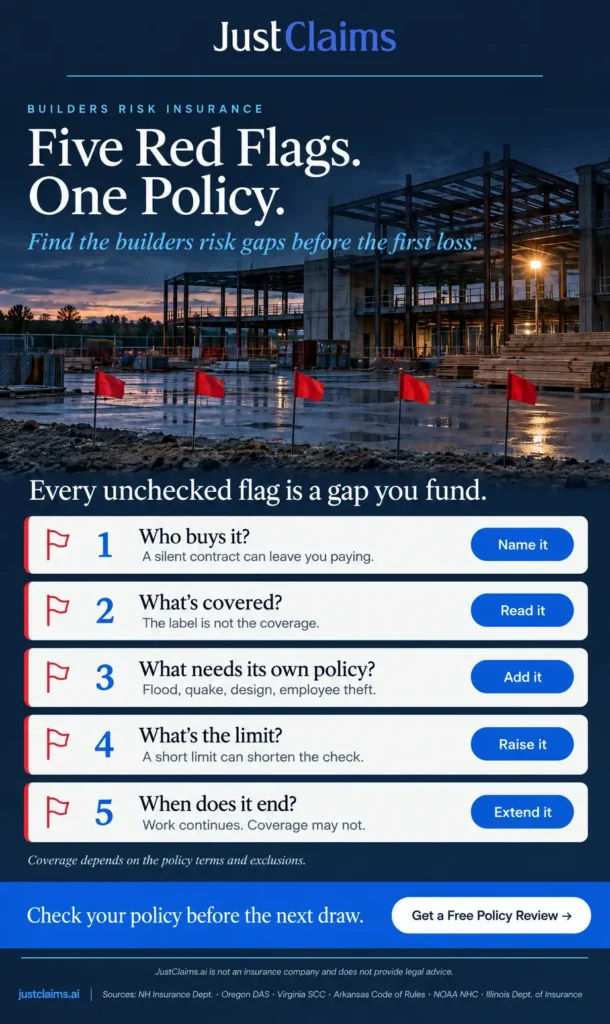
A construction schedule can outlast a builder’s risk insurance policy. When it does, the gap can be created before the first loss: the contract never says who buys the policy, the form is narrower than the project, or the expiration date passes while work continues. The fixes are documentary, and they start before mobilization.
Key Takeaways
- What it is: Builder’s risk insurance covers direct physical loss or damage to a building under construction, including materials and supplies intended to become part of it.
- Policy basis: It can be written on a named-peril or all-risk basis. The form and exclusions decide what is actually covered.
- Who buys it: The contract should assign the duty to the owner or the general contractor, and both parties should confirm who is named.
- Coverage gap: Builder’s risk is property coverage. It does not replace professional liability, commercial crime, or flood coverage.
- Term: Coverage is tied to the construction period. Check the expiration date and request an extension in writing before it expires.
- Limits: Insure to full completed value. A limit below that can reduce a loss payment.
What Builder’s Risk Insurance Covers on a Construction Site
Covered Perils
Builder’s risk insurance covers direct physical loss or damage to a building during the course of construction from perils such as fire, wind, theft, and vandalism [1][2]. It can cover the structure, building materials and supplies that will become part of it, foundations, and temporary structures at the jobsite [2]. It is property coverage, not liability coverage. That distinguishes it from general liability insurance, which responds to bodily injury and third-party property damage claims arising from the contractor’s operations [1][3].
Named-Peril vs. All-Risk Forms
Policies come in two forms. A named-peril policy covers only the events listed in the policy, such as fire, windstorm, hail, vandalism, or sprinkler leakage. An all-risk policy covers any loss not specifically excluded [3].
Builder’s risk can be written on either basis, and public contracts sometimes specify all risks of direct physical loss [2][4]. The label does not override the exclusions, so read the form.
Wind Without Flood
Wind and flood are separate exposures. Flood is generally excluded from most property policies and is insured separately, often through the National Flood Insurance Program; wind is commonly a covered peril [3]. Confirm both before hurricane season, which runs from June 1 through November 30 in the Atlantic [5].
Who Needs Builder’s Risk Insurance: Owners vs. Contractors
A coverage gap can turn one loss into a stalled schedule, so the first question on any project is who carries the policy. The owner, the general contractor, and the project lender all have money at risk in the project [2][4].
Who Is Responsible for Buying the Policy
Someone has to be responsible for buying the policy. Public construction contracts can place that duty on the contractor: Arkansas rules, for example, require the contractor to procure and maintain builder’s risk insurance during the term of the contract [4]. On a private project, the contract is the place to assign the duty and name the insureds. Do not rely on an assumption.
The Assumption Gap
A costly assumption on a construction site is that the other party bought the policy. Put the answer in the contract, name the owner and the contractor as insureds where appropriate, and exchange certificates before mobilization.
Lender and Contract Requirements
Check your construction loan documents and prime contract for builder’s risk requirements. Confirm the limits reflect the full completed value of the project [2].
Policy Duration, Delays, and Extensions
Because project delays can cause a sound policy to expire before the work is finished, duration deserves as much attention as perils.
When Coverage Can Lapse
Builder’s risk is written for the construction period, not indefinitely [2][4]. Illinois’ consumer definition describes builders risk as coverage for a home under construction, with claim payments based on the percentage completed at the time of loss, and notes that the coverage must be changed to a homeowners policy when the building is complete [6]. A project that runs past the policy expiration can lose protection unless the term is extended [2][4].
How to Request an Extension
If the schedule slips, request an extension in writing before the expiration date. Give the insurer the reason for the delay, the current status, the remaining scope, and the revised completion date. Keep the request and the response with the project file.
Completed Operations
Builder’s risk ends when construction ends [2][6]. General liability policies can include products and completed operations coverage for claims that arise after the work is complete [3][4].
Builder’s Risk Exclusions and Coverage Gaps
Builder’s risk is property coverage, so it does not respond to every construction risk. If the contractor provides design services, professional liability or errors and omissions coverage may be necessary; those policies respond to wrongful acts, errors, and omissions [1][3].
Employee dishonesty is handled by commercial crime coverage or a fidelity bond [3]. Flood is generally excluded from most property policies and insured separately, and earthquake coverage is usually added by endorsement [3].
| Gap | What it looks like | Where coverage may come from |
|---|---|---|
| Professional errors | Design errors or professional judgment claims | Professional liability or E&O [1][3] |
| Employee dishonesty | Theft or fraud by an employee | Commercial crime coverage or fidelity bond [3] |
| Flood | Rising water | Separate flood policy, often through the NFIP [3] |
| Earthquake | Shaking | Earthquake endorsement [3] |
Exclusions and limitations vary by insurer and policy language, so read the actual form rather than relying on a summary.
Checklist for Choosing Coverage Limits
Work through these questions before you bind coverage, and revisit them whenever scope or value changes.
- Contract: Does it state who buys the policy and who is named?
- Completed value: Do the limits reflect the full completed value of the structure and materials [2][4]?
- Form: Is the policy named-peril or all-risk, and have you read the exclusions [3]?
- Flood and earthquake: Is flood insured separately, and is earthquake coverage endorsed [3]?
- Crime and professional liability: Are employee dishonesty and design-related claims covered by separate policies [1][3]?
- Term: Does the policy period cover the expected schedule, and do you know how to request an extension [2][4][6]?
- Soft costs: If a covered loss delays completion, is soft-cost coverage endorsed [2]?
- Underinsurance: If the limit is below full completed value, a penalty may apply [2]?
- Lender and contract: Does the policy meet the loan and contract requirements?
Frequently Asked Questions
Is builder’s risk insurance the same as general liability insurance?
No. Builder’s risk is property coverage for the structure and materials during construction. General liability is a separate policy for bodily injury and third-party property damage claims arising from the contractor’s operations [1][3]. A contractor may carry both, along with professional liability where design services are provided [1].
Who is responsible for buying builder’s risk coverage?
It depends on the contract. Public project contracts can place the duty on the contractor [4]. On a private project, the contract should state who buys it, and both parties should confirm who is named.
Does builder’s risk cover theft by my own employees?
Employee dishonesty is addressed by commercial crime coverage or a fidelity bond [3].
What happens if my project runs past the policy expiration date?
Coverage is tied to the construction period [2][4][6]. Request an extension in writing before the expiration date and document the reason, current status, remaining scope, and revised completion date.
Does builder’s risk cover flood?
Generally no. Most property policies exclude flood, which is insured separately through the National Flood Insurance Program [3]. Confirm whether the policy includes earthquake coverage and whether flood is insured separately [3].
How to Protect Your Project Before Breaking Ground
Builder’s risk protects the physical project from covered perils. It does not replace professional liability or commercial crime coverage, and it does not protect a project after the policy term lapses [1][2][3]. Protect the schedule by settling who buys the policy, confirming the form and endorsements, and requesting extensions before expiration [2][4].
If a builder’s risk claim was denied or underpaid, run a free commercial property policy review with Justin before you accept the carrier’s number.
This content is for informational purposes only and does not constitute legal or insurance advice. Coverage decisions depend on the specific terms, conditions, and exclusions of each policy and the laws of the applicable jurisdiction; policyholders and contractors should consult with a qualified professional for advice on their particular situation.
Sources
[1] How to Verify If Your Contractor Has the Right Insurance — New Hampshire Insurance Department
[2] Insurance Clauses – Builders Risk — Oregon Department of Administrative Services
[4] 22 CAR § 112-319. Contractor’s Insurance Requirements — Arkansas Code of Rules
[5] Tropical Cyclone Climatology — NOAA National Hurricane Center
[6] Commercial Property Insurance Definitions — Illinois Department of Insurance

Collin Corcoran

Experienced Public Adjuster and Property Claims Specialist, Collin is licensed in New York (#1603393), New Jersey (#3003700204), and Connecticut (#19820270). With 20+ years of hands-on construction and property damage experience, he specializes in residential and commercial claims, complex loss inspections, policy review, detailed estimating, and strategic negotiation. Collin’s background in construction, asset management, emergency response, and claims documentation allows him to accurately identify damage, understand repair requirements, and advocate effectively for policyholders. He works with homeowners, business owners, contractors, and insurance professionals to move claims forward with clarity, accuracy, and confidence. Collin is committed to transparency, technical precision, strong communication, and securing fair outcomes for policyholders.