Business Personal Property Insurance: Coverage Guide 2026
October 09, 2026
Written by Stephane Elias
Share


Business personal property (BPP) insurance helps cover the cost to repair or replace company-owned equipment, tools, inventory and furniture damaged or stolen in a covered event such as fire, windstorm or theft. It does not cover the building itself, liability claims or lost income. Minor valuation errors can cost millions when a loss exposes a gap.
Key Takeaways
- What it is: BPP insurance helps cover company-owned equipment, tools, inventory and furniture damaged or stolen in a covered event.
- What qualifies: Furniture, fixtures, machinery and equipment not permanently installed, inventory, and any other personal property owned by and used in your business.
- Outdoor reach: Signs, fences and outdoor property not attached to the building can be insured as business property — coverage can also reach items in a vehicle within 100 feet of the building.
- Replacement cost value (RCV): RCV coverage pays to repair or replace damaged property with materials of like kind and quality.
- Coinsurance: Most insurers require you to insure at least 80% of your property’s value — fall short and your claim payout shrinks.
- BPP vs. BOP: A business owner’s policy (BOP) bundles property coverage with liability and business interruption insurance.
What Is BPP Insurance? Definition and Core Coverage
Core Coverage
BPP insurance helps pay to repair or replace company-owned equipment, tools, inventory and other physical property when a covered event damages or takes it. The NAIC’s list of insurable business property runs from inventory, furniture and machinery to computers, valuable papers, and even signs and fences [1].
BPP sits inside a commercial property policy alongside two other sections: building coverage and personal property of others [2]. The premium is generally tax-deductible as an ordinary business expense [3].
Outside the Building and Property of Others
BPP generally refers to property located inside the building, but filed commercial property forms define it more broadly — the TWIA form filed with the Texas Department of Insurance, for example, covers property in or on the described building, in the open at the described location, or in a vehicle within 100 feet of the building [4].
“Personal property of others” coverage applies to property in your business’s care, custody and control [2] — think a client’s equipment on your premises or a visiting partner’s laptop.
BPP vs. BOP
BPP usually isn’t sold on its own. It comes as part of commercial property coverage, often within a business owner’s policy. The NAIC describes a BOP as a package that typically includes property, business interruption and liability insurance [5] — which means liability claims and lost income live outside BPP, in the other sections of the bundle.
Property owners should confirm which of these protections sit inside their program and which do not. On the income side, coverage written on an actual loss sustained basis pays what the business would have earned, which is why that section deserves its own limit review.
What’s Covered vs. Excluded Under BPP
Because a misvalued schedule compounds fast when a loss hits, the line between covered contents and excluded property is a sensible place to test a policy for gaps. The California Department of Insurance defines Business Personal Property as furniture, fixtures, machinery and equipment not permanently installed, inventory, or any other personal property owned by and used in your business [6].
Whether a given loss is covered also depends on the perils your policy insures against: a “named peril” policy covers only listed events such as fire, windstorm, hail, vandalism or sprinkler leakage, while an “all risk” policy covers any loss by perils not specifically excluded [7].
What Typically Falls Inside BPP
| Item | Typical treatment under BPP |
|---|---|
| Desks, computers, furniture | Covered — listed by the NAIC as insurable business property [1] |
| Tools, machinery and equipment not permanently installed | Covered as business personal property [2] |
| Inventory and supplies | Covered [1] |
| Valuable papers, books and documents | Listed as insurable business property [1] |
| Signs, fences and outdoor property not attached to the building | Listed as insurable business property [1] |
| Property of others in your care, custody or control | Covered under the “personal property of others” section [2] |
| Tenant improvements and betterments | Covered — permanently installed improvements a tenant can’t remove when vacating [6] |
| Buildings and permanently installed fixtures | Not BPP — they fall under building coverage [2] |
| Business property in transport | Not standard BPP — inland marine insurance covers business property in transport [2] |
Tenants get their own slice of protection: improvements and betterments coverage covers permanently installed improvements that cannot be removed when a tenant vacates the building [6]. A separate “personal property of others” section covers property in the insured’s care, custody or control [2].
What Typically Falls Outside BPP
Buildings and permanently installed fixtures fall under building coverage, not BPP [2]. Business property damaged or destroyed while in transport is the territory of inland marine insurance [2], so a company that moves equipment between sites should ask how that exposure is insured. And BPP alone covers neither liability claims nor lost income — those belong to the liability and business interruption sections of a BOP [5].
Replacement Cost vs. Actual Cash Value
Valuation basis decides how much of a loss becomes your problem: the same damage produces a different payout depending on the basis written into the policy.
| Valuation basis | How the payout is determined | Watch out |
|---|---|---|
| Actual cash value (ACV) | Replacement amount minus depreciation at the time of the loss [2] | Often does not pay enough to fully replace your property [8] |
| Replacement cost value (RCV) | Repair or replacement with materials of like kind and quality [8] | Still subject to the coinsurance clause [6] |
How Each Basis Pays
The NAIC example is a $10,000 loss. With replacement cost coverage, the policy pays $10,000 to replace the damaged property, minus the deductible. With ACV coverage, the insurer weighs age and condition and pays a depreciated amount instead [8]. Walking your own inventory through the actual cash value formula before a loss makes that depreciated number less of a surprise.
The NAIC article is written for residential policyholders, but the same valuation logic applies to business personal property policies. Now picture that depreciation gap multiplied across a warehouse of equipment and stock.
Recoverable Depreciation
The North Carolina Department of Insurance defines RCV as the amount needed to replace belongings at today’s cost for a similar item. ACV is that cost minus the decrease in value from age or use [9].
With replacement cost coverage, the insurer may first pay the actual cash value; once the item is repaired or replaced and receipts are submitted, the company reimburses the difference. The withheld amount is called “Recoverable Depreciation” [9]. Property owners should ask how and when that withheld amount is released.
How to Calculate Business Personal Property Coverage Limits
Underinsurance is the practical risk behind valuation errors, so limits should be built from documented values rather than rough estimates.
Build a Documented Inventory
The NAIC tells business owners to keep thorough, up-to-date records of business inventory, accounts receivable and equipment purchases — one copy on-site and another somewhere else — and to have the property value assessed before buying insurance and periodically after [1]. That documented inventory does double duty: it sets your coverage limits from real numbers, and it becomes your evidence if you file a claim.
Check the Coinsurance Requirement
Most insurers require you to insure at least 80% of your property’s value — the coinsurance requirement is generally 80%, 90% or 100%, and it directly affects what you receive on a claim [10].
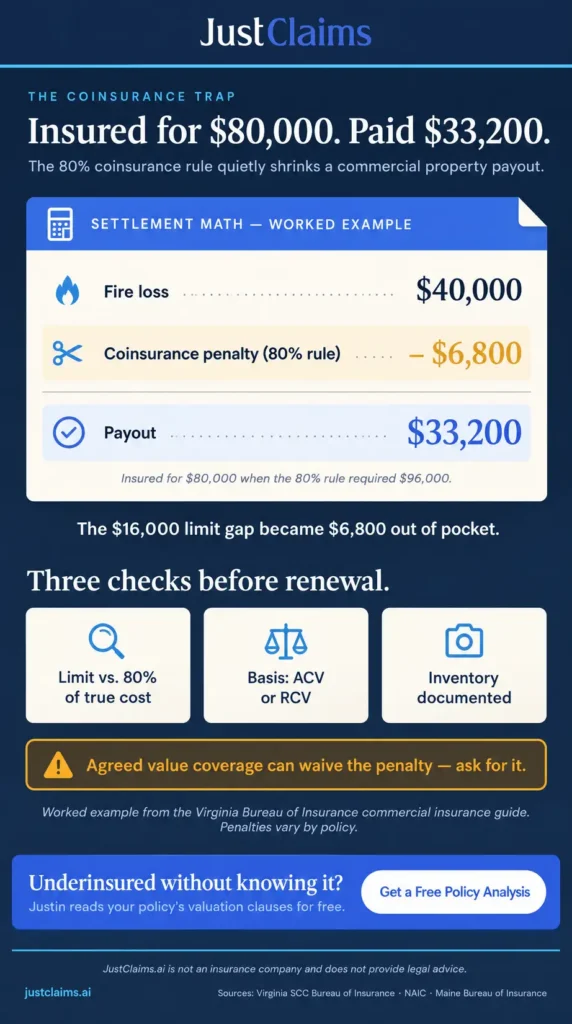
The Virginia Bureau of Insurance’s example shows the bite (their example uses a building; the clause works the same way for contents): insure for $80,000 when 80% of true replacement cost requires $96,000, and a $40,000 fire loss pays only $33,200 — the insurer pays the ratio of what you carried to what you should have carried [7]. An inventory that understates value can leave a policy short of that threshold without the owner realizing it.
Understand Premium Drivers
Regulators list type of construction, location and availability of fire protection among the factors that shape commercial property premiums [2] — so construction details and fire protection sit alongside the dollar figures on your inventory when a carrier prices the risk.
One more lever: agreed value coverage waives the coinsurance penalty and pays 100% of the stated amount for a covered loss [6]. Ask your broker whether your program qualifies. The value the carrier agrees to is documented on a schedule of values filed with the policy, so the numbers on it deserve the same care as the inventory itself.
Frequently Asked Questions
What does business personal property insurance cover?
BPP helps pay for company-owned equipment, tools, furniture and inventory when a covered event such as fire, windstorm or theft damages them [1][7]. Property of others in your care, custody or control can be covered under its own section of the policy [2].
Is BPP the same as a business owner’s policy?
No. BPP is one section of a commercial property policy, and it does not respond to liability claims or lost income. A BOP is a package that typically includes property, business interruption and liability insurance together [5].
Is business property covered while it’s being transported?
Not under standard BPP. Inland marine insurance is the specialized coverage that protects business property damaged or destroyed while in transport [2] — so if equipment moves between jobsites, ask how that exposure is insured.
Why does coinsurance matter when setting limits?
Most insurers require you to insure at least 80% of your property’s value. If your limit falls below the required percentage, the insurer applies a coinsurance penalty and you will not receive the full value of your loss [10].
Should I choose replacement cost or actual cash value?
Replacement cost pays to repair or replace damaged property with materials of like kind and quality [8]. Actual cash value pays the replacement amount minus depreciation — and often does not pay enough to fully replace your property [8]. Both bases remain subject to the coinsurance clause [6].
How to Protect Your Business Property Value
Business personal property coverage rewards precision. You need a documented inventory, a clear view of what is excluded, a deliberate choice between replacement cost and actual cash value, and limits that satisfy the coinsurance requirement. Minor valuation errors can cost millions, and gaps often sit outside BPP itself, in lost income or the cost of rebuilding to current code. Regulators note that commercial claims tend to be more complex and that fast claim assessment matters [6] — one more reason prompt reporting and careful documentation pay off.
Upload your policy and loss documentation and get a free AI policy analysis from Justin — it can flag coverage gaps in Business Interruption and Law & Ordinance for you to review before you respond to the carrier.
This content is for informational purposes only and does not constitute legal or insurance advice. Coverage decisions depend on the specific terms, conditions, and exclusions of each policy and the laws of the applicable jurisdiction; policyholders and contractors should consult with a qualified professional for advice on their particular situation.
Sources
[1] Small Business Insurance — National Association of Insurance Commissioners
[3] Publication 535, Business Expenses — Internal Revenue Service
[4] TWIA Commercial Policy Form (Windstorm and Hail), filed with the Texas Department of Insurance
[5] Business Interruption and Business Owner Policy — National Association of Insurance Commissioners
[6] Commercial Insurance Guide — California Department of Insurance
[9] Actual Cash Value vs. Replacement Cost Value — North Carolina Department of Insurance
[10] Insuring Your Business: The Basics of Property & Liability Coverage — Maine Bureau of Insurance

Stephane Elias

A seasoned insurance professional with nearly a decade of experience, Stephane Elias is currently serving as a Senior Claims Professional and Public Adjuster with JustClaims. Throughout his career, Stephane has represented policyholders through leading public adjusting firms and served as a loss consultant for law firms specializing in insurance litigation, giving him extensive expertise in complex property insurance claims. A licensed public adjuster in TX (#2645032), FL (#W564547), and six other states, he specializes in commercial and residential property claims, claims management, appraisals, mediation, and strategic partnerships. Stephane is passionate about helping policyholders overcome delayed, denied, and underpaid insurance claims, ensuring they receive the full recovery they’re entitled to under their policy.