HOA Master Policy Renewal Checklist 2026

October 20, 2026
Written by Taylor Bezek
Share


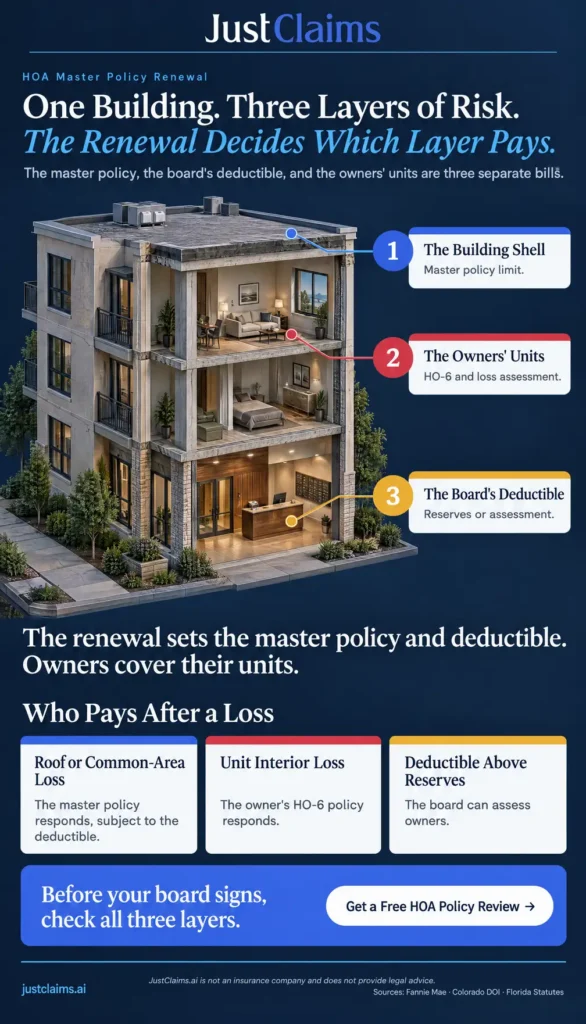
HOA master policy deductibles in Colorado are rising from 5% to 10%, and a 10% deductible may fall outside the scope of some traditional loans. The renewal your board signs decides how much of the next loss the policy pays — and how much may be assessed to property owners. A structured review before expiration gives the board time to check each term while changes are still possible.
Key Takeaways
- Fannie Mae coverage floor: The master property insurance coverage amount must equal at least 100% of the estimated replacement cost value of the project improvements, including common elements and residential structures.
- Fannie Mae deductible cap: The maximum allowable deductible for all required property insurance perils is 5% of the master property insurance coverage amount per occurrence.
- Fannie Mae per-unit deductible cap: The maximum allowable per-unit deductible is $50,000 per unit.
- Review cadence: Colorado’s Division of Insurance recommends that boards review the master policy regularly and that owners compare their own policy annually.
- Colorado deductible trend: The Colorado Division of Insurance reports deductibles rising from 5% to 10%.
- Loss assessment gap: Many owner policies limit loss assessment coverage to $1,000 toward a deductible.
What a Board Should Confirm Before Renewing
Before signing, confirm that limits track current replacement cost, that the deductible can be funded, that every required peril is covered, and that the policy form matches your governing documents.
Fannie Mae’s Selling Guide gives a useful benchmark: the master property insurance coverage amount must equal at least 100% of the estimated replacement cost value of the project improvements, including common elements and residential structures, and premiums must be paid as a common expense by the HOA [1].
Colorado’s Division of Insurance puts the governing-document test directly: the HOA is responsible for obtaining coverage that meets the requirements of its CC&Rs [2].
How HOA Master Policy Renewals Work
Renewal terms decide whether a loss is absorbed by the policy or passed to owners. Colorado’s Division of Insurance recommends that boards review the master policy regularly to identify coverage gaps or necessary adjustments, and that owners compare their own policy with the master policy annually [2].
A history of frequent or severe claims can make insurers hesitant to offer or renew coverage, and in Colorado it can push an HOA into the non-admitted market, where coverage is more expensive and may offer less protection [2].
A Sample Renewal Timeline
| Illustrative days before expiration | Board task |
|---|---|
| 90 | Confirm expiration dates, assign responsibilities, request loss runs, gather current policies |
| 75 | Update property values, roof details, and building systems |
| 60 | Submit renewal applications and supporting records |
| 45 | Answer underwriting questions |
| 30 | Compare quotes, deductibles, limits, exclusions, and endorsements |
| 15 | Approve the program and complete binding requirements |
Use this schedule as a planning template, not a legal deadline. Work backward from expiration so valuation, loss runs, and CC&R review are finished before quotes are due, and ask your broker when quotes will actually arrive.
Associations with older buildings, prior claims, catastrophe exposure, or limited insurer options may need to start earlier; Colorado’s Division of Insurance notes that a claims history can make insurers hesitant to offer or renew coverage [2].
What to Gather Before You Call the Broker
Assemble a renewal file before the first broker call: the current policy and endorsements, loss runs, the most recent replacement-cost valuation, roof and building-system updates, the reserve study, maintenance records, a summary of prior claims, and the CC&Rs.
Colorado’s Division of Insurance notes that insurers are pressing harder on insurance-to-value and that claims history can affect whether an insurer offers or renews coverage [2]. Compare limits, exclusions, deductibles, valuation terms, and endorsements — not just the premium.
The 10 Checks That Matter Before Your Board Signs
Each item below can move cost from the policy to the owners, which is why they belong on the renewal checklist.
1. Coverage Type
Colorado’s Division of Insurance describes two common master policy types: an “all-in” policy covers fixtures within units, while a “bare walls-in” policy covers only exterior and common areas. The master policy typically covers common areas and building structures, including roofs and exterior walls, and the CC&Rs determine the extent of coverage the HOA must carry [2].
Ask the broker to confirm which type your policy is and where the unit-owner boundary sits. For a deeper comparison, see master policy vs. HO-6; for the coverage types in detail, see our HOA master insurance policy guide.
2. Limits vs. Replacement Cost and Coinsurance
Fannie Mae requires the master property insurance coverage amount to equal at least 100% of the estimated replacement cost value of the project improvements, including common elements and residential structures. The policy must be written on a replacement cost basis, with an exception for roofs: roofs must be insured, but they do not have to be insured on a replacement cost basis [1].
Colorado’s Division of Insurance warns that insurers are more insistent that properties be insured-to-value, because underinsurance poses a risk in a disaster [2]. If the limit falls short, the HOA may need to levy a loss assessment to cover costs the master policy does not fully pay [2]. Ask how any coinsurance or valuation clause would apply to a partial loss.
3. Deductible Structure
Fannie Mae caps the maximum allowable deductible for all required property insurance perils at 5% of the master property insurance coverage amount per occurrence. A per-unit deductible is capped at $50,000 per unit. When the master policy has a per-unit deductible, the borrower must also have a unit owners property insurance policy. A deductible buy-back policy purchased by the HOA may be used to meet the maximum deductible requirements if it meets Fannie Mae’s other property insurance requirements [1].
Ask whether your deductible is a flat dollar amount or a percentage of insured value; a percentage deductible moves with your limit, so the dollar exposure grows as the building’s insured value grows.
A lower premium does not always mean a lower community cost: Colorado’s Division of Insurance notes that raising deductibles or reducing coverage can lower the premium, but the HOA remains responsible for coverage that meets its CC&Rs [2]. For the owner-side view, see HOA hurricane deductibles.
4. Ordinance or Law and Equipment Breakdown
Fannie Mae describes three parts: Coverage A for loss to the undamaged portion of a building, Coverage B for demolition costs, and Coverage C for increased costs of construction. The coverage may be included in the property coverage form or obtained as an endorsement, and it is not required if it is not obtainable in the insurance market available to the association [1].
If the project has central heating or cooling, equipment breakdown coverage is also required, in an amount equal to the lesser of $2 million or the replacement cost value of the building or buildings housing the boiler or machinery [1].
5. Flood
Confirm in writing whether flood is covered, limited, or excluded. Ask the broker whether flood is covered by the master policy or requires a separate policy, and get the answer in writing. If the master policy excludes or limits a required peril, Fannie Mae requires the HOA to obtain an acceptable policy — for example, a stand-alone policy — for that peril [1].
6. Fidelity and Crime
Colorado’s Division of Insurance lists fidelity (crime) coverage as one of the core policies an HOA carries. It protects against fraudulent activities by HOA employees or members [2]. Ask the broker what it covers and whether the limit matches the maximum funds in the association’s custody.
7. Directors and Officers (D&O)
Colorado’s Division of Insurance defines D&O as liability coverage for HOA board members against lawsuits related to their duties [2]. Confirm the limit, who is insured, and whether defense costs are inside or outside the limit.
8. Umbrella and Liability Limits
Colorado’s Division of Insurance defines general liability coverage as protecting the HOA against claims for bodily injury or property damage that occur in common areas [2]. Review the limit and ask whether an umbrella or excess layer sits above it.
9. Loss Runs
Request loss runs early. Colorado’s Division of Insurance notes that a history of frequent or severe claims can lead insurers to raise premiums, become hesitant to offer or renew coverage, and in some cases force an HOA into the non-admitted market, where coverage is more expensive and may offer less protection [2].
10. Exclusions and Endorsements
Read the exclusions line by line and compare them with the prior term. Fannie Mae requires the master policy to cover a list of required perils, including fire, lightning, explosion, windstorm, hail, smoke, and water damage, and requires the HOA to obtain a stand-alone policy if a required peril is excluded or limited [1]. Colorado’s Division of Insurance says understanding exclusions is crucial because they define what is not protected [2].
Red Flags That Turn Into Special Assessments
Because deductibles and valuation gaps can land on owners, certain renewal terms deserve extra scrutiny [2].
- A deductible with no funding plan. Colorado’s Division of Insurance tells HOA members to ask their board how adequately funded reserves are to cover insurance shortfalls or deductibles without requiring special assessments [2]. Decide before a loss whether the deductible would come from operating funds, reserves, or a special assessment.
- Silent CC&Rs. Colorado’s Division of Insurance says the CC&Rs determine the extent of coverage the HOA must carry, and that the HOA remains responsible for coverage that meets them [2]. For Florida condominium associations, property insurance deductibles and damages above coverage are a common expense of the condominium, except for damage caused by a unit owner’s intentional conduct, negligence, or failure to comply with the declaration or rules [3]. Read your governing documents and state law before assuming who pays.
- Owner coverage that falls short. Colorado’s Division of Insurance warns that many policies limit loss assessment coverage to $1,000 toward a deductible, that not all HO-6 policies offer loss assessment coverage up to the amounts now needed, and that some cannot be increased outside renewal [2]. It also notes that loss assessment coverage can be triggered at the date of loss or the date of assessment, so a change of insurer can leave a gap [2]. Owners should review their own policy before renewal, not after a loss.
- Underinsurance. If the master policy limit falls short of replacement cost, the HOA may need to levy a loss assessment to cover costs the policy does not fully pay [2]. Colorado’s Division of Insurance defines a loss assessment as an extra charge for costs the master policy does not fully cover, including deductibles, significant property damage, liability claims, or money owed beyond policy limits [2].
Owners should read loss assessment coverage before the next renewal notice goes out.
Questions to Ask the Broker at Renewal
Because renewal terms shift costs to owners, the broker conversation should focus on how those costs are allocated [2].
- Does the quote come from an admitted or a non-admitted carrier? Colorado’s Division of Insurance defines the non-admitted (surplus lines) market as insurers that do not have to meet state regulations like admitted companies, but are more willing to cover higher-risk properties [2].
- Do replacement cost limits reflect recent construction inflation? Colorado’s Division of Insurance notes that reconstruction costs have risen and that insurers are pressing harder on insurance-to-value [2].
- How do deductibles apply across multi-unit losses?
- How does the property form match our governing documents? Colorado’s Division of Insurance says the CC&Rs determine the coverage the HOA must carry [2].
- Can you explain the policy type, insurance-to-value, the aggregate limit, and loss assessment coverage?
- If we raise the deductible to cut the premium, how would owners and lenders be affected? Colorado’s Division of Insurance notes that homeowners may be responsible for the HOA’s deductible and any overages beyond the master policy limits [2].
Colorado’s Division of Insurance notes that the HOA remains responsible for coverage that meets its CC&Rs even when it cuts premiums [2].
State Notes: Florida and Colorado
Statute-specific duties change what a renewal must include [3].
- Florida: Florida Statutes §718.111 requires every condominium association to have adequate property insurance. Replacement cost may be based on an independent insurance appraisal or an update of a previous appraisal, and must be determined at least once every 3 years [3].
Policies may include deductibles as determined by the board, but the deductibles must be consistent with industry standards and prevailing practice for communities of similar size and age and similar construction and facilities [3].
Florida also requires insurers to offer commercial residential policyholders a choice between an annual hurricane deductible and a per-hurricane deductible [4]. If your association is a homeowners’ association rather than a condominium association, ask counsel which statute applies. - Colorado: The Division of Insurance reports that master policy costs are increasing by 200–500% and that insurers are pressing harder on insurance-to-value [2]. It also notes that a history of claims can push an HOA into the non-admitted market, and that a 10% deductible may fall outside the scope of some traditional loans [2].
If your broker cannot help, the Division points boards to the Professional Independent Insurance Agents of Colorado [2]. - Other states: Ask association counsel which statutes apply before binding.
Frequently Asked Questions
How early should an HOA start the master policy renewal process?
Start from your policy’s expiration date. Colorado’s Division of Insurance recommends that boards review the master policy regularly to identify coverage gaps or necessary adjustments, and that owners compare their own policy with the master policy annually [2]. A practical approach is to work backward from expiration so valuation, loss runs, and CC&R review are complete before quotes are due.
What are the lender HOA insurance requirements for a master policy?
Fannie Mae’s Selling Guide requires the master property insurance coverage amount to equal at least 100% of the estimated replacement cost value of the project improvements. It caps the maximum allowable deductible for all required property insurance perils at 5% of the master property insurance coverage amount per occurrence and the maximum allowable per-unit deductible at $50,000. If the policy has a per-unit deductible, the borrower must also have a unit owners property insurance policy [1].
Who pays the master policy deductible after a claim?
It depends on the governing documents and state law. For Florida condominium associations, property insurance deductibles and damages above coverage are a common expense of the condominium, except for damage caused by a unit owner’s intentional conduct, negligence, or failure to comply with the declaration or rules [3]. Colorado’s Division of Insurance says homeowners may be responsible for the HOA’s deductible and any overages beyond the master policy limits [2]. Read your CC&Rs and ask association counsel before assuming who pays.
Is a lower renewal premium always better?
No. Colorado’s Division of Insurance notes that raising deductibles or reducing coverage can lower the premium, but the HOA remains responsible for coverage that meets its CC&Rs [2]. Compare limits, exclusions, valuation terms, and endorsements alongside price.
What to Do Before You Sign
Treat the renewal as a cost-allocation decision. Check coverage type, valuation, the deductible, ordinance or law, flood, fidelity, D&O, liability, loss runs, and exclusions. Then run the red-flag list against your CC&Rs so a loss doesn’t turn into an unplanned assessment for property owners.
JustClaims is a licensed public adjusting firm. Upload your master policy and renewal quote to Justin, JustClaims’ AI policy tool, for a free HOA master policy review and get the deductible, exclusions, and limits summarized before your board signs.
This content is for informational purposes only and does not constitute legal or insurance advice. Coverage decisions depend on the specific terms, conditions, and exclusions of each policy and the laws of the applicable jurisdiction; associations, boards, property managers, and owners should consult a licensed attorney and a qualified insurance professional about their particular situation.
Sources
[1] Selling Guide B7-3-03, Master Property Insurance Requirements for Project Developments — Fannie Mae
[2] Toolkit for Homeowners and HOAs on Insurance — Colorado Division of Insurance

Taylor Bezek

As the General Manager at JustClaims, Taylor Bezek brings over a decade of experience managing complex residential, commercial, and large-loss claims. A licensed Public Adjuster in TX (#2125659), FL (#W455048), CO (#769172), and 10 additional states, Taylor founded his own firm before joining JustClaims to scale a tech-forward solution for the insured. He is committed to combining industry expertise with AI to enhance speed, clarity, and outcomes for every policyholder. Taylor's mission is to modernize the public adjusting profession and ensure owners get exactly what they are entitled to.