What Is Subrogation? Insurance Guide & Process 2026
October 14, 2026
Written by Collin Corcoran
Share


When your insurer pays a covered claim, it may then pursue the person or company that caused the loss, and in some cases part of what it recovers can return to you as your deductible. That process is called subrogation, and the rules for sharing recoveries differ by state and by type of insurance. Knowing how it works helps you ask the right questions while your claim is still open.
Key Takeaways
- What it is: The NAIC describes subrogation as an insurer’s legal right, acting for the insured, to bring a liability suit against a third party who caused the insured’s losses.
- Why it exists: It prevents double recovery, meaning payment from both the insurer and the at-fault party for the same loss.
- Deductible impact: If the insurer’s subrogation claim succeeds, the money recovered may help cover your deductible. The clearest regulator rules on this are written for auto claims, so ask how your property policy handles it.
- California rule (auto): An insurer that pursues subrogation must include your deductible in the effort. If it will not pursue subrogation, it must tell you so you can try to recover the deductible yourself.
- New York timing (auto): For motor vehicle physical damage claims, the insurer must pay the insured’s pro rata share of any net recovery within 30 calendar days of the recovery.
- Waiver risk: A waiver of subrogation signed before a loss can limit what the owner’s insurer may recover from a contractor. One federal appeals court wrote that if the owner is covered by property insurance, neither it nor its insurer can recover from the contractor to the extent of that coverage.
Subrogation Meaning: Definition and Purpose
Subrogation is the legal mechanism that lets your insurer step into your shoes after it pays your claim. The Washington State Office of the Insurance Commissioner explains that it allows the insurance company to recover the payment it made to the person it insures from the person responsible for the damages or their insurance company [1].
The NAIC, the association of state insurance commissioners, describes it as a situation where an insurer, on behalf of the insured, has a legal right to bring a liability suit against a third party who caused losses to the insured [2].
The “Stand in the Shoes” Principle
Courts describe subrogation in terms of position: the insurer steps “into the shoes” of its insured [3]. After paying your claim, the insurer can then pursue the person or company responsible for the damage to recoup that payment [1].
Preventing Double Recovery
Subrogation also keeps an insured from collecting twice. The New York Court of Appeals described the principle as having a dual objective: to prevent the insured from “recovering twice for one harm,” and to “require the party who has caused the damage to reimburse the insurer for the payment the insurer has made” [4].
The Washington Supreme Court adds that subrogation “seeks to impose ultimate responsibility for a wrong or loss on the party who, in equity and good conscience, ought to bear it” [3].
How the Subrogation Process Works After a Claim Is Paid
Because subrogation is the route by which your deductible can come back to you, the order of events matters. Your insurer first pays the covered claim under your policy. Only after that payment does it ask the responsible party, or that party’s insurance company, to reimburse what it paid [1][2].
What the Insurer Does
Washington’s insurance commissioner explains, in its auto-claims guidance, that when you file a claim your insurer can try to recover costs from the person responsible for the injury or property damage, and that if you paid a deductible the company must include it in its subrogation demand to the at-fault party [5].
Recovery is not guaranteed. California’s auto guide notes that when a company’s efforts succeed “in whole or in part,” most companies reimburse the deductible in accordance with the recovery [6].
When Fault Is Shared
If fault is shared, your deductible recovery shrinks with it. Washington’s insurance commissioner says that if the accident investigation shows you are partially at fault, you will only recover a percentage of your deductible [5], and its motor vehicle claims regulation allocates recoveries first to the insured for the deductible “less applicable comparable fault” [7].
What You Should Avoid Doing
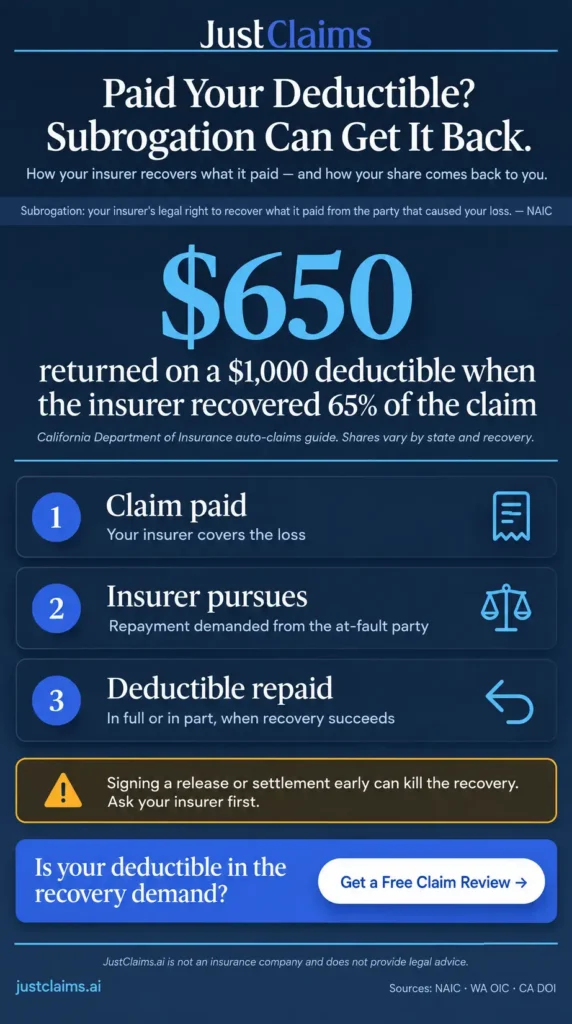
California’s regulator says you cannot do anything that jeopardizes the company’s right of recovery, for example by signing an agreement releasing the other party in exchange for payment of your deductible [6]. Before you sign any release or settlement with the party who caused the loss, ask your insurer whether it affects subrogation.
How Subrogation Affects Your Deductible
Because deductible recovery depends on whether your insurer actually pursues the at-fault party, your deductible is one of the parts of subrogation that can directly affect your own finances. In its auto guide, the California Department of Insurance says the insurer must advise you whether it intends to pursue subrogation. If it does, it must include your deductible in the process. If it does not, it must tell you so you can pursue the deductible on your own [6].
Washington’s insurance commissioner likewise says an insurer must include your deductible in its subrogation demand [5]. These are auto-claim rules. For a homeowners, condo, HOA or commercial property claim, ask your insurance adjuster in writing whether your deductible is included in any subrogation demand and how recoveries are shared.
Proportional Reimbursement
In California’s auto guide, most companies reimburse the deductible in accordance with the recovery. The regulator gives the example that a 100 percent recovery of the paid claim returns 100 percent of the deductible, while a 65 percent recovery returns 65 percent. On a $1,000 deductible, that formula would return $650. Expenses or fees the company incurs in its recovery efforts are apportioned between the company and you [6].
The NAIC’s model claims settlement regulation, in its automobile-claims standards, provides that insurers shall, upon the claimant’s request, include the first party claimant’s deductible in subrogation demands and share recoveries on a proportionate basis unless the deductible amount has otherwise been recovered [8]. Rules vary by state, as the table below shows.
State-by-State Differences
Deductible rules are not uniform. These examples come from each state’s own regulator or legislature:
| State | Applies to | Deductible reimbursement rule |
|---|---|---|
| California | Auto (Department of Insurance guide) | An insurer that pursues subrogation must include your deductible, and most companies reimburse in accordance with the recovery [6] |
| New York | Motor vehicle physical damage claims | The insured shares pro rata in any net recovery, and the insurer must pay that share within 30 calendar days of the recovery [9] |
| Texas | Private passenger auto policies | Within one year after paying the claim, the insurer must take action to recover the deductible from the third party or pay the deductible to the insured, unless it notifies the insured in writing, by the earlier of that date or 90 days before the negligence limitations period expires, that it will not pursue collection and authorizes the insured to do so [10] |
| Washington | Motor vehicle claims | Insurers must include the insured’s deductible in subrogation demands, and recoveries are allocated first to the insured for the deductible, less applicable comparable fault [7] |
These are auto rules. Property policies depend on their own wording and your state’s law, so check your state’s rules and ask your adjuster in writing whether your deductible is included in any subrogation demand.
Common Examples of Subrogation in Auto and Property Claims
Because subrogation depends on someone else causing your loss, the clearest examples involve an identifiable at-fault party.
Auto Insurance Example
Suppose another party is at fault in an accident that damages your car, and you have a collision claim. Your company will ask the other party to reimburse the money it paid on your claim [6]. If you paid a deductible, your company must include it in its subrogation demand to the at-fault party [5].
Property Insurance Example
Property losses can involve outside parties, too. In a 2009 Third Circuit decision applying Pennsylvania law, a construction-project case, the court explained that an owner may waive its rights against the contractor for property damage to the extent covered by the owner’s property insurance, which assigns losses from property damage caused by the contractor’s negligence exclusively to the owner’s property insurer, to the extent it pays the owner for damages incurred [11].
Property policies can also limit subrogation directly. Florida’s statute, for example, provides that if a condominium association’s insurance policy does not provide rights for subrogation against the unit owners, a policy issued to an individual unit owner may not provide rights of subrogation against the association [12]. If water damage spreads between units, see who pays for water damage in a condo.
Waiver of Subrogation
A waiver of subrogation is a contract term, agreed before a loss, in which parties give up rights against each other for damage covered by property insurance. In the standard construction-contract language the Third Circuit reviewed, the owner and construction manager “waive all rights against… each other… for damages caused by fire or other causes of loss to the extent covered by property insurance”. The court wrote that “if the owner is covered by property insurance, neither it nor its insurer standing in its shoes can recover from the contractor to the extent of that coverage” [11].
How a waiver applies depends on the contract’s wording and your state’s law, so read any contract that mentions subrogation before you sign it, and ask your insurer how it could affect your coverage. Owners and contractors can also compare named insured vs additional insured status before signing.
Frequently Asked Questions
What is subrogation in simple terms?
It is your insurer’s right to seek repayment from whoever caused your loss after it has paid your claim. The insurer essentially takes over your legal position against that party [1][3].
Will I get my deductible back through subrogation?
You might, but it is not assured. If the insurer’s recovery succeeds, the money may help cover your deductible, and in California’s auto guide most companies reimburse in accordance with the recovery [6]. When fault is shared you may recover only a percentage of your deductible [5]. Property policies vary, so ask your adjuster how yours handles it.
Can I pursue the at-fault party myself?
Sometimes. In its auto guide, California’s regulator says that if you choose not to have the company include your deductible in its efforts, you can seek recovery directly from the other party, and an insurer that does not pursue subrogation must tell you so you can pursue your deductible on your own [6]. Texas law for private passenger auto policies also lets an insurer authorize you in writing to take further collection actions [10]. Discuss it with your insurer first to avoid jeopardizing its recovery [6].
Why does subrogation exist at all?
It prevents an insured from recovering twice for one harm, and it requires the party who caused the damage to reimburse the insurer [4]. Courts also describe it as placing responsibility for a loss on the party who, in equity and good conscience, ought to bear it [3].
Can you give an example of subrogation in insurance?
Suppose another party is at fault in an accident that damages your car, and you have a collision claim. Your company pays your claim, then asks the other party to reimburse the money it paid [6]. On a construction project, an owner’s property insurer may be unable to recover from the contractor to the extent the loss is covered by property insurance, if the owner waived its rights against the contractor [11].
When can subrogation be waived?
Before a loss, parties can agree in a contract to waive their rights against each other for damage covered by property insurance, as in the standard construction-contract language the Third Circuit reviewed [11].
An insurer can also decide not to pursue subrogation. In California’s auto guide, it must then tell you so you can pursue your deductible yourself [6]. Whether a waiver applies depends on the contract’s wording and your state’s law.
What does it mean if my insurer stops pursuing subrogation?
In California’s auto guide, an insurer that does not pursue subrogation must tell you so you can try to recover your deductible on your own [6]. Under Texas law for private passenger auto policies, an insurer is not required to act on the deductible if it notifies you in writing that it does not intend to take further collection actions and authorizes you to take them [10]. For other policy types, ask your insurer in writing what its decision means for your deductible.
How to Protect Your Deductible Recovery Rights
Subrogation can return part or all of your deductible, depending on whether your insurer pursues recovery, how much it collects, and the rules that apply to your policy and state [6]. Ask your insurer in writing whether it intends to pursue the at-fault party and whether your deductible is included in the demand [6].
Before you release the other party, talk to your insurer so you do not jeopardize its recovery [6]. Read any waiver of subrogation language carefully before you agree to it [11].
Not sure what your policy says about recovery rights, deductibles or waivers? Run it through Justin, JustClaims’ free insurance policy analyzer, and see what the language means before you sign or settle.
This content is for informational purposes only and does not constitute legal or insurance advice. Coverage decisions depend on the specific terms, conditions, and exclusions of each policy and the laws of the applicable jurisdiction; policyholders and contractors should consult with a qualified professional for advice on their particular situation.
Sources
[1] A consumer’s insurance glossary — Washington State Office of the Insurance Commissioner
[2] Glossary of Insurance Terms — National Association of Insurance Commissioners (NAIC)
[3] Mahler v. Szucs, 135 Wn.2d 398, 957 P.2d 632 (1998) — Washington Supreme Court (via CourtListener)
[5] Filing an auto insurance claim — Washington State Office of the Insurance Commissioner
[6] So You’ve Had an Accident, What’s Next? (auto) — California Department of Insurance
[12] Fla. Stat. § 627.714, Residential condominium unit owner coverage (2025) — The Florida Senate

Collin Corcoran

Experienced Public Adjuster and Property Claims Specialist, Collin is licensed in New York (#1603393), New Jersey (#3003700204), and Connecticut (#19820270). With 20+ years of hands-on construction and property damage experience, he specializes in residential and commercial claims, complex loss inspections, policy review, detailed estimating, and strategic negotiation. Collin’s background in construction, asset management, emergency response, and claims documentation allows him to accurately identify damage, understand repair requirements, and advocate effectively for policyholders. He works with homeowners, business owners, contractors, and insurance professionals to move claims forward with clarity, accuracy, and confidence. Collin is committed to transparency, technical precision, strong communication, and securing fair outcomes for policyholders.