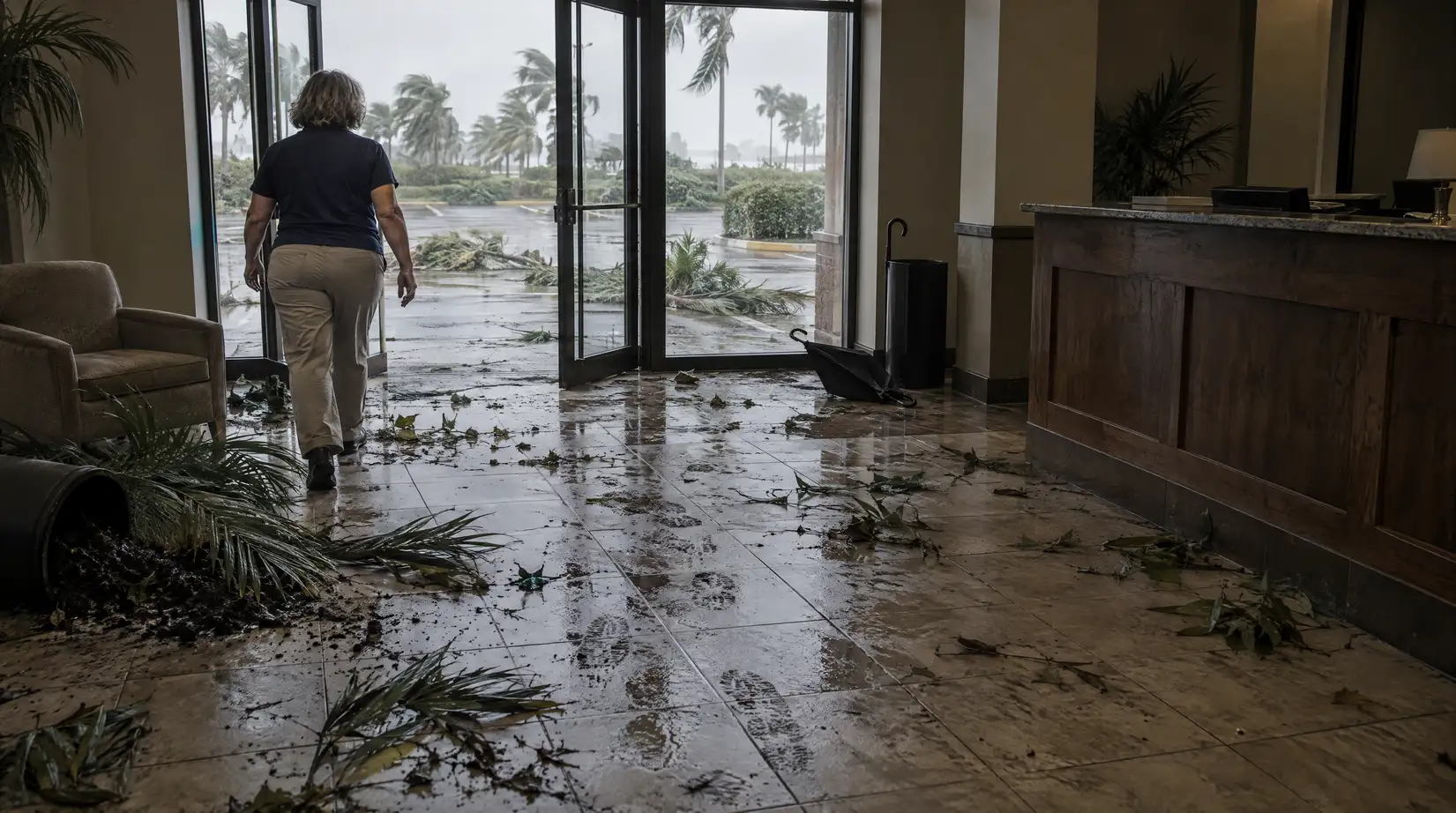
Xactimate Line Items Adjusters Delete: Defend Your Estimate
October 13, 2026
Written by Collin Corcoran
Share


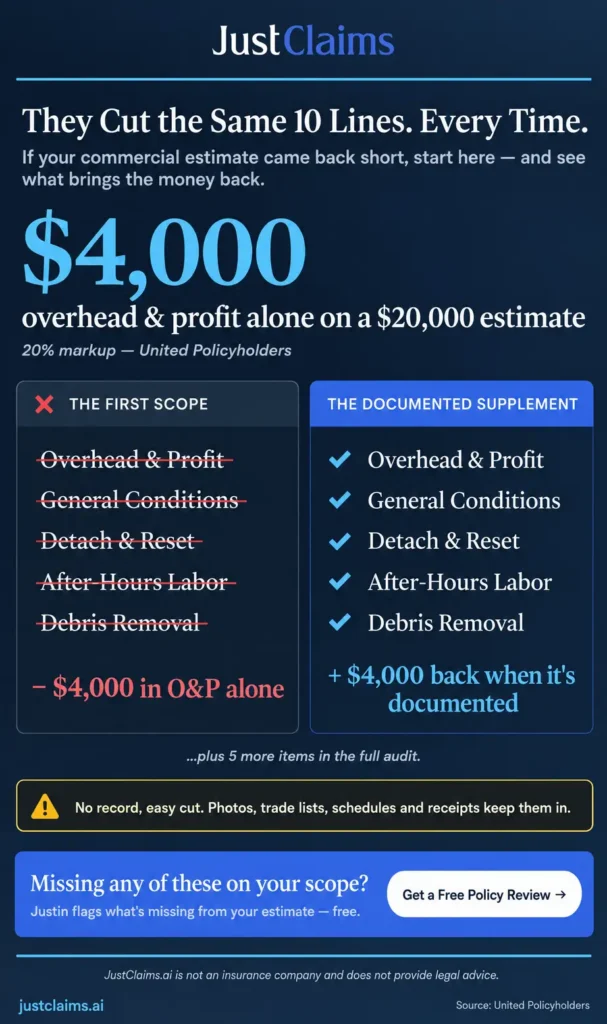
Overhead and profit is generally estimated at 20% of a repair estimate — on a $20,000 roof replacement, that is $4,000. Whether and when it gets paid is one of the most common disputes in property claims, and on commercial scopes O&P is one of several line items that can vanish from a first-round estimate. Documentation, not argument, is usually what keeps them in.
Key Takeaways
- Markup size: Overhead and profit (O&P) is generally estimated at 20% of the total estimate.
- Dollar example: On a $20,000 roof replacement, a 20% O&P markup equals $4,000.
- Trade-count rule of thumb: Adjusters have long treated O&P as owed once three trades are involved in a repair — the point at which carriers typically presume a general contractor is necessary.
- Not the law: The three-trade rule has no binding authority in most states. It is an adjusting convention, not a statute.
- Xactimate behavior: Xactimate does not add general contractor O&P automatically; the estimator enters it manually, built into the line items or itemized at the bottom.
- Case law direction: Courts in Arizona, Florida, and New York have included GC overhead and profit in repair costs — including actual cash value payments — when a GC is reasonably likely to be needed. The rule varies by state and policy language.
Why Commercial Adjusters Delete Xactimate Line Items
Overhead and profit is the clearest example of a line item that gets cut. It is generally estimated at 20% of the total estimate [1], so on a $20,000 roof replacement the markup is worth $4,000.
United Policyholders calls whether and when O&P should be paid “one common problem” in property claims [1]. If O&P is missing from the carrier’s initial scope, recovering it falls to the contractor’s supplement.
The same pattern applies to other line items on commercial scopes. A line item with no supporting record is easy to remove. A line item tied to photos, a trade list, a schedule or a written narrative is harder to remove without a stated reason. The audit below is built around that idea. For each item, ask what record would let a reviewer see why it belongs in the scope.
The 10 Line Items Commercial Adjusters Delete
Because missing records give a reviewer a reason to cut a line, each item below is paired with the documentation that supports it.
1. Overhead and Profit
The long-standing rule of thumb in insurance adjusting is that O&P is owed once three trades are involved in the repair — the point at which carriers typically presume a general contractor is needed to coordinate the work [1].
United Policyholders cautions that the rule has no binding authority in most states, so treat it as a convention to argue from, not a statute to cite [1]. List every trade on the job and explain who coordinates them.
2. General Conditions
Supervision, site management, scheduling and temporary facilities are often treated as already included in unit pricing. Support them with a project schedule, a staffing plan and a short narrative of what coordination the building requires.
3. Detach and Reset
Rooftop units, signage, light fixtures and fixtures-in-place often have to come off before the repair and go back afterward. Photograph each item in place and note the connections that must be disconnected and restored.
4. Masking and Prep
Protecting adjacent surfaces, finished floors and inventory areas is real labor. Show it with before-photos and a note on which surfaces sit next to the work zone.
5. Content Manipulation
Moving and returning furniture, shelving, equipment and stock is easy to overlook in a tenant-occupied space. Record the room-by-room contents and who moved them.
6. After-Hours Labor
Some commercial buildings may require work outside operating hours. Keep the tenant’s written access limits and the crew’s time records so the premium has a stated reason.
7. Temporary Protection
Tarps, barriers and dust containment protect the building while permanent work is pending. Keep dated photos of the installed protection and any related invoices.
8. Access Equipment
Lifts, scaffolding and similar equipment depend on building height and site constraints. Attach site photos and a short explanation of why ladders or hand access would not be practical.
9. Permits and Fees
Permit and inspection costs can be struck as incidental. Keep the jurisdiction’s requirement, the application and the receipt together with the estimate.
10. Debris Removal and Haul-Off
Disposal is frequently reduced or merged into other line items. Document the volume and type of material removed, and keep disposal tickets where available.
Case Law on General Contractor Overhead and Profit
Since a deleted O&P line often becomes a legal-standard argument, it helps to know how courts have treated it. Jurisdictions take different approaches [1], but courts in Arizona, Florida, and New York have each included general contractor overhead and profit in repair or replacement costs when a general contractor is reasonably likely to be needed — including in actual cash value (ACV) payments.
| State | Case | Citation | Year |
|---|---|---|---|
| Arizona | Tritschler v. Allstate Ins. Co. [2] | 213 Ariz. 505 (Ariz. App.) | 2006 |
| Florida (11th Cir.) | Mills v. Foremost Ins. Co. [3] | 511 F.3d 1300 | 2008 |
| New York | Mazzocki v. State Farm Fire & Cas. Co. [4] | 1 A.D.3d 9 (App. Div.) | 2003 |
In Mills, the Eleventh Circuit held that an insurer could not withhold GCO&P simply because the insured had not yet incurred the charge [3]. Tritschler applied the same reasonable-likelihood analysis under Arizona law and sent the case back for further proceedings [2]. Each decision turns on its own policy language and facts — confirm how courts in your state treat the issue before citing any of them to a carrier.
Documentation Standards That Make Deletions Harder
Because deletions tend to follow thin records, the strongest defense is built into the estimate before it is submitted. The steps below cover three separate stages.
Before the Estimate: Capture the Scope
Photograph conditions before work starts, list every trade involved, and record tenant access limits. A trade list is the basis for the O&P argument, so it should exist before the estimate is written [1].
Inside the Estimate: Enter and Explain
Xactimate does not add GC overhead and profit on its own — the estimator enters the O&P percentages under Claim Info > Parameters, and the program then applies them to the estimate [5]. O&P can be built into the line items or itemized at the bottom of the estimate [6].
Pair each non-obvious line with a one- or two-sentence note explaining why it applies. Before submitting, compare your unit pricing against current market data so a pricing objection does not become the stated reason for a cut.
After a Deletion: Supplement Line by Line
When a carrier removes O&P or another item, answer the specific reason given in a line-by-line supplement. Attach the matching records, cite the trade count where it applies, and state which line items you are restoring. A broad rebuttal is easier to dismiss than a line-specific one.
If a line-item dispute survives supplementing, the policy’s appraisal clause is the next contractual step — see the step-by-step appraisal guide for PAs and contractors.
Frequently Asked Questions
How many trades does it take to justify overhead and profit?
Adjusters have long used three trades as the working rule — the point at which carriers typically presume a general contractor is necessary [1]. The rule has no binding authority in most states, so document why a GC is reasonably likely to be needed rather than relying on the trade count alone [1].
Does Xactimate add general contractor overhead and profit on its own?
It does not. The estimator enters the O&P percentages under Claim Info > Parameters, and the program applies them to the estimate [5]. O&P can be spread across the line items or shown as its own entry at the bottom of the estimate [6].
Is the three-trade rule the law?
No. United Policyholders notes that it “does not seem to have any binding authority in most states” [1]. It is a long-standing adjusting convention, so document why a general contractor is reasonably likely to be needed rather than relying on the trade count alone. Courts in Arizona, Florida, and New York have applied that reasonable-likelihood standard [2] [3] [4].
Can I rely on the case law table for my claim?
Treat it as a starting point. Each decision turns on its own policy language and facts, and jurisdictions take different approaches [1], so verify current authority in your jurisdiction before relying on any case.
What to Do Before You Submit Your Estimate
Confirm that O&P has been entered manually and that your trade list supports it [5] [1]. A supplement that answers each stated reason for a deletion is stronger than a general objection. Then get a free commercial policy review from Justin — it reads your policy and flags the coverage terms behind every line item in this audit.
This content is for informational purposes only and does not constitute legal or insurance advice. Coverage decisions depend on the specific terms, conditions, and exclusions of each policy and the laws of the applicable jurisdiction; policyholders and contractors should consult with a qualified professional for advice on their particular situation.
Sources
[1] Payment of Overhead and Profit — United Policyholders
[2] Tritschler v. Allstate Ins. Co., 213 Ariz. 505 (Ariz. App. 2006) — CourtListener
[3] Mills v. Foremost Ins. Co., 511 F.3d 1300 (11th Cir. 2008) — CourtListener
[4] Mazzocki v. State Farm Fire & Cas. Co., 1 A.D.3d 9 (N.Y. App. Div. 2003) — CourtListener
[5] Add O&P in Xactimate Online — Xactware Help (official Xactimate documentation)
[6] Guidelines for Reviewing Adjusters’ and Contractors’ Estimates — United Policyholders

Collin Corcoran

Experienced Public Adjuster and Property Claims Specialist, Collin is licensed in New York (#1603393), New Jersey (#3003700204), and Connecticut (#19820270). With 20+ years of hands-on construction and property damage experience, he specializes in residential and commercial claims, complex loss inspections, policy review, detailed estimating, and strategic negotiation. Collin’s background in construction, asset management, emergency response, and claims documentation allows him to accurately identify damage, understand repair requirements, and advocate effectively for policyholders. He works with homeowners, business owners, contractors, and insurance professionals to move claims forward with clarity, accuracy, and confidence. Collin is committed to transparency, technical precision, strong communication, and securing fair outcomes for policyholders.