Non-Admitted Insurers: Risks & Benefits Guide 2026

October 15, 2026
Written by Collin Corcoran
Share


Surplus lines coverage can place commercial property risks that the standard market declines, but no state guaranty fund will pay claims if a non-admitted insurer becomes insolvent. That moves the work of vetting the carrier and the policy wording onto the buyer.
Key Takeaways
- Guaranty fund status: Guaranty fund coverage is not available for surplus lines policies.
- Governing model law: The NAIC regulates surplus lines through its Non-Admitted Insurance Model Act #870.
- Federal reform: The Nonadmitted and Reinsurance Reform Act took effect in 2011 and limits eligibility rules to the insured’s home state.
- Capital floor: A U.S. surplus lines insurer must hold capital and surplus of at least the greater of the home-state minimum or $15 million.
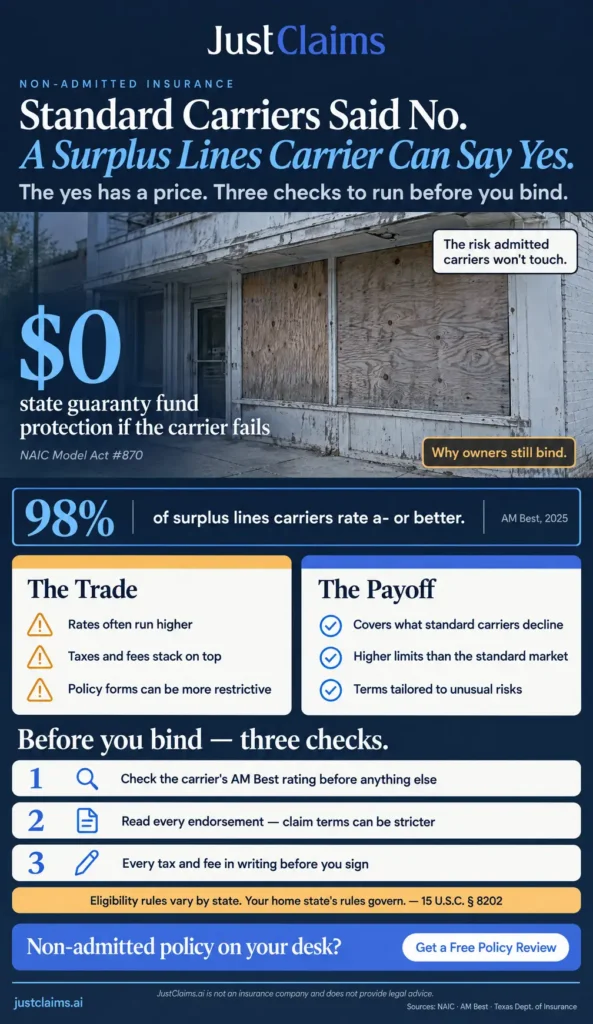
- Rating benchmark: As of mid-year 2024, 98% of surplus lines insurers held AM Best long-term Issuer Credit Ratings of “a-” or higher.
- Market share: Surplus lines made up 12% of U.S. property and casualty direct premiums written in 2024.
Definition and Regulatory Status of Non-Admitted Insurers
What “Non-Admitted” Means
The North Carolina Department of Insurance describes surplus lines coverage as insurance that admitted carriers do not offer but that can legally be placed with eligible non-admitted companies [1]. Only licensed surplus lines brokers can place it. The department also notes that these insurers are unlicensed in the state, which is the meaning of “non-admitted” [1].
How Regulators Oversee the Market
The NAIC says surplus lines insurers are regulated through its Non-Admitted Insurance Model Act #870. U.S.-domiciled insurers are overseen by their domiciliary state, and it is the surplus lines transaction itself that is regulated [2].
Since the Nonadmitted and Reinsurance Reform Act (NRRA) took effect in 2011, a non-admitted placement is subject to the statutory and regulatory requirements solely of the insured’s home state [3], and states cannot impose surplus lines eligibility requirements beyond the standards in the NAIC Model Act or nationwide uniform standards adopted through a compact [4].
Rate and form regulation is minimal: Texas, for example, does not require surplus lines insurers to file rates or policy forms with its insurance department [5].
Admitted vs. Non-Admitted at a Glance
| Feature | Admitted carrier | Non-admitted carrier |
|---|---|---|
| State guaranty fund | Protection exists [2] | Not available [2] |
| Rate and form filing | Must file rates and forms [5] | Generally not required to file [5] |
| Licensing in the state | Licensed [1] | Unlicensed, or “non-admitted” [1] |
Nearly all states require the insured to receive notice that a surplus lines policy is not covered by the state guaranty fund [6]. Read that notice carefully before you bind coverage.
Why Commercial Owners Use the Non-Admitted Market
Because the guaranty fund backstop disappears in this market, the reason to accept that trade-off should be concrete. Surplus lines exist for risks that are difficult to place in the standard insurance market — the exposures admitted carriers decline through normal underwriting [7].
Risk Categories That End Up in Surplus Lines
Oregon’s Division of Financial Regulation groups these risks into three categories [7].
- Distressed risks — properties in high-risk areas, like flood zones, or those with a history of previous claims.
- Unique risks — highly specialized or unusual risks that require unique policy forms or specialized underwriting expertise.
- High-capacity risks — risks that need higher policy limits than admitted insurers typically provide.
For commercial property owners, that typically means buildings in high-risk areas such as flood zones, properties with a history of previous claims, or other exposures standard carriers treat as unusual or high-risk [7][8].
The Diligent Search Requirement
Surplus lines placement is conditioned on a diligent search of the admitted market: an agent must make a diligent effort to find a licensed insurer before selling a surplus lines policy [5].
The exact declination standard varies by state — Oregon’s regulator, for example, allows placement only when coverage is unavailable from at least two admitted insurers [7]. If your broker is placing a property that standard carriers have turned away, ask to see the documented declinations.
Rate and Form Freedom
Surplus lines insurers generally have more freedom than admitted insurers in setting rates and policy wording. Texas, for example, does not require them to file rates and policy forms with its insurance department, and the Texas Department of Insurance cautions that surplus lines policy forms may be more restrictive than the forms it reviews [5]. That freedom supports tailored policies for unique risks that need unique policy forms [7].
Endorsements can change terms in ways that materially affect a claim, so review each one. Coverage also usually costs more: Oregon’s regulator notes surplus lines carriers may charge significantly higher rates [7], and states add taxes and fees on top — Florida’s consumer brochure notes both a premium receipts tax and a service fee on surplus lines policies [8].
Key Risks: Solvency and Taxes
The missing guaranty fund is the central trade-off of this market, and the risks below follow from it.
Insolvency Exposure With No Fund Backstop
Guaranty fund protection exists in the admitted market but not in the surplus lines market. If a non-admitted carrier fails, policyholders have no state fund to cover unpaid claims [2].
The NAIC Model Act requires a notice to buyers that these insurers generally do not participate in state guaranty funds [9], and the NAIC licensing handbook says nearly all states require this warning [6].
Capital and Eligibility Standards
Under the NRRA, a U.S.-domiciled surplus lines insurer must be authorized in its home state for the lines it writes. It must hold capital and surplus of at least the greater of the home-state minimum or $15 million. The insured’s home-state commissioner may reduce or waive that requirement down to $4.5 million [4][9].
Many states also require the insurer to be on an eligibility list — in Texas, for example, a surplus lines insurer must meet certain requirements and appear on TDI’s eligible list [5].
A peer-reviewed study in the NAIC’s Journal of Insurance Regulation found that nearly all surplus lines insurers substantially exceed state minimum capital requirements [10]. Strong capital does not remove the need to check ratings independently.
Premium Tax and Procurement Tax Costs
Under the NRRA, only the insured’s home state may require a premium tax payment on non-admitted insurance, so the home state receives 100% of the tax [11]. NIMA, a former tax-sharing agreement, was dissolved in 2016, and SLIMPACT never became operational [12].
The tax comes on top of the premium: Florida’s consumer brochure notes both a premium receipts tax and a service fee on surplus lines policies [8].
Buy a non-admitted policy independently, without a broker, and you may have to report the transaction and remit the tax yourself — the NRRA contemplates insureds who independently procure insurance filing tax allocation reports with their home state [11], and Florida, for example, requires independently procured transactions to be reported to its Surplus Lines Service Office to account for the tax, service fee and assessments [8]. Build both into your cost comparison with admitted quotes.
How to Verify Financial Strength With A.M. Best Ratings
Since no guaranty fund will step in, carrier stability is the main protection a commercial property owner has in this market.
Know Who Is Writing the Coverage
Surplus lines made up 12% of U.S. property and casualty direct premiums written in 2024. U.S. insurers wrote 75% of that premium, Lloyd’s syndicates 16% and non-U.S. insurers 9% [2]. With a quarter of the market written by Lloyd’s syndicates and other non-U.S. carriers, checking an insurer’s domicile and listing status matters.
The NAIC’s International Insurers Department publishes a Quarterly Listing of Alien Insurers naming the non-U.S. insurers and Lloyd’s syndicates that meet NAIC criteria [2], and the NRRA ties alien-insurer eligibility to that listing [4].
Where to Look Up Ratings
AM Best’s public ratings search lets you look up an insurer by AMB number, NAIC number, FEIN or Alien Insurer ID Number. It shows the Best’s Credit Rating, the outlook and the latest rating action (affirmed, downgraded, under review or withdrawn) [13].
AM Best’s 2025 surplus lines report found that, as of mid-year 2024, 98% of surplus lines insurers held long-term Issuer Credit Ratings of “a-” or higher. AM Best says that is a higher share than the broader property and casualty industry [14]. A carrier below that level is therefore unusual for the segment and worth questioning.
Checklist for Evaluating Carrier Stability
1. Look up the insurer’s Best’s Credit Rating, outlook and latest rating action [13].
2. Compare the rating with the “a-” or higher benchmark that most surplus lines insurers meet [14].
3. Cross-check other agencies, including Fitch, Demotech, Moody’s and S&P [15].
4. Confirm the insurer’s domicile and, for non-U.S. carriers, its presence on the NAIC Quarterly Listing of Alien Insurers [2][4].
5. Confirm that it meets your home state’s eligibility and capital requirements [4][9].
6. Review complaint records with the state insurance department [15].
7. Read the guaranty fund disclosure notice and confirm the broker is licensed for surplus lines [1][6].
8. Review every endorsement for changes to claim terms [5].
9. Ask for a written breakdown of premium tax, procurement tax and fees [8].
Frequently Asked Questions
Is a non-admitted insurer the same as an unlicensed or illegal insurer?
No. Non-admitted means the insurer is not licensed in your state, but it can legally write coverage there through a licensed surplus lines broker. Placement requires a diligent search of the admitted market first, and the insurer must meet your home state’s eligibility requirements [1][5].
What happens if my surplus lines carrier becomes insolvent?
No state guaranty or solvency fund will pay your unpaid losses [1]. The NAIC attributes this to the unique, higher-risk exposures the industry writes [2]. That is why checking the carrier’s financial strength before you bind coverage matters.
Why would a commercial property be placed in the surplus lines market?
Admitted carriers may decline a property because it sits in a high-risk area like a flood zone, has a history of previous claims, or presents an unusual, high-risk exposure [7][8]. Some risks need unique policy forms the admitted market does not offer, and some need higher limits than standard insurers provide [7]. In those cases, a surplus lines policy may be the only available option.
Who pays the surplus lines premium tax?
The tax is charged on top of the premium: Florida’s consumer brochure, for example, notes both a premium receipts tax and a service fee on surplus lines policies [8]. Under the NRRA, only the insured’s home state may require the premium tax payment [11]. For independently procured policies, you may have to report the transaction and remit the tax yourself — Florida requires those transactions to be reported to its Surplus Lines Service Office [8].
Where can I check an insurer’s financial strength?
AM Best’s public ratings search covers insurers by several identifiers and shows the rating, outlook and latest rating action [13]. United Policyholders also recommends checking Fitch, Demotech, Moody’s and S&P, along with complaint records at the state insurance department [15].
What You Should Check Before Binding Coverage
Surplus lines coverage fills real gaps for hard-to-place commercial property, but it comes with no guaranty fund protection, added taxes and policy wording that may be more restrictive than state-reviewed forms [2][5][8]. Work through the stability checklist and compare the declination record, endorsements and tax costs before you bind.
Minor valuation errors can cost millions, and complex claims require forensic-level analysis, particularly where Business Interruption and Law & Ordinance provisions are written on non-standard forms.
If a claim is denied or underpaid, JustClaims’ expert team, accelerated by our bespoke AI, reviews the policy language against your documentation to identify those coverage gaps. Or start now: upload your non-admitted policy to Justin, our free AI commercial property policy review tool, and get a plain-English read on your Business Interruption and Law & Ordinance wording before you respond to the carrier.
This content is for informational purposes only and does not constitute legal or insurance advice. Coverage decisions depend on the specific terms, conditions, and exclusions of each policy and the laws of the applicable jurisdiction; policyholders and contractors should consult with a qualified professional for advice on their particular situation.
Sources
[1] Surplus Lines for Businesses — North Carolina Department of Insurance
[2] Surplus Lines — National Association of Insurance Commissioners
[3] 15 U.S.C. § 8202 — Regulation of Nonadmitted Insurance by Insured’s Home State — GovInfo
[4] 15 U.S.C. § 8204 — Uniform Standards for Surplus Lines Eligibility — GovInfo
[5] Commercial General Liability Insurance (Surplus Lines Insurers) — Texas Department of Insurance
[6] State Licensing Handbook, Chapter 10 — National Association of Insurance Commissioners
[7] Surplus Lines Insurance Facts — Oregon Division of Financial Regulation
[8] Surplus Lines Consumer Brochure — Florida Department of Financial Services
[9] Non-Admitted Insurance Model Act (#870) — National Association of Insurance Commissioners
[10] Regulation and Surplus Lines Activity (Ely & Klein), Journal of Insurance Regulation — NAIC
[11] 15 U.S.C. § 8201 — Reporting, Payment, and Allocation of Premium Taxes — GovInfo
[13] Best’s Credit Ratings Search — AM Best
[14] Improved Underwriting and Operating Results Sustain U.S. Surplus Lines Market Momentum — AM Best
[15] How to Check an Insurer’s Financial Strength — United Policyholders

Collin Corcoran

Experienced Public Adjuster and Property Claims Specialist, Collin is licensed in New York (#1603393), New Jersey (#3003700204), and Connecticut (#19820270). With 20+ years of hands-on construction and property damage experience, he specializes in residential and commercial claims, complex loss inspections, policy review, detailed estimating, and strategic negotiation. Collin’s background in construction, asset management, emergency response, and claims documentation allows him to accurately identify damage, understand repair requirements, and advocate effectively for policyholders. He works with homeowners, business owners, contractors, and insurance professionals to move claims forward with clarity, accuracy, and confidence. Collin is committed to transparency, technical precision, strong communication, and securing fair outcomes for policyholders.