Liberalization Clause: How It Expands Insurance Coverage

October 07, 2026
Written by Taylor Bezek
Share


A liberalization clause extends broadened coverage to an existing policy when the insurer expands its terms without charging additional premium. For commercial property owners, that can mean protection beyond the original wording at no added cost. The benefit depends on the exact trigger language in your policy, which varies by carrier.
Key Takeaways
- What it is: A provision that lets the insurer broaden covered risks without charging the policyholder an additional premium.
- Who it reaches: New York’s insurance regulator describes it as making an insurer’s broadened form changes apply automatically to policies already in force.
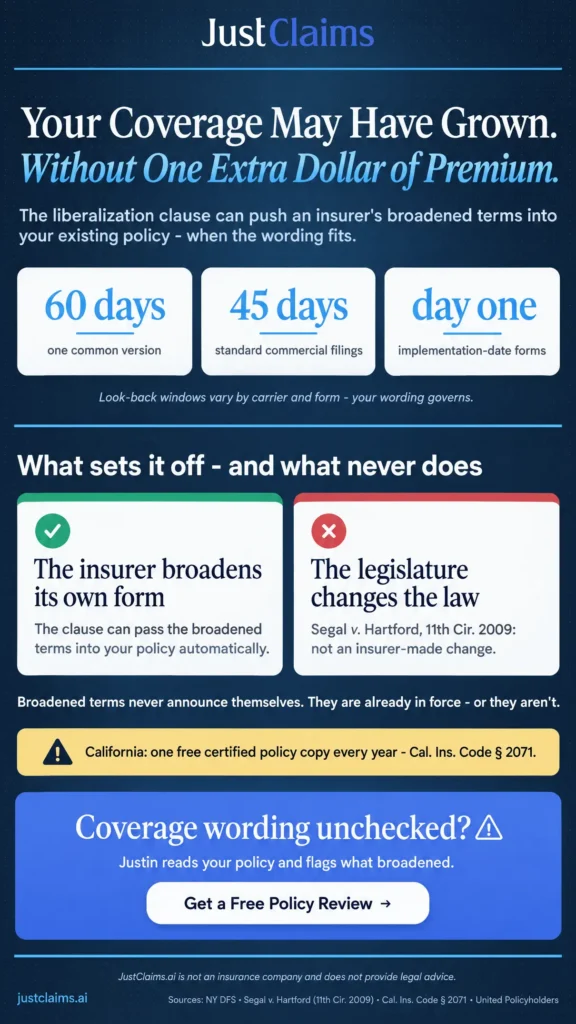
- Look-back window: Common policy versions apply expanded coverage when a revision is adopted within 45 or 60 days before or during the policy period.
- Trigger language: A form litigated in federal court applies a broadening change automatically as of the date the insurer implements it in your state.
- Statutory limit: In Segal v. Hartford, the 11th Circuit held that a change made by the Florida Legislature was not a change the insurer made.
- Verification step: Consumer advocates recommend requesting a complete, certified copy of your policy with all endorsements.
How the Liberalization Clause Works
A liberalization clause is a policy provision under which broadened coverage reaches existing policyholders without a new premium charge [1].
New York’s Department of Financial Services describes it this way: changes an insurer makes to its policy forms for new or renewed policies that broaden coverage, without additional premium charge, automatically apply to policies issued within a set period before the change takes effect [1].
For a commercial property owner, whether your policy contains this clause — and how it is worded — can decide whether newer, broader coverage is already yours when a loss occurs.
The No-Additional-Premium Requirement
The clause is built around a simple exchange: the insurer broadens coverage, and the policyholder does not pay more for it [1]. Because the broadened terms apply automatically, no new policy documents or endorsements are needed for the extension to take effect [1]. For you, that means an improvement in the carrier’s forms can apply to your policy without any action on your part, provided your wording supports it.
Look-Back Windows and Trigger Language
Wording differs from one insurer to the next, so the details matter more than the general concept. One common version quoted by New York’s insurance regulator applies expanded coverage immediately if the insurer adopts a revision that broadens coverage without added premium “within 60 days prior to or during the policy period” [1].
Standard commercial property forms filed in public procurement records shorten that window: “If we adopt any revision that would broaden the coverage under this Coverage Part without additional premium within 45 days prior to or during the policy period, the broadened coverage will immediately apply to this Coverage Part” [2].
A Hartford form at issue in federal court goes further, saying a change broadening coverage under that edition of the policy “will automatically apply to your insurance as of the date we implement the change in your state” [3]. Check the look-back window and trigger language in your own policy rather than assuming any one version applies.
Real-World Examples of Broadened Coverage
Because the clause only helps when the wording fits the change, examples show where it can and cannot add value for a commercial property owner. These scenarios are illustrative, and each depends on the specific policy language.
Updated Form Editions
Suppose your carrier adopts a revised edition of its commercial property form that broadens a coverage grant and does not raise the price. Under clause language like the Hartford wording, that broadened change can apply to your policy as of the date the carrier implements it in your state [3]. In that situation, you may be able to point to the newer form when a loss touches the broadened provision. One grant that newer editions often broaden is debris removal limits, where revised filings commonly raise what the policy will pay.
Legislative Mandates
Statutory changes are less certain. In Segal v. Hartford Insurance Co., decided by the U.S. Court of Appeals for the Eleventh Circuit on June 18, 2009, the court read the clause by its plain language [3].
The clause began “If we make a change,” so a change made by the Florida Legislature — a statutory ban on depreciation holdback under Fla. Stat. § 627.7011(3) — did not count as a change made by the insurer: “The clause unambiguously covers changes made only by Hartford” [3]. The court declined to import the statute into the policy through the liberalization clause [3]. That is a single federal appellate decision applying Florida law, so it illustrates a risk rather than a universal rule.
Benefits for Policyholders
When an insurer’s broadened terms are adopted without added premium, the clause can keep your coverage current in ways a static policy cannot [1]. Three benefits stand out.
- Automatic protection: Broadened coverage can extend to your existing policy without a new purchase [1].
- No manual updates: The broadened coverage applies automatically, so you are not relying on a mid-term endorsement process for the extension to operate [1].
- Stronger position at claim time: If a loss touches a broadened provision, the clause gives you a documented basis to ask whether the newer terms apply.
Limitations of the Clause
The clause is narrower than many property owners assume, so its limits belong in any coverage review. Statutory changes that force broader payouts belong to a different track: what ordinance or law coverage pays is driven by building codes, not by the insurer’s own form revisions.
- Premium dependency: The mechanism is framed around broadening coverage without an additional premium [1]. A change that carries a higher premium falls outside that structure, and you should confirm with your carrier how it treats such changes.
- Insurer-made changes only: If the clause says “If we make a change,” as in Segal, a legislative change may not qualify [3].
- Wording variation: Look-back windows and trigger language differ by carrier — 60 days in one common version, 45 days in standard commercial property filings, and implementation-date triggers in others [1] [2] [3].
- Limited case law here: The Segal ruling is a single federal appellate decision applying Florida law, and other jurisdictions may read similar language differently [3].
How to Verify Whether Your Policy Was Liberalized
Because the clause depends on exact wording, verification is a practical step rather than an afterthought. United Policyholders, a national nonprofit consumer advocate, publishes a sample letter policyholders can use to request “a complete and certified copy” of their policy, including all declarations, endorsements, riders, and changes [4]. For a faster first read of the wording itself, a free AI insurance policy analyzer can walk you through what your forms say. Practical steps:
- Look for the liberalization clause in your policy and note its trigger language and look-back window.
- Ask the carrier for the most recent forms and endorsements, and request a complete, certified copy of the policy with endorsements [4].
- Know your state’s rules: in California, for example, statute entitles an insured to one free complete copy of the policy each year, and to a complete, current copy within 30 calendar days of a request after a covered loss [5].
Frequently Asked Questions
What is a liberalization clause in commercial property insurance?
It is a policy provision that lets coverage grow when the insurer broadens its terms. The extension happens without an added premium for the policyholder, and it applies automatically to policies already in force [1].
Does a liberalization clause cover changes in the law?
Not necessarily. In Segal v. Hartford, the Eleventh Circuit concluded that a Florida statutory change was not a change the insurer made, so the clause did not bring it into the policy [3]. Whether your clause reaches legislative changes turns on its exact wording and your jurisdiction.
How do I find out whether my policy has been liberalized?
Start by locating the clause in your policy and reading its trigger language. Then ask your carrier for its current forms and endorsements, and request a complete, certified copy of your policy with all endorsements [4].
Do all insurers word the clause the same way?
No. One common version looks back 60 days before or during the policy period, standard commercial property filings use 45 days, and another applies a change as of the date the insurer implements it in your state [1] [2] [3]. Compare your own policy language against those patterns instead of relying on a general description.
How to Check Your Policy for Liberalization
Begin with your declarations page and the forms it lists. Then ask your carrier for its current forms and a complete, certified policy copy so you can compare editions [4].
If the clause wording is unclear, the cost of guessing wrong only shows up after a loss. Get a free commercial property insurance policy review from JustClaims’ expert team, accelerated by our bespoke AI — we will review the wording and flag potential Business Interruption and Law & Ordinance coverage gaps before a loss.
This content is for informational purposes only and does not constitute legal or insurance advice. Coverage decisions depend on the specific terms, conditions, and exclusions of each policy and the laws of the applicable jurisdiction; policyholders and contractors should consult with a qualified professional for advice on their particular situation.
Sources
[3] Leon Segal v. Hartford Insurance Company, No. 09-10588 (11th Cir. June 18, 2009) — Justia Law
[4] Sample Letter Requesting Complete Copy of Homeowners Policy — United Policyholders
[5] California Insurance Code § 2071 — California Legislative Information

Taylor Bezek

As the General Manager at JustClaims, Taylor Bezek brings over a decade of experience managing complex residential, commercial, and large-loss claims. A licensed Public Adjuster in TX (#2125659), FL (#W455048), CO (#769172), and 10 additional states, Taylor founded his own firm before joining JustClaims to scale a tech-forward solution for the insured. He is committed to combining industry expertise with AI to enhance speed, clarity, and outcomes for every policyholder. Taylor's mission is to modernize the public adjusting profession and ensure owners get exactly what they are entitled to.