HOA Board Insurance Responsibilities: New Member Guide 2026

October 15, 2026
Written by Taylor Bezek
Share


As a new HOA board member, you help decide who pays when the association’s insurance falls short, and the answer can land on your neighbors’ bills through deductibles, special assessments and coverage gaps. This guide covers what you’re responsible for, from the five core insurance duties to the claims playbook.
Key Takeaways
- Community scale: 78.1 million residents lived in U.S. community associations as of 2025.
- Volunteer base: about 2.55 million board and committee members give 102.6 million hours of volunteer service each year in U.S. community associations.
- D&O limits can decide your protection: California conditions its volunteer-director liability shield on general liability and D&O coverage of at least $500,000 (100 or fewer interests) or $1 million (more than 100).
- Fidelity/crime minimum: Fannie Mae’s Selling Guide sets the baseline at three months of assessments on all units when the association follows its listed financial controls.
- Claim reporting window: Claims-made liability policies cover events reported within the policy’s effective dates, so check your policy’s exact notice terms.
- Review cadence: Colorado’s Division of Insurance tells boards to review the master policy regularly for gaps and adjustments, and tells owners to compare their own policy with it annually.
What HOA Board Members Must Do About Insurance
As a board member, you are responsible for making sure the association carries the coverage its governing documents and state law require. Colorado’s Division of Insurance lists the core tasks: review the master policy regularly to find coverage gaps or needed adjustments, understand how loss assessments and high deductibles affect the HOA and individual homeowners, and communicate changes in the HOA’s insurance responsibilities to homeowners [1].
Directors & officers (D&O) insurance is the policy that safeguards board members against lawsuits related to their duties, subject to its terms and exclusions [1].
Your duty is to manage the community’s insurance, and that goes beyond signing the renewal. Boards choose the policy types, limits and deductibles. In Texas, for example, Property Code §204.010 lets a property owners’ association, acting through its board, buy the insurance and fidelity bonds, including D&O coverage, that the board considers appropriate or necessary [2].
An insurance professional who works with community associations can help you make those choices. The sections below break these duties into steps you can act on.
What You Actually Signed Up For as a Volunteer Director
Because insurance oversight sits at the center of the board’s job, it helps to be clear about what the role is. You likely ran for the board to help your neighbors, not to become a risk manager.
You are far from alone. The Foundation for Community Association Research counts 373,000 community associations and 78.1 million residents in the U.S. as of 2025, with about 2.55 million board and committee members who give 102.6 million hours of volunteer service each year [3].
The role still carries legal weight. Board members owe fiduciary duties: in Florida, for example, HOA officers and directors have a fiduciary relationship to the members the association serves [4]. Some states also limit directors’ personal exposure, with conditions.
Florida Statutes §617.0834 shields officers and directors of nonprofits recognized under IRC §501(c)(3), (c)(4) or (c)(6) from personal liability for money damages over their statements, votes, decisions or failures to act, unless they breached their duties and the breach amounts to a criminal violation, an improper personal benefit, or recklessness, bad faith, malicious purpose or wanton and willful disregard of human rights, safety or property [5].
Whether a statute like that covers your association depends on how it is organized and where it sits, so confirm with a licensed attorney. Insurance is one of the clearest places where those duties show up in practice.
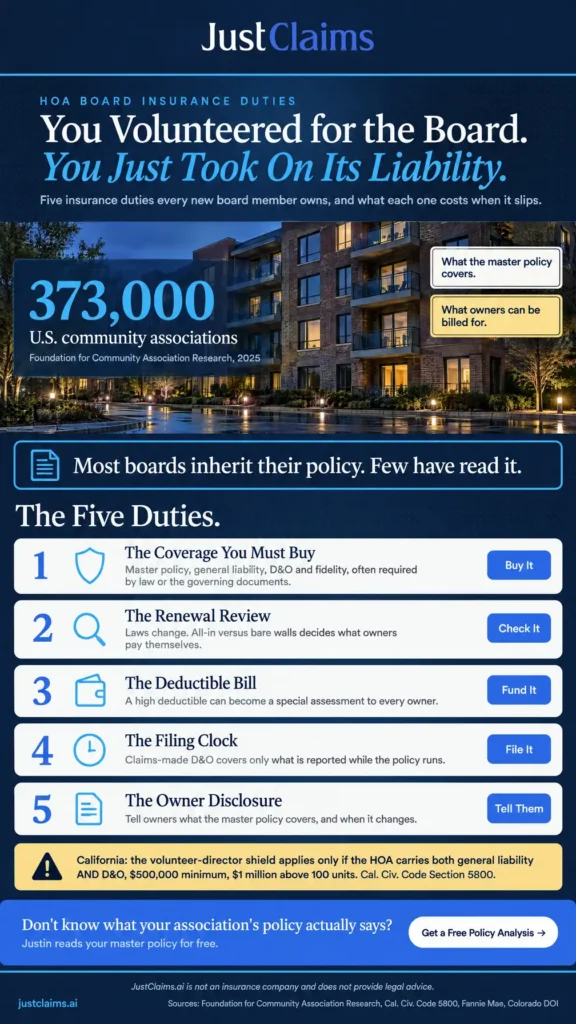
The 5 Insurance Duties Every New Board Member Carries
Because personal and community exposure both flow from how the board handles coverage, these five duties are the practical core of the job.
1. Carry the Required Coverage
Your governing documents and state law shape the minimum. Texas Property Code §204.010(a)(15), for example, lets a property owners’ association in the subdivisions the chapter covers purchase insurance and fidelity bonds, including directors’ and officers’ liability insurance, that its board considers appropriate or necessary [2].
Colorado’s Division of Insurance lists the core HOA policy types as a master policy, general liability, D&O and fidelity (crime) coverage [1]. The board chooses the policy types, limits and deductibles, so ask an insurance professional who knows association risk to walk you through each one.
2. Review the Full Package at Renewal
Look past the premium. Colorado’s Division of Insurance tells boards to review the master policy regularly to find coverage gaps or needed adjustments, and says regular reviews keep the HOA’s insurance in step with current needs and values [1].
Check three things in particular: whether limits track current replacement cost (insured-to-value, the principle meant to prevent underinsurance), whether the policy is “all-in” (covering fixtures within units) or “bare walls-in” (covering only exterior and common areas), and what your CC&Rs say about the extent of coverage [1]. Consider scheduling the review ahead of each renewal so changes can still be made.
3. Know the Deductible and How You’d Fund It
Decide in advance how a major deductible would be paid. The City of Alexandria, Virginia, notes that an association may pay it from the operating account or an operating reserve account, or make a special assessment [6].
Colorado’s Division of Insurance asks boards how well reserves would cover insurance shortfalls or deductibles without special assessments, and notes that homeowners may be responsible for the HOA’s deductible and any overages beyond the master policy’s limits [1]. Deciding before a loss is far easier than deciding during one.
4. Document Damage and File on Time
Set clear procedures for reporting and managing claims before anything happens: who reports, to whom, and how. Notice terms are written into each policy, so read yours now. If your liability policy is claims-made, the NAIC describes it as covering insured events that are reported within the policy’s effective dates, subject to retroactive dates and extended reporting periods [7]. That makes timing part of the coverage itself.
5. Keep Owners Informed
Tell owners what the master policy does and doesn’t cover, and tell them when it changes so they can adjust their own coverage [1]. California’s Davis-Stirling framework, one state-specific model, requires associations to distribute an annual summary of their property, general liability, earthquake, flood and fidelity policies that includes each insurer’s name, the type of insurance, the policy limit and the deductible [8].
Even where no statute applies, the same disclosure helps owners compare their personal policy, such as an HO-6, against the master policy each year, which Colorado’s Division of Insurance recommends [1]. For a closer look at that split, see our guide to master policy vs HO-6.
The Four Policies an Association Typically Carries
Each of these policies protects against a different kind of loss, so a board that understands only one of them may be exposed on the others.
Master Policy
The master policy is the association’s main property policy, funded by the HOA fees owners pay. Colorado’s Division of Insurance says it typically covers common areas and building structures, including roofs and exterior walls, and also provides liability coverage in the common areas.
How much of each unit it reaches depends on the policy type (“all-in” policies cover fixtures within units, while “bare walls-in” policies cover only exterior and common areas) and on the CC&Rs [1]. For coverage types in detail, see our guide to the HOA master insurance policy.
General Liability
General liability protects the association against claims for bodily injury or property damage that occur in common areas [1]. Limits matter: when an HOA charges owners extra for costs the master policy doesn’t cover, Colorado’s Division of Insurance lists deductibles, significant property damage, liability claims and money owed beyond policy limits among them [1]. Check that your limits fit the community, not just the minimum your governing documents require.
Fidelity and Crime
Fidelity/crime coverage addresses dishonest or fraudulent acts by anyone who handles association funds. Fannie Mae’s Selling Guide, which sets standards for loans Fannie Mae buys, requires this coverage whether or not the person is paid, and says the association’s policy must include coverage for the acts of any management agent [9]. A policy held only by the management company does not substitute for one in the HOA’s name [9].
The guide sets the minimum at three months of assessments on all units if the association and its management company adhere to one or more of its listed financial controls: separate working and reserve accounts with bank statements sent directly to the association; a management company that cannot draw checks on or transfer funds from the reserve account; or two board signatures on reserve checks. Otherwise, coverage must equal the maximum funds in the custody of the association or its manager at any time [9]. Your governing documents and state law may require more, so confirm the required amount.
Directors & Officers (D&O)
The NAIC describes D&O as liability coverage protecting directors or officers from liability arising out of the performance of their duties [7]. Colorado’s Division of Insurance lists it separately from general liability and says it safeguards board members against lawsuits related to their duties [1].
Every policy has its own limits, exclusions and defense-cost terms, so ask your broker to walk you through them in writing. D&O can be written on a claims-made basis, which covers insured events reported within the policy’s effective dates, subject to retroactive dates and extended reporting periods, so your policy dates matter [7].
In California, Civil Code §5800 limits a qualifying volunteer director’s personal liability to the coverage of the association’s insurance, but only if the association carries both general liability and officer-and-director liability coverage of at least $500,000 (100 or fewer separate interests) or $1,000,000 (more than 100). That is a state-specific example, so check your own state’s rules [10].
What Happens When a Board Under-Insures or Delays Filing
Since the duties above all lead to the same two failures, thin coverage and late action, this is where boards can pay for their mistakes.
When Coverage Falls Short
In California, a volunteer director’s liability shield depends in part on the association carrying general liability and D&O coverage when the act or omission occurred and when a claim is made, and the statute does not limit the association’s own liability for its negligence or that of its officers and directors [10].
On the property side, when the master policy falls short, owners may be asked to cover the difference. Colorado’s Division of Insurance defines a loss assessment as an extra charge the HOA levies for costs the master policy doesn’t fully cover, such as deductibles, significant property damage, liability claims or money owed beyond policy limits [1]. That is where loss assessment coverage comes in. Named-storm deductibles can be a particular surprise, as covered in our HOA hurricane deductible guide.
When Claims Are Filed Late or Not at All
Notice terms vary by policy, so read the notice clause before you need it. On a claims-made policy, coverage turns on whether the insured event was reported within the policy’s effective dates, subject to retroactive dates and extended reporting periods [7]. California’s volunteer-director shield also requires the coverage to be in force when the act or omission occurred and when a claim is made, so a lapse can matter [10].
Report written threats of legal action and potential claims to your carrier and broker right away, and follow the policy’s notice terms. If a carrier has already denied your association’s claim, see what to do next in HOA insurance claim denied.
A Board’s Claims Playbook
A claim goes better when the board has rehearsed the steps before the loss. Use this sequence as a starting point:
- Secure the property and photograph everything. Record damage before repairs begin, and keep dated records of every contact with the carrier.
- Notify the carrier and broker immediately. Follow your policy’s notice terms for how and when to report.
- Send written threats of legal action to the carrier right away. Include potential claims, not only formal demands.
- Confirm how the deductible will be funded. That means operating funds, reserves, or an assessment, as decided in advance [1][6].
- Tell owners what is covered and what is not. Give them the policy details so they can check their personal coverage [1][8].
- Check claims-made timing. Confirm the policy was in force when the claim was reported [7][10].
- Keep every policy and claim file. Ask your attorney how long your state and your governing documents require you to keep them.
Tools for Boards Reviewing Their Coverage
- How to get an HOA master insurance policy: the steps for obtaining or replacing coverage.
- Justin, JustClaims’ free AI coverage analysis for HOAs: upload your master policy to get its deductible, exclusions and limits summarized.
- The Colorado Division of Insurance HOA insurance toolkit, a government resource for reviewing master policies [1].
Frequently Asked Questions
Can I be personally liable as an HOA board member?
Possibly. Board members owe fiduciary duties: in Florida, for instance, HOA officers and directors have a fiduciary relationship to the members they serve.[4] Many states also limit personal liability for qualifying directors, with conditions. Florida Statutes §617.0834, for example, does not protect a director whose breach of duty amounts to a criminal violation, an improper personal benefit, or recklessness, bad faith, malicious purpose or wanton and willful disregard of human rights, safety or property [5].
California Civil Code §5800 limits a qualifying volunteer director’s liability to the association’s insurance coverage only if the association carries the required minimum coverage.[10] This is educational information, not legal advice, so ask a licensed attorney about your state.
What does D&O insurance cover for volunteer board members?
The NAIC describes D&O as liability coverage protecting directors or officers from liability arising out of the performance of their duties,[7] and Colorado’s Division of Insurance says it safeguards board members against lawsuits related to their duties.[1] Exact coverage, exclusions and defense-cost terms depend on your policy, so ask your broker to explain them in writing. If the policy is claims-made, it covers events reported within the policy’s effective dates, so the policy dates, retroactive date and any extended reporting period matter.[7]
How often should an HOA board review its insurance?
Colorado’s Division of Insurance tells HOAs to review the master policy regularly to find coverage gaps or needed adjustments, and says regular reviews keep the insurance in step with current needs and values. It also recommends that owners compare their personal policy with the master policy annually.[1] Scheduling the board’s review before each renewal gives owners something current to compare against.
How fast must an HOA report an insurance claim?
It depends on the policy. Notice terms are written into each policy, so check yours for its exact reporting requirements. On a claims-made policy, the NAIC says coverage applies to insured events reported within the policy’s effective dates, subject to retroactive dates and extended reporting periods.[7] When in doubt, ask your broker or carrier for the notice terms in writing.
Does the HOA’s master policy replace owners’ personal insurance?
No. Colorado’s Division of Insurance says damage to common areas is typically covered by the master policy, while homeowners are responsible for damage within their units that the master policy does not cover, and may also be responsible for the HOA’s deductible and any overages beyond its policy limits. It advises owners to compare their personal policy with the master policy annually.[1] Telling owners what the master policy covers helps them close the gaps.
What You Should Do Before the Next Loss
Your first big loss will test the questions this guide raises: whether the association carries the right coverage, whether the deductible has a funding plan, and whether the board knows its policy’s notice terms. The time to find out is before a loss. Upload your association’s master policy to Justin for a free HOA insurance policy analysis and get its deductible, exclusions and limits summarized in under 10 minutes.
If a claim has already gone sideways, JustClaims is a licensed public adjusting firm offering HOA insurance claim help with no upfront cost and a fee only if the association recovers. Fee terms are set in your contract and by state law.
This content is for informational purposes only and does not constitute legal or insurance advice. Coverage decisions depend on the specific terms, conditions, and exclusions of each policy and the laws of the applicable jurisdiction; associations, boards and property managers should consult a licensed attorney and a qualified insurance professional about their particular situation.
Sources
[1] Toolkit for Homeowners and HOAs on Insurance — Colorado Division of Insurance
[3] Statistical Review 2025 — Foundation for Community Association Research
[4] Florida Statutes §720.303, Association powers and duties — The Florida Senate
[6] Master Policy v. Personal Insurance, News of Value — City of Alexandria, Virginia
[7] Property & Casualty Product Coding Matrix — National Association of Insurance Commissioners (NAIC)
[8] California Civil Code §5300 — California Legislative Information
[9] Selling Guide B7-4-02, Fidelity/Crime Insurance Requirements for Project Developments — Fannie Mae
[10] California Civil Code §5800 — California Legislative Information

Taylor Bezek

As the General Manager at JustClaims, Taylor Bezek brings over a decade of experience managing complex residential, commercial, and large-loss claims. A licensed Public Adjuster in TX (#2125659), FL (#W455048), CO (#769172), and 10 additional states, Taylor founded his own firm before joining JustClaims to scale a tech-forward solution for the insured. He is committed to combining industry expertise with AI to enhance speed, clarity, and outcomes for every policyholder. Taylor's mission is to modernize the public adjusting profession and ensure owners get exactly what they are entitled to.