Insurance Dropped My Church: What to Do After a Claim (2026)
October 22, 2026
Written by Taylor Bezek
Share


A cancellation does not automatically cancel your claim. If the loss happened while your church’s policy was in force, that policy still governs the claim — even if the insurer ends the policy afterward. What you do in the next few weeks decides whether the claim and your replacement coverage both survive.
Key Takeaways
- Open claims: When coverage is triggered by the date of loss, a loss that happened while the policy was in force is still governed by that policy, even if the insurer cancels afterward.
- Texas: After day 60 of the initial term, a commercial property policy cannot be canceled mid-term except for a short list of specific grounds.
- Maryland: Mid-term cancellation is limited to five grounds, including fraud in presenting a claim.
- Georgia: You have 15 days to ask the Commissioner to review a cancellation, with a 30-day pro rata premium tender — and coverage can stay in force during the review.
- First move: Get the cancellation notice and the stated reason in writing, then calendar every deadline before the effective date.
Is It Legal for an Insurer to Cancel a Church Policy Mid-Term?
Your board is probably asking whether the insurer punished the church for using its policy. Sometimes the insurer is within its rights; sometimes it is not. Either way, the decision has to follow your state’s notice and reason rules, and it does not erase a claim already in progress.
The answer turns on two things: whether the insurer is canceling mid-term or declining to renew, and whether your state limits the grounds for cancellation or only regulates the notice. Texas and Maryland limit the grounds; Virginia and Georgia regulate the notice, the stated reason, and the review rights. That difference decides whether “we filed a claim” can be the reason.
If you sit on the board or manage the facilities, treat the notice as the start of a deadline, not a formality.
Mid-Term Cancellation vs. Non-Renewal
Cancellation ends a policy before its term is complete. Non-renewal ends it at expiration. Texas treats the two differently: the insurer must give 10 days’ written notice before a cancellation takes effect, but 60 days’ notice before a non-renewal [1]. If the non-renewal notice is late, coverage continues until the 61st day after it is delivered or mailed [1].
If your policy is simply not being renewed, see our church insurance non-renewal guide. For the general mechanics of being dropped, see Can an Insurance Company Drop You?.
State Rules Vary Widely
Four states show how differently the rules are written. They illustrate the two models: states that limit the grounds for cancellation, and states that regulate the notice, reason, and review.
| State | Mid-term cancellation rule | Notice / action window |
|---|---|---|
| Texas | No mid-term cancellation on a renewal or continuation policy, and none after day 60 of the initial term, except fraud in obtaining coverage, nonpayment, an increase in hazard within the insured’s control that would produce a rate increase, loss of reinsurance, or supervision, conservatorship, or receivership (§551.052) [1] | 10 days before cancellation; 60 days before non-renewal [1] |
| Maryland | Limited to material misrepresentation or fraud (including in connection with a claim), a public-safety threat, an increased hazard, nonpayment, or license or certificate suspension or revocation (§27-603) [2] | 45 days; 10 days for nonpayment [2] |
| Virginia | Business-entity liability policies: 45 days’ notice, specific reason, and review rights for cancellation, refusal to renew, reduction in coverage, or premium increase (§38.2-231) [3] | 45 days; 15 days for nonpayment [3] |
| Georgia | Notice must explain the right to Commissioner review; a review request requires a 30-day pro rata premium tender (Rule 120-2-53) [4] | Review request within 15 days of receipt [4] |
The reason in the notice has to be specific. Texas requires the precise incident, circumstance, or risk factor and the source of the information the insurer relied on [1]. Virginia requires the specific reason or reasons and notice of the right to request a review [3]. Georgia requires the notice to state any and all reasons in clear, easy-to-understand language [4]. Maryland’s protection works differently: it limits the grounds the insurer may use in the first place [2].
If your state is not listed, ask your insurance department which statute governs commercial cancellation and what notice period applies. One more caveat: in Texas, the cancellation and nonrenewal rules do not apply to surplus lines insurers [5], so confirm with your broker which rules govern your policy.
Why Your Open Claim Usually Survives a Cancellation
The fear is that the claim disappears with the policy. For a loss that happened while coverage was in force, that is usually not what happens.
For occurrence coverage, the trigger is the date of loss, not the date of the claim. TDI explains that an occurrence policy covers claims arising from injury or damage that occurred while the policy was in force, regardless of when the claim is first made [5]. A claims-made policy is different: it covers claims that are reported during the policy period, and claims reported outside that period are not covered unless prior-acts or tail coverage was purchased [5]. If a claims-made policy is not continued, TDI advises buying run-off coverage from the previous insurer or prior-acts coverage from the new one to avoid a gap [5].
For a church, that means two questions for the declarations page: which coverage parts do we hold, and is any liability part written on a claims-made basis? Ask your agent to confirm both in writing, because the answer decides whether a later claim is payable [5].
Immediate Steps After Your Church Is Dropped
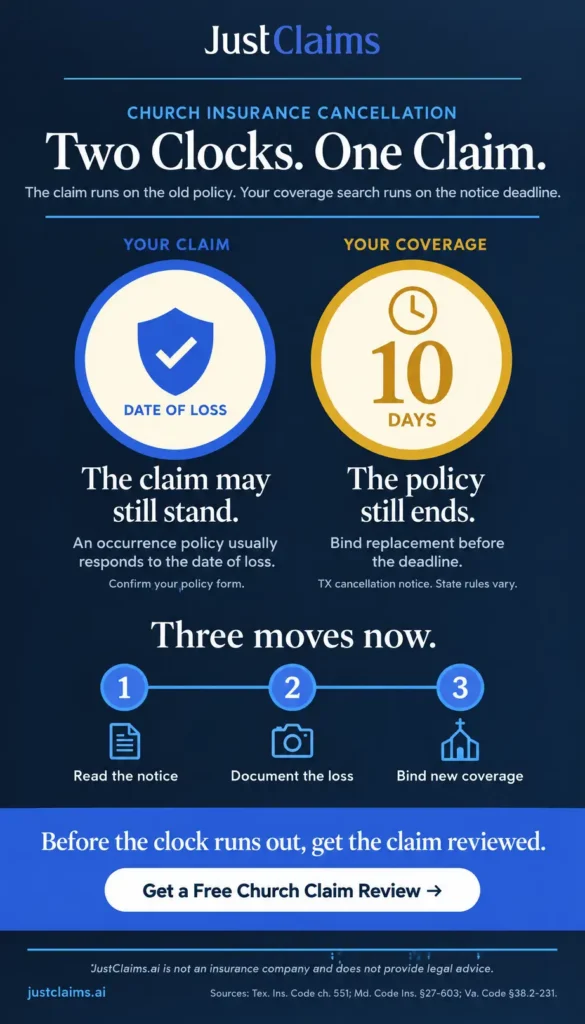
Because the claim usually survives, the next few weeks are about protecting the record and the clock. Three actions matter most.
Get the Cancellation and Its Reason in Writing
Ask for the full notice and the declarations page. Confirm the effective date, the stated reason, and whether that reason is one your state permits [1][2][3]. If the notice does not state a reason, ask the insurer in writing for it and point to the state rule that requires one [1][3][4]. Texas requires the notice to go to the first-named insured at the address on the policy [1] — if the policy is held by a parent body or association, confirm the notice reached the right entity.
Then compare the notice date to the statutory minimum. Texas requires 10 days before a cancellation and 60 days before a non-renewal [1]. Maryland requires 45 days, or 10 days for nonpayment [2]. Virginia requires 45 days for business-entity liability policies, or 15 days for nonpayment [3].
Calendar Every Deadline
Two states give you a formal review window, and one attaches a payment condition:
- Virginia: Within 15 days of receiving the notice, the insured can ask the Commissioner of Insurance in writing to review the action [3].
- Georgia: Within 15 days of receipt, the insured can mail or deliver a written request for review to the Commissioner. The request must state why the cancellation violates O.C.G.A. § 33-24-45, and a 30-day pro rata premium tender must accompany it [4]. Georgia law provides interim coverage while the Commissioner reviews the cancellation; that interim coverage cannot end less than five days after the decision [4]. If the Commissioner finds the cancellation unlawful, the insurer must reinstate or renew the policy [4].
- Texas: The non-renewal clock is 60 days, and a late notice extends coverage to the 61st day after delivery or mailing [1].
Document the Damage and Limit Further Loss
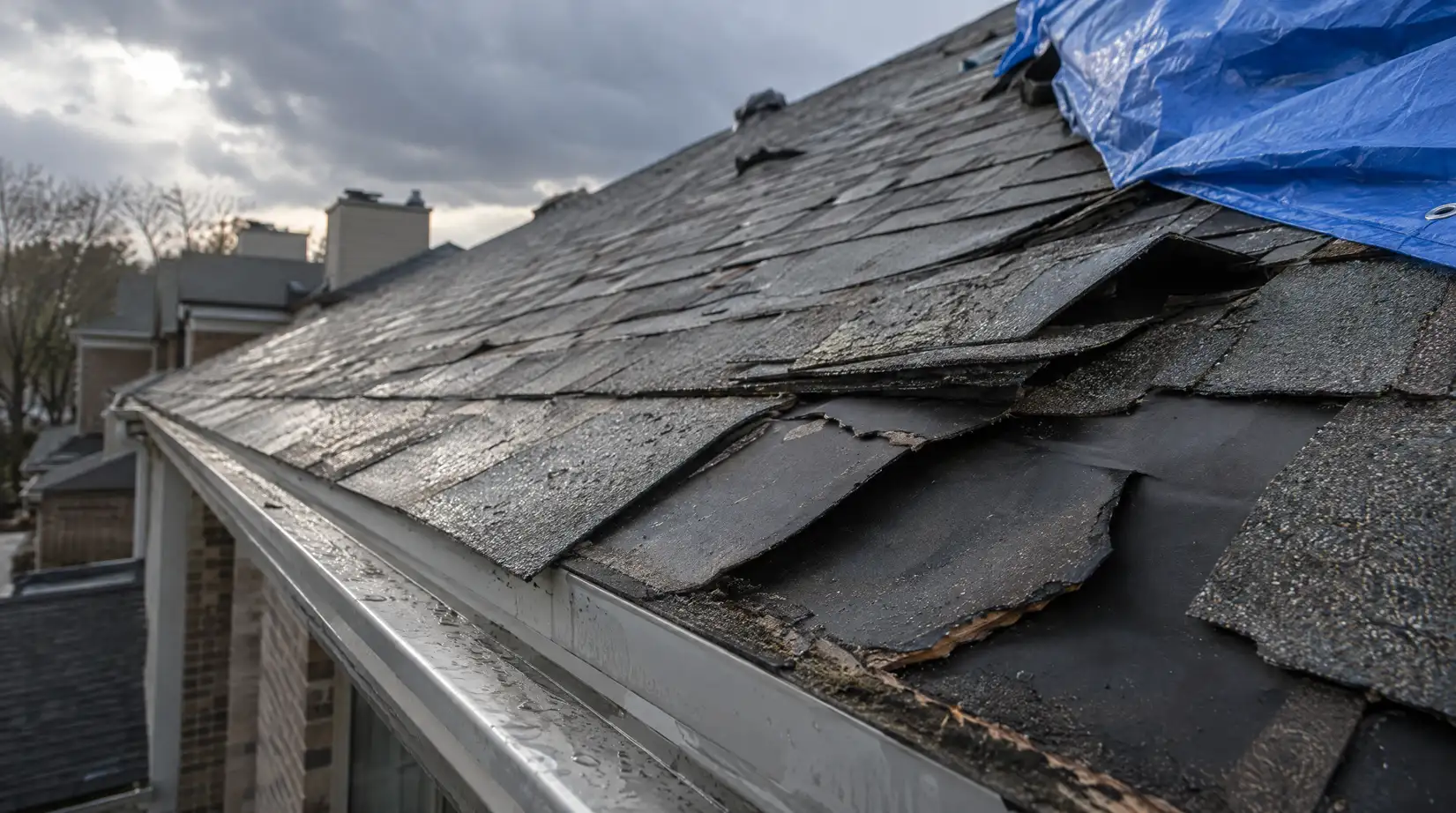
File the claim as soon as you can. TDI’s claim guide says to take photos and videos of all damage, do what is needed to keep the damage from getting worse (such as tarping or temporary repairs), keep receipts for all expenses, and take notes on phone calls [6]. The page is written for home and auto claims; apply the same documentation discipline to a commercial claim.
United Policyholders recommends a claim diary: record names, phone numbers, job titles, and supervisors; set deadlines and enforce them; and confirm agreements in writing [7]. Cooperate with reasonable requests for information, but do not give a recorded or sworn statement until you understand your rights [7]. It also warns against signing any release or waiver until you know your rights, and says your state insurance department can give you the rules that govern claim handling [7]. Its tips are written for households, but the guide adds that if a business was destroyed, the same steps apply — plus business interruption coverage [7].
If the insurer is slow to respond, call your state insurance department and ask which claim-handling rules apply [7].
How a Public Adjuster Can Help Keep the Claim Moving
If the carrier is slow to settle the open claim, a public adjuster is one option for keeping it moving. Pennsylvania’s Insurance Department explains that a public adjuster is hired by the policyholder, not the insurer, to negotiate the claim, and that you are not required to hire one for the insurer to pay [8]. The department says the adjuster can read the policy to determine what is covered, determine how long repairs will take and what they will cost, and negotiate the settlement [8]. The policyholder pays the adjuster, usually a percentage of the total claim under a signed contract [8].
Pennsylvania also sets conduct rules: the adjuster may not begin work without a signed contract, and must report every settlement offer to the insured in writing within 5 business days [8]. Texas caps the fee at 10% of the amount the insurer pays, bars the adjuster from acting as your contractor, and gives you 72 hours after signing to cancel the contract [9]. Both pages are written around homeowners claims, so treat them as examples and confirm your own state’s rules.
Ask three questions before signing:
- Is the adjuster licensed in my state? [8][9]
- Is the fee stated as a dollar amount or a percentage of the total claim? [8][9]
- If the offer does not improve, do I still owe the fee? [9]
If the dispute is only about the amount of the loss, ask whether the policy has an appraisal provision.
Finding Replacement Coverage After Cancellation
The claim stays with the old carrier. Ongoing coverage is a separate problem, and the clock is already running.
- Start with your current agent. California’s commercial guide says a broker-agent will review your current policy and compare limits, exposures, classifications, exclusions, and endorsements to find gaps [10]. Verify the license with the state before you rely on the advice [10].
- Get quotes from more than one. Any one agent may represent a limited number of companies, so the guide says it is reasonable to approach several [10].
- Ask about surplus lines. Washington’s Office of the Insurance Commissioner says surplus line insurance is used when other insurers will not offer coverage because the risk is high, uncommon, or outside their guidelines [11]. In California, it can only be accessed through a specially licensed surplus line broker, who must give a disclosure notice before the sale, and the state guaranty association does not apply [10]. In Texas, the cancellation and nonrenewal rules do not apply to surplus lines insurers, and the guaranty association does not protect them [5].
- Ask about state programs. California’s FAIR Plan writes a small percentage of commercial property policies, and any broker-agent can help place one [10].
- Move now, not at expiration. The notice windows are the runway: 60 days in Texas, 45 in Maryland, 45 in Virginia [1][2][3]. Do not let the old policy lapse before replacement coverage is bound in writing.
Frequently Asked Questions
Can an insurance company drop a church after a claim?
In many states, yes at renewal, if the insurer follows the notice rules. Mid-term cancellation is narrower in some states. Texas bars mid-term cancellation after day 60 except for a short list of grounds, and requires 60 days’ notice and a stated reason before a non-renewal [1]. Maryland limits mid-term cancellation to five grounds and requires 45 days’ notice [2]. A claim itself is not a listed mid-term ground in Texas; Maryland lists fraud in connection with the presentation of a claim [1][2].
Does my open claim end if my church’s policy is canceled?
Usually not, if the loss occurred while the policy was in force. TDI explains that occurrence coverage responds to claims arising from injury or damage that occurred during the policy period, regardless of when the claim is first made [5]. Claims-made coverage is different and depends on reporting during the policy period or on tail coverage [5]. Confirm which form you hold.
Do I need a public adjuster for my church’s claim?
No. Pennsylvania’s Insurance Department states that hiring one is not required for the insurer to pay [8]. An adjuster can help with documentation and negotiation, and is paid by the policyholder, usually a percentage of the claim [8]. Texas caps the fee at 10% of what the insurer pays [9].
How quickly should my church look for replacement coverage?
Start the day the notice arrives. The statutory notice windows give you a fixed runway: 60 days in Texas, 45 in Maryland, and 45 in Virginia for business-entity liability policies [1][2][3]. If standard carriers decline, ask a broker whether surplus lines is an option [11].
How to Protect Your Church’s Open Claim
A cancellation does not automatically cancel your claim, but it does start a clock. Secure the written notice and the stated reason, calendar every deadline, document the damage, keep the claim diary, and line up replacement coverage through a licensed broker before the old policy expires. Keep every agreement in writing.
If you want the claim reviewed before the notice period runs out, get a free church insurance claim review from JustClaims. To see what your policy says about cancellation, occurrence coverage, and your duties after a loss, upload your church’s policy for a free AI coverage analysis.
This content is for informational purposes only and does not constitute legal or insurance advice. Coverage decisions depend on the specific terms, conditions, and exclusions of each policy and the laws of the applicable jurisdiction; policyholders and contractors should consult with a qualified professional for advice on their particular situation.
Sources
[2] Maryland Insurance Code §27-603 — Cancellation of Commercial Insurance — Maryland General Assembly
[4] Georgia Rule 120-2-53 — Cancellation and Nonrenewal Regulation — Georgia Secretary of State
[5] Commercial General Liability Insurance — Texas Department of Insurance
[6] Steps to Getting Your Home or Car Insurance Claim Paid — Texas Department of Insurance
[7] General Claim Tips — United Policyholders
[8] Hiring a Public Adjuster — Pennsylvania Insurance Department
[10] Commercial Insurance Guide (Form 700, revised June 14, 2024) — California Department of Insurance
[11] Surplus Line Insurance — Washington Office of the Insurance Commissioner

Taylor Bezek

As the General Manager at JustClaims, Taylor Bezek brings over a decade of experience managing complex residential, commercial, and large-loss claims. A licensed Public Adjuster in TX (#2125659), FL (#W455048), CO (#769172), and 10 additional states, Taylor founded his own firm before joining JustClaims to scale a tech-forward solution for the insured. He is committed to combining industry expertise with AI to enhance speed, clarity, and outcomes for every policyholder. Taylor's mission is to modernize the public adjusting profession and ensure owners get exactly what they are entitled to.