Blanket vs Scheduled Coverage: Key Differences 2026
October 21, 2026
Written by Stephane Elias
Share


A blanket limit of $5 million spread across three buildings could pay the full amount on a loss at just one of them, while a scheduled limit caps the same loss at the figure listed for the damaged building. For property owners, contractors, and property managers, that structural difference can determine how much a claim recovers. Knowing which structure sits in the policy before a loss is a core part of managing risk.
Key Takeaways
- Blanket structure: A single limit of insurance applies across multiple properties or categories of property.
- Scheduled structure: Separate limits are assigned to each insured item or location.
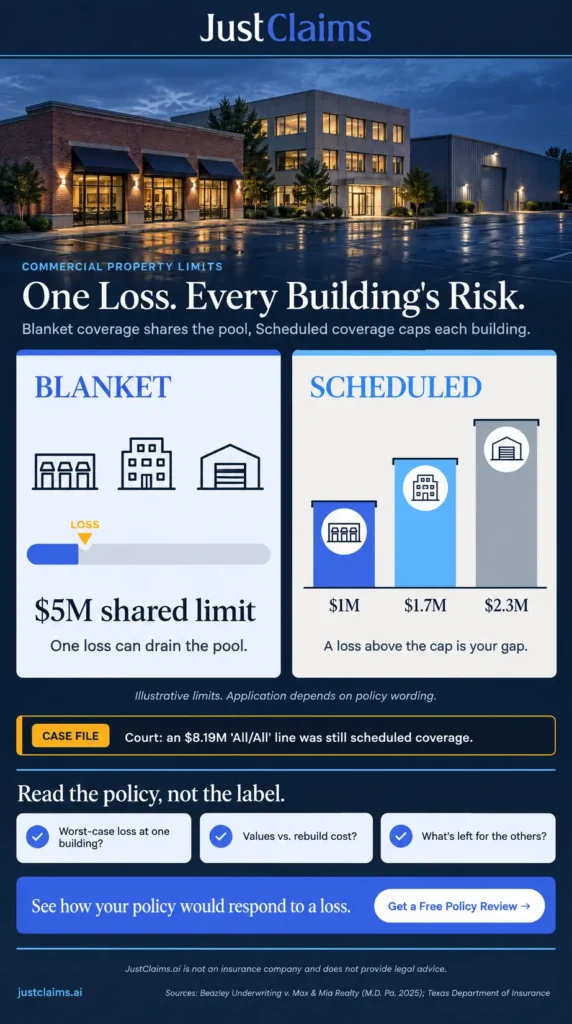
- Blanket example: A $5 million blanket limit over three buildings could apply in full to a loss at one building.
- Scheduled example: A building listed at $1 million is paid no more than that amount on a total loss.
- Exhaustion risk: One severe loss can use up a shared blanket limit, leaving less for other locations.
- Pricing: Compare quotes on the same statement of values, because a cheaper policy may provide less coverage.
- Documentation risk: A federal court in Pennsylvania held that a policy provided scheduled coverage even though its declarations page showed a single $8,190,598 “All/All” limit.
How Blanket and Scheduled Limits Work
Both structures protect commercial property, but they divide the policy limit in very different ways. That division determines what a claim pays after a loss. Policies can also include coinsurance terms that reduce a payout below the stated limit [1].
Blanket Coverage: One Limit Across Many Assets
A blanket policy applies a single limit of insurance across multiple properties or categories of property [1]. Picture a $5 million blanket limit covering three buildings. A loss at one building could draw on the whole amount, even if the other two are untouched [1].
That is the defining feature of blanket coverage: the property is insured collectively, without a distribution of the limit to each item [1]. The policy wording, not the label on the declarations page, controls how the limit responds.
Scheduled Coverage: Itemized Limits for Each Asset
A scheduled policy assigns a separate limit to each insured item or location [1]. If Building A is listed at $1 million and suffers a total loss, the most the policy will pay is that listed amount. This holds even when unused capacity remains at other locations [1].
Pros and Cons of Each Structure
Because the central question is how a limit actually responds after a loss, the strengths and weaknesses of each structure follow from the mechanics above.
Blanket Coverage: Advantages and Drawbacks
The main advantage is flexibility. One shared limit can absorb a severe loss at a single location, because the full limit may apply to that one building [1]. For a contractor whose property values shift over time, a shared limit can reduce the risk that a single listed number falls short.
The drawbacks are price uncertainty, documentation, and the risk of exhaustion. A severe loss at one location can consume the shared limit and leave less for the others [1], and what a blanket limit covers still turns on the issued policy language — not the declarations label [1].
Scheduled Coverage: Advantages and Drawbacks
The main advantage is clarity. Each item or location carries its own stated limit, so a property owner can see the maximum recovery for each asset before a loss happens [1].
The drawback is rigidity. A total loss at a building is capped at its listed limit, regardless of coverage left unused elsewhere [1]. If a listed value has fallen behind the real cost of replacement, the shortfall falls on the policyholder [1].
Premium and Limit Trade-offs
Because the limit structure shapes both premium and recovery, price should be weighed against how a loss would actually play out. Coverage and rates vary by company, so compare quotes on the same statement of values [2].
The Texas Department of Insurance also advises comparing policies with similar coverage, because a cheaper policy might provide less coverage [2]. Owners and contractors comparing quotes should treat the premium difference as one input, not the deciding factor. A lower-cost scheduled policy can leave a gap if one asset is undervalued [1], while a blanket limit can respond to a concentrated loss with the full shared amount [1].
A useful comparison asks three questions:
- What is the highest plausible loss at any single location?
- Does the scheduled limit for that location cover it?
- Is the added blanket premium smaller than the potential shortfall?
Claim Scenarios: Where the Structure Decides the Payout
Claim disputes often come down to the limit structure, which is why the same loss can produce very different outcomes under each approach.
A Total Loss at One Building Under a Blanket Limit
With a $5 million blanket limit across three buildings, a total loss at one building could be paid up to the full shared limit while the other two remain undamaged, leaving nothing for those locations if the limit is exhausted [1]. The shared pool is what makes this outcome possible.
A Total Loss at One Building Under a Scheduled Limit
Under a scheduled policy, the same loss pays no more than the limit listed for that building. At a $1 million listing, that is the ceiling, even when the policyholder has unused capacity at other locations [1].
When the Declarations Page and the Policy Disagree
In Beazley Underwriting, Ltd. v. Max & Mia Realty, LLC, a federal court in Pennsylvania held that the policy unambiguously provided scheduled rather than blanket coverage, even though the declarations page showed a single $8,190,598 “All/All” limit that the insured read as blanket coverage [1]. The building was listed at $3,413,330 in the statement of values, while the insured argued the policy entitled it to $7,770,598 [1].
The lesson for property owners and contractors is practical. Compare the declarations and the limit endorsements line by line before the policy takes effect. A large total limit on the declarations page may not control the outcome if a scheduled limit endorsement says something different [1].
Choosing Based on Asset Value and Mobility
The right structure depends on how the business actually holds property, so the choice should follow the asset profile rather than the premium alone.
- Concentrated, high-value assets: A location whose replacement cost could exceed its listed value may benefit from a shared blanket limit, since the full limit could apply to a loss there [1].
- Stable, well-valued assets: Property with predictable values may suit scheduled limits, which state the maximum for each item [1].
- Assets that move between sites: Mobile property complicates itemized listing, because each item or location needs its own stated limit under a schedule [1]. Contractor equipment and property in transit are often insured separately under inland marine coverage, so confirm which policy responds before a loss [2].
Whichever structure is chosen, ask the broker to confirm in writing how the limit applies at each location.
Frequently Asked Questions
What is the main difference between blanket and scheduled property coverage?
A blanket policy pools one limit across several properties or categories of property. A scheduled policy gives each insured item or location its own separate limit [1]. The practical result is that a blanket limit can concentrate on one loss, while a scheduled limit stops at the amount listed for the damaged asset.
Is blanket coverage more expensive than scheduled coverage?
Not necessarily. Coverage and rates vary by company. The Texas Department of Insurance advises comparing policies with similar coverage, because a cheaper policy might provide less coverage [2]. Ask your broker to quote both structures on the same statement of values, then weigh the premium against the highest plausible loss at any one location [1].
Can a policy with a large “All/All” limit still be scheduled coverage?
Yes. In Beazley Underwriting, Ltd. v. Max & Mia Realty, LLC, a federal court in Pennsylvania found that the policy provided scheduled coverage even though the declarations page showed a single $8,190,598 “All/All” limit [1]. The scheduled limit endorsement and the statement of values controlled, so the issued wording is what counts.
How does a blanket limit get applied across locations?
A blanket limit provides a total amount for the covered properties, and a loss at one location can draw on the whole amount — potentially exhausting what remains for the others [1]. The exact application depends on the policy language, so property owners should confirm it with the broker before binding coverage.
What You Should Confirm Before Binding Coverage
Blanket and scheduled structures differ in how limits are shared and how clearly they state the maximum recovery for each asset [1]. The Beazley ruling shows that the issued policy controls, so owners, contractors, and property managers who treat the final declarations as the source of truth protect their position before a loss.
Before signing, compare what you were quoted with the issued policy, confirm how the limit is applied at each location, and match each listed value to realistic replacement cost [2]. Run a free commercial property policy review with Justin to see how your limit structure was written and flag any gap between what was quoted and what the policy says.
This content is for informational purposes only and does not constitute legal or insurance advice. Coverage decisions depend on the specific terms, conditions, and exclusions of each policy and the laws of the applicable jurisdiction; policyholders and contractors should consult with a qualified professional for advice on their particular situation.
Sources
[2] Commercial Property Insurance Guide (updated Dec. 9, 2025) — Texas Department of Insurance

Stephane Elias

A seasoned insurance professional with nearly a decade of experience, Stephane Elias is currently serving as a Senior Claims Professional and Public Adjuster with JustClaims. Throughout his career, Stephane has represented policyholders through leading public adjusting firms and served as a loss consultant for law firms specializing in insurance litigation, giving him extensive expertise in complex property insurance claims. A licensed public adjuster in TX (#2645032), FL (#W564547), and six other states, he specializes in commercial and residential property claims, claims management, appraisals, mediation, and strategic partnerships. Stephane is passionate about helping policyholders overcome delayed, denied, and underpaid insurance claims, ensuring they receive the full recovery they’re entitled to under their policy.