Apartment Building Insurance: Coverage & Policy 2026
October 21, 2026
Written by Taylor Bezek
Share


Apartment building insurance coverage is only as good as the paperwork behind it: the valuation clause in the policy, the coinsurance percentage on the declarations page, and the invoices that prove what the repair actually cost. Owners who understand those three pieces before a loss can spot a shortfall while the claim is still open.
Key Takeaways
- Valuation method: Commercial property policies pay on actual cash value (ACV), replacement cost (RCV), or a combination of both.
- ACV: Pays replacement cost minus depreciation, so the check can fall short of the repair bill.
- RCV: Pays current repair costs with materials of like kind and quality, without deducting for depreciation.
- Coinsurance: Compares the limit you bought with the value of the building at the time of loss; a shortfall reduces the payment proportionally.
- Code upgrades: Replacement cost does not automatically pay the extra cost of rebuilding to current codes; ordinance or law coverage does.
- Documentation: When a policy withholds replacement cost, the difference is generally released after the work is done and the costs are documented.
What an Apartment Building Policy Typically Covers
Commercial property insurance pays to repair or replace the building and business property damaged by a fire, storm, or other covered event, and it can pay some of the income lost while the property cannot be used [1].
For an apartment building, the property section generally starts with the structure and completed additions listed on the declarations page, plus permanently installed fixtures, machinery, and equipment. It can also cover business personal property — furniture, equipment, inventory, and similar property used to operate the building — and personal property of others in the owner’s care, custody, or control [2].
Apartment policies can also pair property coverage with liability coverage and time-element coverage. Time-element coverage includes business interruption, extra expense, and loss of rents and rental value; loss of rents covers rental income lost when damage makes the building unfit for occupancy [2]. California’s guide notes that a business owners policy, which combines property, general liability, and business interruption, is written with size limits and may fit low-density apartment houses [2].
Two gaps deserve attention before a loss. First, most commercial property policies do not cover flooding; a separate flood policy is required, and there is typically a 30-day waiting period before it takes effect [1]. Second, replacement cost coverage does not automatically pay the extra cost of rebuilding to current building codes. That gap usually requires a separate endorsement or coverage form.
Ordinance or Law Coverage
Ordinance or law coverage is typically written as a separate coverage form or endorsement that pays increased construction or repair costs to meet current building codes [1]. California’s guide divides it into three parts: Coverage A for the undamaged portion of the building that must be demolished, Coverage B for demolition costs, and Coverage C for increased construction costs. Replacement cost coverage must be in effect for Coverage C to apply [2].
ACV vs. RCV: How Apartment Building Policies Define Payout Value
Two policies on similar buildings can produce very different checks after the same storm. The difference can come down to the valuation method printed in the policy and the limits the owner chose at renewal.
Actual Cash Value
Actual cash value coverage pays replacement cost minus depreciation. Depreciation is the decrease in value caused by wear and tear or age. NAIC explains that ACV coverage pays for the loss but often does not pay enough to fully repair the damage or replace the property [3]. Texas’s commercial property guide puts the same point plainly: an ACV policy might not pay enough to fully rebuild the building [1].
Replacement Cost Value
Replacement cost coverage pays to repair or replace damaged property at current costs, with materials of like kind and quality [1][3]. Maine’s insurance guide adds that replacement cost is calculated without deducting anything for depreciation [4]. A policy may provide replacement cost, actual cash value, or a combination of both [1]. On older apartment buildings, years of depreciation can pull an ACV payment far below the cost of current construction. Replacement cost is not unlimited, though: California’s guide notes that replacement cost remains subject to coinsurance [2].
Why Coinsurance Can Reduce an Apartment Building Payout
In property insurance, coinsurance is the minimum share of a building’s value the owner is expected to insure — not a copay on each claim. California’s commercial guide warns that a building not insured to value can be subject to a monetary penalty at the time of loss — commonly called coinsurance [2]. Replacement cost coverage does not avoid the test; it is subject to coinsurance as well [2].
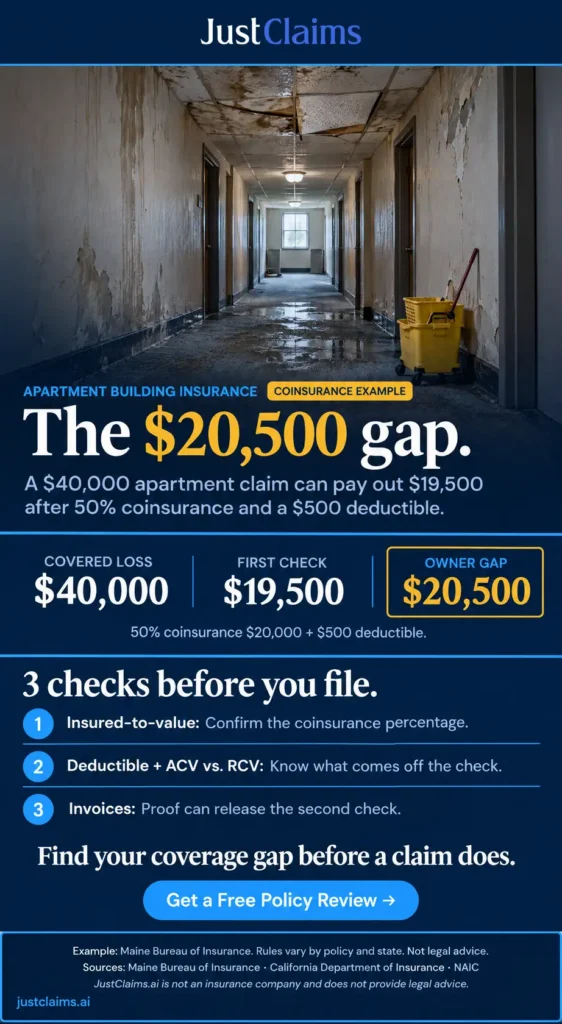
Maine’s guide walks through the math. Divide the amount of insurance carried (HAVE) by the amount that should have been carried (SHOULD), then multiply that percentage by the loss [4]. In the guide’s inadequate-insurance example, a building costs $250,000 to replace and the policy requires 80% coinsurance, so the owner should carry $200,000. The owner carries $100,000, or 50% of the required amount. A $40,000 loss is paid at 50%, or $20,000, minus the $500 deductible — $19,500 [4]. The owner absorbs the remaining $20,500.
Agreed value is another option. California’s guide explains that agreed value waives the coinsurance penalty and pays 100% of the stated amount for a covered loss [2]. For a contractor-facing walkthrough of insurance-to-value and coinsurance exposure, see Is your client’s property insured to full replacement cost?.
How Contractor Invoices Shape the Replacement Cost Payment
Replacement cost can be released in two stages. Under California’s claim-handling rules for residential and commercial policies, when the policy makes full replacement cost conditional on repairing or replacing the property, the insurer pays actual cash value first — then the difference between the ACV payment and the full replacement cost reasonably paid, up to the policy limits [5].
That two-stage structure is why itemized invoices and proof of payment matter: they establish the replacement cost that was reasonably paid, and therefore the size of the second payment. Your policy’s loss conditions — and any state claim-handling rules that apply to it — control the release mechanism.
Ask the adjuster, in writing, what deadline applies to the second payment and what documentation the insurer requires. The policy’s loss conditions control those details, not a verbal summary.
Policy Checks Before You Submit a Repair Estimate
Before an estimate goes to the carrier, owners, property managers, investors, and their contractors can work through a short policy review:
- What valuation method applies? Confirm whether the declarations page shows ACV, replacement cost, or agreed value [2].
- What coinsurance percentage applies, and to what value? The test uses the cost to repair or replace the building at the time of loss, not its purchase price [2][4].
- Is ordinance or law coverage included? Replacement cost alone does not pay code-upgrade costs [1][2].
- Does the policy include loss of rents? Confirm the limit and how long it runs [2].
- Is flood excluded? Most commercial property policies exclude flood, and a separate policy may have a 30-day waiting period [1].
- What documentation releases any withheld replacement cost? If the policy pays ACV first, the second payment is based on the replacement cost reasonably paid, so expect to document completed work and payment [5].
Keeping dated, itemized records of scope, materials, and labor also protects the owner’s position if a carrier questions a line item later.
Frequently Asked Questions
What is the difference between ACV and RCV on an apartment building claim?
ACV pays replacement cost minus depreciation for age and wear. RCV pays to repair or replace with materials of like kind and quality at current costs, without deducting for depreciation [1][3][4]. Because depreciation comes out under ACV, that payment can leave a gap against the real cost of the work [3].
Does the insurer pay replacement cost all at once?
Not always. Where the policy makes full replacement cost conditional on repair or replacement, California’s claim-handling rules require the insurer to pay ACV first and the difference afterward [5]. Ask the adjuster what deadline and documentation apply to that second payment.
Does replacement cost coverage pay for code upgrades?
Not automatically. Ordinance or law coverage pays increased construction or repair costs to meet current building codes; replacement cost coverage alone does not [1][2].
Why do contractor invoices matter for the claim?
If the policy withholds part of the replacement cost, that second payment is based on the full replacement cost reasonably paid [5]. Itemized invoices and proof of payment are what document that figure.
Can the policy wording change how the claim is paid?
Yes. Agreed value, the coinsurance percentage, and endorsements can change the calculation [2][4]. The declarations page and attached forms control over any general summary.
How You Can Document Your Full Claim Value
A claim file that separates ACV from replacement cost — and supports both figures with records — makes the calculation easier to verify line by line. Start with the declarations page, confirm the valuation method and coinsurance percentage, and keep itemized invoices for every repair [2][5].
Upload your apartment building policy to Justin for a free coverage review to see how your policy’s ACV, replacement cost, coinsurance, and ordinance or law terms may leave a gap.
This content is for informational purposes only and does not constitute legal or insurance advice. Coverage decisions depend on the specific terms, conditions, and exclusions of each policy and the laws of the applicable jurisdiction; policyholders and contractors should consult with a qualified professional for advice on their particular situation.
Sources
[1] Commercial Property Insurance Guide — Texas Department of Insurance
[2] Commercial Insurance Guide (Form 700) — California Department of Insurance
[3] What’s the Difference Between Actual Cash Value Coverage and Replacement Cost Coverage? — NAIC
[4] Insuring Your Business… The Basics of Property & Liability Coverage — Maine Bureau of Insurance

Taylor Bezek

As the General Manager at JustClaims, Taylor Bezek brings over a decade of experience managing complex residential, commercial, and large-loss claims. A licensed Public Adjuster in TX (#2125659), FL (#W455048), CO (#769172), and 10 additional states, Taylor founded his own firm before joining JustClaims to scale a tech-forward solution for the insured. He is committed to combining industry expertise with AI to enhance speed, clarity, and outcomes for every policyholder. Taylor's mission is to modernize the public adjusting profession and ensure owners get exactly what they are entitled to.