Material Misrepresentation: Claims Guide & Impact 2026

October 26, 2026
Written by Collin Corcoran
Share


Under New York law, an insurer that issued a policy in reliance on a material misrepresentation may rescind it — a remedy that can nullify the policy as if it had not existed. For commercial property owners, a statement on an application, such as a building value or occupancy detail, can become the basis for denying a loss long after the policy was issued. Knowing how carriers build these denials is the first step toward contesting them.
Key Takeaways
- Legal effect: Under New York law, an insurer may rescind a policy obtained through a material misrepresentation, which can nullify coverage as if the policy had not existed.
- Regulator position: The New York DFS General Counsel has said an insurer may cancel or rescind a policy based on a material misrepresentation made when the policy was obtained.
- Policy language: New York’s statutory standard fire policy voids the entire policy if the insured willfully concealed or misrepresented a material fact, or committed fraud or false swearing.
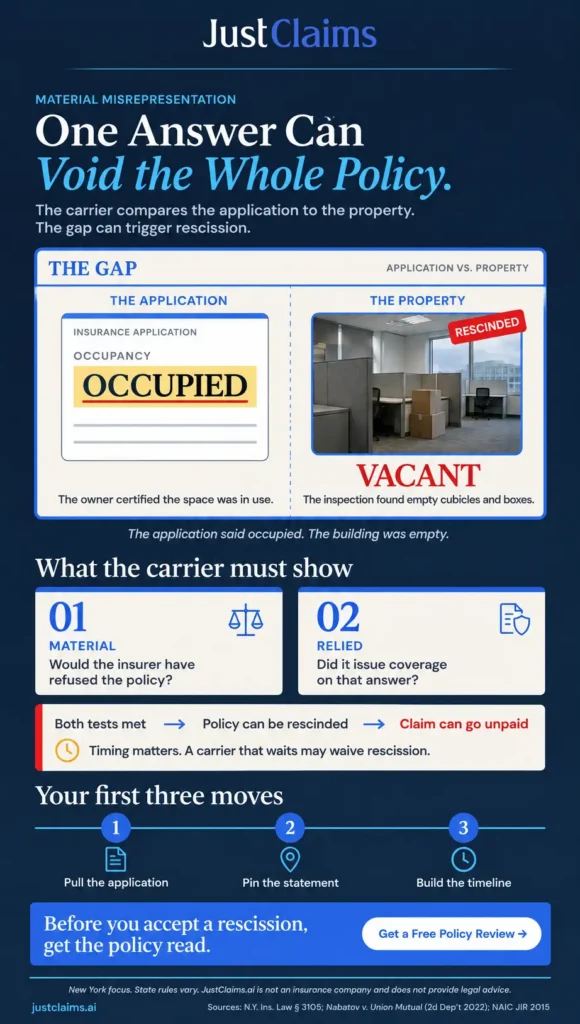
- Materiality: A misrepresentation is material under New York law only if knowing the truth would have led the insurer to refuse the policy.
- Intent: Missouri requires intent to deceive; Kentucky and New York decisions can treat an innocent misrepresentation as sufficient for rescission.
- Illinois waiver risk: Illinois treats a material misrepresentation as making the policy voidable, not void, and a carrier that delays may waive rescission.
Definition: What Material Misrepresentation Means in Insurance Law
A material misrepresentation is a false statement that affects whether an insurer would issue a policy [1]. In commercial property insurance, the issue can arise in an application or renewal submission, and in statements made during the claims process [2][3]. In a 2022 New York case, a carrier rescinded commercial property policies after the insured repeatedly misrepresented whether a swimming pool was on the property [2]. Because a single disputed statement can put an entire policy at risk, carriers may use it to seek rescission or deny a claim.
Rescission is different from cancellation: the New York Department of Financial Services has explained that rescission under Insurance Law § 3105 nullifies the policy as if it had not existed [4]. New York’s statutory standard fire policy also contains a concealment, fraud condition: the entire policy is void if, before or after a loss, the insured willfully concealed or misrepresented a material fact or circumstance concerning the insurance or the property, or committed fraud or false swearing [5]. A carrier may point to that condition when it denies a claim. New York courts have enforced rescission even where the misrepresentation was innocent or unintentional [2].
Rules differ by state, so the analysis below focuses on New York and flags where other states diverge [3].
Key Elements: How Materiality Is Tested
Because carriers can use a misrepresentation allegation to challenge an otherwise covered commercial claim, the elements they must establish are where a policyholder’s response begins.
The Materiality Threshold
Materiality asks whether the insurer would have refused to issue the policy had it known the true facts [1]. In New York, the test is whether knowledge of the facts misrepresented would have led the insurer to refuse the contract [1]. A court can consider the insurer’s underwriting practice for similar risks [1].
In the Nabatov case, the carrier established materiality with underwriting guidelines showing it would not have issued the policy if the application had disclosed the swimming pool [2]. The disputed fact can be a physical feature of the property, a prior loss, or another underwriting detail [2][3].
Reliance and Causal Connection
New York’s rescission rule applies where the policy was issued in reliance on the misrepresentation [1][4]. Policyholders sometimes argue that no causal connection exists between the misstatement and the loss [3]. The NAIC’s Journal of Insurance Regulation identifies that argument as one of seven common responses to rescission, but it also notes that most jurisdictions do not require a causal connection [3].
Insurer Knowledge and Conduct
The NAIC article also discusses waiver and estoppel, and it lists the insurer’s duty to investigate among the arguments insureds raise [3]. In Illinois, for example, a carrier that knew of a misrepresentation but did not promptly act may be found to have waived rescission, leaving the policy voidable rather than void ab initio [3]. The timeline of what the carrier knew, and when, can therefore matter as much as the misstatement itself.
Intentional vs. Innocent Misstatements
Courts disagree on whether intent to deceive must be shown. Missouri requires intent to deceive before an insurer can rescind [3]. Kentucky law makes no distinction between honest mistakes and intentional lies [3]. New York courts have held that a material misrepresentation, even if innocent or unintentional, is sufficient to warrant rescission [2].
Lack of intent is still a common argument against rescission, but the NAIC study found it is not powerful in most states [3]. Another common argument is that an agent or broker completed the application [3]. Property owners who relied on a broker should preserve draft applications, emails, and signed pages showing who supplied each answer.
Real-World Examples
The scenarios below are hypothetical illustrations, not reported decisions. They show how misrepresentation allegations can arise in commercial property disputes.
- Valuation discrepancy: A carrier compares the building value on the application with a post-loss appraisal and alleges the earlier figure was misstated. The owner may argue the figure was a good-faith estimate or that the broker entered it, but New York courts have treated an innocent misrepresentation as sufficient for rescission [2][3].
- Omitted loss history: A prior claim is missing from the application. The owner argues the broker completed the form or that the omission had no causal connection to the new loss; the NAIC study notes insureds generally have difficulty prevailing on those arguments in summary judgment [3].
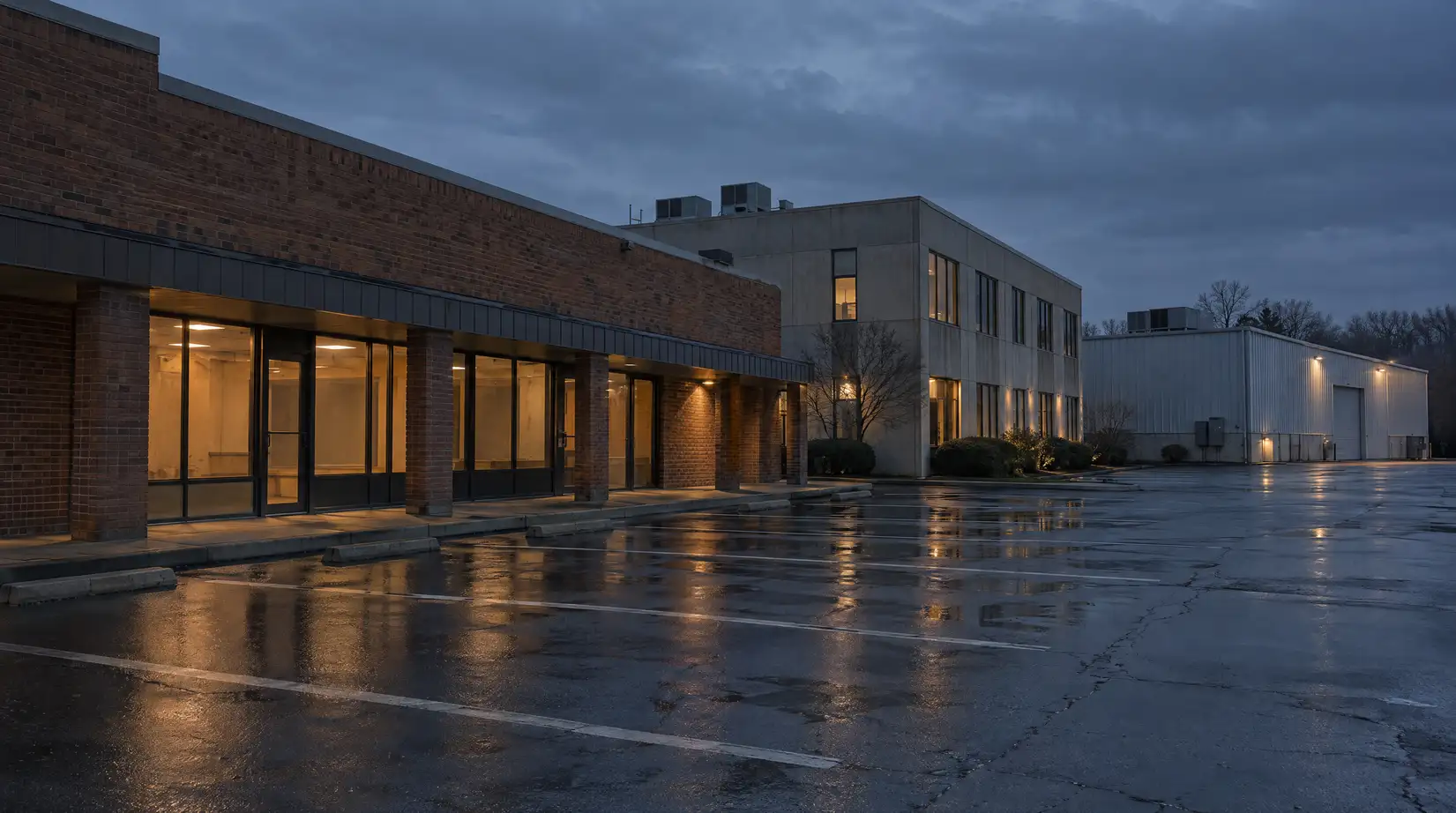
- Occupancy description: The application describes a fully operating building, but part of it sat idle. The carrier calls the description material, and the owner disputes whether it would have changed underwriting [1][2].
- Carrier delay: An insurer learns of a discrepancy during underwriting or investigation but does not promptly act. The timing of the carrier’s response can affect whether rescission is still available [3].
Remedies and Consequences: Rescission, Voided Policies, and Damages
Each scenario ends with the same question: what remedy is the carrier seeking, and how can the policyholder respond?
Rescission and Voided Policies
Rescission is the central remedy in these disputes. It unwinds the contract, and the New York Department of Financial Services has explained that rescission under Insurance Law § 3105 nullifies the policy as if it had not existed [4]. In the Nabatov case, the court declared commercial property policies void ab initio where the insured made a material misrepresentation [2]. Illinois law reaches a different result: the policy is voidable, not void ab initio, and a carrier that delays may waive rescission [3].
Damages and Wrongful Denial
A policyholder who defeats a rescission or denial may pursue the benefits owed under the policy. Whether the carrier’s handling supports additional claims is a separate question. Disputes about a carrier’s performance of its obligations are covered in our guide to breach of insurance contract.
Practical Response Steps
Property owners facing an allegation can take several steps:
- Request the complete application and underwriting file.
- Ask the carrier to identify the specific statement it considers false.
- Gather broker communications showing who prepared each answer.
- Build a timeline of when the carrier learned of the issue.
Whether a statement is legally material, or whether a rescission can be challenged in court, is a legal question that may require an attorney licensed in the relevant state.
Frequently Asked Questions
What is a material misrepresentation in a commercial property policy?
It is a false statement that bears on the insurer’s decision to issue coverage [1]. Whether a given statement qualifies depends on the facts and the governing state law.
Can an insurer cancel my policy after a loss because of an application error?
An insurer may attempt to rescind a policy — a remedy distinct from cancellation — based on a material misrepresentation made when the policy was obtained. The New York DFS General Counsel has said an insurer may cancel or rescind in that situation [4]. Whether a delay affects rescission depends on state law.
Does an honest mistake count the same as intentional fraud?
That varies by jurisdiction. Missouri requires intent to deceive [3]. Kentucky law does not distinguish honest mistakes from intentional lies [3]. New York courts have treated an innocent or unintentional misrepresentation as sufficient for rescission [2].
What if my broker filled out the application?
It can be an argument, but it does not necessarily succeed. The NAIC study lists the agent or broker completing the application among the defenses insureds raise, and it notes that insureds generally have difficulty prevailing on that argument in summary judgment [3]. In New York, the Precision Auto case rejected a broker-negligence defense and held that an innocent misrepresentation was sufficient for rescission [3]. Keep every draft, email, and signed page that shows who supplied each answer.
Is a denial for misrepresentation the same as a breach of contract claim?
No. A misrepresentation denial turns on statements made when obtaining coverage, and rescission can unwind the contract itself [4]. A breach claim concerns whether the carrier performed its obligations under the policy, which is addressed in our breach of insurance contract guide.
How You Can Contest a Misrepresentation Denial
A misrepresentation allegation in New York turns mainly on materiality and reliance, and in some states on intent and the carrier’s own conduct [1][2][3]. A disputed application answer can put the entire policy at risk, so the response should focus on the underwriting file, the specific statement at issue, and the carrier’s timeline.
Property owners should secure the application and underwriting file, document who prepared each answer, and consult qualified counsel on legal questions; JustClaims is a claims-policy resource, not a law firm. To see how the allegation is framed against your policy, get a free commercial property policy review with Justin — upload your policy or denial letter for an AI-assisted coverage review.
This content is for informational purposes only and does not constitute legal or insurance advice. JustClaims is not a law firm, and legal questions about rescission or policy validity may require counsel licensed in your state. Public adjusters must be licensed in the state where they practice, so verify any adjuster’s licensing status with your state department of insurance before engaging their services. Coverage decisions depend on the specific terms, conditions, and exclusions of each policy and the laws of the applicable jurisdiction; policyholders and contractors should consult with a qualified professional for advice on their particular situation.
Sources
[1] N.Y. Insurance Law § 3105 — Representations by the Insured — New York State Senate

Collin Corcoran

Experienced Public Adjuster and Property Claims Specialist, Collin is licensed in New York (#1603393), New Jersey (#3003700204), and Connecticut (#19820270). With 20+ years of hands-on construction and property damage experience, he specializes in residential and commercial claims, complex loss inspections, policy review, detailed estimating, and strategic negotiation. Collin’s background in construction, asset management, emergency response, and claims documentation allows him to accurately identify damage, understand repair requirements, and advocate effectively for policyholders. He works with homeowners, business owners, contractors, and insurance professionals to move claims forward with clarity, accuracy, and confidence. Collin is committed to transparency, technical precision, strong communication, and securing fair outcomes for policyholders.