Flood Insurance for Condo Owners: Coverage & Costs 2026
October 29, 2026
Written by Stephane Elias
Share


FEMA states that the master flood policy a condo association buys does not include personal property coverage, and it also excludes additional living expenses such as temporary housing. Unit owners can be left to cover belongings, relocation costs, and sometimes a share of the association’s costs on their own. Knowing where that gap sits before a flood is far easier than finding it afterward.
Key Takeaways
- Who can buy the master policy: Only a condominium owners’ association can buy the Residential Condominium Building Association Policy (RCBAP).
- RCBAP building limit: up to the lesser of the building’s replacement cost or $250,000 times the number of units.
- Contents coverage: Personal property is not included in the RCBAP’s building coverage, and contents claims are always paid at actual cash value.
- Combined building cap: A unit owner’s Dwelling Form policy and the RCBAP together cannot exceed $250,000 in building coverage.
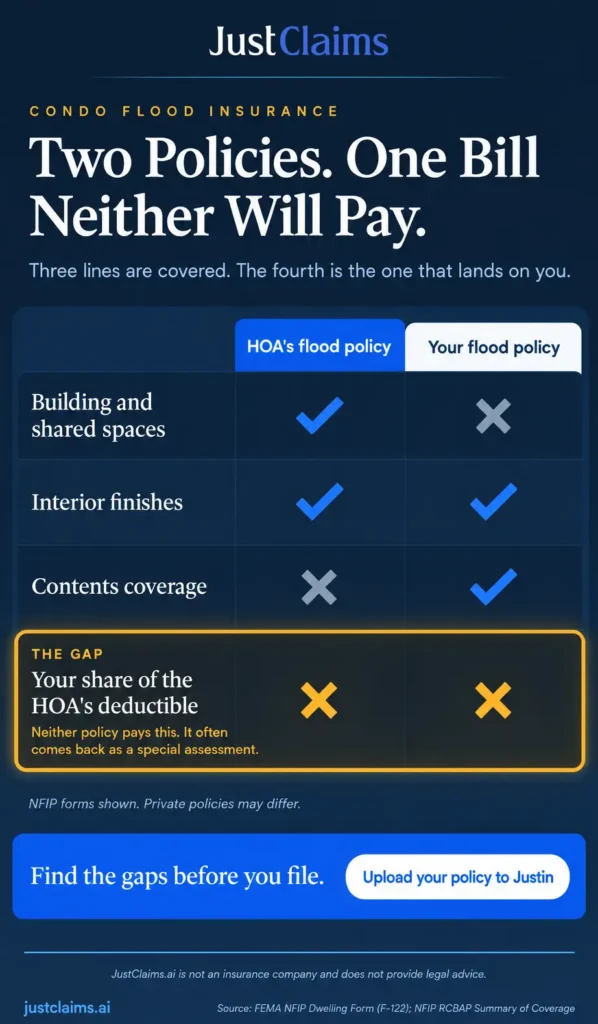
- Master deductible exclusion: The NFIP Dwelling Form’s loss assessment coverage excludes assessments that result from the association’s deductible.
- Getting a price: FEMA directs owners to FloodSmart.gov to get a quote unique to their property.
Master Policy vs. Unit Owner Policy: Where the Gap Starts
The RCBAP is the NFIP’s master policy. It is used for condo buildings where 75% or more of the floor area is residential [1]. Its building limit is up to the lesser of the building’s replacement cost or $250,000 times the number of units. Claims are paid at replacement cost value, with a co-insurance penalty if the building is not insured to within 80% of its replacement cost [1].
What the Master Policy Leaves Out
Contents coverage is not part of the RCBAP’s building coverage. FEMA says individual unit owners may want their own contents policies [1]. Contents claims are always paid at actual cash value, which is replacement cost less depreciation. The RCBAP also excludes additional living expenses, such as temporary housing [1].
Private carriers also write condo master flood policies on their own forms. Owners should read the association’s actual policy rather than assume it is an RCBAP. For non-flood water losses, see our guide on who is responsible for water damage in a condo.
Lender Requirements Add Another Layer
Fannie Mae requires the association to maintain an RCBAP or equivalent private flood coverage for condo buildings in a Special Flood Hazard Area. The coverage must be at least the lesser of 80 percent of replacement cost or the maximum amount of NFIP coverage available for the building [2]. On certain loans, a unit owner must carry a supplemental policy if the master policy’s per-unit amount falls short [2]. Fannie Mae does not require a master policy for high-LTV refinance loans, for projects with 2–4 units, or for detached condos whose owners hold a qualifying individual dwelling flood policy [2].
What NFIP and Private Flood Policies Cover Inside Your Unit
Because the master policy gap leaves much of the unit interior and its contents to the owner’s own coverage, it helps to know what each policy typically reaches. FEMA’s agent site says a condo owner’s flood policy usually covers the unit’s interior, such as drywall, flooring, and cabinets. It does not cover the building’s exterior or shared spaces, and coverage for improvements may be subject to policy limits [3].
FEMA’s RCBAP brochure also lists permanently installed carpeting over an unfinished floor, paneling, wallboard, bookcases, and cabinets among the interior items building coverage can reach, subject to that same 80 percent coinsurance requirement [1]. Because the two policies can overlap, owners should compare them line by line. Private flood forms vary, so the same comparison applies to any private policy.
| Item | Association’s RCBAP | Your own policy |
|---|---|---|
| Interior finishes | Permanently installed carpeting over an unfinished floor, paneling, wallboard, bookcases, and cabinets [1] | FEMA says drywall, flooring, and cabinets are usually covered [3] |
| Personal belongings | Not included [1] | Covered only if purchased separately, with its own limit and deductible [3] |
| Exterior and shared spaces | Building coverage up to the lesser of the building’s replacement cost or $250,000 times the number of units [1] | Not covered [3] |
Contents coverage (furniture, clothing, electronics) must be purchased separately from building coverage. High-value items such as artwork or jewelry have limits and may need additional coverage [3].
When a building is covered by an RCBAP, the combined building coverage of the owner’s Dwelling Form policy and the RCBAP cannot exceed $250,000 [4]. For limits beyond condos, see our guide to maximum flood insurance coverage.
Loss Assessment Coverage and the Master Deductible
The master policy gap is widest when the association passes costs to residents. Loss assessment coverage is the part of a unit owner’s policy that responds to those charges, and it has real limits.
What the NFIP Dwelling Form Covers
The NFIP Dwelling Form covers a unit owner’s share of loss assessments charged by the association under its articles, declarations, and the owner’s deed. The assessment must result from direct physical loss by or from flood during the policy term, to the unit or to the common elements of the NFIP-insured building [5]. The coverage is up to the Coverage A limit of liability. It does not increase Coverage A, and the policy deductible does not apply to these claims [5].
What It Excludes
The Dwelling Form excludes any assessment that results from a deductible under the association’s insurance for the common elements. Your NFIP dwelling policy therefore will not pay your share of the HOA’s flood deductible. It also excludes assessments charged by a governmental body and assessments that result from loss to personal property [5]. If a unit has both a Dwelling Policy and an RCBAP, combined payments cannot exceed the single-unit maximum [5].
A standard condo unit owner’s policy (HO-6) doesn’t fill this gap either: flood damage is not covered under a standard homeowner’s policy [6]. Your own NFIP or private flood policy with building coverage is the route, and its building limit also serves as the loss assessment limit [5].
A Court Example of the Master Deductible Clause
In Grife v. Allstate Floridian Ins. Co. (S.D. Fla. 2007, aff’d 11th Cir. 2008), the condo association’s master policy carried a deductible of $719,080. The association passed it to owners by special assessment, about $1,200 for Mr. Grife. His claim was denied because his policy contained a “Master Deductible” clause excluding assessments based on the association’s deductible [7]. Florida Statute § 627.714 requires condo unit owner policies to include at least $2,000 in property loss assessment coverage, with a deductible of no more than $250 [8]. Rules differ by state, so owners should read the exclusions in their own policy.
Condo Flood Insurance Cost Factors and Getting a Quote
Since the master policy gap shifts so much risk onto your own policy, understanding what drives its price helps you decide how much coverage to buy.
What Drives Premiums
Under FEMA’s Risk Rating 2.0, premiums depend on property characteristics such as distance to a water source, elevation, and the cost to rebuild. FEMA spreads premiums across policyholders based on home value and each property’s own flood risk [9]. Building coverage limits also affect cost. The RCBAP is capped up to the lesser of the building’s replacement cost or $250,000 times the number of units, and Increased Cost of Compliance coverage adds up to $30,000 but cannot push the building and ICC claims past that cap [1].
FEMA now rates each property using more variables than flood zone alone, so a zone-wide average won’t tell you what a specific unit will cost [9]. The practical way to price your own coverage is a quote for that specific property [10].
Mitigation Features That Can Lower Cost
Elevating a building from 0 to 5 feet above the ground can save about 34%. Elevating machinery and equipment can save up to 5%, and flood openings in a 5-foot crawlspace save about 5%. An owner can give the agent an elevation certificate to see whether it lowers the cost [9].
How to Get a Quote
FEMA directs owners to FloodSmart.gov to get a quote unique to their property. To buy, share the quote with an agent or call your insurer. You can also call the NFIP at (877) 336-2627 [10].
Frequently Asked Questions
Does my HOA’s flood policy cover my furniture and belongings?
No. FEMA says the association’s RCBAP does not include contents coverage within its building coverage. Unit owners who want protection for belongings generally need their own contents coverage, which pays at actual cash value [1].
Will my flood policy pay my share of the association’s flood deductible?
Generally not under the NFIP Dwelling Form. Its condominium loss assessment coverage carves out assessments that stem from the deductible on the association’s common-element insurance.[5] Some private policies contain similar master deductible clauses [7].
Is there a combined limit if both I and my association carry flood coverage?
Yes. FEMA’s manuals state that building coverage from your Dwelling Form policy and the association’s RCBAP together cannot exceed $250,000 [4][5]. That means buying a second policy does not stack coverage beyond that figure.
How quickly can I find out what flood coverage might cost?
FEMA’s FloodSmart.gov tool generates a quote unique to your property. You can also call the NFIP at (877) 336-2627 to get started [10].
How to Close Your Condo Flood Coverage Gap
The master policy gap is manageable once you know where the association’s coverage ends. Request the association’s actual flood policy, compare it with your own, and confirm your contents and loss assessment coverage. An initial insurer offer does not always reflect what the policy language supports. A licensed public adjuster can review the documents on your behalf, and contingency fees apply only where state rules permit.
Upload your flood policy to Justin before you file to flag coverage gaps and loss-assessment exclusions in minutes.
This content is for informational purposes only and does not constitute legal or insurance advice. Coverage decisions depend on the specific terms, conditions, and exclusions of each policy and the laws of the applicable jurisdiction; policyholders should consult a qualified professional for advice on their particular situation. This article was prepared with review by a licensed public adjuster. Public adjuster licensing and fee rules vary by state, so verify any adjuster’s license with your state insurance department. No public adjuster can promise a specific settlement or outcome.
Sources
[1] NFIP Summary of Coverage: Residential Condominium Buildings — FEMA/NFIP
[2] Flood Insurance Requirements for All Property Types — Fannie Mae Selling Guide
[3] What Does Flood Insurance Cover for Home and Condo Owners? — FEMA/NFIP
[4] NFIP Flood Insurance Manual, April 2024 — FEMA
[5] Dwelling Form, Standard Flood Insurance Policy (F-122), October 2021 — FEMA
[6] Flood Insurance — National Association of Insurance Commissioners (NAIC)

Stephane Elias

A seasoned insurance professional with nearly a decade of experience, Stephane Elias is currently serving as a Senior Claims Professional and Public Adjuster with JustClaims. Throughout his career, Stephane has represented policyholders through leading public adjusting firms and served as a loss consultant for law firms specializing in insurance litigation, giving him extensive expertise in complex property insurance claims. A licensed public adjuster in TX (#2645032), FL (#W564547), and six other states, he specializes in commercial and residential property claims, claims management, appraisals, mediation, and strategic partnerships. Stephane is passionate about helping policyholders overcome delayed, denied, and underpaid insurance claims, ensuring they receive the full recovery they’re entitled to under their policy.