HO8 Insurance Meaning: Coverage & Policy Guide 2026
October 29, 2026
Written by Taylor Bezek
Share


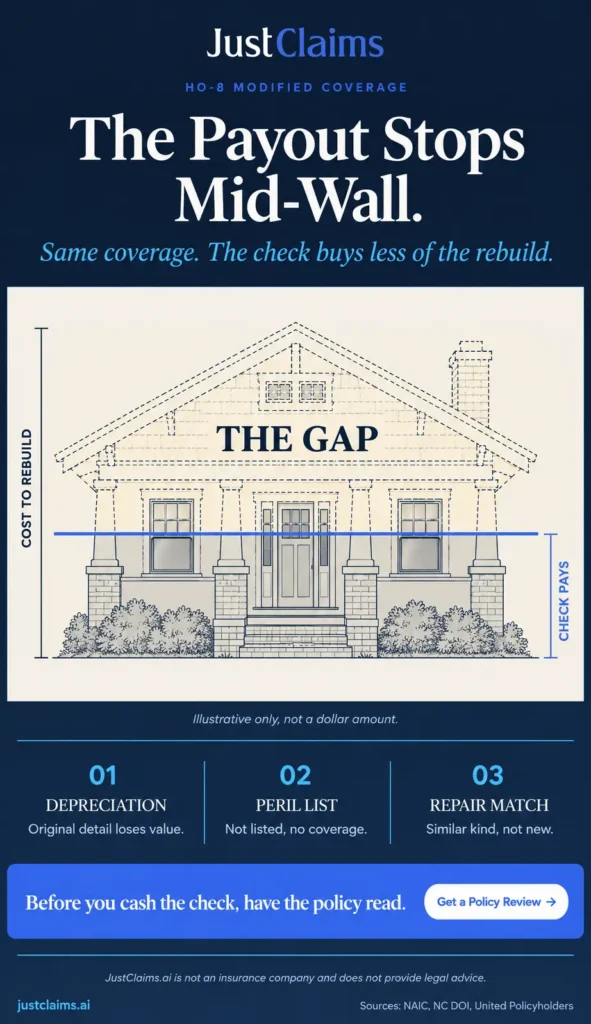
An HO-8 policy — the modified coverage form — is written for older homes where the cost to rebuild is greater than the home’s market value. It settles losses on an actual cash value basis instead of paying the cost to rebuild, and it covers only the named perils listed in the Basic Form. Knowing both limits before a claim is how you spot a payout that may fall short.
Key Takeaways
- What it is: HO-8 is the modified coverage form, written for older homes where rebuilding costs more than the home is worth.
- What it pays: losses settle at actual cash value — the home’s value considering age and wear and tear — not the cost to rebuild.
- Covered causes: the same named perils as the Basic Form. If the cause of loss is not on that list, the policy does not respond.
- Where the gap opens: between the depreciated payout and the price of period-appropriate repair.
- Where disputes start: depreciation percentages and peril wording, not just the deductible.
What an HO8 Policy Is and Why It Exists
An HO8 policy is the modified coverage form. The National Association of Insurance Commissioners describes it as the form for older homes, “where the cost to rebuild is greater than the market value” [1]. That single sentence explains why the form exists: the rebuild number and the market number have come apart.
What it protects is the home’s value at the time of loss, not the price of putting it back the way it was. The NAIC’s shopping guide for homeowners is explicit about the basis: the modified form — “sometimes called the HO-8 policy form” — “covers your home and personal property for their actual cash value” [2]. The NAIC defines actual cash value as the value of your home considering its age and wear and tear, and warns that ACV coverage “often doesn’t pay enough to fully repair or replace the damage” [1]. North Carolina’s insurance department puts it concretely: ACV is the amount needed to fix your home, minus the decrease in value from age or use [3].
That is where the out-of-pocket gap opens. Replacement cost is the cost to rebuild or repair using “materials of similar kind and quality” [1]. On an older home — the kind this form exists for — the distance between those two numbers can be wide, especially on features that cannot be sourced off a shelf.
The tradeoff is not only in the settlement. The modified form covers the same perils as the Basic Form rather than the all-perils-except-exclusions coverage of a Special Form policy [1]. Premiums, meanwhile, depend on the company and on the home itself; the NAIC notes that the age and condition of a home often affect the premium [1].
The Named Perils an HO8 Policy Covers
An HO8 payout depends on the cause of loss as much as on depreciation, so the perils list is the first thing to check after damage.
The modified coverage form covers “the same set of perils as the Basic Form” [1]. The NAIC’s consumer guide lists those perils together: fire, smoke, windstorm, hail, lightning, explosion, vehicles and civil unrest, plus theft and vandalism [1]. To be reimbursed, “a covered peril … must have caused your loss” [1] — so a cause outside that list is not covered.
That is why the cause of loss matters after a storm. A few practical steps can help:
- Read the named perils list in your own policy form, since it defines what your policy can pay for.
- Ask the carrier in writing which named peril it relied on when it accepted or denied the loss.
- Document the cause of damage with dated photos, repair estimates, and any inspection reports.
- Compare the event that damaged your home against the exact wording of each named peril.
A denial based on cause of loss is a different dispute from an underpayment based on depreciation. Knowing which one you face shapes what you ask for next.
Actual Cash Value vs. Replacement Cost on Older Homes
The named perils decide whether a loss is covered. The valuation method then decides how much you are paid — and on an older home, that is where the shortfall can open.
1. How the Two Valuation Methods Are Defined
The North Carolina Department of Insurance defines Actual Cash Value as the amount needed to fix your home minus the decrease in value from age or use, also called Depreciated Cash Value. Replacement Cost Value is the amount needed to repair your home at today’s prices for building supplies, or to replace belongings at today’s cost [3]. United Policyholders puts the replacement side simply: replacement cost is the “new” price of what it would cost to actually repair or replace a damaged or destroyed item [4]. For the full math, see our guide to the actual cash value formula.
2. How Depreciation Reduces a Payout
Depreciation is the mechanism that turns a repair estimate into a smaller check. The NAIC describes ACV as the value of your home considering its age and wear and tear, and warns that ACV coverage “often doesn’t pay enough to fully repair or replace the damage” [1].
On an older home, the gap shows up on the items that are expensive to replicate: original millwork, plaster walls, period cabinetry, and flooring that cannot be matched from stock. Each is valued as it stood before the loss, not as the replacement you have to buy [3].
One detail is worth knowing before you argue about the number. On a replacement cost policy, an insurer may pay actual cash value first and release the withheld depreciation after the repair is finished and receipts are submitted — a process North Carolina’s regulator calls “Recoverable Depreciation” [3]. Whether any depreciation is recoverable depends on the form and the policy language, so ask the carrier in writing before you treat the first number as final.
3. Whether Replacement Cost Coverage Is Available
Replacement cost settlement is not something a policyholder can elect mid-claim. The NAIC describes replacement cost and actual cash value as coverage choices made when the policy is written [1]. If you want to move off an ACV form, the question to put to the carrier in writing is whether the home can be written on a form that pays replacement cost — and what documentation or upgrades that would require. Eligibility depends on the insurer and on the condition of the home.
Common HO8 Exclusions to Watch For
The valuation gap is only one source of out-of-pocket cost. The other is what the policy leaves out entirely. Since depreciation already narrows payouts on older homes, an exclusion can remove coverage altogether.
The first exclusion to check is built into the form itself. Any cause of loss that is not among the named perils is not covered [1]. Flood is the standard example: the NAIC’s guide states that homeowners policies do not cover flood damage [1]. Beyond that, exclusions are policy-specific, so the written policy language controls. Property owners can take these steps:
- Request the full policy, including endorsements, and read the exclusions section before filing.
- Ask the carrier to cite the exact exclusion if any part of a claim is denied.
- Separate the covered portion of a loss from the excluded portion in your own documentation.
- Keep records of original features and period-appropriate materials, since replacing them can cost far more than a depreciated payout reflects.
Signs an HO8 Claim Payout May Be Underpaid
Because HO8 payouts rest on depreciation judgments, the estimate is where an underpayment can hide. Several checks can help you decide whether a first offer deserves a closer look:
- Depreciation rate: Ask how the carrier set the percentage of value lost on each item, and request a written explanation of how depreciation was calculated.
- Material comparison: Check whether the estimate prices period-appropriate materials or cheaper modern substitutes.
- Peril alignment: Confirm the cause of loss in the estimate matches the named peril that applies to your claim [1].
- Scope gaps: Compare the carrier’s scope of work against your own contractor’s estimate for missing rooms, finishes, or original features.
- Deductible math: Verify the deductible was subtracted once and applied correctly to the final payout.
Rules for disputing estimates differ by state and by policy, so the deadlines and procedures that apply to you depend on where the property is located. The NAIC notes that if you and your insurer still disagree about the value of a claim, the policy may include an appraisal clause [1]. Where the fight is over value rather than coverage, see how insurance claim appraisal works. A licensed public adjuster can compare an estimate against the policy language and your documentation where state law permits.
Frequently Asked Questions
What does HO8 insurance mean?
HO8 is the modified coverage form, a policy built for older homes where the cost to rebuild is greater than the market value. It pays actual cash value — the value of your home considering its age and wear and tear — rather than the cost to rebuild with current materials and labor [1].
Which perils does an HO8 policy cover?
The modified form covers the same named perils as the Basic Form. The NAIC’s consumer guide lists them as fire, smoke, windstorm, hail, lightning, explosion, vehicles, civil unrest, theft, and vandalism [1]. When the cause of damage is not on that list, the policy does not respond to the loss.
Does an HO8 policy pay replacement cost?
No. The payout is based on actual cash value, meaning the home’s value after accounting for age and use [3]. The NAIC notes that ACV coverage often does not pay enough to fully repair or replace the damage [1], which is why restoring an older home can leave you paying more out of pocket than the check covers.
Can an HO8 policy be changed to an HO-3?
Sometimes, but not by request at claim time. The NAIC describes replacement cost and actual cash value as choices made when the policy is written [1]. Ask the carrier in writing whether the home qualifies for a form that pays replacement cost, and what documentation or upgrades that would require. Eligibility depends on the insurer and on the condition of the home.
How does a state regulator define actual cash value?
The North Carolina Department of Insurance describes it as the amount needed to fix your home, less the drop in value caused by age or use. It is also called Depreciated Cash Value [3]. Other states may word their definitions differently, so check your own state’s insurance department.
How to Review Your HO8 Claim Payout
Older homes can have features that a depreciation-based payout may undervalue, and a closed perils list can narrow coverage further. Stop fighting your insurance company alone. A first offer may not reflect the full amount the policy supports, and we review whether the offer matches the coverage the policy provides. No upfront cost to start; fees, where charged, are contingent on recovery and subject to state limits.
Start a free AI policy review — upload your HO8 policy and the carrier’s estimate, and Justin flags where depreciation, peril wording, or exclusions may have reduced your payout.
This content is for informational purposes only and does not constitute legal or insurance advice. Coverage decisions depend on the specific terms, conditions, and exclusions of each policy and the laws of the applicable jurisdiction; policyholders should consult a qualified professional about their situation. Outcomes vary and no specific settlement is promised. Public adjuster licensing disclosure: public adjusting services are offered only through licensed public adjusters where state law requires a license, and licensing, fee, and contract rules differ by state. Prepared under the byline of a licensed public adjuster.
Sources
[1] A Consumer’s Guide to Home Insurance — National Association of Insurance Commissioners ↩
[2] A Shopping Tool for Homeowners Insurance — National Association of Insurance Commissioners ↩
[3] Actual Cash Value vs. Replacement Cost Value — North Carolina Department of Insurance ↩

Taylor Bezek

As the General Manager at JustClaims, Taylor Bezek brings over a decade of experience managing complex residential, commercial, and large-loss claims. A licensed Public Adjuster in TX (#2125659), FL (#W455048), CO (#769172), and 10 additional states, Taylor founded his own firm before joining JustClaims to scale a tech-forward solution for the insured. He is committed to combining industry expertise with AI to enhance speed, clarity, and outcomes for every policyholder. Taylor's mission is to modernize the public adjusting profession and ensure owners get exactly what they are entitled to.