Date of Loss Meaning: Guide to Insurance Claims 2026
October 27, 2026
Written by Taylor Bezek
Share


As a general rule, the date of loss is the day the damaging event actually happened—the hail fell, the pipe burst, the fire started. It is not the day the damage was discovered or the day the claim was reported. For contractors, property owners, and property managers, recording that one date accurately can affect every deadline that follows.
Key Takeaways
- What it is: As a general rule, the date of loss is the day the damaging event occurred, not the day the damage was discovered.
- What it is not: It is not the discovery date or the reporting date.
- Policy period: A loss outside the policy period is not covered.
- State deadlines: Florida bars a claim unless notice is given within 1 year after the date of loss, and a supplemental claim within 18 months.
- Gradual leaks: Texas regulators say policies usually will not cover damage from gradual leaks.
- Continuous leakage: A Texas Department of Insurance guide shows some homeowners forms exclude constant or repeated seepage or leakage over 14 or more days.
- Documentation: Photograph damage before repairs and keep receipts.
Date of Loss vs. Date of Discovery
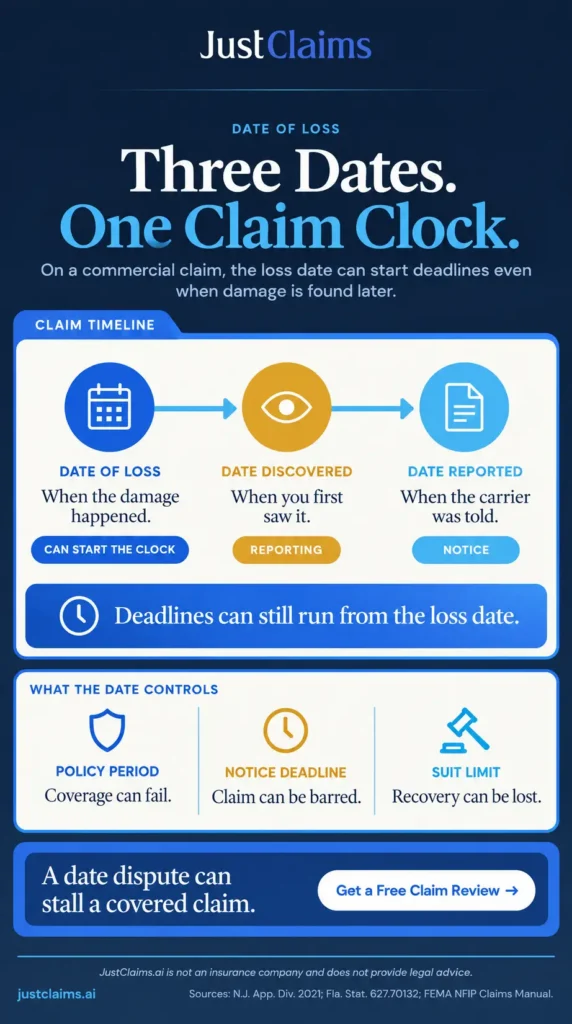
As a general rule, the date of loss is the date the damaging event occurred—the hail fell, the pipe burst, the fire started. It is not the date the damage was discovered or the claim was reported. In a 2021 unpublished Appellate Division decision involving a commercial property policy, a New Jersey court measured a two-year suit deadline from the April 30, 2015 date of loss—when the property was damaged—not from 2018, when the owner discovered the damage [1].
The Three Dates That Matter
| Date | What it means | Role in the claim |
|---|---|---|
| Date of Loss | When the damage occurred [1] | Starts policy-period and deadline analysis [1] |
| Date Discovered | When the damage was first noticed [2] | Matters for prompt reporting [2], but does not automatically reset the date of loss [1] |
| Date Reported | When the carrier was told [3] | Starts the notice process; deadlines can still run from the date of loss [3][4] |
The date of loss drives policy enforcement, including notice deadlines and lawsuit limits [1][4].
Definitions can vary by policy and peril. For flood claims, FEMA’s NFIP Claims Manual defines the date of loss as the adjuster-verified date the claimed flood damaged the property [5].
Why the Policy Period Matters
Coverage depends first on the policy period. In the New Jersey case, the court noted that, under the manifest-trigger rule—which can tie coverage to the policy in effect when damage becomes manifest—an insurer whose policy term expired before the date of loss has no coverage obligation [1]. For progressive damage, do not assume the discovery date resets the policy period. Document when the damage began and check the policy’s occurrence language.
How the Date of Loss Affects Claim Approval
Because the date of loss anchors every deadline in a claim, an incorrect entry can put a covered loss outside a deadline or policy period. State statutes and policy provisions both measure time from that date [1][4].
Notice Deadlines Set by State Law
State deadlines vary. Florida is a useful example. Florida Statute 627.70132 bars a claim or reopened claim unless notice is given within 1 year after the date of loss, and bars a supplemental claim unless notice is given within 18 months [4]. For weather-related claims, the statute defines the date of loss as the date the hurricane made landfall or the weather event was verified by NOAA [4]. A missed notice deadline measured from the date of loss can bar the claim.
Proof of Loss and Suit Limits
Check the policy’s duties-after-loss section for any sworn proof-of-loss requirement and its deadline. Federal flood policies have a fixed deadline: FEMA’s NFIP Claims Manual says the policyholder must submit a proof of loss within 60 days of the date of loss, unless FEMA grants an extension [5].
Most insurance policies have a “Suit Against Us” provision, according to United Policyholders. It says the deadline is often one year from the date of loss, but may be one, two, or more years depending on the event [6]. Some policies tie the deadline to the date the direct physical loss or damage occurred; the New Jersey case enforced a two-year provision with that language [1].
The date of loss determines when each of these clocks starts. The carrier’s own payment timeline is a separate question, covered in our guide on how long an insurance company must pay a claim. Deadlines vary by state and by policy, so confirm the governing language for each client property.
Gradual Damage: Leaks and Mold
The date-of-loss question is hardest when damage develops slowly, because no single event may exist to point to. Common examples include slow plumbing leaks, roof seepage, and hidden moisture behind finishes.
Sudden vs. Gradual Water Damage
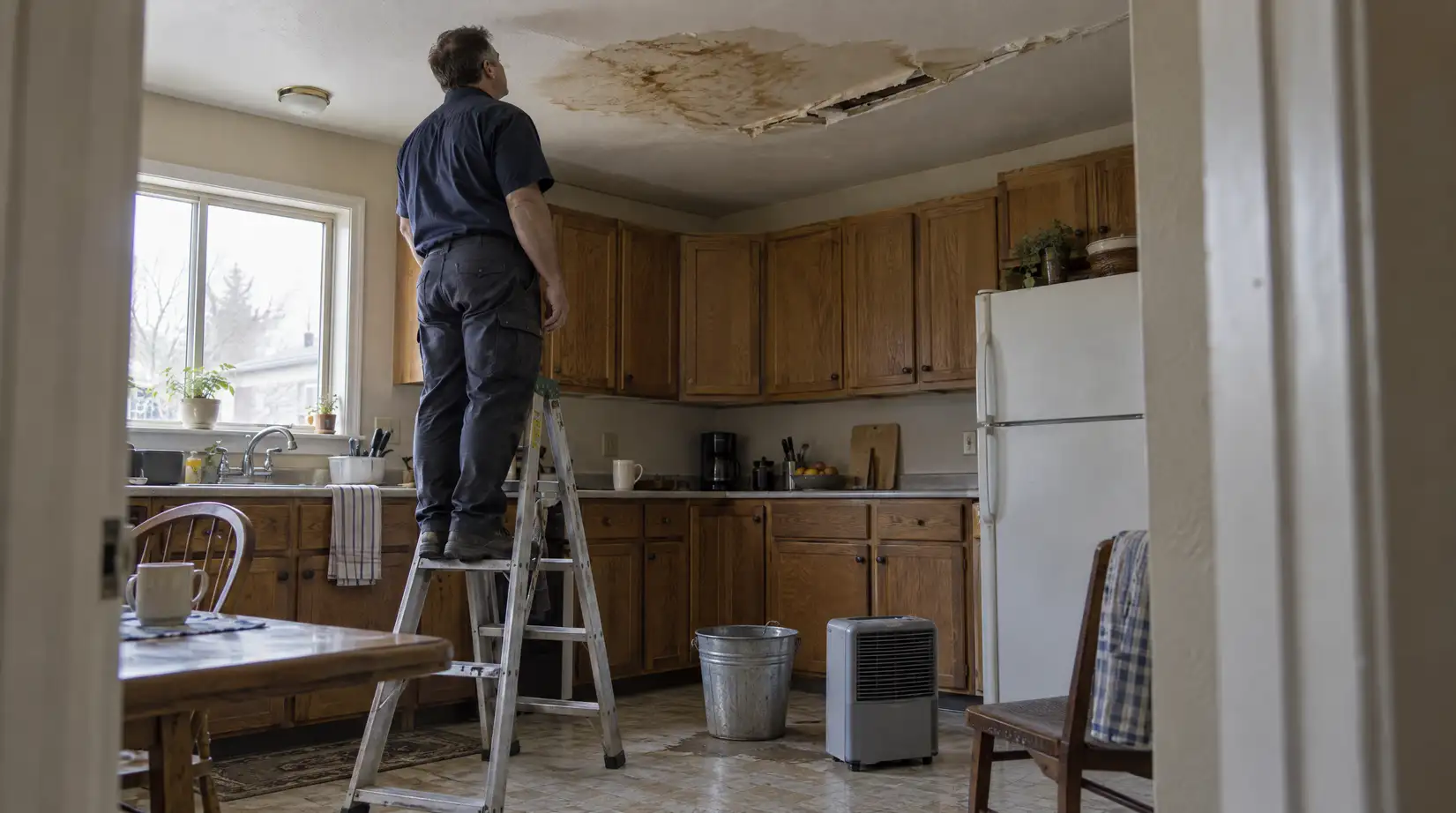
The Texas Department of Insurance says most homeowners and renters policies cover sudden and accidental water damage, such as a burst pipe, toilet overflow, or broken washer hose. It says policies usually won’t cover damage from gradual leaks [2]. Most home policies also don’t cover water damage from gradual leaks or seepage, and that includes mold. Mold from a flood isn’t covered either, because home policies don’t cover floods and a separate flood policy is needed [2].
Hidden Damage and Reporting Windows
The Texas Department of Insurance says mold can start growing within a day after a leak. Policyholders usually must report water damage that was hidden from view within days after they first see it [2]. This makes the discovery date important for timely reporting. This is a state-level source, and rules in other states may differ.
The Continuous-Leak Exclusion
The Texas Department of Insurance’s guide to homeowners policies lists water damage from continuous and repeated leakage or seepage among the exclusions [7]. It also shows that some companies use a 14-day threshold: their forms exclude constant or repeated seepage or leakage of water or steam, or the presence or condensation of humidity, moisture, or vapor, over a period of 14 or more days from within a plumbing, heating, air conditioning, or automatic fire protective sprinkler system, or from within a household appliance [7]. Other forms use “weeks, months, or years,” so the wording varies [7]. Some companies allow policyholders to buy full or limited coverage for continuous and repeated leakage or seepage [7].
Record only what you observed; leave the cause-and-duration opinion to the policyholder’s experts.
Documentation Tips for Proving the Date
Because a disputed date can stall a claim, the records created at the first site visit carry real weight. Document conditions factually and leave coverage interpretation to the policyholder, the insurer, or a licensed public adjuster. For commercial losses, our guide to commercial restoration claim documentation covers the day-one photo, inventory, and proof-of-loss trail.
- Report promptly and say what you have. NAIC’s Post-Disaster Claims Guide says to notify the insurer as soon as you know there is damage and you decide to file a claim. It also says to mention photos, videos, and cost estimates on the first call to the insurer and agent [8].
- Gather before-damage records. NAIC advises gathering photos or videos of the home and property before they were damaged or destroyed, and showing them to the adjuster [8].
- Photograph beyond the damage itself. FEMA’s NFIP Claims Manual says photographs should adequately document the claimed damage. It says photos of undamaged building elements and contents, and damage from causes other than flood, are also important [5].
- Document before repairing. The Texas Department of Insurance advises taking pictures or videos before making repairs and not making permanent repairs until the insurance company sees the damage. It also advises keeping receipts for materials bought to make repairs [2].
- File and capture promptly. Ready.gov (FEMA) tells people to file claims promptly and to take pictures and video of the damage [9].
- Know the reporting requirement. NAIC says most insurance companies have a time requirement for reporting a claim, so contact the agent or company as soon as possible [3].
Frequently Asked Questions
What is the date of loss in an insurance claim?
As a general rule, it is the date the damaging event occurred—the day the hail fell, the pipe burst, or the fire started. It is not the day the damage was discovered or the day the claim was reported. In the New Jersey case, the court measured a two-year suit deadline from the date the property was damaged, not the later date the owner discovered the damage [1].
Is the date of loss the same as the date a claim is reported?
No. The date reported is when the carrier was told. NAIC says most insurance companies have a time requirement for reporting a claim [3]. But state statutes and policy provisions can still measure deadlines from the date of loss; Florida, for example, measures its notice deadlines from the date of loss [4].
How is the date of loss determined for a slow leak or hidden damage?
There may be no single event to point to. The Texas Department of Insurance says policies usually won’t cover gradual leaks and that hidden water damage usually must be reported within days after it is first seen [2]. A New Jersey appellate court refused to apply the discovery rule to a contractual suit-limitation provision and measured the deadline from the date of loss, not the later discovery date [1]. Document when the condition was first observed and check the policy’s occurrence language.
What photo documentation should I collect?
FEMA’s NFIP Claims Manual says photographs should adequately document the claimed damage, and that photos of undamaged building elements and contents, and damage from causes other than flood, are also important [5]. The Texas Department of Insurance advises taking pictures or videos before repairs and keeping receipts [2]. NAIC advises gathering before-damage photos or videos and showing them to the adjuster [8].
What happens if the date of loss falls outside the policy period?
Coverage depends first on the policy period. In the New Jersey case, the court noted that, under the manifest-trigger rule, an insurer whose policy term expired before the date of loss has no coverage obligation [1]. Confirm the policy’s effective dates against the documented date of loss before the claim is submitted.
What You Should Document Before Repairs Begin
You cannot control when a loss happens, but you can control the record you create afterward. For contractors, property owners, and property managers, the date of loss is more than a form field. It can decide whether notice deadlines, proof-of-loss requirements, and suit limits start from the right day. Protect the claim by photographing conditions before repairs, recording observations factually, and encouraging prompt reporting by the policyholder. Keep the distinction clear between when damage happened, when it was found, and when it was reported. State law and policy terms govern the specific deadlines, so check both for each property.
If a claim was denied or underpaid over a date issue, upload the policy and claim file for a free AI coverage review with JustIn, then let the JustClaims team flag date-of-loss inconsistencies to raise with the carrier.
This content is for informational purposes only and does not constitute legal or insurance advice. Coverage decisions depend on the specific terms, conditions, and exclusions of each policy and the laws of the applicable jurisdiction; policyholders and contractors should consult with a qualified professional for advice on their particular situation. Public adjusters must be licensed in the state where they practice, so verify any adjuster’s license with the state department of insurance before engaging their services.
Sources
[2] When are water damage and mold covered by insurance? — Texas Department of Insurance
[3] Navigating the Claims Process: Recover & rebuild — National Association of Insurance Commissioners
[4] Florida Statute 627.70132, Notice of Property Insurance Claim (2026) — Florida Legislature
[5] NFIP Claims Manual (June 2023) — Federal Emergency Management Agency
[6] Lawsuit Limitations in Insurance Policies — United Policyholders
[7] Texas Homeowners Policies (2018) — Texas Department of Insurance
[8] Post-Disaster Claims Guide — National Association of Insurance Commissioners

Taylor Bezek

As the General Manager at JustClaims, Taylor Bezek brings over a decade of experience managing complex residential, commercial, and large-loss claims. A licensed Public Adjuster in TX (#2125659), FL (#W455048), CO (#769172), and 10 additional states, Taylor founded his own firm before joining JustClaims to scale a tech-forward solution for the insured. He is committed to combining industry expertise with AI to enhance speed, clarity, and outcomes for every policyholder. Taylor's mission is to modernize the public adjusting profession and ensure owners get exactly what they are entitled to.