2026 Colorado Wildfire Forecast: Historic Risk Levels
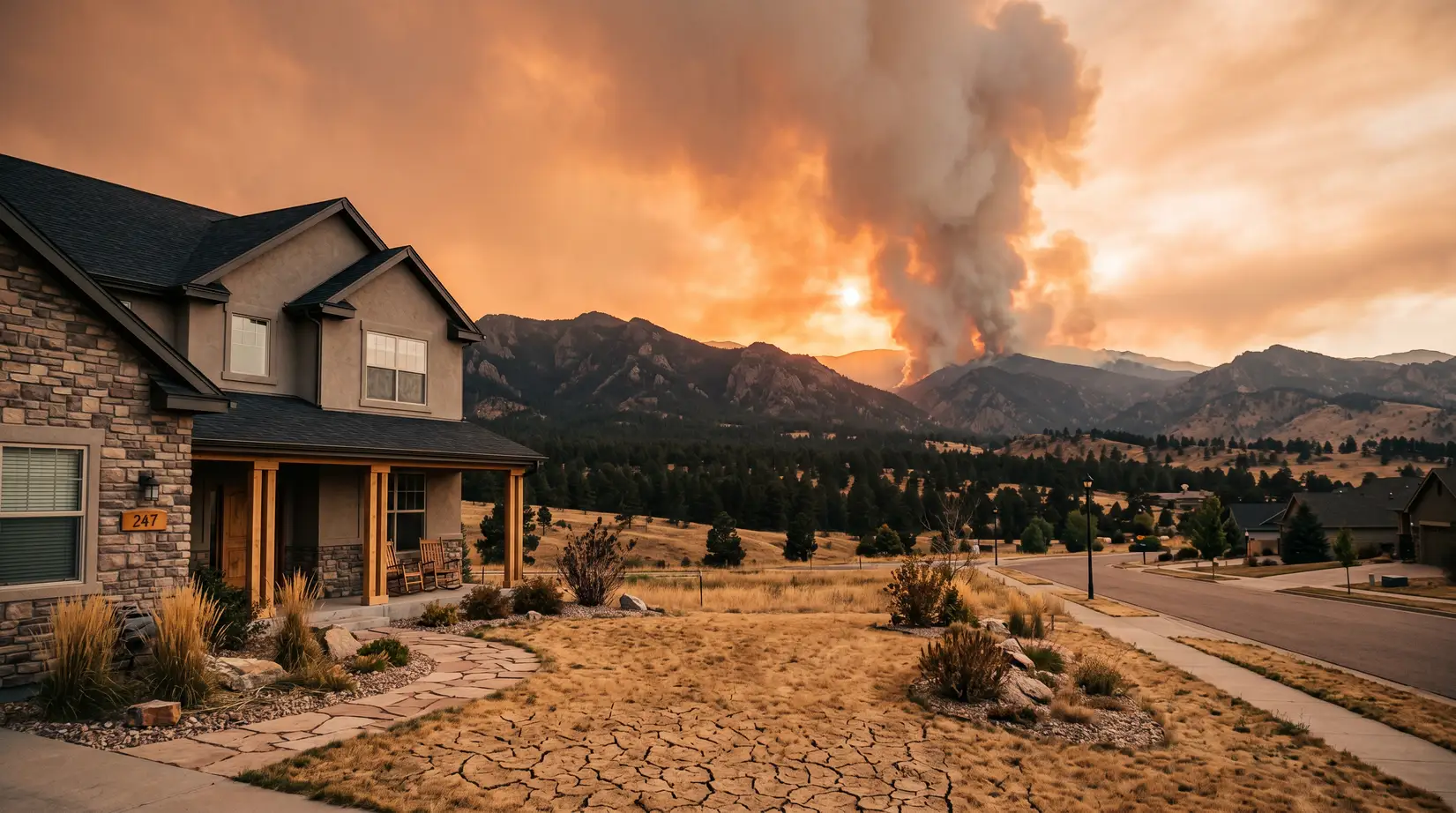
May 20, 2026
Written by Taylor Bezek
Share


Colorado property owners are facing an unprecedented threat as the March 2026 DFPC Spring Fire Seasonal Outlook reports the warmest winter on the 132-year record, standing 1.6°F above the previous high. With statewide snowpack plummeting to its lowest level in over 40 years, officials warn that the upcoming wildfire season could surpass the state’s most destructive historical benchmarks.
Key Takeaways
- Record Winter Heat: Climatological winter was the warmest on the 132-year record, measuring 1.6°F above the previous warmest winter of 1981.
- Snowpack Collapse: Statewide snowpack in Colorado’s watersheds has dropped to its lowest point in over 40 years, sitting at roughly 40% of historic medians.
- Drought Severity: In 2026, 18% of Colorado faced exceptional drought, while 58.5% of the state was in extreme drought.
- Recent Escalation: Four of the top five largest wildfires in Colorado history occurred in just the last six years (2020 and 2025).
- Property Destruction: The 1,109 Marshall Fire remains the most destructive in state history, resulting in the loss of 1,109 homes.
Colorado wildfire history timeline — major fires and their causes
The frequency and severity of these events have accelerated rapidly in recent years. Three of the top five largest wildfires in Colorado history occurred in 2020, and the 2025 Lee Fire ranks fifth at 137,758 acres
The Cameron Peak Fire in 2020 remains the largest wildfire in Colorado history, burning a total of 208,913 acres [1]. While acreage defines the largest fires, the Marshall Fire is the most destructive fire in state history in terms of property damage, resulting in the loss of 1,109 homes [1].
| Fire Name | Year | Impact |
|---|---|---|
| Cameron Peak Fire | 2020 | Burned 208,913 acres |
| Marshall Fire | 1,109 | Destroyed 1,109 homes |
| Lee Fire | 2025 | Burned 137,758 acres |
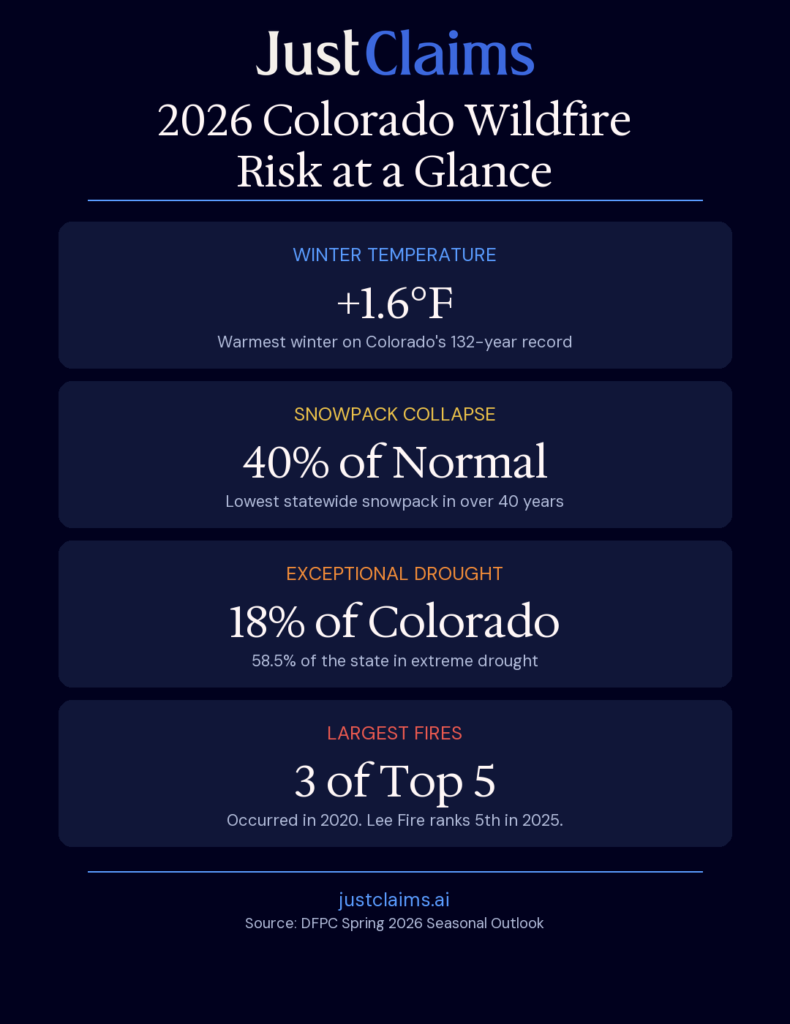
The March 2026 DFPC report: exceptional drought + historic low snowpack in San Juan and Arkansas River watersheds
Because this historical trend of escalating megafires is directly tied to climate conditions, the latest state forecasts present a severe warning for property owners. The March 2026 DFPC Spring Fire Seasonal Outlook reported that climatological winter (Dec-Jan-Feb) was the warmest on the 132-year record for Colorado, standing 1.6°F above the previous warmest winter of 1981 [2].
Statewide snowpack in Colorado’s watersheds is at its lowest in over 40 years, sitting at about 40% of historic medians [2]. The lowest snow-water equivalent totals in the state are located in the San Juans, Arkansas River, and Upper Rio Grande watersheds [2]. Extreme drought conditions are present in the Flat Tops, Gore, Mosquito, and Sawatch Ranges, with drought spreading significantly across the northern tier of Colorado compared to the previous year [2].
How drought escalates fire risk — the data behind 2026
Driven by these historically low snowpack levels and record winter temperatures, the escalating drought conditions are creating a highly combustible environment across the state. In 2026, 18% of Colorado was facing exceptional drought, while 58.5% of the state was in extreme drought, significantly increasing wildfire risk [3].
State fire leaders warned of a ‘very challenging’ wildfire season as drought covered the entire state, with an estimated 1,490 wildfires sparking [4]. Ongoing drought, particularly in northwest Colorado, was expected to accelerate fuel availability and increase ignition potential during the 2026 season [2].
Year-round fire risk: why snowpack loss means no off-season anymore
As exceptional drought accelerates fuel availability, the traditional concept of a safe season for property owners has completely vanished. Across the western U.S., 93% of snowpack monitoring stations show declines averaging 23%, with snow disappearing about 18 days earlier on average [6].
A study by Western Colorado University analyzing 36 years of data found that early snowmelt is strongly associated with earlier fire seasons and greater total area burned, while low snow water content leads to more severe fires and higher tree mortality [7]. Wildfires create a negative feedback loop where burned debris and black carbon darken the snowpack, causing it to absorb more sunlight and melt earlier for more than a decade in some places after a fire [6].
What counties are most at risk: El Paso, Larimer, Boulder
With year-round fire risk now the reality across the state, specific regions with dense populations and high fuel loads face catastrophic exposure. The Front Range’s growing suburban plains counties, particularly El Paso and Larimer, face the greatest wildfire property risk in the state .
Larimer County has had more than 20% of its total land area burned by wildfires, largely driven by massive megafires like the 2020 Cameron Peak Fire (which burned over 208,000 acres) and the High Park Fire [9]. Boulder County faces extreme risk from fast-moving, single-day grass fires, as demonstrated by the wind-whipped Marshall Fire in December 1,109, which destroyed over 1,109 homes [8].
Frequently Asked Questions
Because the historic drought and snowpack collapse of 2026 present unprecedented challenges, property owners must understand how this environmental shift impacts their immediate risk.
What is the wildfire history in Colorado?
The Cameron Peak Fire in 2020 remains the largest wildfire in Colorado history, burning a total of 208,913 acres. Three of the top five largest wildfires in Colorado history occurred in 2020, and the 2025 Lee Fire ranks fifth at 137,758 acres.
Why is the 2026 wildfire risk so high in Colorado?
Colorado’s 2026 risk is driven by exceptional drought conditions, historically low snow-water equivalent in the San Juan and Arkansas River watersheds, and record-high winter temperatures that caused snowpack to melt months ahead of schedule. In 2026, 18% of Colorado was facing exceptional drought, while 58.5% of the state was in extreme drought, significantly increasing wildfire risk.
How does early snowmelt affect wildfire severity?
A study by Western Colorado University analyzing 36 years of data found that early snowmelt is strongly associated with earlier fire seasons and greater total area burned. Furthermore, low snow water content leads to more severe fires and higher tree mortality, creating a dangerous environment for rapid fire spread.
What This Means for Your Property
Recovering from a wildfire requires more than just filing paperwork; it demands a proactive approach to documenting losses, understanding state-mandated coverage minimums, and holding insurers accountable to Colorado regulations. From securing immediate Additional Living Expenses to navigating the complexities of smoke damage and replacement costs, property owners must treat their insurance claim as a rigorous financial transaction.
Falling into the underinsurance trap or accepting a lowball settlement can jeopardize your ability to rebuild your life. By maintaining detailed inventories, leveraging the Colorado Division of Insurance’s complaint process when necessary, and understanding your rights regarding secondary damage, you can better protect your financial future. Upload your claim documents to JustClaims to see in minutes if your insurer missed coverage you’re owed.
This content is for informational purposes only and does not constitute legal or insurance advice.
Sources
[1] https://dfpc.colorado.gov/sections/wildfire-information-center/historical-wildfire-information
[3] https://coloradosun.com/2026/04/30/colorado-wildfire-forecast-2026/
[4] https://www.denverpost.com/2026/04/30/colorado-wildfire-season-risks-2026-outlook/
[7] https://western.edu/newsroom/low-snowpack-kindles-more-severe-wildfires-western-study-finds/
[8] https://coloradosun.com/2022/05/19/wildfire-risk-colorado-first-street-foundation/
[9] https://csuredi.org/redi_reports/battle-scars-trends-in-wildfire-size-and-impact-across-colorado/

Taylor Bezek

As the General Manager at JustClaims, Taylor Bezek brings over a decade of experience managing complex residential, commercial, and large-loss claims. A licensed Public Adjuster in TX (#2125659), FL (#W455048), CO (#769172), and 10 additional states, Taylor founded his own firm before joining JustClaims to scale a tech-forward solution for the insured. He is committed to combining industry expertise with AI to enhance speed, clarity, and outcomes for every policyholder. Taylor's mission is to modernize the public adjusting profession and ensure owners get exactly what they are entitled to.