Public Adjuster Guide: Maximize Your Commercial Insurance Claim
June 12, 2026
Written by Taylor Bezek
Share


As insurance carriers increasingly rely on artificial intelligence to manage surge capacity, legal professionals warn that these algorithms can produce biased claims handling and lower settlement offers. On average, claims costs represent about 80 percent of total costs commercial property owners face a growing risk of automated underpayment. Independent representation provides the forensic-level analysis required to counter skewed historical data and recover full policy value.
Key Takeaways
- Carrier AI Risks: Legal professionals caution that AI algorithms used by insurance companies could potentially lead to biased claims handling or lower settlement offers if based on skewed historical data.
- Expense Reduction: On average, claims costs represent about 80 percent of total costs [2]
- Adjuster Goals: The primary goal of a public adjuster is to secure the highest possible claim payout for the policyholder, contrasting with insurance company adjusters who aim to minimize the insurer’s costs.
- Automation Efficiency: Artificial intelligence and computer software are increasingly used in claims adjusting to automate tasks such as evaluating photographs of damaged property and calculating estimated claim amounts.
The Role of Independent Representation in Commercial Claims
Because minor valuation errors can cost millions, understanding the difference between carrier adjusters and independent representation is essential for commercial property owners. The primary goal of a public adjuster is to secure the highest possible claim payout for the policyholder [5]. This contrasts sharply with insurance company adjusters, whose objective is to minimize the insurer’s costs [1]. When a commercial property suffers extensive damage from fire, wind, or hail, relying solely on the carrier’s staff adjuster often leaves significant coverage gaps unaddressed.
Commercial insurance policies are dense contracts filled with complex endorsements, strict exclusions, and conditional sub-limits that require specialized knowledge to interpret correctly. Independent professionals work exclusively for the policyholder, analyzing this complex policy language to identify entitlements that the carrier may overlook or omit. By bringing in an expert who understands the nuances of commercial property valuation, property owners can level the playing field against large insurance corporations and support the position that all damages must be fully compensated.
The 3 Complex Claim Scenarios That Require Forensic Analysis
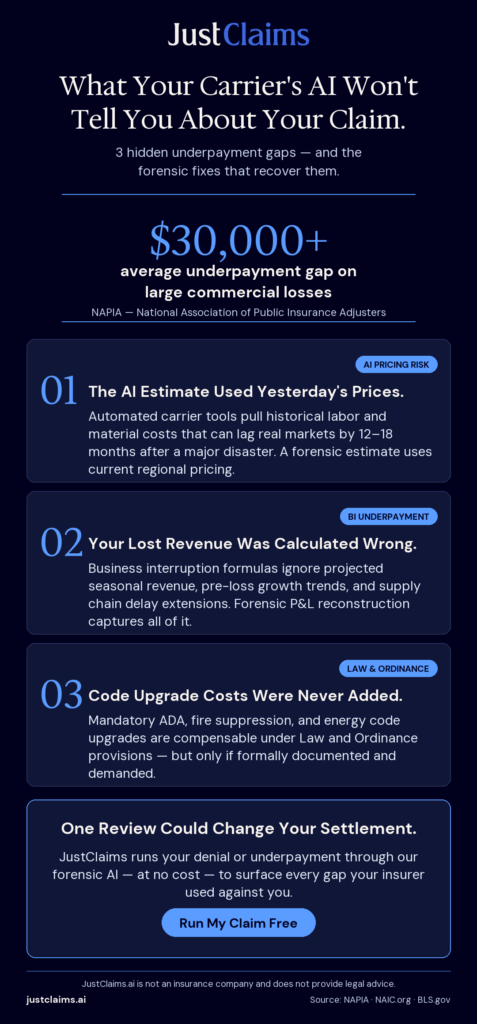
Since carrier adjusters aim to minimize costs, complex commercial losses often demand specialized intervention to prevent substantial financial shortfalls. Complex claims require forensic-level analysis to uncover hidden damages and enforce policy terms accurately.
1. Algorithmic Bias and Low Settlement Offers
The integration of artificial intelligence in claims adjustment is largely driven by the need to manage surge capacity during catastrophes and to reduce claims handling expenses [2]. However, AI algorithms used by insurance companies can potentially lead to biased claims handling or unfair outcomes if trained on skewed historical data, [2][3]. For example, automated systems might rely on outdated material pricing or localized labor rates that do not reflect the current market reality following a major disaster. Independent policyholder representation can help challenge automated valuations and support a fair settlement by presenting real-world pricing data and requesting review of AI-generated estimates [2].
2. Business Interruption and Revenue Loss
Commercial policies often include business interruption coverage, which is notoriously difficult to calculate and frequently disputed by carriers. Insurers may use restrictive formulas to project lost income, ignoring seasonal revenue spikes, projected growth, or extended recovery periods caused by supply chain delays. Independent adjusters perform detailed financial modeling to capture the true economic impact of the closure. They analyze historical tax returns, profit and loss statements, and payroll records to build a comprehensive claim. This forensic accounting supports the position that the carrier must compensate for the full operational loss, including extra expenses incurred to keep the business running at a temporary location.
3. Law and Ordinance Upgrades
When rebuilding a damaged commercial structure, local building codes often require expensive upgrades that were not present in the original building. These can include mandatory fire suppression systems, ADA-compliant accessibility modifications, or energy-efficient HVAC installations. Carriers frequently omit Law and Ordinance coverage from their initial estimates, treating these mandatory upgrades as uncovered betterments. A public adjuster identifies these specific policy provisions and documents the municipal requirements, putting the carrier on notice that code-related expenses are fully compensable under the policy. Without this intervention, property owners may be left paying out-of-pocket for legally required building upgrades.
The 3 Steps That Define the Adjustment Process
To counter the risk of skewed historical data lowering your settlement, independent adjusters follow a rigorous documentation process from the initial inspection to the final negotiation.
1. Initial Damage Inspection and Photo Evaluation
The adjustment process begins with a comprehensive site inspection to document every aspect of the physical damage. Artificial intelligence and computer software are increasingly used in claims adjusting to automate tasks such as evaluating photographs of damaged property and calculating estimated claim amounts [2]. AI tools used by public adjusters include drone-based aerial imagery analysis, computer vision for damage documentation, AI-assisted Xactimate estimating, and automated policy language review platforms By utilizing advanced software, independent adjusters can improve overall efficiency and match the technological capabilities of the carrier [1]. This phase often involves capturing thousands of high-resolution images, utilizing thermal imaging to detect hidden moisture, and creating 3D models of the affected structure to ensure no detail is missed.
2. Policy Language and Coverage Gap Identification
After documenting the physical damage, the focus shifts to the insurance contract itself. Commercial policies contain complex endorsements, sub-limits, and exclusions that carriers often interpret in their own favor. Independent adjusters cross-reference the documented damage with the specific policy language to identify coverage gaps. They scrutinize co-insurance clauses to identify and challenge potential penalties and review declarations pages to confirm all applicable coverages are triggered This meticulous review helps demonstrate what the policyholder may be entitled to receive under the terms of the policy
3. Settlement Negotiation and Carrier Communication
Once the independent estimate is complete, the public adjuster presents the findings to the insurance company and handles all subsequent communication. This phase involves disputing low-ball offers, challenging automated carrier estimates, and providing the forensic evidence necessary to justify the higher valuation. If the carrier refuses to negotiate fairly, the independent adjuster can help navigate formal dispute resolution processes, such as invoking the appraisal clause. By managing the negotiation, the independent adjuster helps demonstrate the true cost of the loss and works to secure a fair resolution without the property owner having to navigate the stressful back-and-forth.
How to Select a Licensed Professional
Public adjuster licensing requirements vary by state When selecting a public adjuster, commercial property owners should verify state licensing and look for professionals with specific experience in large-loss commercial claims. It is important to ask about their fee structure — Public adjuster fees typically range from 10% to 20% of the final settlement for large commercial losses, though the full industry range varies significantly — from as low as 2% to as high as 33% in some states — depending on claim size, property type, and applicable state regulations — and to request references from past commercial clients.
Property owners should also be wary of contractors attempting to negotiate claims on their behalf, as this often violates Unauthorized Practice of Public Adjusting (UPPA) laws. [3] A qualified, licensed adjuster will be transparent about their process, adhere to strict ethical guidelines, and possess the forensic expertise required to navigate complex policy language and counter carrier algorithms effectively.
Frequently Asked Questions
What is the main difference between a public adjuster and a carrier adjuster?
A public adjuster works exclusively on behalf of the policyholder to maximize the financial recovery from a loss. In contrast, a carrier adjuster is employed by the insurance company and is tasked with protecting the insurer’s financial interests by minimizing claim costs.
Why are insurance companies using AI to evaluate claims?
Carriers are adopting artificial intelligence primarily to handle high volumes of claims during natural disasters and to cut down on operational expenses. While this improves their internal efficiency, legal experts warn that these automated systems can rely on flawed historical data, resulting in unfairly low settlement offers for property owners.
How do independent adjusters help with business interruption claims?
Business interruption claims involve complex financial calculations that carriers often attempt to minimize. Independent professionals use forensic accounting techniques to accurately project lost revenue, ensuring that seasonal trends and extended recovery timelines are fully factored into the final demand.
When should a commercial property owner hire independent representation?
It is advisable to seek independent representation for large-loss events, complex claims involving business interruption or code upgrades, or whenever a carrier issues a low-ball settlement offer. Engaging an expert early in the process helps prevent minor valuation errors from compounding into massive financial shortfalls.
How to Protect Your Commercial Settlement
Navigating a large-loss commercial claim requires specialized expertise to counter carrier algorithms and enforce complex policy terms. By securing independent representation, you can challenge skewed automated valuations and demand a thorough, accurate assessment of your property damage. Run your business interruption denial through JustClaims‘ expert team — accelerated by our bespoke AI — to identify the coverage gaps your insurer used against you.
This content is for informational purposes only and does not constitute legal or insurance advice. Coverage decisions depend on the specific terms, conditions, and exclusions of each policy and the laws of the applicable jurisdiction; policyholders and contractors should consult with a qualified professional for advice on their particular situation.
Sources
[2] https://nationalclaimsadjusterauthority.com/ai-and-automation-in-claims-adjustment/

Taylor Bezek

As the General Manager at JustClaims, Taylor Bezek brings over a decade of experience managing complex residential, commercial, and large-loss claims. A licensed Public Adjuster in TX (#2125659), FL (#W455048), CO (#769172), and 10 additional states, Taylor founded his own firm before joining JustClaims to scale a tech-forward solution for the insured. He is committed to combining industry expertise with AI to enhance speed, clarity, and outcomes for every policyholder. Taylor's mission is to modernize the public adjusting profession and ensure owners get exactly what they are entitled to.