Recorded Statements After a Claim: What to Say 2026
July 28, 2026
Written by Taylor Bezek
Share


When you file a property damage claim, the adjuster will often ask for a recorded statement within days. Your policy’s “Duties After Loss” condition does require you to cooperate with the investigation — but what that obligation actually covers, and how quickly you must answer, depends on your policy wording and your state’s law. Knowing the difference between cooperating and volunteering helps you avoid a misstatement that gets used to reduce or deny your claim.
Key Takeaways
- Third-party requests: Duties After Loss bind only people claiming coverage under that specific policy. If another party’s insurer contacts you and you are not a claimant under their policy, that policy’s cooperation clause does not apply to you.
- First-party requirements: Your own policy requires you to cooperate with the investigation. Whether a recorded statement specifically is required depends on your form — some property policies expressly require recorded statements, while the standard HO-3 requires only cooperation, records, and an examination under oath.
- Reasonable timing and counsel: Policy language limits insurers to requests made “as often as we reasonably require,” and some states codify this — California requires reasonable notice at a reasonably convenient place and expressly allows the insured to be represented by counsel.
- Answering strategy: Answer only the specific questions asked and avoid guessing about causes or values you have not verified. A recorded statement is evidence — under Minnesota’s standard fire policy language, insureds must be told that their answers may be used against them in later civil or criminal proceedings.
Why Insurers Request Recorded Statements Early in the Process
Immediately after a property loss, insurance adjusters move quickly to establish the facts of the event. A recorded statement serves as a formal, documented account of how the damage occurred, what was affected, and the timeline of the incident. While the adjuster may frame this conversation as a routine customer service call to process your file, it is actually a primary evidence-gathering tool.
The details you provide during this initial conversation set the foundation for how the carrier will evaluate coverage. Insurers request these statements early because memories are fresh, but also because property owners have often not yet fully assessed the extent of the damage. Providing a recorded statement before you understand the full scope of your loss can inadvertently limit the scope of your claim later on. Knowing your rights regarding these recordings helps you maintain control over the claims process from day one.
The 3 Rules of Contractual Obligation That You Need to Know
Because early recorded statements serve as formal evidence, understanding your exact legal and contractual obligations is your primary defense against accidental claim denials. Property owners must navigate different sets of rules depending on who is asking for the recording.
1. Distinguishing Between Your Insurer and Third Parties
If your property was damaged by someone else—such as a neighbor’s falling tree or a negligent contractor—their insurance company may contact you to investigate. The duty to give statements is contractual, not general: policy forms limit Duties After Loss to “you, any insured, and any person or entity claiming coverage under this policy” [2]. If you are not claiming coverage under that carrier’s policy, its cooperation clause does not reach you, and you can ask to communicate in writing or through counsel instead. Note the exception — if you are also pursuing a claim against your own policy for the same loss, your own policy’s duties still apply in full.
2. Complying With Your Own Policy Terms
The rules change significantly when dealing with your own insurance provider. Property policies include a “Duties After Loss” condition that requires you to “cooperate with us in the investigation of a claim” [1]. What is less widely understood is that cooperating and giving a recorded statement are not automatically the same obligation, and the answer is in your policy form.
The widely used HO-3 form lists cooperation, producing records, submitting to an examination under oath, and returning a signed sworn proof of loss — it does not separately compel a recorded statement [1]. Other forms do. The homeowners form on file with the Nevada Division of Insurance requires the insured to “submit to recorded statements by a person we choose at the location of our choice” [2], and Florida’s Citizens HO-3 requires insureds to “Submit to examinations under oath and recorded statements” [3].
Read your own Duties After Loss section before you decide. The consequence of getting this wrong is real but narrower than it is often described: the HO-3 states the insurer has “no duty to provide coverage under this policy if the failure to comply with the following duties is prejudicial to us” [1]. Prejudice matters, and some states go further — Colorado bars an insurer from pleading failure-to-cooperate unless it first made a written request, gave 60 days to respond, gave written notice describing the alleged failure, and allowed 60 days to cure [6].
3. Exercising Your Right to Postpone
Cooperating with your carrier does not mean cooperating instantly. The controlling policy language is “as often as we reasonably require” [1], and several states put limits around that. California provides that an examination under oath “may only be conducted upon reasonable notice, at a reasonably convenient place and for a reasonable length of time,” and that “the insured may be represented by counsel and may record the examination proceedings in their entirety” [5]. Minnesota’s standard fire policy requires the insured to submit “within a reasonable period after demand,” and only after being informed of the right to counsel [4]. Policy forms themselves contemplate counsel being present — the Nevada-filed form allows the examination to proceed with no one else present “other than the examinee’s attorney” [2].
Practically, if an adjuster calls unexpectedly, you can ask to schedule the statement for a specific later time. Confirm the request and the new time in writing, since regulators advise following up phone contact in writing and retaining copies of all correspondence [8]. These protections vary by state and by policy, so confirm what applies to yours.
Common Phrasing Traps Adjusters Use During Statements
A recorded statement is an evidence-gathering step, and the questions are often open-ended or ask for estimates about things you have not yet evaluated. That is not necessarily adversarial — it is how investigations work — but it does mean your wording carries weight. Minnesota’s standard fire policy makes this explicit: before an examination, the insured must be informed “that any answers may be used against the insured in later civil or criminal proceedings” [4].
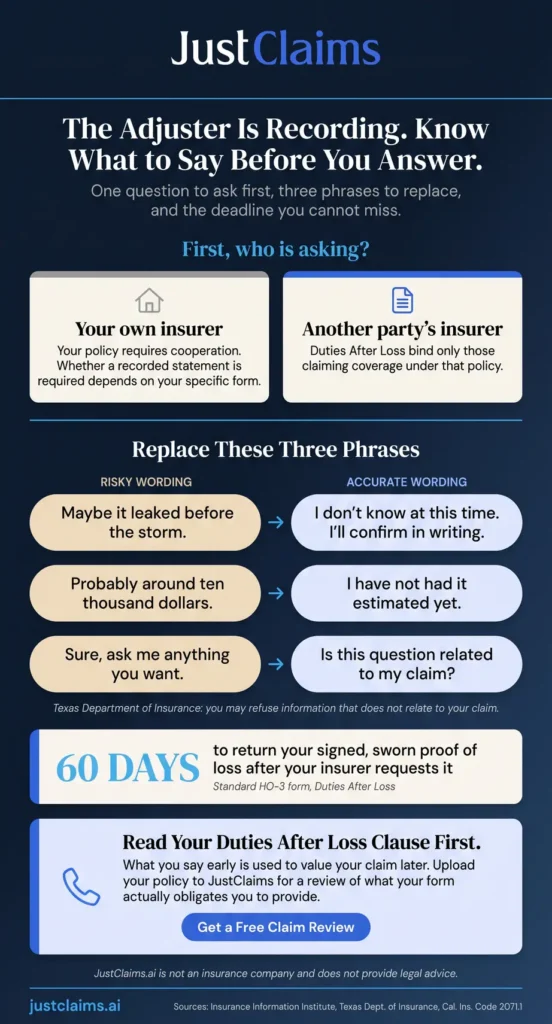
Two habits follow from that. First, answer the specific question asked. Texas gives policyholders the right “to refuse to provide your insurance company with information that does not relate to your claim” [7], and California limits examinations to information that is “relevant and reasonably necessary to process or investigate the claim” [5]. Second, do not guess. If an adjuster asks whether the roof leaked before the storm and you answer “maybe,” that uncertainty can support classifying the damage as pre-existing wear and tear. “I don’t know at this time, and I’ll confirm and follow up in writing” is an accurate and complete answer. Regulators emphasize providing complete and correct information — incomplete or incorrect information delays claims [10].
How to Prepare Before the Call Begins
Knowing that your responses can be used against you later in the process, thorough preparation is essential before you agree to start the recording. Property owners should never enter a recorded statement relying solely on memory.
Before the call, gather photographs of the damage, a written timeline of the event, and any preliminary repair estimates. State regulators advise keeping a log of every phone call and copies of all correspondence with your insurer [9], and the NAIC’s guidance to policyholders is to keep records of telephone and in-person contacts including the date, name and title of the person you spoke with and what was said [10].
Read your own Duties After Loss section so you know exactly what your policy obligates you to provide, and note the sworn proof of loss deadline — the HO-3 gives 60 days after the insurer’s request [1]. If an adjuster tells you something is not covered, New York’s regulator advises asking to see the specific contract language [8]. Preparation is what lets you answer accurately instead of approximately.
Recorded Statement vs. Examination Under Oath: Know Which One You’re Being Asked For
These two requests are often used interchangeably in conversation, but they are different instruments with different protections. A recorded statement is typically an informal audio-recorded interview with an adjuster. An examination under oath is a formal proceeding, taken under oath before a court reporter or notary, and policy forms require you to review and sign the transcript afterward [2].
The distinction matters because the express protections tend to attach to the EUO. California’s statute covering examinations under oath requires reasonable notice and a reasonably convenient place, limits questioning to relevant and reasonably necessary information, permits counsel, and lets the insured record the proceedings and obtain a free transcript copy [5]. Minnesota’s standard fire policy requires that the insured be informed of the right to counsel beforehand [4]. Before you agree to anything, ask the adjuster in writing which one is being requested and under which provision of your policy.
One point often missed by property owners who have hired help: these duties are not delegated away. Florida’s Citizens form extends Duties After Loss to “any agent or representative, including any public adjuster, engaged on behalf of you” [3]. Representation does not remove your obligation to cooperate.
Frequently Asked Questions
Do I have to let the other party’s insurance company record my statement?
Usually not. The duty to give a statement comes from an insurance contract, and policy forms limit Duties After Loss to “you, any insured, and any person or entity claiming coverage under this policy” [2]. If you are not claiming coverage under that carrier’s policy, its cooperation clause does not apply to you, and you can ask to handle communications in writing or through counsel. If you are also claiming under your own policy for the same loss, your own policy’s duties continue to apply.
What happens if I refuse to give a recorded statement to my own insurance provider?
It depends on whether your policy specifically requires a recorded statement, and on your state’s law. Some forms do require them expressly [2][3]; the standard HO-3 requires cooperation, records, an examination under oath, and a sworn proof of loss, but not a recorded statement as a separate duty [1]. A blanket refusal to cooperate is the real risk: the HO-3 states the insurer has no duty to provide coverage where non-compliance “is prejudicial to us” [1]. Some states add procedural hurdles first — Colorado requires a written request, 60 days to respond, written notice of the alleged failure, and 60 days to cure before an insurer may plead failure to cooperate [6]. Declining a recording while cooperating fully in other ways is a different situation from refusing to cooperate at all.
Can I delay the recorded statement if the adjuster calls me unexpectedly?
Generally yes. Policy language obligates you “as often as we reasonably require” rather than on demand [1]. California requires reasonable notice at a reasonably convenient place and expressly allows the insured to be represented by counsel [5]; Minnesota requires the insured to submit “within a reasonable period after demand,” after being informed of the right to counsel [4]. Ask to schedule a specific time and confirm it in writing [8]. Rules vary by state and policy, so verify what applies to yours.
How much detail should I volunteer during the recording?
Answer the question asked, completely and accurately, and stop there. Texas policyholders have the right “to refuse to provide your insurance company with information that does not relate to your claim” [7], and California limits examinations to information “relevant and reasonably necessary to process or investigate the claim” [5]. Do not speculate about causes, dates, or dollar amounts you have not verified — say you will confirm and follow up in writing. Regulators stress that incorrect or incomplete information only delays your claim [10].
How to Protect Your Claim Settlement
Navigating a recorded statement comes down to three things: reading your own Duties After Loss section so you know what you actually owe, preparing documentation so you can answer accurately instead of approximately, and scheduling the conversation rather than taking it cold. Regulators also caution against rushing a settlement and recommend seeking professional advice if you have questions about whether an offer is fair [10], and Texas confirms policyholders have “the right to reject any settlement amount, including any unfair valuation, offered by the insurance company” [7].
If you have already given a statement or are preparing for one, upload your policy and claim documents to JustClaims for a review of your coverage and your Duties After Loss obligations. Results depend on your policy language, your loss, and applicable state law.
The statutes and policy provisions cited here are drawn from specific states and specific policy forms and are used to illustrate how these obligations are typically written. They do not necessarily apply to your policy or your state. Read your own policy’s Duties After Loss condition and confirm your state’s requirements.
This content is for informational purposes only and does not constitute legal or insurance advice.
Sources
[1] Insurance Information Institute. Homeowners 3 – Special Form (HO-3), Section I – Conditions, B. Duties After Loss. https://www.iii.org/sites/default/files/docs/pdf/HO3_sample.pdf
[2] Nevada Division of Insurance. Homeowners Form HO 80 03 01 14 (American Family), Duties After A Loss. https://doi.nv.gov/uploadedfiles/doinvgov/_public-documents/Consumers/Home/American_Family/HO_80_03_01_14.pdf
[3] Citizens Property Insurance Corporation. Homeowners 3 – Special Form (CIT HO-3), certified policy with endorsements, Section I – Conditions, B. Duties After Loss. Filed with the Florida State Courts System. https://www.flcourts.gov/content/download/880901/file/Citizens-Certified-Policy-with-Endorsements_Redacted.pdf
[4] Minnesota Office of the Revisor of Statutes. Minn. Stat. § 65A.01, subd. 3 — Standard Fire Policy. https://www.revisor.mn.gov/statutes/cite/65A.01
[5] California Legislative Information. California Insurance Code § 2071.1 — Examination of an insured under oath. https://leginfo.legislature.ca.gov/faces/codes_displaySection.xhtml?lawCode=INS§ionNum=2071.1
[6] Colorado Revised Statutes. C.R.S. § 10-3-1118 — Failure-to-cooperate defense. https://law.justia.com/codes/colorado/title-10/article-3/part-11/section-10-3-1118/
[7] Texas Department of Insurance. Consumer Bill of Rights — Homeowners, Dwelling and Renters Insurance, 28 TAC § 5.9970, items 28 and 33. https://www.tdi.texas.gov/rules/2004/1011-059.html
[8] New York State Department of Financial Services. Homeowners and Tenants Insurance Guide. https://www.dfs.ny.gov/consumers/help_for_homeowners/homeowner_tenant_guide
[9] California Department of Insurance. Residential Property Claims Guide. https://www.insurance.ca.gov/01-consumers/105-type/95-guides/03-res/upload/Residential-Claims-Guide-Updated-040623.pdf
[10] National Association of Insurance Commissioners. Consumer Alert: Get Smart About Your Insurance Coverage. https://www.in.gov/idoi/files/consumer_alert_claim_smart.pdf

Taylor Bezek

As the General Manager at JustClaims, Taylor Bezek brings over a decade of experience managing complex residential, commercial, and large-loss claims. A licensed Public Adjuster in TX (#2125659), FL (#W455048), CO (#769172), and 10 additional states, Taylor founded his own firm before joining JustClaims to scale a tech-forward solution for the insured. He is committed to combining industry expertise with AI to enhance speed, clarity, and outcomes for every policyholder. Taylor's mission is to modernize the public adjusting profession and ensure owners get exactly what they are entitled to.