Independent Adjuster vs Public Adjuster: Who Works for You

November 16, 2026
Written by Taylor Bezek
Share


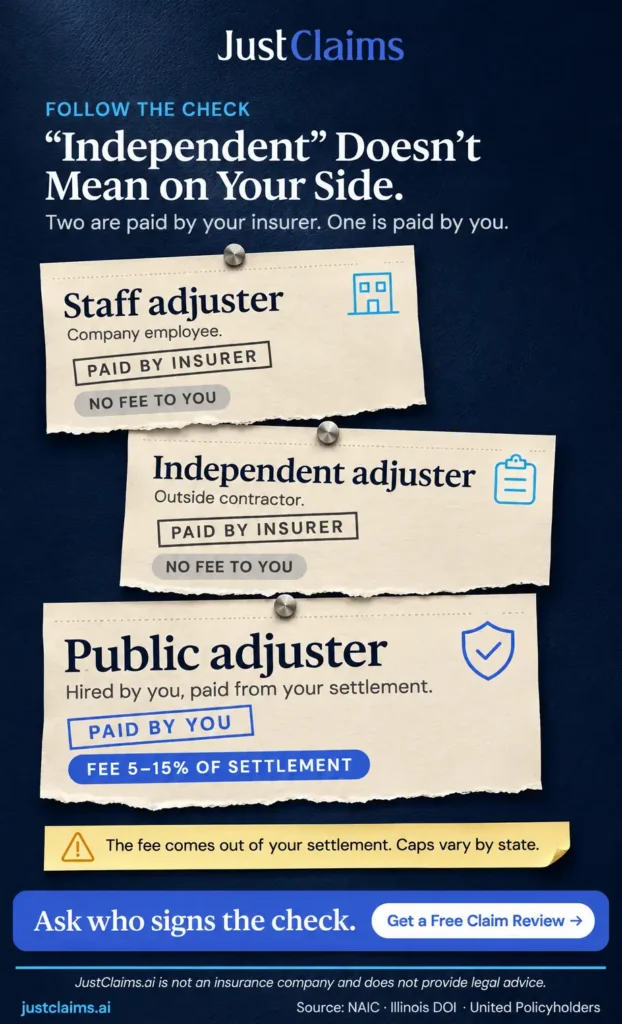
The word “independent” in an independent adjuster’s title describes how the adjuster is employed, not whose interests they represent. Their client is still the insurance company. Of the three types of adjusters who can appear on a property claim, the public adjuster is the only one hired by, and paid by, the policyholder.
Key Takeaways
- Independent adjuster’s client: The insurer — the adjuster is a contractor rather than an employee, but still represents the carrier.
- Who pays an independent adjuster: The insurance company pays. You are not charged a fee.
- Public adjuster’s client: The policyholder, not any insurance company.
- Typical public adjuster fee: A contingency percentage of the settlement, commonly 5% to 15%.
- Fee control: The contract you sign sets the fee, and some states cap it after a declared emergency.
- Hiring requirement: You are not required to hire a public adjuster for your insurer to pay your claim.
The Three Adjuster Types: Staff, Independent, and Public
Three kinds of adjusters can appear on a property claim, and the difference between them comes down to whose interests they represent. For a deeper look at the profession itself, see our explainer on what an insurance adjuster does and our guide to what happens at an adjuster inspection.
Staff (company) adjusters
A staff adjuster is a direct employee of an insurance carrier and settles claims on behalf of that employer. The NAIC’s post-disaster guidance puts it plainly: a company adjuster works only for that insurance company, and the company hires and pays them [1].
Independent adjusters
An independent adjuster is hired on a contract basis by an insurance company to represent the company’s interest in settling your claim, and the company pays them [2]. Carriers use them when they don’t have enough adjusters on staff — which the NAIC says often happens in a large disaster [1]. An independent adjuster may work for several different insurance companies, and you are not billed for their work [1]. They are not insurance company employees, but their client is still the insurer [2].
Public adjusters
A public adjuster is a person or business a policyholder can hire, at a cost, to negotiate an insurance claim with the insurance company. They are hired by the policyholder and are not employees of insurance companies [3]. The Texas Department of Insurance adds that public adjusters work for you, not the insurance company, charge fees, and cannot give legal advice or take part in repairing your property [4]. You can learn more in our guide to what a public adjuster is.
Who Pays Whom
Because each type is paid by the party it represents, payment is the fastest way to see whose interests the adjuster serves.
The Illinois Department of Insurance states that an independent adjuster is paid by your insurance company and will not charge you a fee [2]. Public adjusters are different: you hire one by signing a contract agreeing to a fee or commission based on a percentage of your settlement, and that fee comes out of what the insurer pays [2]. United Policyholders, a consumer advocacy nonprofit, reports that most public adjusters work on contingency fees ranging from 5% to 15% of what the insurer pays[5]. Some states cap those fees — Florida, for example, limits them to 10% of the claim payment for one year after a Governor-declared emergency, then 20% [6].
| Adjuster type | Hired by | Paid by | Fee charged to policyholder |
|---|---|---|---|
| Staff adjuster | Insurance carrier (employer) | Insurance carrier | None |
| Independent adjuster | Insurance carrier (contract) | Insurance carrier | None |
| Public adjuster | Policyholder | Policyholder, usually a percentage of the settlement | Yes |
What Each Adjuster Can and Cannot Do
A company adjuster or independent adjuster is there to represent the insurer’s interest in settling your claim [2]. United Policyholders notes that company, or “staff,” adjusters are employed by your insurer, and that so-called independent adjusters work only for insurance companies on a contract basis [5]. Property owners can still cooperate with them, but their role is to assess the loss for the carrier.
Public adjusters
A public adjuster does not work for any insurance company. Public adjusters have no ties to the insurance company: they estimate the damage, review your coverage, and negotiate the settlement for you [1]. Illinois requires them to serve with objectivity and complete loyalty to your interests alone [2].
Limits on public adjusters
Public adjusters face restrictions. In Illinois, they cannot solicit you while a loss-producing event such as a fire is continuing or while the fire department is at your property, and they cannot solicit between 7:00 p.m. and 8:00 a.m. [2]. Texas says they cannot give legal advice, take part in repairing the property, or act under a conflict of interest [4]. Florida requires them to be licensed by the Department of Financial Services and limits solicitation to Monday through Saturday, 8 a.m. to 8 p.m. [6]. Florida also caps fees at 10 percent of the claim payment for one year after a Governor-declared emergency, then 20 percent, and bars fees on payments made before the contract date [6]. These are state-specific rules, and other states differ.
Why Insurers Bring In Independent Adjusters After Catastrophes
This is where the “independent” label can mislead property owners, because the adjuster at your door after a storm often works for the carrier.
The NAIC’s Post-Disaster Claims Guide says an insurer will typically send either a company adjuster or an independent adjuster to assess and estimate the damage [1]. The guide explains the staffing logic: an insurer uses independent adjusters when it doesn’t have its own adjusters on staff or needs more than it has available, which often happens in a large disaster [1]. It also warns that in larger events, not all adjusters will live or work in your state — some are sent from other states to help with the volume of claims [1]. The Texas Department of Insurance has reminded carriers that they may use nonresident and emergency adjusters to handle disaster-related claims [7].
How to Tell Who You Are Talking To
Because surge staffing makes titles easy to confuse, a few direct questions can clarify whose interests the person in front of you represents.
- Ask who hired them and who pays them. A company adjuster is an insurer employee paid by the company. An independent adjuster is hired on a contract basis and is also paid by the insurer. Neither charges you a fee [2].
- Look for a contract. A public adjuster does not work for any insurer. You hire one by signing a contract that sets a fee or commission, usually a percentage of your settlement [2]. Missouri’s Department of Commerce and Insurance says a public adjuster should give you a contract, and that public adjusters charge the consumer while company and independent adjusters are paid by insurers [8].
- Check the license. North Carolina advises consumers to ask to see a public adjuster’s license and to write down the full name and license number [9]. California runs a license-status lookup that returns license status and discipline history for an adjuster [10]. Other states have their own lookups.
- Expect the insurer to redirect correspondence. Once you sign with a public adjuster, the adjuster notifies your insurer, which then sends all correspondence to the public adjuster [2].
When a Public Adjuster May Be Worth Considering
Hiring a public adjuster is a choice, not a requirement. Pennsylvania states that you are not required to hire a public adjuster for the insurance company to pay your claim [3]. Even if you hire one, Missouri notes your insurer may still send its own adjuster and does not have to accept your public adjuster’s estimate [8].
A public adjuster may be worth weighing when the loss is complicated, when you lack time to document and present it, or when the carrier’s estimate seems to leave out damage you can show. Before signing, review the points below.
- Compare the percentage fee, and get it in writing: the contract sets the amount you will pay [2].
- Find out whether your state caps fees [6].
- Confirm the license before you sign [9].
- Understand the cancellation window. Florida allows cancellation within 10 business days of signing. For claims tied to a declared state of emergency, the window is 30 days after the date of loss or 10 days after signing, whichever is longer[6].
Frequently Asked Questions
Is an independent adjuster on my side?
No. An independent adjuster is hired on a contract basis by your insurance company to represent the company’s interest in settling your claim, and the company pays them [2]. The word “independent” refers to their employment status, not to neutrality toward the policyholder.
Does an independent adjuster charge me anything?
No. The Illinois Department of Insurance states that the insurance company pays the independent adjuster and that they will not charge you a fee [2]. The NAIC’s guidance says the same: you do not pay an independent adjuster [1]. That is one clue that the adjuster answers to the carrier.
Do I have to hire a public adjuster?
No. Pennsylvania’s Insurance Department says you are not required to hire one for your insurer to pay the claim [3]. It is an optional service, and you can weigh the fee against the help you expect to receive.
How are public adjusters paid?
Usually a percentage of the settlement your insurer pays, under a contract you sign [2]. United Policyholders describes the common range as 5% to 15%, and some states cap fees [5][6].
Can I check whether a public adjuster is licensed?
Yes. State insurance departments publish guidance and lookup tools, such as California’s license-status search and North Carolina’s advice to ask for a license and record the number [10][9]. Verify the license before signing any contract.
Verify Who Your Adjuster Works For
The central question on any claim is who pays the adjuster and who they answer to. Staff and independent adjusters represent the insurer, while a public adjuster is the only one of the three who represents you, in exchange for a fee [2]. Ask for the contract, check the license, and compare the fee before you commit [8][9].
If you want to know what your own policy says before you evaluate an adjuster’s estimate, run a free policy review with Justin to see the coverage language, limits, and deadlines that decide your claim.
This content is for informational purposes only and does not constitute legal or insurance advice. Coverage decisions depend on the specific terms, conditions, and exclusions of each policy and the laws of the applicable jurisdiction; policyholders and contractors should consult with a qualified professional for advice on their particular situation.
Sources
[1] Post-Disaster Claims Guide (PDF) — National Association of Insurance Commissioners
[2] Public Adjusters — Illinois Department of Insurance
[3] Hiring a Public Adjuster — Pennsylvania Insurance Department
[4] Home Insurance Guide (public adjusters section, updated June 1, 2026) — Texas Department of Insurance
[5] Questions to Ask Before Hiring a Public Adjuster — United Policyholders
[6] Public Adjusters Overview — Florida Department of Financial Services
[7] Commissioner’s Bulletin B-0008-24 — Texas Department of Insurance
[8] Not All Insurance Adjusters Are the Same — Missouri Department of Commerce and Insurance
[9] A Consumer’s Guide to Public Adjusters — North Carolina Department of Insurance
[10] Check License Status — California Department of Insurance

Taylor Bezek

As the General Manager at JustClaims, Taylor Bezek brings over a decade of experience managing complex residential, commercial, and large-loss claims. A licensed Public Adjuster in TX (#2125659), FL (#W455048), CO (#769172), and 10 additional states, Taylor founded his own firm before joining JustClaims to scale a tech-forward solution for the insured. He is committed to combining industry expertise with AI to enhance speed, clarity, and outcomes for every policyholder. Taylor's mission is to modernize the public adjusting profession and ensure owners get exactly what they are entitled to.