Hazard Insurance for Rental Property: Landlord Guide
November 18, 2026
Written by Collin Corcoran
Share


A rental property claim can fail for reasons that have nothing to do with the damage: the wrong dwelling form, an exclusion nobody read, or a lost-rent limit that runs out before the drywall goes back up. The form on your declarations page decides how the carrier values the loss, what it excludes, and whether the rent you lose is covered at all.
Key Takeaways
- Which form you hold: Rental property is usually written on a dwelling fire policy (DP-1, DP-2 or DP-3) because the owner does not live there.
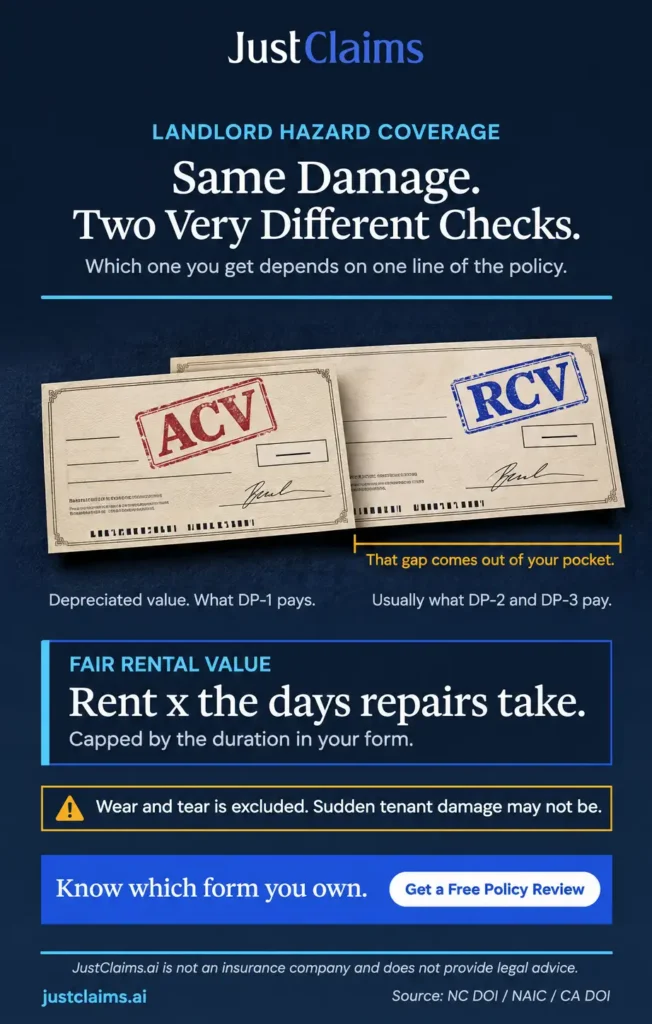
- What the form changes: DP-1 settles at actual cash value, DP-2 typically settles at replacement cost, and DP-3 is the broadest of the three.
- Tenant belongings: A landlord policy covers the building and the owner’s own items, not the tenant’s possessions.
- Lost rent: Fair rental value replaces rent while covered repairs make the unit unlivable, subject to the limit and duration in your policy.
- Where claims go wrong: Vacancy, wear and tear, mold, pests and seepage are written into the standard exclusion list — read them before you file.
What Counts as Hazard Insurance on a Rental
Hazard insurance is the property coverage in the policy — the part that pays for physical damage to the building from covered perils. On a rental, that coverage is usually written on a dwelling fire policy [1]. The North Carolina Department of Insurance describes the form as one used by an owner who does not make the property their primary residence, and lists rental properties, vacation homes, vacant homes and seasonal homes among the properties it fits [1]. It also notes that dwelling policies typically do not provide liability coverage the way some homeowners forms do [1].
What separates the three forms is the perils they cover and the basis on which a claim is settled.
| Form | Perils approach | What the regulator says about it |
|---|---|---|
| DP-1 (basic) | Named perils: fire, lightning, internal explosion; wind, hail and other extended perils only if purchased | Settled on an actual cash value basis, with replacement cost available for an additional cost [1] |
| DP-2 (broad) | Named perils with a longer list, including vandalism and malicious mischief, windstorm, hail and weight of ice and snow | Typically settles on a replacement cost basis [1] |
| DP-3 (special) | Open perils for the dwelling and other structures; named perils for personal property | The most comprehensive dwelling fire coverage available, subject to the exclusions named in the policy [1] |
Read the declarations page for the form number before you read anything else. For the full form-by-form walkthrough, see our guide to what DP3 insurance means.
Landlord Insurance vs. Homeowners Insurance
The NAIC puts the difference plainly: when a house becomes a rental, it has gone “from being a residence to a place of business” [2]. A landlord policy covers the house, other structures on the property, the owner’s possessions, lost rental income if the house becomes uninhabitable, and some liability protection [2]. Three differences do most of the work.
Personal Property
A landlord policy covers the owner’s interest in the building and the owner’s own items — not the tenant’s possessions. The Massachusetts Division of Insurance states that the landlord’s coverage does not extend to a tenant’s personal property [3], and the California Department of Insurance makes the same point [4]. That is why a lease should require the tenant to carry renters coverage.
Loss of Use vs. Fair Rental Value
An owner-occupant policy pays the owner’s additional living expenses when the home cannot be lived in; the California Department of Insurance describes that coverage as normally limited to 20 percent of the Coverage A dwelling limit [4]. A landlord form instead carries fair rental value, which the Idaho Department of Insurance describes as paying when tenants are forced out by a covered loss and the owner cannot collect rent for a period while repairs are completed [5].
Liability
Liability is where the dwelling form and the homeowners form part ways, and where two regulator statements need reconciling. The North Carolina Department of Insurance says dwelling policies typically do not provide liability coverage [1]. The NAIC describes a landlord policy as including some liability protection [2]. Those two statements only reconcile if liability was added to the dwelling form — so read the declarations page and confirm it is listed. Larger buildings raise different questions, which we cover in our guide to apartment building insurance coverage.
Covered Perils and Key Exclusions on a Rental Policy
A DP-3 is an open perils, or all-risk, form. The dwelling and other structures are covered for all types of damage except the exclusions named in the policy, while damaged personal property is covered only for named perils [1]. That split is worth understanding before you file.
What an Open-Perils Form Can Cover
Open perils covers more than fire. On a DP-1, windstorm, hail, smoke, vehicles, riot and vandalism are available only when the extended coverage premium appears on the declarations page [1]; on a DP-2, vandalism and malicious mischief, windstorm and hail, weight of ice and snow, and accidental discharge of water are listed among the covered perils [1].
Which Exclusions Matter on a Rental
The California Department of Insurance lists flood, earthquake, earth movement, pests, water damage from seepage or leaks, losses to a house vacant for 60 days or more, mold, wear and tear or maintenance, and neglect among the perils generally not covered [4]. Flood is the one to check first: FEMA states that most homeowners insurance does not cover flood damage and that flood insurance is a separate policy [6]. Intentional loss is a separate named exclusion on the DP-3 [1]. For the full exclusion list attached to each dwelling form, see our guide to what DP3 insurance means.
Actual Cash Value and Depreciation
Actual cash value is not replacement cost. The California Department of Insurance defines an actual cash value recovery as the cost to repair, rebuild or replace less a fair and reasonable deduction for physical depreciation [4]. On a hail-damaged roof, that depreciation comes out of the payment. Confirming whether the dwelling settles at actual cash value or replacement cost before a loss is the difference between a scope that funds the repair and one that does not.
Does Landlord Insurance Cover Tenant Damage?
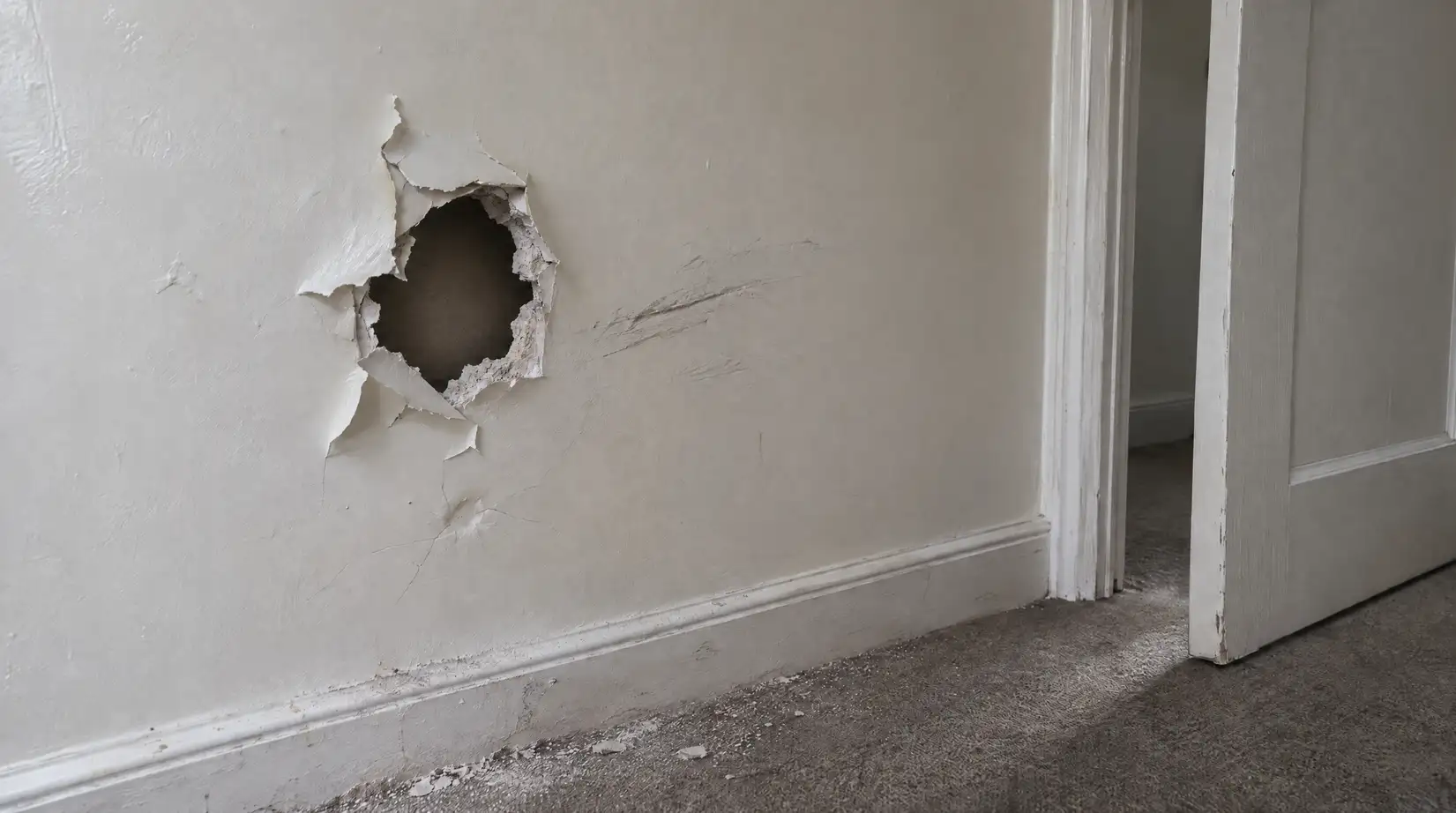
Sometimes — it depends on the cause. The Massachusetts Division of Insurance notes that a landlord’s policy covers structural damage to the building and may protect the owner against damage caused by tenants [3]. The exclusion list decides the rest.
Accidental Damage
Accidental damage sits inside the covered side of the line when the loss is sudden. Fire is a named peril on the basic form [1], so a kitchen fire that damages walls and cabinets is the kind of event a dwelling policy is written to answer. Damage that accumulates — wear and tear, maintenance deferred too long, seepage — is excluded [4].
Intentional Damage and Vandalism
Intentional loss is a named exclusion on the DP-3 [1]. Vandalism and malicious mischief are different: on a DP-1 they can be added, and on a DP-2 they are listed among the covered perils [1]. Whether a tenant’s damage is treated as an accident or as intentional conduct can decide the claim, so document the cause as carefully as the damage.
Tenant Belongings
A landlord policy responds to the structure and the owner’s financial interest in it. Tenant possessions sit outside that interest [3][4], which is why a lease should require renters coverage. For how a tenant’s own claim works, see our guide to the renters insurance claim process.
Lost Rent and Fair Rental Value
Lost rent is the part of a rental claim that has no equivalent on an owner-occupant policy. The Idaho Department of Insurance describes fair rental value as paying when tenants are forced out of the property by a covered loss and the owner cannot collect rent for a period while repairs are completed [5]. The NAIC confirms that lost rental income is part of what a landlord policy covers when the house becomes uninhabitable [2].
How the Figure Is Calculated
Fair rental value is not a blank check for the rent you hoped to charge. The Florida First District Court of Appeal described it as revenue minus the expenses that are no longer incurred for the period when renting is not occurring [7]. That definition tells you what records to keep: the lease, the rent roll, and the bills that stopped when the unit emptied.
How Long It Lasts
Duration and dollar limits come from the policy, not from a rule of thumb. In Krum v. Chubb Ltd., a non-precedential Tenth Circuit order, the court reviewed a policy that covered fair rental value “for up to 15 days” and only while the property was “usually rented” [8]. The insurer denied the claim in full because the owner had not rented the property in the four years before the loss, and the court affirmed [8]. Read the fair rental value limit, the time period and any rental-condition wording on your own declarations page before a loss, not after.
What It Does Not Cover
Fair rental value covers lost rent, not the repair. The dwelling portion of the claim pays to fix the building; the fair rental value portion pays for the income the building stopped producing while it could not be rented [5]. Keep the two calculations separate, with separate documentation.
Filing a Landlord Claim
A rental claim is two claims in one file: the building and the income. Documenting them separately keeps the carrier from folding one into the other.
Document the Property and the Cause
Photograph and video the damage before repairs begin, and record what caused it. The California Department of Insurance advises keeping an inventory of personal property that lists the items, the dates purchased and the price, along with photographs of anything valuable [4]. Apply the same discipline to the building: dated photos, room by room, before anything is moved or torn out.
Separate Building Damage From Income Loss
Prepare the structure claim and the lost rent claim as distinct pieces. Gather the leases, the rent payment records and the repair timeline, because the fair rental value figure is built from rent revenue minus the expenses that stopped [7]. A repair schedule that shows how long the unit was unusable supports the duration [5].
Review the Settlement Basis Before You Accept an Offer
Check whether the dwelling settles at actual cash value or replacement cost. Under actual cash value, depreciation is deducted from the repair cost [4], so the first number on the page is not the cost of the work. Compare the carrier’s estimate with your contractor’s scope line by line before you sign anything.
Common Denials: Vacancy and Maintenance
Two exclusions are worth reading before a unit sits empty or a repair gets deferred: vacancy and maintenance.
Vacancy
The California Department of Insurance lists losses to a house vacant for 60 days or more among the perils generally not covered [4], and the North Carolina Department of Insurance notes that accidental discharge or overflow of water is covered on a DP-2 only as long as the building was not vacant for 60 days before the loss [1]. Courts enforce those conditions. In Pettinaro Enterprises v. Continental Casualty, the Third Circuit considered a policy that would not pay for loss or damage caused by arson where the building had been vacant for more than 60 consecutive days before the loss [9]. Confirm what your form says before a unit sits empty between tenants.
Maintenance and Wear and Tear
Wear and tear, maintenance, mold, pests, seepage and neglect appear on the regulator’s exclusion list [4]. If a denial cites one of them, the question is chronology: was the loss a sudden covered event, or the end of a slow process? Ask the carrier to identify the specific policy language it relied on, and document the date the damage first appeared.
Frequently Asked Questions
What does hazard insurance cover on a rental property?
It generally covers physical damage to the building and other structures from covered perils, and it may include fair rental value and liability protection depending on the form [1][2]. It does not cover the tenant’s belongings [3].
Is hazard insurance the same as landlord insurance?
Not exactly. Hazard insurance describes the property coverage that responds to physical damage to the building [1]. A landlord policy is what that coverage is called when it is written for a rented property, and it can add fair rental value and liability protection that a bare dwelling form does not provide [2].
Is a DP-3 better than a DP-1 for a rental?
A DP-3 covers the dwelling on an open perils basis, which means all types of damage are covered except the named exclusions. A DP-1 covers only named perils and settles at actual cash value, with extended perils and replacement cost available for an added premium [1]. The right fit depends on the property, the lender and the budget.
Does a landlord policy pay for a tenant’s belongings?
No. The landlord policy responds to the structure and the owner’s interest in it [3][4]. The tenant needs renters insurance for personal possessions.
Will insurance pay for damage a tenant caused on purpose?
Intentional loss is excluded on the DP-3 form [1]. Vandalism and malicious mischief may be added on a DP-1 and are listed among DP-2 perils [1], so the answer depends on the form and the endorsements you bought.
How long does lost rent coverage last?
It depends on your policy. Fair rental value pays for the period the unit cannot be rented while repairs are completed [5], and policies set their own caps — one reviewed by the Tenth Circuit covered it “for up to 15 days” [8]. Read the limit and the time period on your declarations page.
What to Check Before Filing
Landlord claims turn on three things: the form on your policy, the cause of the loss, and how well the rental income is documented. Read the declarations page for the dwelling form, the settlement basis, and the fair rental value limit before you file. Then compare the carrier’s denial or estimate against the exclusions and endorsements actually written into the policy.
Run a free landlord policy review with Justin to see how your form is written, where the exclusions bite, and what the lost-rent limit actually pays. If the carrier has already denied or underpaid the claim, our property insurance claim help service covers what a licensed public adjuster does next.
This content is for informational purposes only and does not constitute legal or insurance advice. Coverage decisions depend on the specific terms, conditions, and exclusions of each policy and the laws of the applicable jurisdiction; policyholders and contractors should consult with a qualified professional for advice on their particular situation.
Sources
[1] Dwelling Policies — North Carolina Department of Insurance
[2] Leaving Home? Insurance Considerations When You Move — NAIC
[3] Consumer Alert: Homeowner to Renter — Massachusetts Division of Insurance
[5] Home & Renters Insurance Coverage — Idaho Department of Insurance
[6] Flood Insurance — FEMA / National Flood Insurance Program
[7] Homeowners Choice Property & Casualty Insurance Co. v. Clark, Fla. 1st DCA (2025) — CourtListener
[8] Krum v. Chubb Ltd., No. 23-1262 (10th Cir. Aug. 19, 2024) (order and judgment) — GovInfo
[9] Pettinaro Enterprises, LLC v. Continental Casualty Co., 3d Cir. (2011) — CourtListener

Collin Corcoran

Experienced Public Adjuster and Property Claims Specialist, Collin is licensed in New York (#1603393), New Jersey (#3003700204), and Connecticut (#19820270). With 20+ years of hands-on construction and property damage experience, he specializes in residential and commercial claims, complex loss inspections, policy review, detailed estimating, and strategic negotiation. Collin’s background in construction, asset management, emergency response, and claims documentation allows him to accurately identify damage, understand repair requirements, and advocate effectively for policyholders. He works with homeowners, business owners, contractors, and insurance professionals to move claims forward with clarity, accuracy, and confidence. Collin is committed to transparency, technical precision, strong communication, and securing fair outcomes for policyholders.