Flat Roof Pros and Cons for Commercial Buildings
November 18, 2026
Written by Taylor Bezek
Share


Commercial flat roofs give owners a large, usable roof plane for equipment and solar, plus one plane that inspection work can reach. Standing water is where problems tend to start: roof design guidance treats water still on the membrane 48 hours after precipitation as ponding, and ponding can be detrimental to the roof assembly. Maintenance records, roof age, and policy valuation terms often shape how an insurer treats a later loss.
Key Takeaways
- Ponding threshold: roof design guidance treats water still on the roof 48 hours after precipitation as ponding.
- Minimum slope: Arkansas requires at least ¼ inch per foot for positive drainage on new state facilities.
- Inspection frequency: FEMA’s low-slope roof guidance calls for inspections at least twice a year, ideally in spring and fall, and after high-wind events.
- ACV coverage: pays only the depreciated cost of damaged property, according to the NAIC.
- RCV coverage: pays to repair or replace damaged property without deducting for depreciation, according to the NAIC.
- Maintenance exclusion: Maine’s insurance regulator says a homeowners policy is not a maintenance contract and does not pay for items that simply wear out.
Commercial Flat Roof Systems: Materials and Service Life
Most commercial flat roofs are low-slope roofs, built with a slight pitch so water drains. A roof treatment guide from the City of Cleveland lists the common systems as EPDM, modified bitumen, built-up roofing, single-ply PVC or TPO, and spray polyurethane foam [1]. The system on your building affects its expected service life and how a carrier may later view a loss.
TPO and EPDM Single-Ply Membranes
TPO and PVC are weldable thermoplastic membranes, and EPDM is a thermoset rubber membrane. The Department of Defense’s roofing criteria state that properly heat-welded thermoplastic seams can exhibit seam strengths comparable to the membrane sheet, and that properly constructed weldable thermoplastic systems may last 15 years or more [2]. The same criteria state that properly constructed EPDM systems are now providing 30 years or more of service life [2]. For how these membranes behave after hail, see our guide to TPO and EPDM hail damage and functional impairment.
Modified Bitumen
Modified bitumen is a factory-made asphalt sheet product, and Cleveland’s guide lists modified bitumen asphalt among the standard flat-roof systems [1]. It is installed as rolled sheets, and the exposed surface can be granulated, foil-faced, or smooth-coated. Its service life falls inside the 10-to-40-year range the guide gives for most flat roof options [1].
Metal Roofing
Metal is the long-life option. Cleveland’s guide puts metal roofing at 30 to 75 years depending on material and maintenance, against 10 to 40 years for most flat roof options [1].
Flat Roof Advantages: Footprint, Rooftop Equipment, Solar, and Access
Because flat-roof maintenance and claim outcomes are closely linked, it helps to understand why owners choose these roofs in the first place. The advantages below come from government and design guidance, not contractor marketing.
A Single Plane Over a Large Footprint
A low-slope roof covers the building’s footprint in a single plane. That plane has to be pitched to drain: Arkansas requires at least one-quarter inch per foot for positive drainage on new state facilities [3]. The same plane is where rooftop equipment and solar arrays sit [4][5].
Rooftop Equipment and Penetrations
Low-slope roofs are where commercial HVAC units, skylights, and roof hatches usually sit. FEMA’s low-slope roof guidance treats rooftop equipment, hatches, and skylights as roof components that must be flashed and secured, because each one is a potential water entry point [4].
Solar Readiness
Commercial rooftop solar is often mounted on flat roofs. The Department of Energy’s Better Buildings guide describes ballasted racking, which uses weights such as concrete blocks to anchor PV systems on a flat roof, and notes that these systems need few or no roof penetrations [5]. It also warns that ballasted systems only work on flat roofs capable of supporting the ballast weight, that some jurisdictions limit fully ballasted systems, and that hybrid systems carry an increased risk of leaks from faulty roof penetrations [5].
Access for Inspection and Repair
Low-slope roofs can be walked for inspection, and maintenance guidance assumes someone will get on the roof. FEMA’s guidance calls for inspections at least twice a year, ideally in the spring and fall, and after high-wind events, with needed repairs completed quickly [4]. Cleveland’s guide likewise calls for yearly maintenance to keep a roof secure, watertight, and clear of debris [1].
Flat Roof Drawbacks: Ponding, Seams, and Shorter Lifespan
The same single plane that makes a flat roof practical also makes drainage the first thing to verify.
Ponding Water
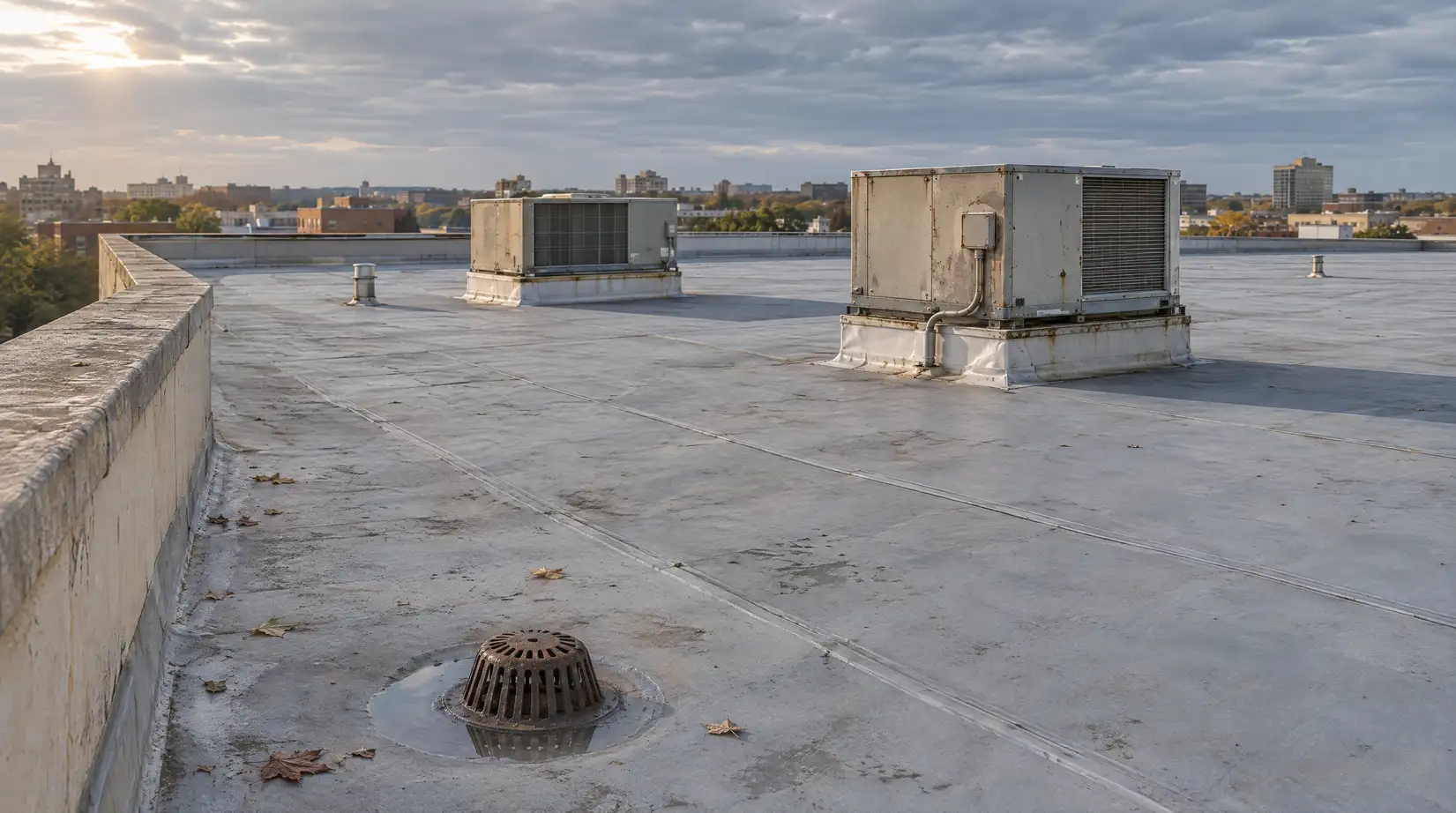
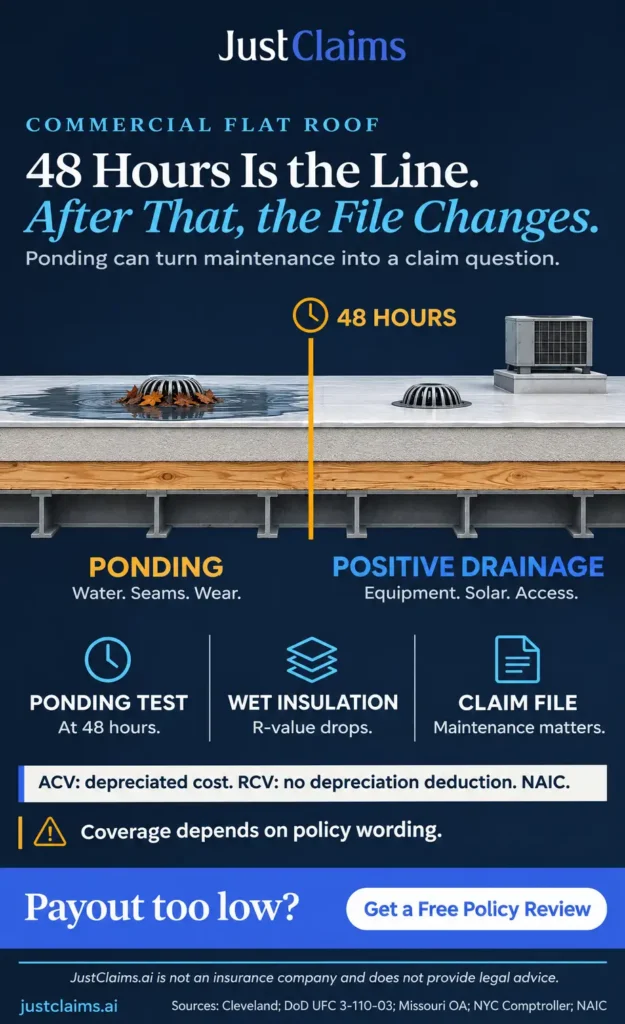
Ponding is the flat-roof problem design guidance addresses first. Missouri’s roof design guidelines for state facilities use a 48-hour test: no ponding water on the roof surface 48 hours after a precipitation event under conditions conducive to drying [6]. A New York City Comptroller audit applies the same test and quotes NRCA’s Roofing Manual: “the criterion for judging proper slope for drainage is that there be no ponding water on the roof 48 hours after a rain during conditions conducive to drying” [7].
The audit describes what prolonged ponding does: moisture can accumulate in the roof subsurface, and the insulating value (R-value) of thermal insulation can be reduced [7]. In the buildings it examined, the audit attributed the ponding primarily to inadequate slopes that did not produce positive flow to the drains [7]. Arkansas addresses the design side directly, requiring roof surfaces with a minimum slope of one-quarter inch per foot for positive drainage on new state facilities [3].
Seams and Penetrations
Flat and low-slope systems deteriorate over months or years rather than in a single event. Seams and penetrations are where the membrane is joined or interrupted, so seam quality matters: the Department of Defense’s criteria note that properly heat-welded thermoplastic seams can exhibit seam strengths comparable to the membrane sheet [2]. Because deterioration is gradual, there is often no single event date, which complicates whether a loss was sudden or the result of long-term wear.
Shorter Service Life
Compared with metal, membrane systems turn over sooner. Cleveland’s guide puts most flat roof options at 10 to 40 years with proper maintenance and appropriate installation, while metal roofing can last 30 to 75 years [1]. The Department of Defense’s criteria are more conservative on thermoplastics, putting properly constructed systems at 15 years or more, and put properly constructed EPDM at 30 years or more [2].
Flat Roof Lifespan and Maintenance Schedule
Because maintenance moves service life [2], the maintenance schedule is also the paper trail an insurer may request after a loss.
Expected Service Life by System
Use ranges, not a single number. The figures below come from government guidance, and they overlap because installation quality, climate, and maintenance move the result [1][2]:
- Most flat roof systems: 10–40 years with proper maintenance and appropriate installation [1]
- Metal roofing: 30–75 years depending on material and maintenance [1]
- EPDM: 30 years or more for properly constructed systems [2]
- Weldable thermoplastic (PVC/TPO): may last 15 years or more for properly constructed systems [2]
Manufacturer warranties, installation quality, climate, and maintenance all shift these numbers, so use them for capital planning rather than as a prediction for a specific roof.
Inspection Frequency
FEMA’s low-slope roof guidance says the roof should be inspected at least twice per year, ideally in the spring and fall, to evaluate condition and identify potential repair needs, and that inspections should also be done after high-wind events [4]. Needed repairs should be completed quickly after the inspection so additional damage does not occur [4].
| Roof situation | Inspection approach |
|---|---|
| Most low-slope roofs | At least twice a year, ideally spring and fall [4] |
| After a high-wind event | Inspect for storm-related damage [4] |
| After the inspection | Complete needed repairs quickly to prevent additional damage [4] |
Maintenance Documentation
The Department of Defense’s roofing criteria state that with good maintenance, the service life of a roof is extended many years and the life-cycle cost of roofing is reduced [2]. Dated inspection reports, drainage photos, and repair invoices are the practical evidence of that program, and they can help show a carrier how the roof was cared for before a loss. United Policyholders advises documenting every communication with the insurer and confirming promises made by phone in a follow-up email or letter [8].
Insurance Implications: Maintenance Exclusions, Roof Age, and ACV vs. RCV
Because flat roofs often fail gradually, insurers tend to look closely at maintenance history and roof age when a loss is reported. Much of the consumer guidance below is written for residential policies, so commercial terms may differ. Review the wording with your broker and in the context of a broader commercial property insurance claim.
Maintenance Exclusions and Wear and Tear
Maine’s Bureau of Insurance puts the principle plainly for homeowners policies: a policy insures against damage from perils such as fire, wind, and hail, and it does not pay to repair items that simply wear out, like aging roof shingles [9]. On a flat roof with chronic ponding or failed seams, a carrier may point to that line between a covered peril and wear-out.
Roof Age and Payment Schedules
Roof age can change the coverage itself. The Texas Department of Insurance warns that as roofs age, some companies will switch roof coverage to actual cash value, and that a roof in poor condition might not be covered at all [10]. It advises checking at renewal whether roof coverage terms have changed [10]. Separately, United Policyholders describes insurer “roof payment schedules” that state what a roof will be worth, based on age and roof type, if a loss occurs [11].
ACV vs. RCV: How the Valuation Basis Changes the Payout
The NAIC explains that RCV coverage pays to repair or replace damaged property without deducting for depreciation, while ACV coverage pays only the depreciated cost [12]. Insurers usually calculate depreciation based on the condition of the property when it was lost or damaged, what a new item would cost, and how long the item would normally last [12].
The NAIC’s roof example uses two families with the same $15,000 loss and a $1,000 deductible. The RCV policyholder receives $14,000. The ACV policyholder, with $10,000 deducted for depreciation, receives $4,000 [12].
The DC Department of Insurance, Securities and Banking offers a second example. A 10-year-old roof that costs $25,000 to replace and is depreciated by 50% would pay $25,000 minus the deductible under RCV, but $12,500 under ACV, and the policyholder covers the rest [13]. The department notes that ACV policies often cost less upfront but can leave significant out-of-pocket expenses [13]. Both examples are written for residential policies, so commercial terms may differ.
Recoverable Depreciation and Proof of Replacement
The North Carolina Department of Insurance explains that with replacement cost coverage, the insurer may first pay the actual cash value. Once the item is repaired or replaced and receipts are submitted, it reimburses the extra amount, called “recoverable depreciation” [14]. Keep replacement invoices and completion records so the second payment is not delayed.
When Flat Roof Damage Becomes a Claim
Everything above leads to one practical question: when does a maintenance problem become a covered loss? The distinction matters because a policy does not pay for items that simply wear out [9]. For the broader process, see our guide to a roof insurance claim.
Signs that a roof problem may warrant a claim review include:
- Damage found after a severe storm, which is when FEMA says an inspection should occur [4]
- New leaks or interior moisture that appear after a defined weather event
- Membrane splits, lifted seams, or displaced rooftop equipment that follow a specific incident
- Standing water that persists past the 48-hour drainage criterion [6][7]
Before filing, gather your last inspection report, dated photos, maintenance invoices, and the policy’s valuation clause. Confirm whether the roof is valued at ACV or RCV [12], and how the policy treats wear-out [9]. A roof loss can also interrupt operations and trigger code-upgrade costs, so ask the carrier in writing how lost income and ordinance-driven costs are being handled.
Frequently Asked Questions
How long can water sit on a flat roof before it is considered ponding?
Missouri’s roof design guidelines for state facilities treat water still on the roof 48 hours after precipitation as ponding [6]. A New York City Comptroller audit, quoting NRCA’s Roofing Manual, uses the same 48-hour test and notes that ponding beyond it can be detrimental to the roof assembly [7].
Which flat roof system lasts the longest?
Metal, by a wide margin. Cleveland’s guide puts metal roofing at 30 to 75 years, against 10 to 40 years for most flat roof options [1]. Among membranes, the Department of Defense’s criteria put properly constructed EPDM at 30 years or more and weldable thermoplastic systems at 15 years or more [2].
Will insurance cover damage from a flat roof that has ponding problems?
It depends on the policy and the cause of loss. Maine’s insurance regulator says a homeowners policy does not pay for items that simply wear out [9], and as roofs age some companies switch roof coverage to actual cash value [10]. Documented inspections and prompt repairs help show the damage came from a covered event rather than neglect.
How often should a commercial flat roof be inspected?
FEMA’s low-slope roof guidance calls for inspections at least twice a year, ideally in the spring and fall, plus inspections after high-wind events [4].
What is the difference between ACV and RCV on a roof claim?
ACV pays the depreciated value of the roof, while RCV covers repair or replacement without a depreciation deduction [12]. With RCV, the insurer may pay the ACV first and release the withheld depreciation after you submit proof of repair or replacement [14].
How to Protect Your Flat Roof Claim
Flat roofs offer usable rooftop space, a single plane for equipment and solar, and roof-level access for inspection. Standing water is the risk that matters most: roof design guidance treats water still on the membrane 48 hours after precipitation as ponding, and ponding can be detrimental to the roof assembly [6][7]. Schedule inspections twice a year and after high-wind events, correct drainage problems early, and keep every report and invoice together. Valuation terms can change the size of the payment on a large commercial schedule.
Before you respond to the carrier, get a free commercial property policy review from Justin and flag coverage gaps in Business Interruption and Law & Ordinance.
This content is for informational purposes only and does not constitute legal or insurance advice. JustClaims is not a law firm. Coverage decisions depend on the specific terms, conditions, and exclusions of each policy and the laws of the applicable jurisdiction, so consult a qualified professional for advice on your situation. This article reflects a licensed public adjuster’s perspective on claims and policy issues; public adjuster licensing requirements vary by state, so confirm the licensing status of any adjuster you retain. No outcome or settlement amount is promised or implied.
Sources
[1] Roof Treatment Guide (2026) — City of Cleveland
[3] 22 CAR § 111-1207: Minimum Roof Slopes for Positive Roof Drainage — Arkansas Code of Arkansas Rules
[4] Fact Sheet 3.3.2: Roof Systems—Low-Slope Roofs (FEMA P-2181) — Federal Emergency Management Agency
[5] Commercial Rooftop Solar: Frequently Asked Questions — U.S. Department of Energy, Better Buildings
[6] AE Roof Design Guidelines — Missouri Office of Administration
[7] Audit Report SE18-059A — New York City Comptroller
[8] Speak UP: How to Communicate With Your Insurance Company — United Policyholders
[9] A Consumer’s Guide to Homeowners Insurance — Maine Bureau of Insurance
[11] Roof Insurance: ACV Versus Replacement Cost — United Policyholders
[13] Roof Damage Claims: What You Need to Know — DC Department of Insurance, Securities and Banking
[14] Actual Cash Value vs. Replacement Cost Value — North Carolina Department of Insurance

Taylor Bezek

As the General Manager at JustClaims, Taylor Bezek brings over a decade of experience managing complex residential, commercial, and large-loss claims. A licensed Public Adjuster in TX (#2125659), FL (#W455048), CO (#769172), and 10 additional states, Taylor founded his own firm before joining JustClaims to scale a tech-forward solution for the insured. He is committed to combining industry expertise with AI to enhance speed, clarity, and outcomes for every policyholder. Taylor's mission is to modernize the public adjusting profession and ensure owners get exactly what they are entitled to.