Risk Management Insurance for Contractors: A Practical Guide (2026)
November 20, 2026
Written by Taylor Bezek
Share


Insurance is only one part of a contractor’s risk program. The rest sits in the contract you sign, the way you run the work, and the records you can produce after a loss. Miss those, and a claim that should pay can still stall, shrink, or land on your balance sheet. This guide shows how to identify, allocate, and transfer risk—and what to keep in writing so a covered loss does not become a cash-flow problem.
If you hire contractors, the same clauses decide whether their insurance actually protects your property—and whether a loss ends up on your balance sheet.
Key Takeaways
- Insurance is one tool, not the program. Contracts allocate risk, safety and quality control reduce it, and insurance transfers the part you cannot prevent.
- State law can void the clause. Anti-indemnity statutes in states such as California and Texas limit what you can be forced to indemnify; Texas also limits additional insured requirements.
- A certificate is not coverage. The ACORD certificate is information only; it does not give the holder rights or change the policy. Read the endorsements.
- Verify subcontractor coverage. Some states can treat you as the statutory employer for a subcontractor’s workers’ comp exposure.
- Claims history follows you. An experience factor compares your losses with similar employers, and a claim can affect premiums for three years.
Risk Management vs. Buying Insurance
A contractor’s risk program has three parts. The contract decides who bears which risk. The work itself—preconstruction planning, means and methods, supervision, and safety—reduces how often a loss happens and how severe it gets. Insurance transfers the residual risk you cannot safely retain.
Insurance does not allocate responsibility between you and the owner, and it does not stop a loss. It responds according to the policy wording, limits, exclusions, and endorsements. That is why two contractors with the same policy can get different outcomes: the contract and the claim file can decide which coverage applies and how much is paid.
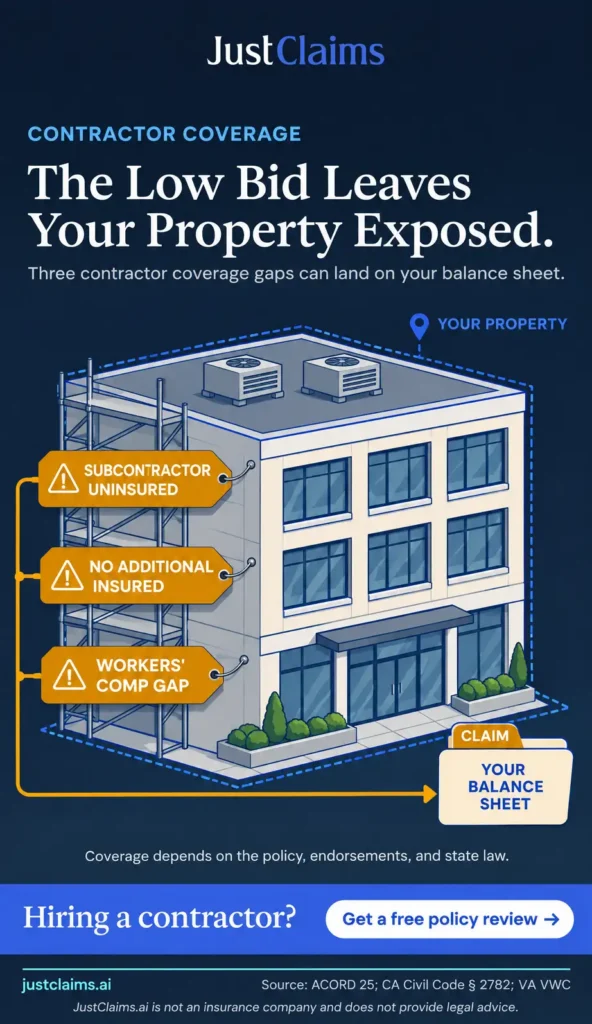
This matters at bid time. A low insurance price can hide a gap that shows up after a loss—an uninsured subcontractor, an additional insured endorsement that was never issued, or a workers’ comp exposure that follows the general contractor. The rest of this guide follows the money: contract terms, the coverage stack, subcontractor proof, experience rating, and claim documentation.
What Risk Management Actually Controls
Risk management is the process of deciding which risks to avoid, reduce, retain, or transfer. For a contractor, the practical controls are:
- Contract terms: indemnity, additional insured status, waivers of subrogation, and insurance specifications.
- Operations: preconstruction planning, sequencing, qualified labor, inspections, and safety programs.
- Insurance: general liability, commercial auto, workers’ comp, builders risk, and inland marine.
- Claims records: notices, photos, logs, receipts, and written communication with the carrier.
No single one of these is enough. A strong safety program does not cure a bad indemnity clause, and a good policy does not fix a claim file with no documentation.
Upstream and Downstream Risk: Contract Terms, Indemnity and Insurance Requirements
Risk flows both ways. Upstream, owners and general contractors push obligations down to you. Downstream, you push them to your subcontractors. Both directions run through indemnity clauses and insurance requirements.
Indemnity Is a Promise, Not a Policy
An indemnity clause is a promise to pay or defend another party for a defined loss. It does not by itself provide a defense or the money to satisfy a judgment. That is why owners and general contractors usually pair an indemnity clause with insurance requirements and additional insured status.
CGL policies contain exclusions—including damage to your work and care/custody/control—that can affect construction claims [1]. An additional insured endorsement is what extends a subcontractor’s liability coverage to the general contractor or owner; the ACORD certificate itself says the policy must have additional insured provisions or be endorsed [2]. For a deeper look at who is actually covered, see named insured vs additional insured.
State Anti-Indemnity Rules Change What Is Enforceable
Anti-indemnity statutes vary by state, and they can change the deal you thought you signed. Two examples show the range.
California Civil Code § 2782 makes void and unenforceable a construction contract clause that purports to indemnify the promisee for the promisee’s sole negligence or willful misconduct, or for design defects furnished by the promisee or its agents [3]. The statute also addresses residential construction defects: a subcontractor’s promise to insure or indemnify the builder or general contractor is unenforceable to the extent the claims arise from the builder’s or contractor’s negligence or design defects, or do not arise out of the subcontractor’s scope of work [3]. Subdivision (a) expressly does not affect the validity of an insurance contract, workers’ compensation, or an agreement issued by an admitted insurer [3].
Texas takes a different route. Texas Insurance Code § 151.104 makes void and unenforceable an additional insured provision in a construction contract to the extent it requires coverage prohibited by the state’s anti-indemnity rules [4]. Subsection (b) creates an exception for a consolidated insurance program to the extent the provision lists, adds, or deletes named insureds [4]. Chapter 151 also excludes owner-controlled and contractor-controlled consolidated insurance programs from other parts of the subchapter, except as provided in § 151.104 [4].
The practical lesson: do not assume the clause you signed in one state is enforceable in another. Read the indemnity and insurance requirements together, and verify the current statute before you sign.
Two State Examples Worth Knowing
California’s § 2782 is not a blanket ban on indemnity. It targets specified conduct and design defects, and subdivision (a) preserves insurance contracts [3]. Subdivision (d) separately limits insurance and indemnity for residential construction defect claims [3]. Texas’s § 151.104 does not ban every additional insured requirement; it voids the provision only to the extent it requires coverage the anti-indemnity law prohibits, with a consolidated-program exception [4]. Those distinctions are where disputes live.
The Coverage Stack: GL, Auto, Workers’ Comp, Builders Risk and Inland Marine
Once the contract has allocated risk, insurance is the layer that pays when the allocation fails. A typical contractor stack can include five core policies. The exact forms, limits, and endorsements decide what actually responds.
General Liability
General liability protects against financial loss from bodily injury, property damage, medical expenses, libel, slander, defending lawsuits, and settlement bonds or judgments [5]. A commercial general liability (CGL) policy typically covers premises liability, products liability, and completed operations [1]. It also has major exclusions—including damage to your work, care/custody/control, automobiles, and mobile equipment—so the policy is not a backstop for every business dispute [1].
Professional liability is a separate line for malpractice, errors, and negligence in services [5]. Do not assume a CGL policy fills that gap.
Commercial Auto
Commercial auto protects the company from liability arising from automobiles used in the business, and it can cover damage to the covered vehicle [1]. A business auto policy can cover business, hired, and non-owned autos depending on the coverage purchased [1].
Personal auto coverage is not a safe substitute. Maine’s Bureau of Insurance notes that most personal automobile insurance policies exclude business use of a personal auto [6]. If you use a vehicle primarily for business—driving to worksites, hauling tools and equipment, making deliveries—ask for a commercial auto policy.
Workers’ Compensation
Workers’ compensation pays statutory benefits when an employee suffers a work-related injury or illness [1]. California employers are required to carry it under Labor Code § 3700 [1]. States set their own rules, and ownership status matters: Tennessee’s Bureau of Workers’ Compensation explains that non-construction sole proprietors, LLC members, and partners are not covered by the policy unless they specifically choose to include themselves [7].
The exposure can also travel. Under Virginia’s statutory employer law (§ 65.2-302), a contractor can bear workers’ comp liability for a subcontractor’s employees who perform the same trade, business, or occupation, or who fulfill a contract obligation of the contractor [8].
Builders Risk
Builders risk covers direct physical loss to a building or structure during construction, including building supplies and materials that will become part of the structure [9]. It can also cover foundations, excavations, temporary structures, and scaffolding at the jobsite [9]. Soft costs—additional interest, real estate taxes, advertising, lease renegotiation, architects’ and engineers’ fees, insurance premiums, and legal and accounting fees—can be added by endorsement [9].
The limit matters. If the limit is below 100% of the full completed value, the insurer may apply a penalty and pay only part of the loss [9]. On Oregon state contracts, the standard clause requires the contractor to maintain builders risk, so read your contract to see who is responsible on your job [9]. For a deeper look, see our guide to builders risk insurance.
Inland Marine
California’s regulator lists builders risk as a commercial inland marine line, alongside equipment floaters [10]. Inland marine is a specialized property line that primarily covers your business property while it is in transport, and it can cover liability for property in your care, custody, or control during transport [1].
For contractors, a common form is an equipment floater for contractors’ equipment [1]. Coverage and valuation depend on the form, so check the schedule and the valuation clause rather than assuming a tool or a piece of equipment is covered.
Certificates and Subcontractor Compliance
Your downstream risk transfer is only as strong as the coverage your subcontractors actually carry. A certificate helps you check the paperwork, but it is not the policy.
The standard ACORD certificate states that it is issued as a matter of information only and confers no rights on the certificate holder [2]. It also states that it does not affirmatively or negatively amend, extend, or alter the coverage afforded by the policies [2]. A certificate alone therefore does not prove the coverage a subcontract requires.
Check the Endorsements, Not the Description Box
The ACORD form states that if the certificate holder is an additional insured, the policy must have additional insured provisions or be endorsed [2]. If subrogation is waived, certain policies may require an endorsement [2]. A statement on the certificate does not give the holder rights in place of those endorsements [2]. Request and read the actual endorsements, and compare the named insured, additional insured, limits, and policy period to the subcontract.
Why Workers’ Comp Verification Matters
Virginia’s statutory employer law shows why a certificate check is not enough [8]. A contractor can bear workers’ comp liability for a subcontractor’s employees who perform the same trade, business, or occupation, or who fulfill a contract obligation of the contractor [8]. If the subcontractor’s coverage is missing or defective, the general contractor can end up with the exposure.
Ask for proof of workers’ comp coverage, not just a general liability certificate. Check the entity name, policy period, and coverage status, and keep the proof with the subcontract file. For a full compliance checklist, see our post on subcontractor insurance requirements.
EMR and Claims History as Pricing Inputs
Loss prevention and claims history feed into what you pay for coverage, which affects both margins and bid competitiveness. Workers’ comp experience rating—often called the experience modification rate, or EMR—is a clear example.
Washington’s Labor & Industries agency describes the experience factor as a prediction of how a business’s future claim costs will compare with other businesses in its risk classifications [11]. If the business’s claim costs are likely to be higher than similar businesses, the agency assigns a factor greater than 1 [11]. The factor is built into the premiums the business and its employees pay [11].
How the Experience Period Works
The experience period is generally three years, and a claim can affect premiums for three calendar years [11]. Washington uses the oldest three of the four fiscal years before the effective date of premium rates [11]. The agency also states that a three-year period is common practice in other states [11].
Reading the Number
A factor above 1 predicts higher-than-average claim costs; a factor below 1 points the other way [11]. Because the experience period is multi-year, one bad year can follow you through several renewals [11]. That makes injury prevention a financial priority, not just a safety slogan [11].
When a Claim Goes Wrong: Documentation and Representation
A claim that is poorly documented or underpaid can disrupt cash flow and affect your claims history. The claim file is your evidence. United Policyholders recommends documenting every communication with the insurer in a notebook or diary so you can track the status of the claim [12]. It also recommends creating a paper trail by confirming promises and representations in a follow-up email or letter [12].
Several habits help:
- Document the loss early. Keep dated photos, daily logs, material receipts, and subcontractor records with the claim file.
- Keep the policy and endorsements together. Coverage often turns on endorsement wording, so compare the carrier’s position against the actual policy language.
- Ask for written explanations. If a carrier denies or reduces a claim, request the basis in writing and ask the insurer to point to the specific policy language it relied on [12].
- Track every communication. Dates, names, and documents sent create a record you can use if the dispute continues [12].
The same discipline applies to property losses at your own yard, office, or equipment storage; see our guide to a commercial property insurance claim. A clean, well-supported claim also gives you a stronger record if the dispute continues.
Frequently Asked Questions
What does risk management insurance mean for a contractor?
It generally refers to the mix of policies a contractor buys to transfer the risks that cannot be cheaply prevented, such as general liability, commercial auto, workers’ compensation, builders risk, and inland marine [1][5]. Those policies work best when paired with clear contract terms and a real safety program.
Does a certificate of insurance prove my subcontractor is covered?
Not by itself. The standard ACORD certificate says it is issued for information only and does not amend, extend, or alter the policy’s coverage [2]. Requesting the underlying endorsements gives a clearer picture of additional insured status and waivers of subrogation [2].
How does EMR affect what a contractor pays?
The experience factor (EMR) compares a contractor’s claim costs with similar employers and is built into workers’ comp premiums [11]. A factor above 1 predicts higher-than-average claim costs; a factor below 1 points the other way [11]. Preventing injuries and managing claims is the lever the experience system is designed to reward [11].
Are indemnity clauses enforceable in every state?
No. Anti-indemnity statutes vary by state, and they can void or limit indemnity and additional insured provisions [3][4]. California and Texas are two examples; verify the current rule in the state where the work is performed before you sign [3][4].
Steps You Can Take Before Your Next Bid
Managing risk well can help keep you insurable and can reduce payment disputes. That means reading indemnity and insurance clauses before you sign, verifying subcontractor endorsements instead of relying on certificates, keeping your experience factor low through injury prevention and claims management, and documenting every loss from the first day.
If a property claim is denied or underpaid, run a free AI policy review with Justin. Our licensed public adjuster team and purpose-built AI review the policy language, compare it against your documentation, and flag likely underpayments so you can go back to the carrier with a clearer position.
This content is for informational purposes only and does not constitute legal or insurance advice. Coverage decisions depend on the specific terms, conditions, and exclusions of each policy and the laws of the applicable jurisdiction; policyholders and contractors should consult with a qualified professional for advice on their particular situation.
Sources
[1] Commercial Insurance Guide — California Department of Insurance
[2] Certificate of Liability Insurance (ACORD 25) — New York State Department of Financial Services
[3] California Civil Code § 2782 — California Legislative Information
[4] Texas Insurance Code Chapter 151 — Texas Constitution and Statutes
[5] Get Business Insurance — U.S. Small Business Administration
[6] Business Use of Personal Auto — Maine Bureau of Insurance
[7] Other Coverage Options: Sole Proprietors, Partners and LLC Members — Tennessee Bureau of Workers’ Compensation
[8] Contractor Information — Virginia Workers’ Compensation Commission
[9] Insurance Clauses: Builders Risk — Oregon Department of Administrative Services
[10] Lines of Insurance — California Department of Insurance
[11] Experience Rating — Washington State Department of Labor & Industries
[12] Speak UP: How to Communicate With Your Insurance Company — United Policyholders

Taylor Bezek

As the General Manager at JustClaims, Taylor Bezek brings over a decade of experience managing complex residential, commercial, and large-loss claims. A licensed Public Adjuster in TX (#2125659), FL (#W455048), CO (#769172), and 10 additional states, Taylor founded his own firm before joining JustClaims to scale a tech-forward solution for the insured. He is committed to combining industry expertise with AI to enhance speed, clarity, and outcomes for every policyholder. Taylor's mission is to modernize the public adjusting profession and ensure owners get exactly what they are entitled to.