Commercial Public Adjuster: What Business Owners Need
November 12, 2026
Written by Taylor Bezek
Share


On a commercial property claim, one valuation error can ripple through every coverage on the policy—business interruption, extra expense, ordinance or law, and the property limit itself. A commercial public adjuster is a licensed professional who documents and negotiates the full loss across those layered coverages on the policyholder’s behalf. The work is detail-heavy, and the fee terms deserve as much scrutiny as the estimate.
Key Takeaways
- BI trigger: Business interruption coverage replaces income lost when operations are disrupted by a covered physical loss, such as a fire.
- Coverage packaging: A businessowner’s policy (BOP) combines property, general liability, and business interruption coverage for small businesses.
- Ordinance or Law timing: Coverage C—increased cost of construction—is generally not paid until the building is actually repaired or rebuilt.
- Typical adjuster fee: Public adjusters typically charge 5% to 15% of the final settlement, according to the Ohio Department of Insurance.
- Hiring requirement: A business is not required to hire a public adjuster, according to the Illinois Department of Insurance.
- Illinois cap scope: Illinois’ 10% cap applies to claims arising from damage to a personal residence or from a catastrophic event.
Commercial Public Adjuster: What Business Owners Need
How Commercial Claims Differ From Other Property Claims
A commercial loss is rarely one claim under one policy. It is a set of coverages that interact, so a small error in how one is valued can spread through the whole settlement.
Business Interruption and Extra Expense
Business interruption—often called business income—replaces income lost when operations are disrupted by a covered physical loss, such as a fire. It typically picks up continuing expenses such as payroll, taxes, and loan payments while the property cannot be used [1].
Extra expense coverage repays additional costs incurred during the period of repairs—for example, rent at a temporary location—so the business can keep operating instead of closing. Civil authority coverage can respond when a government order restricts access after a direct physical loss; these clauses usually carry time limits and waiting periods [1].
The National Association of Insurance Commissioners (NAIC) says business interruption is typically bundled into a businessowner’s policy (BOP) that also includes business property and liability coverage. Contingent business interruption (damage to a supplier’s or customer’s property) and extended business interruption are optional coverages added by endorsement [2]. For a deeper look, see our guide to business interruption, extra expense and loss of rents.
Ordinance or Law Coverage
Ordinance or law coverage responds when building, zoning, or land-use law affects the rebuild. The California Department of Insurance describes three parts: Coverage A for loss to the undamaged portion of the building, Coverage B for demolition and removal of undamaged parts, and Coverage C for the increased cost of repairs or reconstruction. Replacement cost must be in effect for Coverage C to apply [3].
Coverage C is generally not payable until the building is actually repaired or rebuilt. Some forms also set a completion deadline; the Texas Department of Insurance windstorm form, for example, requires the work to be done as soon as reasonably possible and not to exceed two years after the loss.[4]
We break the three coverages down separately in ordinance or law coverage A, B and C.
Blanket vs. Scheduled Limits
A blanket limit is coverage that extends to more than one location or class of property, according to the NAIC glossary [5]. A scheduled policy instead lists a separate limit for each building. The difference matters at claim time: one shared limit can be consumed by a single large loss. Before you file, ask which limit applies to the damaged building—and whether a sublimit caps it.
We cover the full comparison in blanket vs. scheduled coverage. For the broader claim process, see commercial property insurance claims.
Who Hires a Commercial Public Adjuster, and When
Because layered coverage makes commercial losses hard to value, the decision to bring in outside help usually follows a specific trigger.
Common Triggers
The Ohio Department of Insurance says public adjusters help with large or total losses by inventorying and documenting the loss [6]. United Policyholders, a national nonprofit consumer advocacy organization, puts the underlying work plainly: documenting and negotiating a claim takes more effort than most people realize, and you may do better with help [7]. Situations that justify a closer look include:
- A denied claim, or a payment far below your repair estimates
- Extensive damage, such as a major fire or hurricane
- A claim that has stalled, or insurer communication that has gone quiet
United Policyholders advises policyholders to screen carefully, resist high-pressure sales pitches, and not hire prematurely [7].
Limits and Trade-Offs
Ohio Department of Insurance guidance states that, aside from attorneys and the broker of record, licensed public adjusters are the only type of claims adjuster that can legally represent an insured’s rights during the claim process. It also warns that adding an adjuster adds another level of communication, which can complicate or delay matters [6].
The Illinois Department of Insurance says a business is not required to hire a public adjuster. It notes that insurer staff adjusters help at no charge and that policies do not cover a public adjuster’s fee [8]. Weigh the size and complexity of the loss against that cost.
The Claim Team Behind a Large Commercial Loss
Because complex claims require forensic-level analysis, a large commercial claim is usually built by a team, not one person.
Forensic Accountant
A forensic accountant combines accounting and auditing with investigative expertise to calculate a business income loss. United Policyholders notes that adjusters often hire one—and that you may need your own to back up your accountant’s calculations. You have the right to hire your own accountant at your expense and to have that person work with the adjuster or the carrier’s accountant [9].
For a substantial loss, United Policyholders calls it “penny-wise and pound-foolish” not to bring in your own accountant or other financial professional [9].
Expect to supply proof of business income and expenses for at least one to two years before the loss, including financial statements, payroll records, sales records, continuing expenses, and business income and sales tax returns [9]. For how the loss calculation itself works, see our guide to actual loss sustained business income.
Engineer and Contractor
You can hire your own cost estimate. United Policyholders notes that consulting firms can prepare a detailed scope of work and cost estimate, and that an independent consultant may be a better choice than a contractor’s number if the dispute turns litigious [10].
Coverage Counsel
Large or complex commercial claims benefit from experienced coverage counsel early. United Policyholders notes that an insurance lawyer or public adjuster experienced with business interruption claims can help maximize recovery by insisting the loss be calculated under the policy terms, the law, and applicable insurance regulations—and that ambiguity be resolved in your favor [9].
Counsel can also help in appraisal disputes. United Policyholders cautions that appraisers are not supposed to decide issues outside actual cash value or the amount of loss, but often do [11].
Fee Expectations and Engagement Terms
The fee terms in the contract deserve the same scrutiny as the estimate. The Ohio Department of Insurance says public adjusters typically charge 5% to 15% of the final settlement, paid by the insured, with the rate varying by complexity and amount recovered [6]. For how the role works, see what a public adjuster does; for the full state-by-state picture, see public adjuster fees.
Caps and contract rules differ by state and by claim type:
| State | Catastrophic claims | Other claims | Notes |
|---|---|---|---|
| Illinois | Capped at 10% | 10% if the claim is a personal residence; otherwise the written contract controls | Cap applies when the claim arises from damage to a personal residence or a catastrophic event.[12] |
| Utah | No more than 10% | No more than 20% | No fee, retainer, or deposit before the claim is settled.[13] |
| Hawaii | Presumed unreasonable above 10% | Presumed unreasonable above 15% | Also applies to hourly arrangements if the aggregate fee exceeds those percentages.[14] |
Your state’s rule may differ; confirm the cap and contract requirements with your state insurance department.
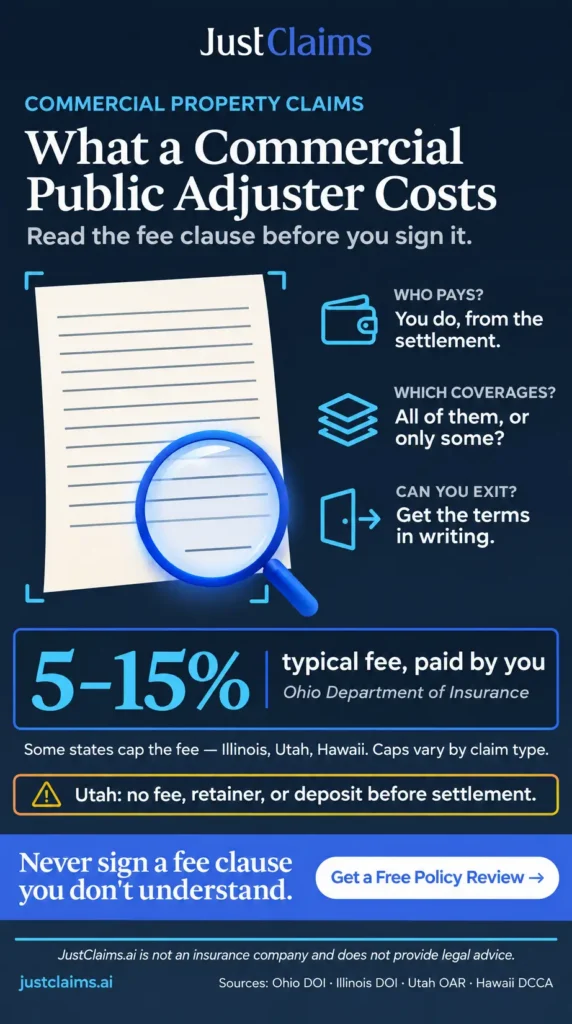
Contract mechanics matter too. Illinois requires every public adjuster contract to state the full compensation, including any applicable cap, and the exact percentage if the fee is a share of the settlement. An Illinois contract may not let the adjuster collect the entire fee from the first check rather than as a percentage of each check, or charge a percentage on money that is due but not yet paid [15].
Questions to Ask Before Signing
Because fee terms and adjuster capacity shape the outcome as much as the claim itself, use this checklist before you sign anything.
Fee and Scope Questions
United Policyholders says fees on that range of contingency percentages are capped in some states and negotiable in all states [7]. Agree up front on three points [16]:
- Whether the adjuster takes a percentage of money the insurer already agreed in writing to pay but has not yet paid
- Whether the fee applies to all coverage categories or only some
- Whether the adjuster handles only part of the claim
The Illinois department adds that fees can and should be negotiated. It requires a written contract approved by the Director of Insurance that specifies services and compensation, and it advises verifying that the adjuster is licensed and in good standing [8].
Capacity and Experience Questions
- Will the person you interview personally handle your claim, or is that person a sales rep who will hand it off [16]?
- How many other claims has the adjuster signed in the area? An overloaded adjuster cannot give your claim the attention it needs [16].
- How long have they been licensed in your state [16]?
- Can they provide at least three references from claims they personally handled in the past 3 years [16]?
Exit and Pressure Questions
Ask whether you can terminate before settlement and what you would owe if you do—and get the answer in the contract. Ask, too, how the fee applies to money the insurer has already paid you [16]. United Policyholders advises resisting high-pressure post-disaster sales pitches, screening candidates carefully, and not hiring prematurely [7]. Complaints go to the state insurance regulator [16].
Frequently Asked Questions
What does a commercial public adjuster do differently from a residential one?
A commercial public adjuster works across several coverages at once, including property damage, business interruption, extra expense, and ordinance or law. The work includes documenting lost income with financial records and matching the analysis to the policy terms [1][9].
Do I have to hire a public adjuster for a business claim?
No. The Illinois Department of Insurance states that a business is not required to hire one, and that insurer staff adjusters assist at no charge. The decision depends on how large and complicated the loss is and how much you can handle during recovery [8].
How much does a commercial public adjuster cost?
The Ohio Department of Insurance reports that fees typically run as a percentage of the final settlement, varying with the claim’s complexity and the amount recovered. Some states set separate limits for catastrophic and non-catastrophic claims, so confirm the rule that applies in your state [6][13][14].
Is a forensic accountant part of the public adjuster’s work?
Often a forensic accountant is a separate specialist who calculates the business income loss from revenue, cost, and expense records. United Policyholders notes that you have the right to hire your own accountant and that, for a substantial loss, doing so is usually worth the cost [9].
When should I hire a public adjuster?
Timing depends on your policy deadlines and your state’s rules. United Policyholders advises against hiring prematurely or under pressure, and recommends screening candidates carefully. If your claim is already underway, ask whether the adjuster will take it mid-process and how the fee applies to money the insurer has already paid [7][16].
How to Vet a Commercial Public Adjuster
Commercial recovery depends on getting every coverage layer valued correctly, from business interruption to ordinance or law. Before you sign, confirm the adjuster’s license, read the fee clause against your state’s rules, and ask who will handle your file.
Decide which specialists—a forensic accountant, an independent estimator, or coverage counsel—your loss needs. Then get a free commercial property policy review from JustClaims, where our expert team, accelerated by bespoke AI, flags likely gaps in your business interruption and ordinance or law coverage before you negotiate.
This content is for informational purposes only and does not constitute legal or insurance advice. Coverage decisions depend on the specific terms, conditions, and exclusions of each policy and the laws of the applicable jurisdiction; policyholders and contractors should consult with a qualified professional for advice on their particular situation.
Sources
[1] What Business Income Loss Coverages Are Out There? — National Association of Insurance Commissioners
[3] Commercial Insurance Guide — California Department of Insurance
[4] Form 431 — Texas Department of Insurance
[5] Glossary of Insurance Terms — National Association of Insurance Commissioners
[6] Using a Public Adjuster — Ohio Department of Insurance
[7] Making the Best Choice When Hiring a Public Adjuster — United Policyholders
[8] Public Adjusters — Illinois Department of Insurance
[9] Getting (Back To) Business Interruption Insurance — United Policyholders
[10] Guidelines for Reviewing Adjusters’ and Contractors’ Estimates — United Policyholders
[11] Policyholders Can Win in Appraisal — United Policyholders
[12] Company Bulletin CB2024-16: Public Adjuster Compensation — Illinois Department of Insurance
[15] 215 ILCS 5/1575 (Public Adjuster Law) — Illinois General Assembly
[16] Questions to Ask Before Hiring a Public Adjuster — United Policyholders

Taylor Bezek

As the General Manager at JustClaims, Taylor Bezek brings over a decade of experience managing complex residential, commercial, and large-loss claims. A licensed Public Adjuster in TX (#2125659), FL (#W455048), CO (#769172), and 10 additional states, Taylor founded his own firm before joining JustClaims to scale a tech-forward solution for the insured. He is committed to combining industry expertise with AI to enhance speed, clarity, and outcomes for every policyholder. Taylor's mission is to modernize the public adjusting profession and ensure owners get exactly what they are entitled to.