AI Property Inspection: Stop Leaving Margin on the Table
September 14, 2026
Written by Taylor Bezek
Share


A manual walkthrough only captures what one inspector saw, on one day, on the surface. On a commercial loss — where a single fire or water event can damage the structure, the systems inside it, and everything stored in it at once — what gets missed at inspection turns into change orders, supplements, and margin that evaporates after tear-out begins. AI-assisted inspection tools are changing that math, giving contractors a way to document every component against pricing data and policy language before a carrier ever pushes back.
Key Takeaways
- What manual scoping misses: Initial inspections capture visible, surface-level damage. Hidden damage — water, smoke, mold, compromised framing — typically surfaces only after tear-out begins.
- Why it costs you: Damage missed on the first scope becomes a supplement battle later — and the later it’s documented, the harder it is to get paid for.
- What AI-assisted inspection changes: Computer-vision tools apply the same evaluation criteria to every photo and cross-check line items against pricing data, producing a documented basis for the scope instead of one inspector’s judgment call.
- What carriers are doing: Insurers already use AI in claims processing — including damage assessment from photos — under formal regulatory governance adopted by the NAIC in December 2023.
- The stakes: Global insured losses from natural catastrophes reached $137 billion in 2024, and the volume of claims built on inconsistent manual scopes keeps climbing.
What Manual Scoping Misses on Commercial Claims
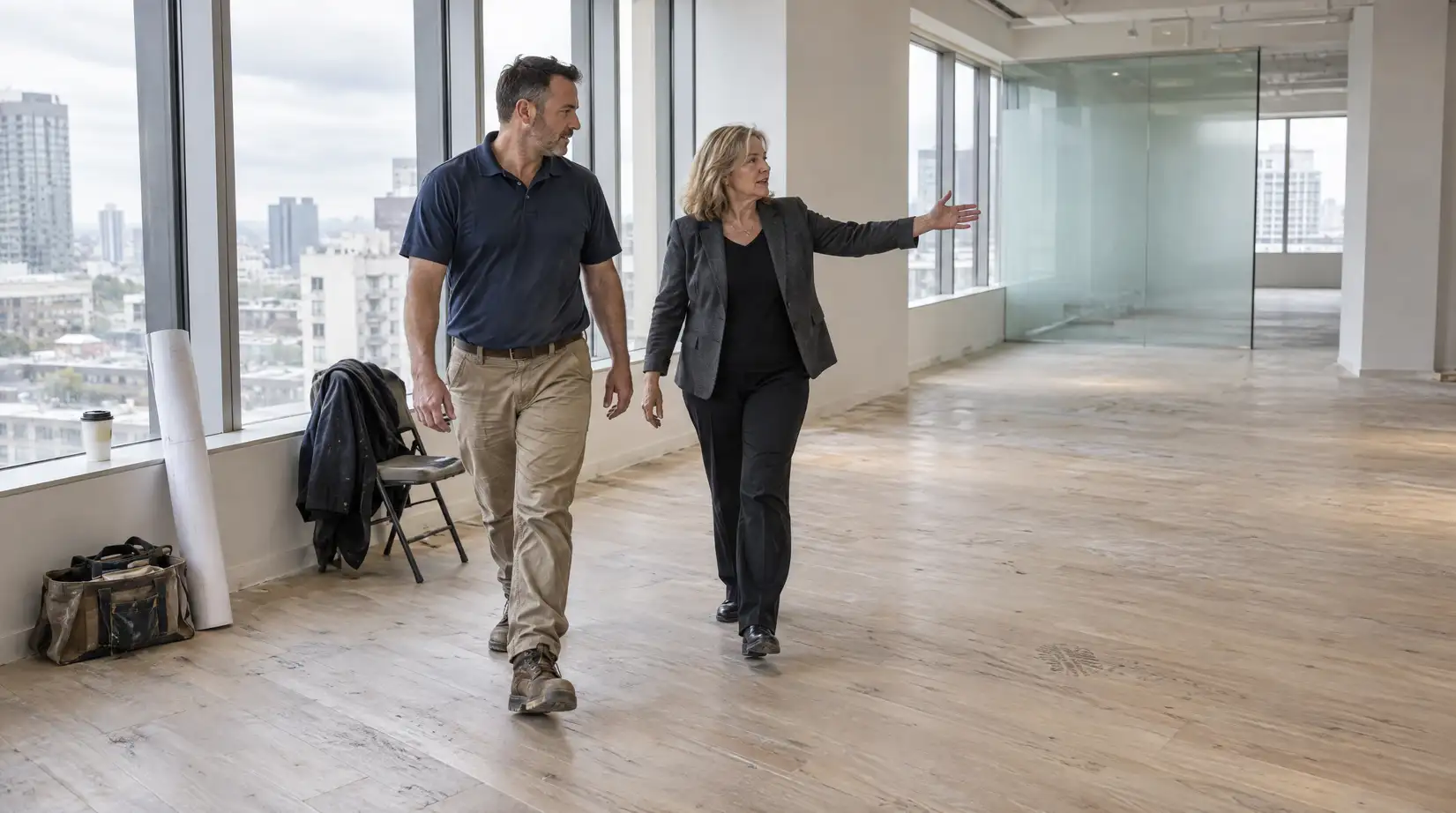
Commercial losses rarely involve a single line item. A fire or water event typically touches the building envelope, mechanical equipment, and inventory at the same time — and a manual walkthrough works through each of those components one at a time. Every day spent waiting on a complete scope is a day material ordering, crew scheduling, and cash flow sit idle behind it.
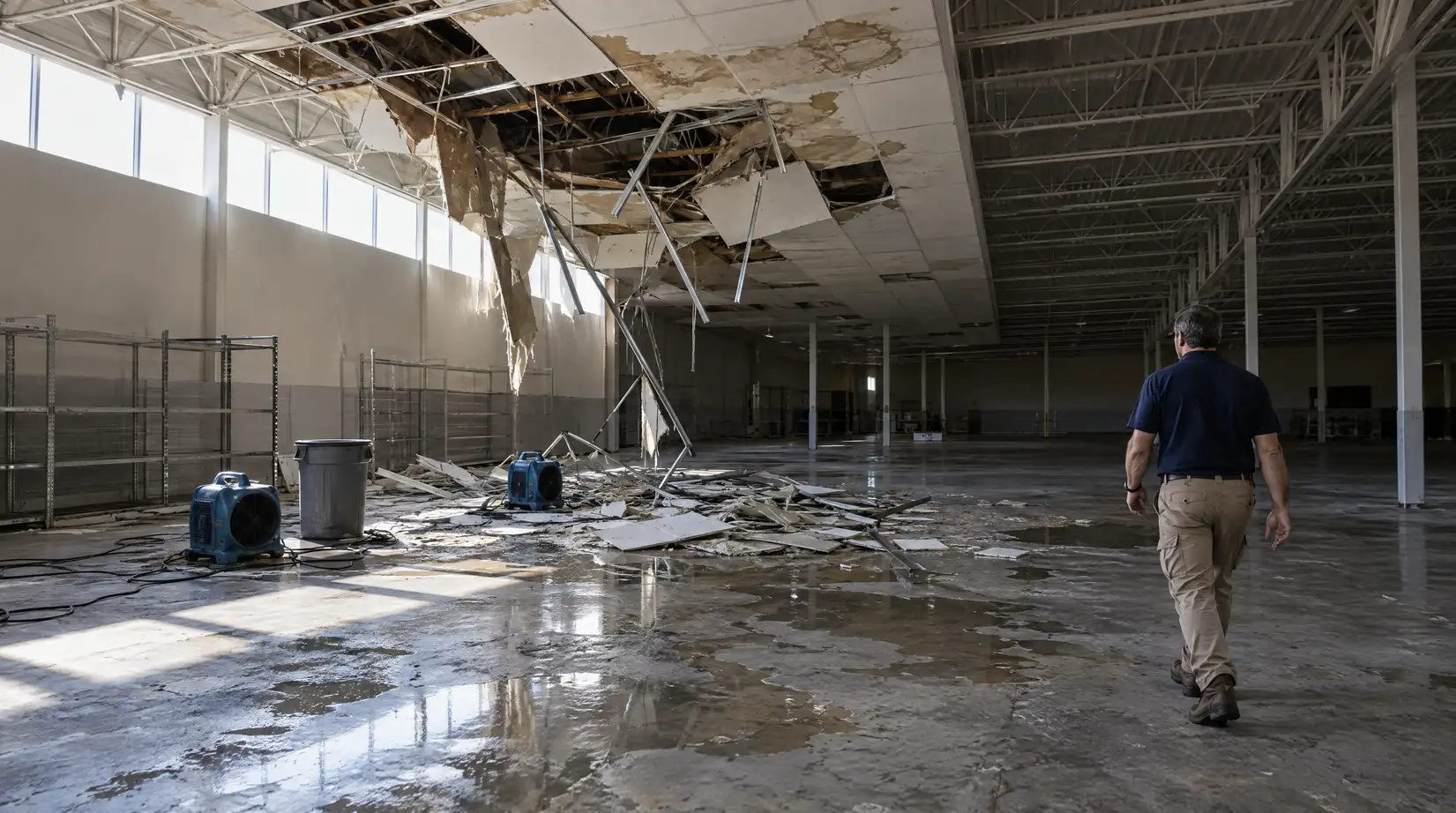
The bigger risk isn’t speed — it’s what a visual-only inspection can’t see. Initial estimates are built from visible, surface conditions, and hidden damage — water, smoke, mold, compromised framing or ductwork — is a known gap in partial losses, often uncovered only when walls are opened during tear-out [1].
United Policyholders’ guidance is blunt: it is rarely sufficient to have a serious loss evaluated only by the adjuster assigned by the insurer, and carriers have a legal duty to thoroughly investigate all damage, including hidden damage [1].
Contractors evaluating a loss should document every component separately, photograph conditions before and during demolition, and flag any damage found after tear-out as a supplement item immediately rather than waiting for the final invoice. United Policyholders’ claim guidance points the same direction: document everything that was damaged, file a timely claim, and file supplemental claims when hidden damage appears [1] — the earlier a hidden-damage finding is logged, the stronger the position when the carrier reviews it.
The 3 Ways AI-Assisted Inspection Closes the Margin Gap
When the adjuster’s file and the contractor’s scope don’t share a baseline, the disagreement itself becomes the dispute — and insurers give more weight to “objective” damage assessments than to a customer’s or contractor’s opinion [1]. Carriers, for their part, are already formalizing AI use: the NAIC’s Model Bulletin on insurers’ use of AI systems was adopted in December 2023, and NAIC survey data shows P&C insurers using AI in claims for image analysis and repair-cost estimation [2]. The specific mechanics of AI-assisted inspection matter more than the marketing language around it. Three capabilities separate a useful tool from a novelty add-on.
1. Faster Scope Documentation Without Sacrificing Detail
A scope that takes weeks to assemble delays everything stacked behind it — material orders, crew schedules, and the supplement that has to be filed while the tear-out is still visible and easy to document. AI-assisted documentation compresses the capture phase of inspection: instead of one inspector hand-recording conditions room by room, photographed conditions are structured into line items as they’re captured.
Regulators describe the same mechanic on the carrier side — AI used in claims processing to estimate repair costs and assess damage using photos and historical data [2]. For a contractor managing several open claims at once, that speed difference is what gets a supplement filed while the evidence is still fresh.
2. Computer Vision Cross-Checks Against Pricing Databases
Rather than relying on a single inspector’s judgment call on quantity or grade of material, computer-vision tools compare photographed conditions against Xactimate estimate pricing data and policy language, producing a documented basis for each line item. This matters most on multi-component losses, where a building, its mechanical systems, and its contents each carry different coverage terms and pricing logic — a scope built against the wrong pricing reference on any one component can undercut the entire claim.
3. Consistent Damage Ratings That Reduce Disputes
Carriers respond better to objective documentation than to opinion — United Policyholders notes that insurers prefer “objective” damage assessments over the opinions of their customers, and recommends an independent specialist’s inspection and report when a dispute arises over the extent of damage [1].
Computer vision applies the same evaluation criteria to every photo regardless of who took it or when, which removes the inspector-to-inspector variability that turns condition ratings into dispute points. A contractor working from a consistently rated scope has a cleaner record to bring back to the carrier if the initial payment falls short — and a documented pattern is easier to defend than a verbal disagreement about condition.
What This Means for Your Bottom Line
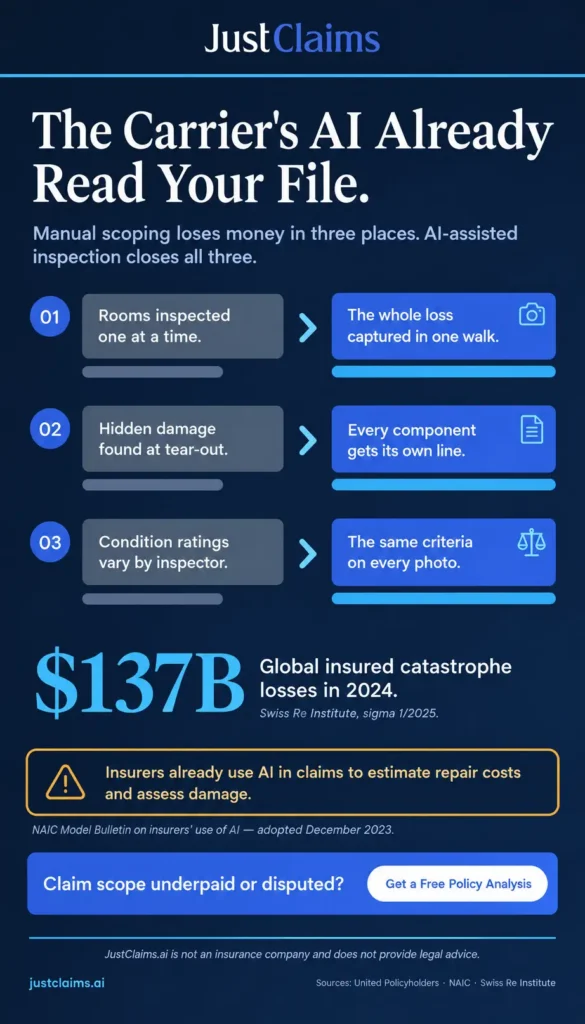
Because the dollars at stake on commercial losses are large by definition, the cost of a missed line item scales accordingly. Global insured losses from natural catastrophes reached $137 billion in 2024, continuing a 5–7% annual growth trend that Swiss Re Institute projects will approach $145 billion for 2025 [3]. That volume flows through claims built, in large part, on manual scopes — while carriers review those files with AI-assisted tooling of their own under formal regulatory governance [2].
A contractor still submitting a scope built on a multi-day manual walkthrough is negotiating against a counterparty that may be reviewing the file faster than the original documentation was built — a mismatch that tends to favor whichever side brought the more complete record to the table first.
Frequently Asked Questions
Does AI-assisted inspection replace a contractor’s own scope and judgment?
No. The tool cross-checks photographed conditions against pricing databases and policy language, but a contractor still determines the repair method, sequencing, and final scope decisions on the job. Regulators take the same position on the carrier side: the NAIC expects AI to support human professionals rather than replace them, with human oversight remaining part of insurance decision-making [2]. Think of it as a documentation layer that strengthens the case a contractor already knows how to build.
Why do manual estimates take longer on commercial losses than on residential ones?
Commercial losses usually involve multiple components — the building envelope, mechanical systems, and inventory — and a manual walkthrough works through each one in sequence rather than at the same time. Each component also carries its own coverage terms and pricing logic, so the scope can’t be finalized until every component has been inspected, documented, and priced — and that’s before any hidden damage surfaces during tear-out [1].
What kind of damage does manual inspection tend to miss?
Initial inspections capture visible, surface-level conditions. The known gap is hidden damage — water, smoke, mold, air-quality and duct contamination, compromised framing — which may only be uncovered when walls are opened during demolition [1]. Those conditions typically surface once tear-out begins, which is why documenting them immediately as a supplement matters.
How consistent are damage ratings between different inspectors?
Condition ratings are subjective by nature, and two professionals walking the same loss can describe the same damage differently. That subjectivity matters because insurers give more weight to objective damage assessments than to a customer’s or contractor’s opinion [1] — which is why a scope documented against consistent, photo-based criteria is harder to dispute than one built on verbal descriptions.
How to Protect Your Scope and Get Paid
The pattern across manual commercial scoping is consistent: sequential review slows the estimate down, subjective condition ratings create disputes, and hidden damage discovered after tear-out often gets missed on the first pass. Each of those gaps has a direct dollar cost, and each is addressable with better documentation practices at the time of inspection rather than after a payment dispute has already started. Contractors who log every component separately, photograph conditions continuously through demolition, and file supplements the moment hidden damage appears are working from a stronger position when a carrier’s initial number falls short [1].
If your commercial claim scope was underpaid or the carrier’s estimate doesn’t match what your crew found once work began, get a free commercial policy analysis from Justin — upload your documentation and the JustClaims team, supported by purpose-built AI, will compare it against the policy language and pricing data and flag where the numbers don’t add up.
This content is for informational purposes only and does not constitute legal or insurance advice. Coverage decisions depend on the specific terms, conditions, and exclusions of each policy and the laws of the applicable jurisdiction; policyholders and contractors should consult with a qualified professional for advice on their particular situation.
Sources
[1] Insurance Claim Tips For Partial Loss Fires — United Policyholders

Taylor Bezek

As the General Manager at JustClaims, Taylor Bezek brings over a decade of experience managing complex residential, commercial, and large-loss claims. A licensed Public Adjuster in TX (#2125659), FL (#W455048), CO (#769172), and 10 additional states, Taylor founded his own firm before joining JustClaims to scale a tech-forward solution for the insured. He is committed to combining industry expertise with AI to enhance speed, clarity, and outcomes for every policyholder. Taylor's mission is to modernize the public adjusting profession and ensure owners get exactly what they are entitled to.