Win More Commercial Bids With Tech: A Contractor Guide 2026

September 17, 2026
Written by Collin Corcoran
Share


Digital capability has moved from a bonus to a baseline expectation in commercial construction. National survey data shows most contractors now run cloud-based project management tools, and property management best-practice benchmarks now formalize digital vendor documentation requirements. Contractors who cannot plug into these systems risk being screened out before a bid is even reviewed. For commercial contractors competing for property management portfolios, technology adoption has quietly become a deciding factor in who wins repeat work.
Key Takeaways
- Digital fluency baseline: Cloud-based project management, digital documentation, and portal-based compliance submissions are now baseline expectations in commercial construction and property management.
- Preferred partner access: Tech-savvy vendors are easier for property managers to justify as preferred partners when reporting to owners and corporate leadership, which supports priority access to larger portfolio projects.
- Performance tracking window: Vendors who track and present performance metrics at regular review points can demonstrate accountability that supports a move from occasional-use vendor to preferred partner.
- Software impact on bids: Contractors use technology to digitize tickets, automate communication, estimate quantities, and schedule work — capabilities that show up directly in bid quality.
- Core software features: Cloud-based project management and document management software — among the top technology investment areas for contractors — support accurate, data-driven bid proposals.
Why Property Managers Are Choosing Tech-Forward Contractors
Technology is rapidly changing how construction projects are procured, planned, and executed, according to the Associated General Contractors of America [1].
Property managers apply the same logic when they select vendors: a contractor who demonstrates technology fluency is easier to defend as a “preferred partner” in ownership reports, which can translate into priority access to larger portfolio projects and reduced competition on individual jobs. For contractors trying to move up from single-property work to multi-site portfolio contracts, this dynamic matters as much as price.
Property managers overseeing dozens or hundreds of units do not have time to manually reconcile paper invoices, mailed certificates of insurance, or phone-tag scheduling across multiple vendors. A contractor who can plug directly into a property manager’s existing systems removes friction from the relationship, and that friction reduction is often what separates a one-time hire from a repeat contract.
How Vendor Vetting Platforms Score Contractor Documentation
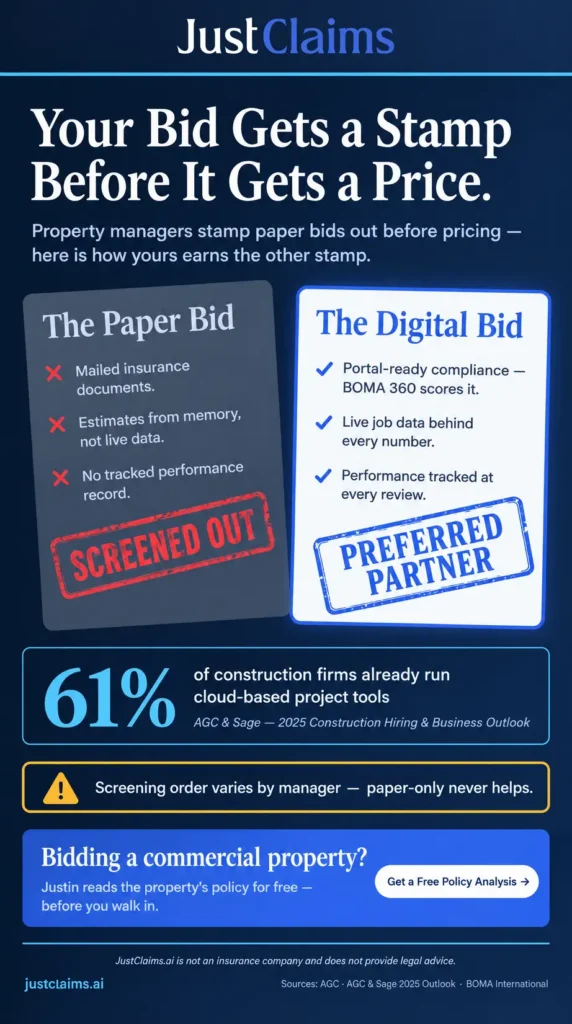
This preference for digital fluency shows up formally in how property managers vet vendors before work is ever assigned. BOMA International’s 360 Performance Program — a national best-practice benchmark for office building management — awards points for documented vendor insurance compliance, including contract language that spells out vendor insurance requirements, with all documentation submitted through a centralized online portal [2]. A contractor who cannot produce insurance certificates and contract documents digitally is a step behind before pricing is ever discussed.
For a contractor, this means a bid proposal is no longer judged on price and licensing alone. Property managers vetting vendors want to see contractors who can supply compliance documents digitally, respond to portal requests promptly, and produce reporting that fits into existing corporate workflows without extra manual entry on the property manager’s side.
Turning Performance Data Into Preferred-Partner Status
Because winning the first job is only half the goal, contractors who want repeat commercial work need a way to prove performance over time rather than relying on a single successful project.
Vendors who track and present their own performance metrics—punctuality, callback rates, warranty work—to property managers at regular review points demonstrate a level of professionalism and data-driven accountability that supports a shift from occasional-use vendor to preferred, repeat-work partner.
This kind of ongoing reporting requires contractors to keep organized records of job completion dates, follow-up requests, and warranty claims rather than reconstructing that history from memory when a renewal conversation comes up.
Contractors who can hand a property manager a clean performance summary at the six-month or annual review point put themselves in a stronger position than competitors relying on reputation alone.
Restoration Software Features That Strengthen Your Bid
Since documentation quality and performance tracking both depend on having reliable systems in place, the software a contractor uses behind the scenes directly shapes what shows up in a bid proposal.
The Associated General Contractors of America reports that contractors already use technology to digitize tickets, automate communication, estimate quantities, develop work plans, and schedule projects [1] — and document management, accounting, and project management software rank among the top areas where firms are increasing technology investment [3]. Each of these capabilities shows up directly in the accuracy and professionalism of a bid package.
Specific capabilities matter here. Sixty-one percent of construction firms now use cloud-based project management tools [3], and ninety-one percent of firms agree their employees need digital technology skills to succeed as firms adopt labor-saving technologies [4]. A bid package built on accurate, current job data reads differently to a property manager than one built on rough estimates, and that difference can be the deciding factor when portfolios are competitive.
Presenting co-branded, third-party-verified documentation platforms alongside a bid can also serve as a credibility signal to property managers evaluating multiple contractors, since it demonstrates that scope and cost figures have been checked against an independent standard rather than produced in-house alone.
Frequently Asked Questions
What do property managers look for when choosing a commercial contractor?
Property managers increasingly weigh a contractor’s ability to work inside digital workflows — cloud-based project management, digital compliance documents, and portal-based submissions — alongside traditional factors like price and licensing [2]. Contractors who can integrate compliance documents and reporting into these workflows are often viewed as easier to justify as preferred vendors to ownership and corporate leadership.
How can contractors prove their performance to win repeat work?
Contractors can track metrics such as punctuality, callback rates, and warranty work, then present that data to property managers at regular review points, such as a six-month or annual review. This kind of documented track record gives property managers a concrete basis for moving a vendor from occasional use to preferred-partner status.
What software features actually help contractors win bids?
Cloud-based project management, document management, and accounting software give contractors accurate, current data to support bid pricing and scope decisions [3]. AGC also reports that contractors use technology to automate communication and estimate quantities [1], which supports stronger communication with insurers and property managers during the bidding process.
Why does digital documentation matter more in commercial bids than residential jobs?
Commercial property managers often oversee multiple properties and must report vendor decisions to owners or corporate leadership, so they favor contractors whose documentation fits cleanly into centralized reporting systems [2]. A contractor who cannot produce digital compliance records or organized job data may be screened out during vendor vetting before price is even discussed.
How to Strengthen Your Next Bid Package
Winning more commercial work from property managers is no longer just about price or crew size—it depends on whether a contractor’s documentation, reporting, and performance history fit into the systems property managers already use to vet and rank vendors. Contractors who track their own performance data, keep compliance records digital, and present accurate real-time job data put themselves in a stronger position for portfolio-level work and repeat contracts.
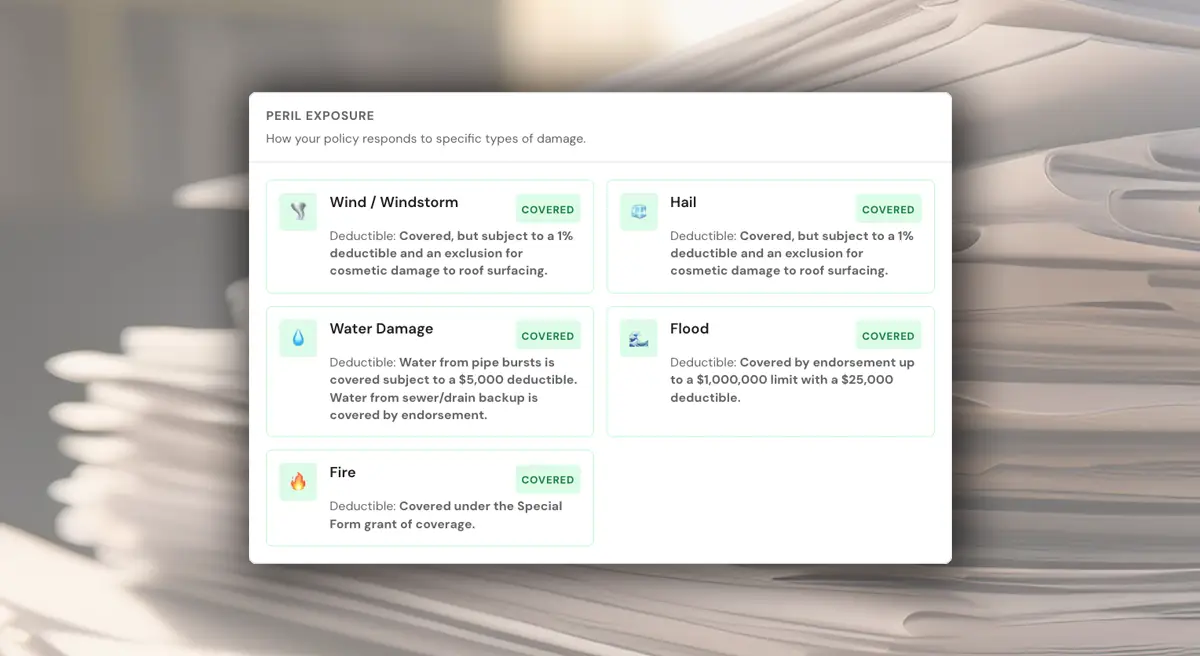
Before your next bid meeting, get a free commercial insurance policy analysis from Justin — upload the property’s policy and walk in knowing exactly what the coverage pays for, down to the clauses that decide who pays what.
This content is for informational purposes only and does not constitute legal or insurance advice. Coverage decisions depend on the specific terms, conditions, and exclusions of each policy and the laws of the applicable jurisdiction; policyholders and contractors should consult with a qualified professional for advice on their particular situation.
Sources
[1] AGC Policy Statement on Digital Means and Methods — Associated General Contractors of America
[2] BOMA 360 Performance Program Application Guide — Office (2026) — BOMA International
[4] 2023 Workforce Survey Analysis — Associated General Contractors of America & Autodesk

Collin Corcoran

Experienced Public Adjuster and Property Claims Specialist, Collin is licensed in New York (#1603393), New Jersey (#3003700204), and Connecticut (#19820270). With 20+ years of hands-on construction and property damage experience, he specializes in residential and commercial claims, complex loss inspections, policy review, detailed estimating, and strategic negotiation. Collin’s background in construction, asset management, emergency response, and claims documentation allows him to accurately identify damage, understand repair requirements, and advocate effectively for policyholders. He works with homeowners, business owners, contractors, and insurance professionals to move claims forward with clarity, accuracy, and confidence. Collin is committed to transparency, technical precision, strong communication, and securing fair outcomes for policyholders.