Roofing Contracts for Insurance Claims: 2026 Guide

August 21, 2026
Written by Taylor Bezek
Share


A roofing service agreement signed before an insurance claim is approved determines far more than price — it can determine whether the contractor gets paid at all. Georgia law lets a property owner cancel an insurance-contingent roofing contract up until midnight on the fifth business day after the insurer denies coverage, and Texas law makes deductible-waiver language and adjuster-style claim negotiation by a contractor illegal outright. For contractors, the contract itself — not the estimate, not the adjuster meeting — is the document that stands up or falls apart when a claim gets disputed.
Key Takeaways
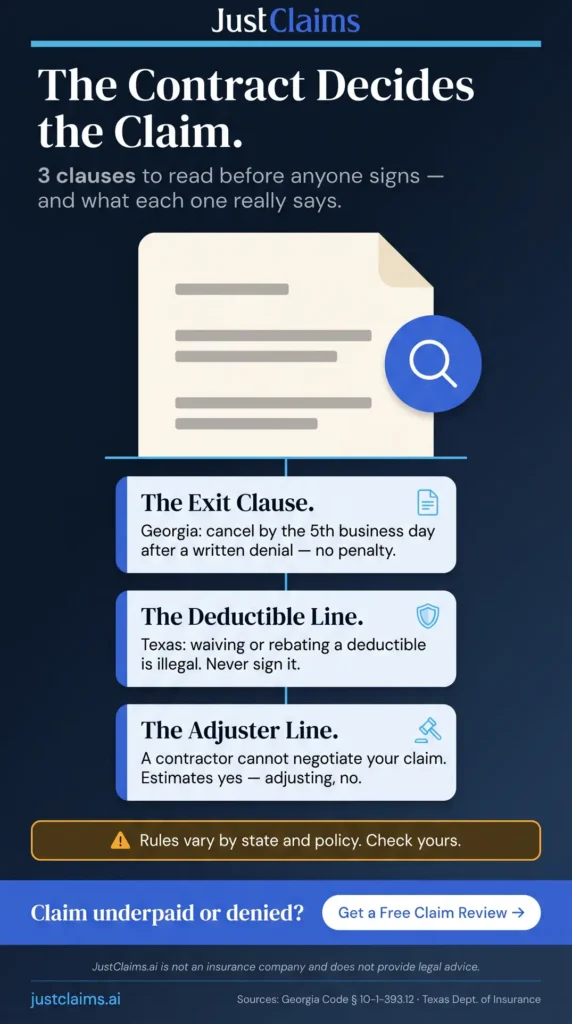
- Cancellation window: Georgia property owners may cancel an insurance-contingent roofing contract until midnight on the fifth business day after receiving written notice that a claim is denied, under O.C.G.A. § 10-1-393.12.
- Deductible waiver ban: Texas law makes it illegal for a roofing contractor to waive, rebate, or absorb a policyholder’s deductible, under Texas Business and Commerce Code § 27.02.
- Adjuster role restriction: Texas Insurance Code § 4102.163 bars a roofing contractor from acting as a public adjuster on any property where the contractor also provides roofing services.
- RCV vs. ACV payout gap: In an NAIC example, an identical $15,000 roof claim paid $14,000 under an RCV policy versus $4,000 under an ACV policy after depreciation.
- Depreciation release window: Under a replacement cost policy, the insurer may first pay the actual cash value, then reimburse the withheld recoverable depreciation after proof of completed repairs is submitted; deadlines to claim it vary by policy, insurer, and state.
- Supplement scope: Supplements let contractors formally request added costs commonly missed by adjusters, such as permit fees and code-required upgrades.
What Is an Insurance Contingency Clause?
An insurance contingency clause is a provision in a roofing service agreement stating that the contractor’s price, or the agreement’s enforceability, depends on the property owner’s insurance carrier approving the claim. Because this clause ties compensation directly to a claim’s outcome, several states regulate how it can be written and how a client may exit the agreement. In Georgia, a property owner who signs a written roofing contract to be paid from insurance proceeds may cancel that contract up until midnight on the fifth business day after receiving written notice from the insurer that all or part of the claim is not covered, under O.C.G.A. § 10-1-393.12 [1]. That right must be disclosed in boldface type, and the contractor is required to attach a Notice of Cancellation form to the agreement [1].
Georgia law also prohibits a residential roofing contractor from representing or negotiating — or advertising to represent or negotiate — on a client’s behalf on any insurance claim tied to roof repair or replacement, unless that person holds a public adjuster license [1]. A well-drafted service agreement should describe the contractor’s role as documenting damage and coordinating estimates, not “representing” the client’s claim in a way that could resemble unlicensed adjusting.
Red Flags in Roofing Contracts
Because the contingency structure above creates legal exposure on both sides of the agreement, certain contract terms function as warning signs long before a claim is disputed. The clearest example is deductible-waiver language. The Texas Department of Insurance states that it is illegal in Texas for a roofing contractor to offer to waive, rebate, or absorb a property policyholder’s insurance deductible, under Texas Business and Commerce Code § 27.02 [2]. That same code section requires a specific notice on contracts of $1,000 or more involving insurance settlements, so agreements at or above that value should include the disclosure rather than omit it [2].
A second red flag is a scope of work that lets the contractor step into the adjuster’s role. Texas Insurance Code § 4102.163 prohibits a roofing contractor from acting as a public adjuster, or advertising to adjust insurance claims, on any property where that contractor is also providing or may provide contracting services [2]. A contract clause promising to “negotiate,” “settle,” or “adjust” the claim on the client’s behalf — rather than simply documenting damage and submitting estimates — can put both the contractor and the client at risk of a compliance dispute instead of a paid claim. Keeping the agreement on the documentation side of that line starts with understanding what an insurance adjuster is actually authorized to do.
A third warning sign is vague payment language tied to “whatever insurance approves,” with no defined scope of work attached. Without a documented baseline scope, there’s nothing concrete to compare against if the insurer’s initial estimate under-scopes the repair.
Essential Elements: Scope of Work, Depreciation, and Supplement Processes
Because red-flag language often appears where a contract’s scope of work is left undefined, the agreement’s core sections deserve the same scrutiny as its insurance clauses. Texas Insurance Code Chapter 4102 (Section 4102.163) prohibits a roofing contractor from acting as an adjuster, or advertising to adjust claims, for any property where that contractor is providing or may provide roofing services — meaning the scope-of-work section should describe repair specifications, not claim-settlement authority [2]. Texas policyholders are entitled to have their home repaired by the contractor of their choice, and insurers may not engage in unfair claim settlement practices or misrepresent the terms of a policy [3] — protections housed in the Homeowners, Dwelling, and Renters Insurance Consumer Bill of Rights (28 Texas Administrative Code § 5.9971) [4], both of which shape how a contract’s payment and scope terms should be drafted.
Depreciation terms belong in the contract as well. A service agreement should state clearly whether the contract price reflects the initial ACV payment, the full RCV amount, or a combination released in two payments. Under a replacement cost policy, the insurer may first pay the actual cash value, then reimburse the withheld recoverable depreciation once the work is completed and receipts are submitted [5]; collecting the full amount requires actually replacing the items and sending the receipts to the insurer with a demand for the balance owed [6]. The deadlines to claim recoverable depreciation vary by policy, insurer, and state, and the agreement should track them explicitly.
Finally, the agreement should address supplements. Contractors are not prohibited from providing estimates or discussing those estimates and other technical information with an insurer or its adjuster [3], and a roofing service agreement should authorize the contractor to submit revised estimates as part of the defined scope of work when the initial estimate omits covered costs — rather than treating that follow-up as a separate negotiation outside the contract. Most of those revised estimates are built in Xactimate, and the Xactimate for contractors workflow is what makes a supplement defensible line by line.
How to Handle ACV vs RCV Payments
Because depreciation terms in the contract only matter once a claim is actually paid, understanding how ACV and RCV payments move through a claim helps set client expectations before work begins. Replacement Cost Value coverage pays the cost to repair or replace damaged property without deducting for depreciation, while Actual Cash Value coverage pays only the depreciated cost, calculated from the property’s condition at the time of loss, its replacement cost, and its expected useful life [7]. The North Carolina Department of Insurance describes ACV (also called Depreciated Cash Value) as the money needed to fix a home minus the decrease in value from age or use, versus RCV, which is the money needed to repair a home at today’s prices for building materials [5].
The payout gap between the two can be significant. In one NAIC example, two identical $15,000 roof claims with a $1,000 deductible resulted in a $14,000 payout for the RCV policyholder, versus only $4,000 for the ACV policyholder after $10,000 in depreciation was subtracted [7]. The Texas Department of Insurance illustrates a similar gap for a $10,000 roof replacement with a $4,000 deductible: a replacement cost policy pays $6,000 regardless of the roof’s age, while an actual cash value policy’s payout shrinks as the roof ages [8].
| Roof Age | RCV Payout | ACV Payout |
|---|---|---|
| 5 years | $6,000 | $4,500 |
| 10 years | $6,000 | $3,000 |
| 20 years | $6,000 | $0 |
Source: Texas Department of Insurance example for a $10,000 roof replacement with a $4,000 deductible [8].
On an RCV policy, the carrier typically issues the first payment at actual cash value — the approved scope minus depreciation and the deductible — and releases the withheld recoverable depreciation as a second payment only after the work is completed and receipts are submitted [5]; the deadlines to claim recoverable depreciation vary by policy, insurer, and state. A roofing service agreement can specify that this depreciation release is coordinated directly with the contractor, so the final payment is submitted as soon as the completed-work documentation is ready.
Rights to Cancel If the Claim Is Denied
Because a contingency-based contract’s price depends on insurer approval, the client’s right to walk away when a claim is denied is one of the most important terms in the agreement — and one of the most often skipped. Georgia law gives that same property owner the right to exit an insurance-contingent contract up through the end of the fifth business day following the insurer’s written denial notice, without penalty for exercising that right on time [1]. The cancellation right must appear in boldface in the contract, with a signed Notice of Cancellation form attached [1].
For contractors, this means the agreement should spell out what happens if a claim is partially or fully denied: whether the client owes anything for work already completed, such as an inspection or emergency tarp, and how a partial denial affects the contracted scope. Cancellation notice requirements vary by state, so a contractor working across multiple jurisdictions should confirm the specific disclosure rules that apply before presenting a contract for signature. Building this clarity into the agreement upfront can reduce disputes if the claim outcome changes after the contract is signed. If a denial or underpayment still lands, the response sequence in our insurance claim assistance guide keeps the file moving.
Frequently Asked Questions
What is an insurance contingency clause in a roofing contract?
It is a contract term making the contractor’s price or the agreement’s validity dependent on the client’s insurance carrier approving the claim. Because payment is tied to a third party’s decision, several states require specific disclosures and cancellation rights within these clauses.
Is it legal for a contractor to waive a client’s insurance deductible?
In Texas, no — offering to waive, rebate, or absorb a policyholder’s deductible is prohibited under state law. Contracts should never advertise deductible waivers as an incentive, since doing so can expose the contractor to regulatory action.
What’s the difference between ACV and RCV payments on a roof claim?
RCV pays the cost to repair or replace the roof with materials of similar kind and quality without subtracting depreciation, while ACV pays only the depreciated value based on the roof’s age and condition. This distinction affects both the initial payment amount and whether a second, depreciation-related payment is owed later.
Can a property owner cancel a roofing contract if the insurance claim is denied?
In Georgia, yes — a property owner may cancel a written, insurance-contingent roofing contract up until midnight on the fifth business day after receiving the insurer’s written denial notice. The right must be disclosed in boldface type and paired with a Notice of Cancellation form.
What are supplements in a roofing insurance claim, and why do they matter?
Supplements are formal requests contractors submit to add costs the adjuster’s initial estimate missed, such as permit fees, code-required upgrades, overhead and profit, and detach-and-reset work. A roofing service agreement should explicitly authorize the contractor to pursue these supplements as part of the agreed scope of work.
How You Can Protect Your Scope and Payment
Because the roofing service agreement itself determines how a claim moves from initial estimate to final payment, treating it as a template to fill in rather than a document to review is where many disputes begin. Confirm that the contract discloses cancellation rights in boldface where required, defines the scope of work separately from any insurance-negotiation language, states whether pricing reflects ACV, RCV, or both, and authorizes supplement requests as part of the agreed scope.
When a claim is underpaid or a supplement is denied without explanation, the contract’s clarity on scope and depreciation terms becomes the primary reference point for resolving the dispute. If your insurance claim was denied or underpaid, JustClaims’ expert team — accelerated by our bespoke AI — reviews the policy language, compares it against your documentation, and flags likely underpayments so you can go back to the carrier with confidence.
This content is for informational purposes only and does not constitute legal or insurance advice. Coverage decisions depend on the specific terms, conditions, and exclusions of each policy and the laws of the applicable jurisdiction; policyholders and contractors should consult with a qualified professional for advice on their particular situation.
Sources
[2] Roofing and insurance: Know the law — Texas Department of Insurance
[3] Bulletin B-0006-21: Severe winter weather — adjusters and repairs — Texas Department of Insurance
[4] Consumer Bills of Rights — Texas Department of Insurance
[5] Actual Cash Value vs. Replacement Cost Value — North Carolina Department of Insurance
[6] Depreciation Basics — United Policyholders
[8] Home policies: Replacement cost or actual cash value? — Texas Department of Insurance

Taylor Bezek

As the General Manager at JustClaims, Taylor Bezek brings over a decade of experience managing complex residential, commercial, and large-loss claims. A licensed Public Adjuster in TX (#2125659), FL (#W455048), CO (#769172), and 10 additional states, Taylor founded his own firm before joining JustClaims to scale a tech-forward solution for the insured. He is committed to combining industry expertise with AI to enhance speed, clarity, and outcomes for every policyholder. Taylor's mission is to modernize the public adjusting profession and ensure owners get exactly what they are entitled to.