Hail Damage on Shingles: How to Identify & Prove Your Claim
May 28, 2026
Written by Taylor Bezek
Share


Contractors can significantly strengthen property owner insurance claims by cross-referencing physical roof damage with official weather data from the National Weather Service’s Storm Events Database. Combining this verified storm data with line-item estimates generated in Xactimate provides an apples-to-apples comparison with insurance adjusters. Identifying subtle signs like dark, circular bruises and missing granules can help support a case for functional damage that may warrant a full replacement rather than a patch, depending on the extent of damage, applicable policy terms, and adjuster findings.
Key Takeaways
- Visual indicators: Hail damage on asphalt shingles typically presents as dark, circular bruises with missing granules.
- Physical evidence: Cracks or soft spots when pressed indicate functional damage to the shingle mat.
- Estimation software: Providing line-item estimates generated in Xactimate ensures an apples-to-apples comparison with adjusters.
- Weather verification: Official weather data from the National Weather Service’s Storm Events Database or NOAA storm logs verifies the date and severity of the hailstorm.
Visual Signs of Hail Damage on Asphalt Shingles
Because adjusters frequently attempt to classify minor granule loss as cosmetic wear, contractors must meticulously document the subtle visual signs of hail impacts to support a full roof replacement.
Identifying Bruising and Granule Loss
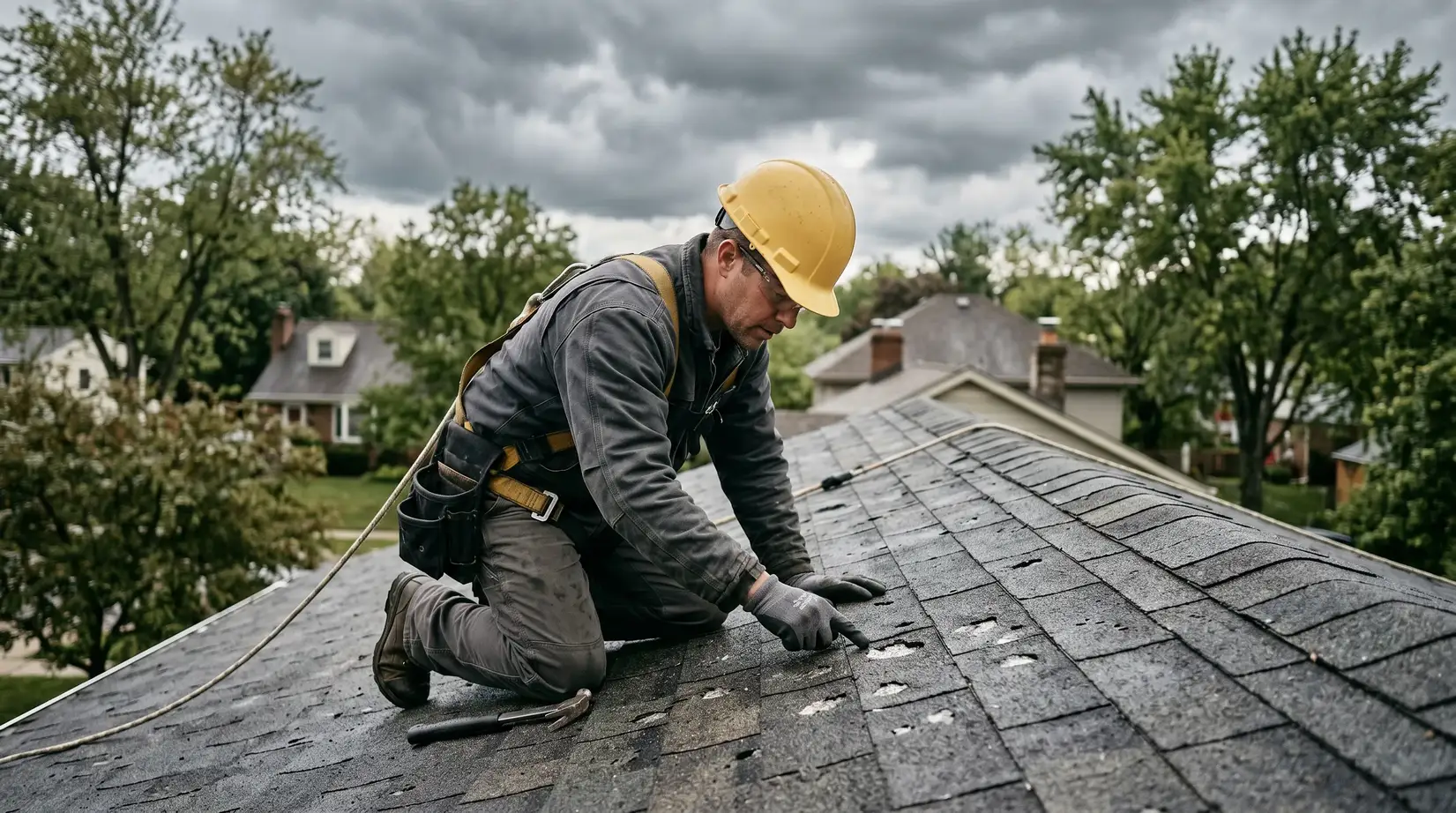
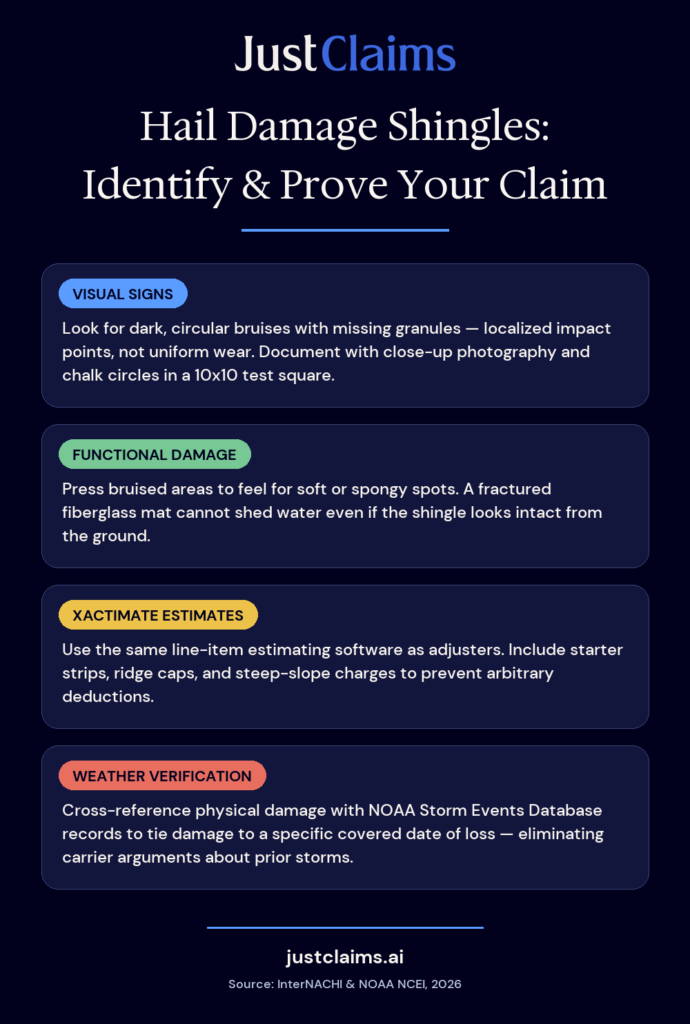
Hail damage on asphalt shingles typically presents as dark, circular bruises with missing granules, as well as cracks or soft spots when pressed [1]. When hail strikes a roof, the kinetic energy of the impact dislodges the protective mineral granules, exposing the underlying asphalt layer to the elements. Contractors inspecting a roof should look for these distinct, localized areas of granule loss rather than uniform wear across the entire slope. Documenting these specific impact points with clear, close-up photography helps demonstrate that the damage was caused by a sudden weather event rather than general aging. Using chalk to circle the impacts within a standard 10-foot by 10-foot test square provides a clear visual reference for the desk adjuster reviewing the file. A clean evidence grid is what moves a desk adjuster supplement review from weeks to days.
Distinguishing Hail from Blistering or Wear
Insurance carriers often attribute shingle damage to manufacturing defects, poor ventilation, or natural wear and tear. Blistering, for example, occurs when trapped moisture expands and pops, leaving a raised, open pockmark that lacks the characteristic bruising of a hail strike [3]. In contrast, a true hail impact pushes the granules into the asphalt mat, creating a depression or soft spot. Pressing on suspected impact zones to feel for soft or spongy spots can help identify possible hail bruising, but a full assessment also requires visual pattern analysis, collateral damage documentation, and weather record correlation to distinguish storm damage from pre-existing wear. Taking macro photographs that show the indentation angle and the presence of granules pushed into the asphalt can further support the position that the damage is storm-related.
Why Functional Damage Matters for Insurance Claims
Since superficial blemishes alone may not qualify for coverage in many policies, proving that hail impacts have compromised the shingle’s water-shedding ability is often the foundation of a successful claim, subject to the specific policy language and jurisdiction.
The Long-Term Risks of Ignored Damage
When granules are stripped from an asphalt shingle, the exposed mat becomes highly vulnerable to ultraviolet (UV) degradation. Over time, UV rays break down the asphalt, causing it to become brittle, crack, and eventually fail. If left unaddressed, this degradation often leads to water infiltration, rotting roof decking, and interior leaks. Highlighting these long-term risks in the inspection report supports the position that a full replacement may be necessary to restore the property to its pre-loss condition and prevent secondary water damage, depending on the policy and adjuster’s findings. Contractors should explain to property owners that patching a few shingles leaves the rest of the aging roof susceptible to these delayed failures. Knowing what a home insurance claim adjuster documents during the inspection changes how you prepare for the visit.
Documenting Soft Spots and Cracks
Functional damage occurs when the structural integrity of the shingle is diminished. A fractured fiberglass mat cannot effectively shed water, even if the shingle appears relatively intact from the ground. Contractors should physically inspect the shingles, gently lifting and pressing on bruised areas to identify hidden fractures. Recording video evidence of these soft spots or cracks provides compelling documentation that the roof system has suffered functional impairment. That evidence is what carries a Denver Colorado hail claim through appraisal. This tactile evidence is often what separates a denied cosmetic claim from an approved functional damage replacement, depending on how the carrier interprets the policy.
Aligning Estimates and Weather Data for Claim Success
Beyond physical documentation, aligning your scope of work with industry-standard pricing and verified meteorological data signals to the carrier that your assessment is thoroughly documented and well-supported.
Utilizing Xactimate for Apples-to-Apples Comparisons
Disputes over pricing and scope frequently derail roof replacement claims. Contractors can strengthen insurance claims by providing line-item estimates generated in Xactimate, the industry-standard estimating software used by the majority of insurance adjusters, creating an apples-to-apples comparison [1]. By speaking the carrier’s language and using their preferred pricing database, contractors reduce the likelihood of arbitrary deductions. A detailed Xactimate estimate that accounts for local labor rates, specific material costs, and necessary building code upgrades helps demonstrate the true cost of restoring the property. Including commonly missed line items, such as starter strips, ridge caps, and steep-slope charges, helps the scope more accurately reflect the required labor and materials.
Cross-Referencing NOAA Storm Logs
Insurance policies require damage to be tied to a specific, covered date of loss. Contractors should cross-reference physical roof damage with official weather data from the National Weather Service’s Storm Events Database or NOAA storm logs to verify the date and severity of the hailstorm [2]. Providing a meteorological report that confirms hail of a specific size fell on the property owner’s address on the claimed date eliminates ambiguity. This objective weather data, combined with physical evidence of bruising and granule loss, builds a comprehensive case for coverage. When adjusters attempt to argue that the damage is from a previous, unfiled storm, these official logs serve as an objective timeline of events. That independent timeline is also how to get more money from an insurance claim when the first number comes in short.
Frequently Asked Questions
What does hail damage look like on an asphalt shingle?
Impacts from hailstones generally leave distinct, dark, and circular indentations where the protective granules have been knocked away. When you physically examine these areas, you will often find that the underlying fiberglass or organic (felt/paper) mat feels soft or exhibits small fractures [1].
Why is granule loss considered functional damage?
The mineral granules on a shingle protect the underlying asphalt from severe UV exposure and weather degradation. When these granules are displaced by a storm, the exposed mat deteriorates more rapidly, which can lead to cracking, brittleness, and eventual water leaks inside the building and may be cited as evidence of functional damage in a claim, depending on the policy language.
How do weather logs support a roof replacement claim?
Pulling historical storm records from NOAA’s Storm Events Database can help link roof damage to a documented weather event. For official storm records that can support insurance proceedings, historical data can be accessed directly from NOAA’s National Centers for Environmental Information (NCEI) at ncei.noaa.gov.
Why should contractors use Xactimate for their estimates?
Xactimate is widely considered the industry-standard estimating software used by many insurance adjusters to calculate property damage replacement costs, though other platforms such as Symbility are also used in the industry. Submitting your scope of work through the same system creates a direct, line-by-line comparison that minimizes pricing disputes and helps justify the total replacement cost [1].
How to Secure Full Roof Replacements for Your Clients
By identifying subtle bruising, recording soft spots in the shingle mat, and presenting your scope in industry-standard software — alongside weather data, collateral damage documentation, and a professional inspection report — you can build a strong case supporting a full roof replacement rather than a temporary patch. Protecting your scope of work requires presenting evidence that carriers cannot easily dismiss as cosmetic wear. If your insurance claim was denied or underpaid, JustClaims‘ expert team — accelerated by our bespoke AI — reviews the policy language, compares it against your documentation, and flags likely underpayments so you can go back to the carrier with confidence.
This content is for informational purposes only and does not constitute legal or insurance advice. Coverage decisions depend on the specific terms, conditions, and exclusions of each policy and the laws of the applicable jurisdiction; policyholders and contractors should consult with a qualified professional for advice on their particular situation.
Sources
[1] https://haagglobal.com/articles/october-2019-blog-post/

Taylor Bezek

As the General Manager at JustClaims, Taylor Bezek brings over a decade of experience managing complex residential, commercial, and large-loss claims. A licensed Public Adjuster in TX (#2125659), FL (#W455048), CO (#769172), and 10 additional states, Taylor founded his own firm before joining JustClaims to scale a tech-forward solution for the insured. He is committed to combining industry expertise with AI to enhance speed, clarity, and outcomes for every policyholder. Taylor's mission is to modernize the public adjusting profession and ensure owners get exactly what they are entitled to.