Insurance Arbitration: When Your Policy Forces It

November 10, 2026
Written by Collin Corcoran
Share


A commercial property policy can send a coverage dispute to a private tribunal in a city named in the fine print, applying that city’s law — and the award is usually final. Insurance arbitration does exactly that. Appraisal does not: it prices a loss and cannot decide coverage.
Key Takeaways
- Two different processes: Appraisal sets the amount of a loss. Arbitration can decide any dispute the clause covers — including coverage and whether the policy was validly formed.
- Finality: A court must confirm a binding award unless it is vacated, modified, or corrected, and the statutory grounds for vacating are narrow.
- Treaty power: The Second Circuit held in May 2025 that Article II, Section 3 of the New York Convention is self-executing, so a state law banning insurance arbitration cannot reverse-preempt it.
- State law still counts: Louisiana bars policy terms that strip its courts of jurisdiction or venue, and limits appraisal to the amount of loss once coverage has been accepted.
- Read it early: The clause fixes the seat, the governing law, and whether an award can be reviewed — all of it locked in when the policy is issued.
What Arbitration Is and Why It Appears in Commercial Property Policies
Arbitration moves a policy dispute out of court and into a private tribunal whose decision the contract may make final. It is a feature of surplus lines and Lloyd’s policies in particular — a market the Second Circuit described as filling “an important niche in the insurance market by covering otherwise uninsurable risks,” with one common use being hurricane coverage in high-risk zones [1].
In its May 2025 decision, the court worked through surplus lines policies issued at Lloyd’s on two commercial properties damaged by Hurricane Ida. The clauses sent “[a]ll matters in difference between the Insured and the [Insurers] … in relation to this insurance, including its formation and validity” to an Arbitration Tribunal, with the seat of arbitration “in New York” and New York law as the proper law of the insurance [1]. Read that scope twice: it reaches the policy’s formation and validity, not just the size of a check.
Louisiana law is the common state-level counterweight. La. R.S. § 22:868(A)(2) bars an insurance contract from containing any term “[d]epriving the courts of this state of the jurisdiction or venue of action against the insurer” [2]. A 2020 amendment carves out one category: the section “shall not prohibit a forum or venue selection clause in a policy form that is not subject to approval by the Department of Insurance” [2]. Note how the carve-out is defined — by which forms escape Department approval, not by the kind of dispute.
The Second Circuit still enforced the clauses. Applying Medellín v. Texas, it held that “Article II Section 3 of the New York Convention is self-executing, with the result that it cannot be reverse preempted by Louisiana law under the MFA” [1]. It also abrogated its own 1995 decision in Stephens v. American International Insurance “to the extent that it holds that Article II Section 3 of the New York Convention is not self-executing” [1]. For a foreign insurer whose award falls under the Convention, a state anti-arbitration insurance statute does not, by itself, keep the dispute in court.
Arbitration Is Not Appraisal
Because a clause buried in a commercial policy can send a dispute to a very different forum than most property owners expect, the first step is separating arbitration from appraisal. The two are routinely confused, and what each one is allowed to decide is the whole ballgame. If you are weighing the two, our guide to appraisal versus litigation for contractors and PA firms goes deeper.
What Appraisal Decides
Appraisal is a valuation process, not a coverage ruling. Louisiana’s appraisal subpart applies only when the insurer “has accepted coverage for a claim, in full or in part” and the dispute is “as to the amount of loss” [3]. The decision “agreed to by both appraisers or by one appraiser and the umpire shall set the amount of loss that the insurer will pay for the claim subject to applicable policy terms, limits, deductibles, and conditions” [4]. That closing phrase is the limit: the award is applied inside the policy, not instead of it.
Regulators draw the same boundary. New York’s Department of Financial Services explains that each appraiser “must evaluate the loss and determine the value of each item,” that disagreements over value “are submitted to and settled by the umpire,” and that “the costs of this process are paid by the policyholder and the insurance company” [5]. The Texas Department of Insurance is blunter: the appraisal process “is for disputes about the amount of your claim. It isn’t for disputes about whether your policy covers a loss” [6].
What Arbitration Decides, and How to Prepare
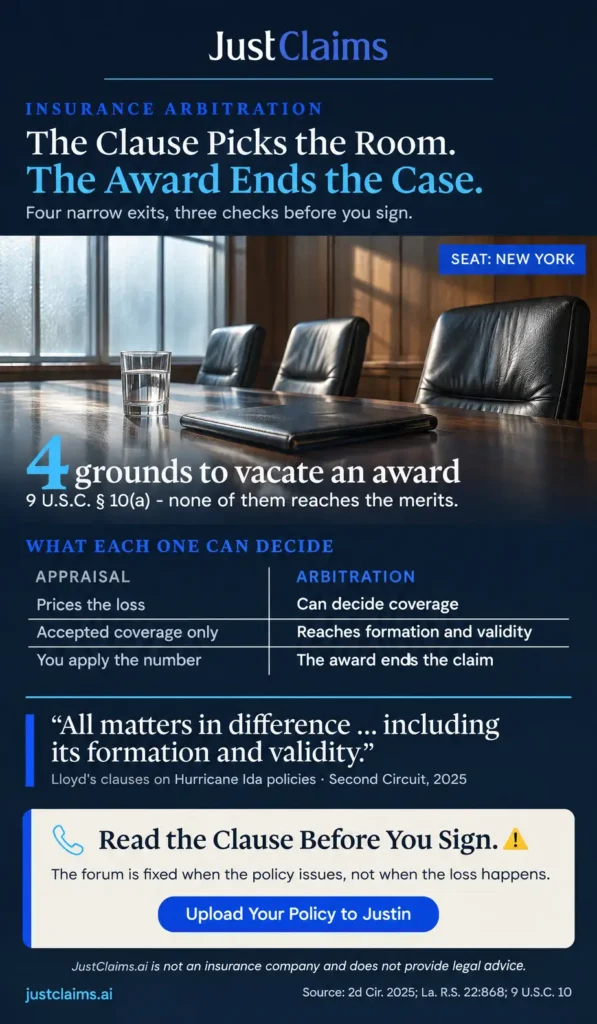
Arbitration is a contractual proceeding, and its scope comes from the clause rather than from a statute. Under the Lloyd’s wording, the tribunal’s reach extended to “all matters in difference,” which included the policy’s “formation and validity” [1]. Appraisal produces a number you apply to the policy; arbitration can produce a decision on whether the policy responds at all.
| Feature | Appraisal | Arbitration |
|---|---|---|
| Question decided | The amount of loss [3][4] | Any matter the clause covers, including coverage and validity [1] |
| Who decides | Two appraisers; the umpire settles disagreements [4][5] | A tribunal seated where the clause says [1] |
| Coverage questions | Outside the process [6] | Can be inside the tribunal’s scope [1] |
| What you get | A loss figure applied within policy terms, limits and deductibles [4] | A decision on the dispute the clause covers [1] |
On a large commercial schedule that distinction is not academic. A Business Interruption period that is measured wrongly, or an Ordinance or Law limitation that is missed, changes the size of a payment materially [7]. Appraisal argues about cost lines. Arbitration can argue about the policy. For a strip center with a disputed business-income period, a multifamily portfolio arguing over scope of repair, or a warehouse schedule with an Ordinance or Law question, that is the difference between re-pricing a claim and re-opening coverage.
Binding vs. Non-Binding Clauses, and Where Enforceability Varies
Binding arbitration means the parties agreed the award is final. Courts do not retry the merits. Where the parties have agreed that judgment may be entered on the award, 9 U.S.C. § 9 provides that the court “must grant such an order unless the award is vacated, modified, or corrected,” and § 10 permits vacatur only where the award “was procured by corruption, fraud, or undue means,” where there was “evident partiality or corruption in the arbitrators,” where the arbitrators were “guilty of misconduct” in refusing to hear material evidence or committed “any other misbehavior by which the rights of any party have been prejudiced,” or where they “exceeded their powers” [8]. That list is narrow, and it addresses the process and the arbitrators’ authority rather than whether the tribunal weighed the evidence correctly.
Non-binding arbitration is the opposite bargain: either side may reject the award and litigate. Which one you have is a matter of what the clause says, and the clause is the only place to answer it.
Appraisal awards follow a different rule, and in Texas the difference is statutory. Texas Insurance Code Chapter 1813 applies only to personal automobile and residential property policies, and it expressly does not apply to “a commercial insurance policy” or to a policy issued by the Texas Windstorm Insurance Association [9]. Within that scope, “[e]xcept for fraud, accident, or material mistake relevant to the appraisal or an appraisal award made without authority, the amount of loss determined by an appraisal under this chapter is binding as to the policyholder and the insurer” [9].
Colorado shows how fast the ground can move. HB26-1247 would have required homeowner policies issued or renewed on or after January 1, 2027 to include a mandatory and binding appraisal process covering “a determination of the amount of loss, causation, and necessary scope of repair or replacement,” while stating that “[t]he appraisal process does not determine coverage” [10]. It did not become law: the House Business Affairs & Labor Committee postponed it indefinitely on March 25, 2026 [10]. Any page describing it as pending law is out of date.
Costs, Procedure and Timelines vs. Litigation
Cost is where the two forums diverge most, and it is usually the part left out of the conversation until a dispute is already live.
Appraisal cost allocation tends to be written into a statute or a rule:
- Louisiana: each party pays “his own appraiser fees and expenses,” half of “the reasonable and necessary costs incurred for an umpire’s fee and expenses,” and half of “any reasonable and necessary costs incurred to conduct the appraisal” [11].
- Texas windstorm claims: “[e]ach party must pay one-half of all reasonable and necessary costs incurred or charged in connection with the appraisal,” including “appraisers’ fees,” the “umpire’s fee” and “umpire’s travel costs”; and if the parties settle before the umpire begins work, “the umpire may not charge a fee” [12]. The rule sits in the Texas Windstorm Insurance Association subchapter, so it does not govern every Texas policy [12].
- New York: the Department of Financial Services states that “the costs of this process are paid by the policyholder and the insurance company” [5].
Arbitration cost is not set by a schedule in the same way. It follows the clause and the arbitral rules the clause incorporates, together with the seat named in the clause [1]. That is why the seat, the rules, and the number of arbitrators belong on the same review list as the coverage grant.
For an owner, the practical question is not which forum is cheaper in the abstract. It is which forum can still hear the evidence that decides the case — causation, scope, and how the file was handled — and whether the clause lets you put that evidence in front of the decision-maker at all.
When an Arbitration Clause May Be Challenged
United Policyholders puts the consumer side plainly: “Many insurance policies (e.g., uninsured motorist coverage under auto policies) contain wording that forces policyholders into private, binding arbitration and deprives them of the constitutional right to have a dispute resolved in a public court of law” [13]. It adds that “[s]ome states expressly prohibit insurers from writing mandatory binding arbitration wording into property policies” [13] — a statement about some states, not a national rule, and worth confirming for the state where your property sits.
The federalism question runs through the McCarran-Ferguson Act: “[n]o Act of Congress shall be construed to invalidate, impair, or supersede any law enacted by any State for the purpose of regulating the business of insurance,” unless the federal act “specifically relates to the business of insurance” (15 U.S.C. § 1012(b)) [14]. That is the textual basis for reverse preemption — and the reason a treaty analysis can change the result.
What the Circuits Have Held
The First Circuit, applying Medellín, held that Article II(3) “manifests precisely the type of directive to United States courts that is a hallmark of a self-executing treaty provision,” and enforced the clause [15]. The Fifth Circuit reached the same outcome on narrower ground: “the McCarran–Ferguson Act does not permit state laws to reverse-preempt the Convention,” and that is “true whether the treaty is self-executing or requires implementing legislation” [16]. The Fourth Circuit enforced a Swedish arbitration clause the same way, holding that the Convention Act “is not subject to reverse preemption” [17]. The Second Circuit’s 2025 decision now puts it in that group — and removes the reasoning its own 1995 precedent had used [1].
Where a Challenge Can Still Land
The Convention is enforced in United States courts through 9 U.S.C. § 201 et seq. [18]. Article II(3) requires a court of a Contracting State, at the request of one party, to “refer the parties to arbitration, unless it finds that the said agreement is null and void, inoperative or incapable of being performed” [19]. That exception is the live ground: the argument is about the agreement itself, not about whether arbitration is a good idea for insureds. It is also the argument that benefits from counsel who has run it before.
If the Clause Has Already Been Invoked
Once the demand is on the table, the scope question stops being academic. Four steps, in this order:
- Get the clause and the demand in writing. Ask the carrier or the tribunal to identify the specific arbitration provision and the relief it is seeking, so the scope argument is anchored to text rather than to a phone call [1].
- Diary every date in the clause and in the rules it names. Appointment of the arbitrator, the response, and the hearing schedule are set by those documents, not by the court’s calendar [1].
- Confirm the seat, the rules, and the governing law. Those three terms decide the procedure and drive the cost [1]. If the seat sits outside the United States, the Convention analysis is in play [18].
- Preserve the claim file before the schedule compresses it. Causation evidence, scope documentation, and the carrier’s written positions are what the tribunal will weigh — and because review of the award is narrow, the record built now is the record you live with [8].
Then get counsel before you respond. The one question that matters most at this stage — whether the clause reaches coverage or only the amount of loss — is the question that determines whether you are in the right forum at all.
Policy Review Checklist: Find the Clause Before a Loss
The forum is fixed when the policy is issued, so the clause has to be found before a loss. In our claims practice the clause is the first thing we read, because it decides everything that follows. Work through these with the full policy in front of you, not the declarations page:
- Search for the word, not the concept. Look for “arbitration,” “Arbitration Tribunal,” “referred to,” and choice-of-law language [1].
- Read the scope sentence. Compare “all matters in difference” against an appraisal provision limited to the amount of loss [1][3].
- Identify binding status. Find the language that says whether an award is final or either side may reject it [8].
- Note the seat and the governing law. The Lloyd’s clause named New York as the seat and New York law as the proper law [1].
- Do not rely on conformity-to-statute wording. The Fifth Circuit held that because the Convention preempts the conflicting state statute, there is no conflict to trigger the clause, so “the conformity provision is not triggered” and the arbitration agreement survives [16].
- Check who pays. Confirm whether appraisal costs are allocated by statute, by rule, or by the policy [11][12][5].
- Read the valuation provisions together. Business Interruption pays for lost net income while repairs are underway [7], so the period and the valuation method decide the number. Ordinance or Law provisions sit beside it and raise their own valuation questions.
- Confirm current state law. Verify the rule for the state where the property sits, and have counsel read a § 22:868-style provision in full, including any later subsection [2][14].
- Check the policy date if you are relying on a new statute. Texas Chapter 1813 took effect September 1, 2025, but it applies only to policies delivered, issued for delivery, or renewed on or after January 1, 2026 [20].
Frequently Asked Questions
Is arbitration the same as appraisal?
No. Appraisal is limited to the amount of loss once coverage has been accepted [3][4], and the Texas regulator states it “isn’t for disputes about whether your policy covers a loss” [6]. Arbitration’s scope comes from the clause, and the Lloyd’s wording reached the policy’s formation and validity [1].
Can an insurer enforce arbitration if my state bans it?
Sometimes. For a foreign insurer whose award falls under the New York Convention, the Second Circuit held Article II Section 3 self-executing, so state law cannot reverse-preempt it [1][19]. The First, Fourth and Fifth Circuits reached the same outcome on varying grounds [15][16][17]. Whether the Convention applies to your policy is a fact question for counsel.
Can an arbitration award be appealed?
Not on the merits. A court must confirm the award unless it is vacated, modified, or corrected, and the grounds for vacating are the narrow ones listed in 9 U.S.C. § 10 — corruption or fraud, evident partiality, misconduct in refusing to hear material evidence, or the arbitrators exceeding their powers [8].
Who pays for an appraisal?
It depends on the state or the rule that applies. Louisiana has each party pay its own appraiser and split the umpire and appraisal costs [11]; Texas windstorm rules require one-half per party, with no umpire fee if the parties settle first [12]; New York’s regulator says the policyholder and the insurer pay [5].
How do I find an arbitration clause in my policy?
Search the full policy for “arbitration,” “Arbitration Tribunal” and “referred to,” then note the seat, the governing law, and whether the clause reaches coverage questions or only the amount of loss [1].
How to Review Your Policy Before a Loss
An arbitration clause decides where a dispute is heard, who decides it, and whether the result can be reviewed. Reading the clause, the appraisal provision, and the state-law overlay together — before a loss — is the difference between choosing a forum and discovering one after the claim is denied.
If you are not sure what your policy says, get a free commercial property coverage analysis from Justin, which reads the arbitration and appraisal language and flags gaps in Business Interruption and Ordinance or Law coverage for you and your counsel to evaluate.
If a dispute is already open, our insurance claim appraisal services explain how appraisal fits alongside arbitration.
This content is for informational purposes only and does not constitute legal or insurance advice. Coverage decisions depend on the specific terms, conditions, and exclusions of each policy and the laws of the applicable jurisdiction; policyholders and contractors should consult with a qualified professional for advice on their particular situation.
Sources
[2] La. R.S. § 22:868, Limiting actions; jurisdiction; venue — Louisiana State Legislature
[3] La. R.S. § 22:1807.12, Applicability — Louisiana State Legislature
[4] La. R.S. § 22:1807.13, Appraisal process — Louisiana State Legislature
[5] Appraisers, Adjusters and Umpires — New York State Department of Financial Services
[6] Home Insurance Guide: What To Do After a Loss — Texas Department of Insurance
[7] Business Interruption and Business Owner Policy — National Association of Insurance Commissioners
[9] Texas Insurance Code Chapter 1813, Appraisal of Disputed Losses — Texas Legislature
[11] La. R.S. § 22:1807.23, Costs — Louisiana State Legislature
[12] 28 Tex. Admin. Code § 5.4221, Appraisal costs — Legal Information Institute, Cornell Law School
[13] Opposing Forced Arbitration of Insurance Disputes — United Policyholders
[20] S.B. 458, 89th Legislature, Regular Session (2025), enrolled text — Texas Legislature

Collin Corcoran

Experienced Public Adjuster and Property Claims Specialist, Collin is licensed in New York (#1603393), New Jersey (#3003700204), and Connecticut (#19820270). With 20+ years of hands-on construction and property damage experience, he specializes in residential and commercial claims, complex loss inspections, policy review, detailed estimating, and strategic negotiation. Collin’s background in construction, asset management, emergency response, and claims documentation allows him to accurately identify damage, understand repair requirements, and advocate effectively for policyholders. He works with homeowners, business owners, contractors, and insurance professionals to move claims forward with clarity, accuracy, and confidence. Collin is committed to transparency, technical precision, strong communication, and securing fair outcomes for policyholders.