Tree Fell on Your House? Insurance Claim Guide
November 11, 2026
Written by Taylor Bezek
Share


A tree on your roof is two claims in one: the damage it did, and the cost to get the tree off your property. Most policies pay for the first and cap the second at a few hundred dollars — so the order you document, report and repair can decide who absorbs the cleanup bill.
Key Takeaways
- Removal cap: A standard homeowners policy pays up to $500 for tree removal in any one loss; some carriers allow $500 or $1,000.
- When removal is covered: When a covered peril drops the tree on a covered structure — and, under some policies, when it blocks your driveway.
- Vehicle damage: A tree that falls on your car is an auto claim under comprehensive coverage, if you carry it — not a homeowners claim.
- Neighbor’s tree: Your own policy usually pays for damage to your home, and you pay your deductible.
- No damage, no removal: A tree that falls in the open yard is usually your bill.
- Before the adjuster arrives: Make temporary repairs only. Permanent repairs can wait.
What Homeowners Insurance Actually Pays For
Two questions decide a tree claim: what the tree hit, and what brought it down.
The North Carolina Department of Insurance states the standard rule: a homeowners policy pays reasonable expense, up to $500 for any one loss, to remove trees from your premises — provided the tree damaged a structure or blocked the driveway [1].
The Connecticut Insurance Department reaches the same number from a different direction. It says the cost to remove the tree from the premises is generally covered up to $500 so long as the tree damages a covered structure or blocks a driveway on the premises, and that the policy generally covers removing a tree from the house itself when a covered peril caused the damage [2].
United Policyholders describes a wider range. It says most policies cover up to $500 or $1,000 for reasonable expenses to remove tree debris after a sudden and accidental loss caused by windstorm, hail, or the weight of ice, snow or sleet — and the fallen tree must have damaged the dwelling or other structures [3].
The Iowa Insurance Division adds the causation test. Coverage usually applies when the fall is sudden and accidental and caused by a covered peril such as wind, hail, lightning, or the weight of ice or snow. Where those conditions are met, the policy may pay for structural repairs, removal of the tree up to the dollar amount defined in the policy, and temporary living expenses if the home becomes uninhabitable [4].
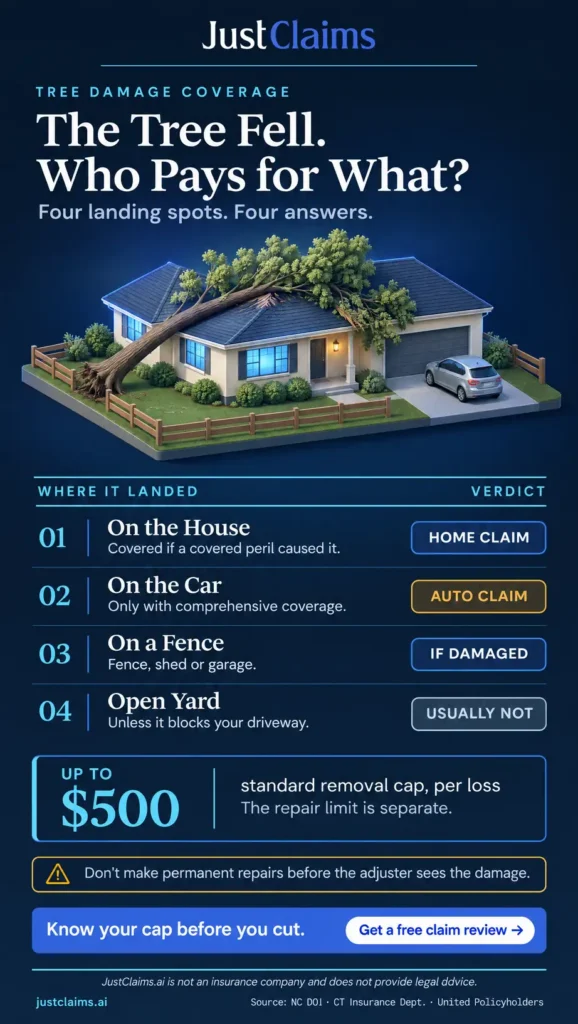
| What the tree hit | Which policy usually responds | What to know |
|---|---|---|
| House | Home insurance, if a covered peril caused the fall | Removal and repair may both be covered [1][2]. |
| Garage, shed or fence | Home insurance, if the structure was damaged | Iowa lists the house, shed and fence among structures a policy may pay to repair [4]. |
| Car | The vehicle owner’s comprehensive auto coverage | The home policy does not respond [1][4]. |
| Open yard, nothing damaged | Generally no removal coverage | Unless the tree blocked your driveway [1][2]. |
| Your home, tree from a neighbor’s yard | Your own home insurance | You pay your deductible [1][4]. |
If a tree falls without damaging a structure and without blocking access, the policy generally does not pay for removal. The Connecticut Insurance Department is blunt about that case: if the tree is blown over and does no damage to structures, there is generally no coverage for the tree and no coverage to remove it from the premises [2]. The Texas Office of Public Insurance Counsel says the same in plain terms: insurance will not usually pay to replace the trees or cover the cost to cut up and remove them [5].
The Removal Cap Is Small — and It Is Not the Repair Limit
The $500 figure is a coverage limit, not an estimate of what removal costs.
The consumer guides describe it differently, and that difference matters:
- Per loss: The North Carolina Department of Insurance states the limit as reasonable expense, up to $500 for any one loss, for removal of trees from your premises [1].
- Same number, different route: Connecticut’s Insurance Department ties the same $500 to a tree that damaged a covered structure or blocked a driveway [2].
- A range across carriers: United Policyholders says most policies cover up to $500 or $1,000 for reasonable tree-debris removal expenses after a sudden, covered loss [3].
- Policy-defined: The Iowa Insurance Division describes removal as typically covered up to a certain dollar amount as defined by your policy [4].
Removal is also a separate line from the repair. Iowa lists structural repairs to the home and removal of the tree as two distinct things a policy may pay, so read both items on your claim separately rather than assuming one limit covers everything.[4]
Because carriers write the provision differently, the only reliable answer sits in your own policy. Read the debris removal provision against your declarations page, and confirm whether your carrier applies a cap per tree or per loss.
Neighbor’s Tree: Whose Claim Is It?
Start with your own policy before you start an argument.
The North Carolina Department of Insurance says that, generally, if a tree falls on your home or other structure, your own homeowners policy covers the damage [1]. The Texas Office of Public Insurance Counsel adds that this is typically true even when the tree belongs to your neighbor [5]. The Iowa Insurance Division notes that your own insurance may cover it, but you pay your deductible [4].
Liability is a separate question from coverage. The Connecticut Insurance Department says a tree owner is legally liable for the damage only if owner negligence caused the tree to fall; otherwise the fall is treated as an Act of God and the neighbor’s own property coverage responds [2]. Where negligence is present, Iowa explains that your insurer may try to recover costs from the neighbor’s insurance through subrogation — and your deductible may be returned. If your tree damages a neighbor’s property, they should file with their insurer, but you could be liable if your neglect or poor maintenance contributed to the fall [4].
OPIC adds a prevention step worth taking now: if you think a neighbor’s tree is a hazard to your property, tell them [5].
State rules differ; this section reflects guidance published by Texas, Iowa and Connecticut.
Document First, Cut Second
Photograph before you clear anything
The Texas Department of Insurance advises taking pictures and video of the damage and not throwing anything away until the adjuster tells you [6]. OPIC says to do it as soon as possible [5]. The Iowa Insurance Division puts the same instruction first: document the damage with clear photos and videos before making any changes or repairs [4].
Make temporary repairs only
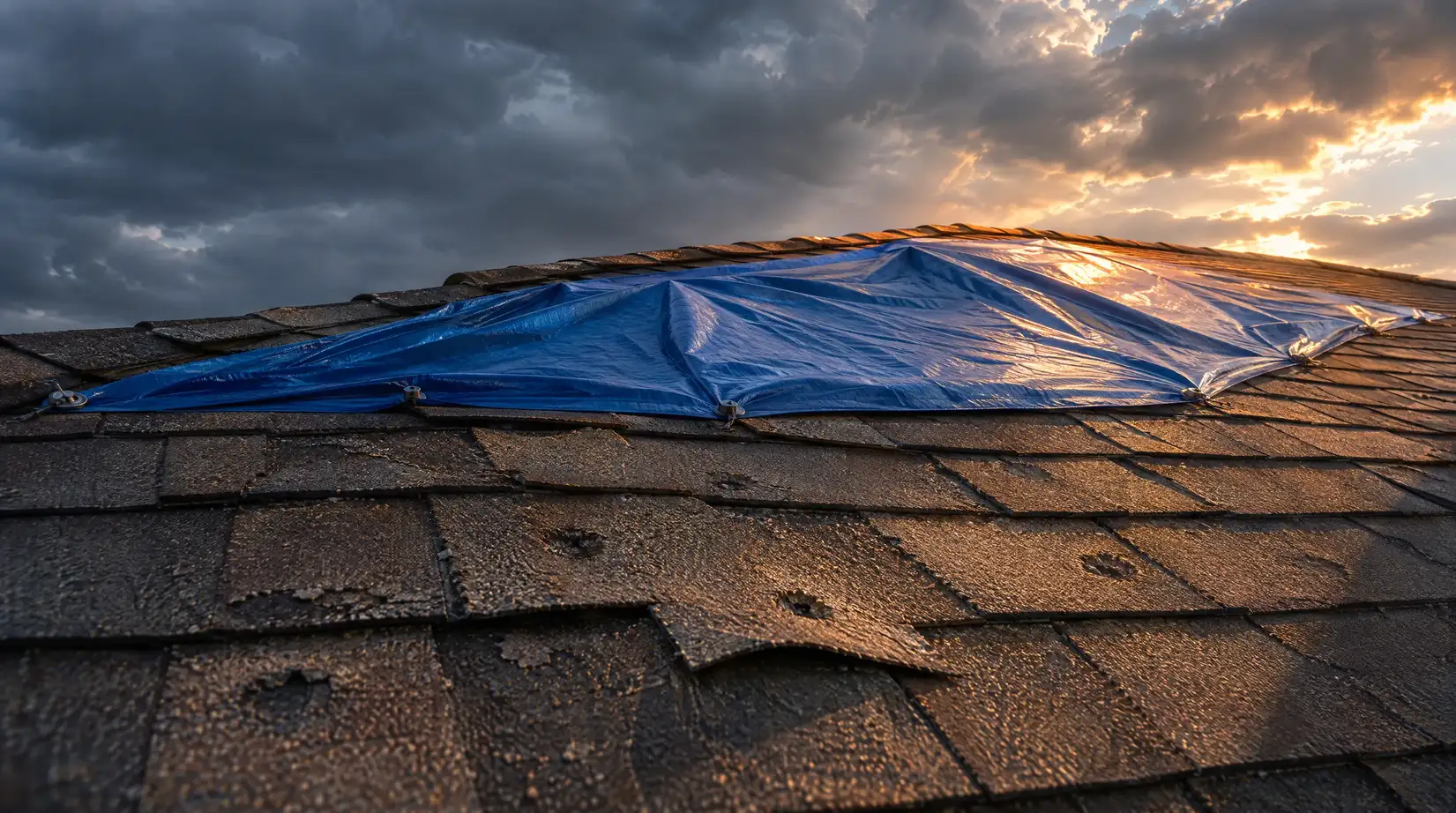
Cover broken windows and holes to keep rain out, and remove standing water [6]. TDI’s wording is explicit: don’t make permanent repairs before the insurance adjuster sees the damage [6]. Iowa describes the same step as mitigating further damage by covering holes or broken windows with tarps or boards [4].
Keep receipts and get competing bids
TDI advises keeping a list of the repairs, saving receipts, and getting multiple bids from contractors to compare with the adjuster’s report before settling [6]. Iowa adds: hire only registered contractors and tree removal services, don’t sign service contracts with blanks, know how much of the cleanup cost you will be responsible for, and keep receipts for reimbursement [4].
Five Steps to File a Tree Damage Claim
1. Put safety first
Stay away from downed power lines and damaged structures, and call emergency services if there is a safety risk [4].
2. Cover openings and capture the damage
Cover holes or broken windows with tarps or boards, and photograph and video the damage before anything changes [4][6].
3. Notify the insurer and confirm cost responsibility
Contact your insurer if the damage appears to exceed your deductible, file promptly, and ask how much of the cleanup cost you will carry [4].
4. Submit your documentation
Provide the photos, video and receipts, and try to be there when the adjuster visits so you can point out every part of the loss [6]. If the claim stalls after that visit, our guide to what a claims adjuster does explains what happens next.
5. Gather repair quotes before you settle
Get multiple bids and compare them with the adjuster’s report before agreeing to a settlement [6].
Why Tree Damage Claims Get Denied
These are the grounds that decide tree claims — and the ones to have an answer for.
- Nothing covered was damaged. No structure damage and no blocked driveway usually means no removal coverage [1][2].
- The tree was neglected, diseased or rotting, and the risk was known. Iowa notes the claim may be denied in that situation [4].
- Permanent repairs came first. TDI’s consumer guidance is explicit: don’t make permanent repairs before the adjuster sees the damage [6].
- The repair bill is below your deductible. Iowa advises contacting your insurer once the damage appears to exceed the deductible [4].
- Flood, not wind, caused the loss. The Connecticut Insurance Department states that a homeowners policy excludes damage caused by flooding, which requires a separate flood policy [2].
- The dispute is about whose tree it was. Liability can turn on neglect or poor maintenance [4].
Ask the carrier to point to the specific policy language behind any denial, then compare it with the cause of loss in your own documentation.
Frequently Asked Questions
Does homeowners insurance cover tree removal?
It depends on what the tree hit. NC DOI ties removal coverage to a tree that damaged a structure or blocked the driveway, and caps the payment at $500 for any one loss [1]. OPIC adds that when a tree causes no property damage, insurance will not usually pay to cut it up or remove it [5].
Who pays when a tree falls on my car?
Your auto insurer, if you carry comprehensive coverage. NC DOI says a homeowners policy does not cover a vehicle damaged by falling trees or debris; auto insurance does if you carry other than collision (comprehensive) coverage [1]. Iowa adds that liability-only auto coverage leaves you paying the repair or replacement yourself [4].
Whose insurance covers a neighbor’s tree that falls on my house?
Yours, in most cases. NC DOI says that, generally, your own homeowners policy covers damage when a tree falls on your home or other structure [1]. Iowa notes your policy may cover it, you pay the deductible, and your insurer may pursue subrogation if the neighbor was negligent [4].
Should I hire a tree service before the adjuster visits?
Document first, and confirm cost responsibility with your insurer. Iowa recommends documenting the damage before any changes or repairs, hiring only registered contractors, and knowing how much of the cleanup you will be responsible for [4]. TDI adds: don’t throw anything away until the adjuster tells you [6].
Does homeowners insurance cover a hotel if I can’t stay in the house?
It may, if a covered loss made the structure uninhabitable. Iowa lists temporary living expenses among what a policy may pay in that situation [4]. Connecticut draws the line more precisely: additional living expense applies when a covered loss damages the structure, and does not apply to a widespread power outage away from your property [2]. TDI advises asking about living expenses and keeping the receipts [6].
The tree only blocked my driveway. Is that covered?
Possibly. Both NC DOI and the Connecticut Insurance Department describe the removal cap as applying when the tree damaged a structure or blocked the driveway [1][2]. Confirm the debris removal provision in your own policy.
What to Do After a Tree Hits Your Home
A tree claim comes down to three things: what the tree hit, whether a covered peril caused the fall, and how well you documented the loss before the cleanup crew arrived.
The removal cap is a fixed dollar figure — $500 for any one loss under the standard rule, with some carriers allowing $500 or $1,000 — so read your debris removal provision before you authorize work [1][3]. Photograph everything, make temporary repairs only, keep receipts, and confirm with your insurer how much of the cleanup you will carry.
If a denial cites neglect, a diseased tree, or damage that never reached a covered structure, ask for the exact policy wording and compare it with your documentation.
Upload your policy and the carrier’s estimate, then review your tree removal insurance coverage in Justin to see your actual cap and flag any denial reason that does not match your policy language. If you manage more than one property, run each policy through the same check — every policy carries its own debris removal provision.
This content is for informational purposes only and does not constitute legal or insurance advice. JustClaims is not a law firm. Coverage decisions depend on the specific terms, conditions, and exclusions of each policy and the laws of the applicable jurisdiction. Public adjuster licensing requirements vary by state; confirm the licensing status of any adjuster you retain. No outcome or settlement amount is promised or implied.
Sources
[1] FAQs About Homeowners Insurance — North Carolina Department of Insurance
[2] Understanding Your Coverage (August 21, 2025) — Connecticut Insurance Department
[3] What’s UP With Trees, Shrubs, and Landscaping Insurance Coverage? (updated March 25, 2026) — United Policyholders
[4] August Consumer Connection: Tree Damage and Insurance (August 1, 2025) — Iowa Insurance Division
[5] Know Your Coverage: Trees — Texas Office of Public Insurance Counsel
[6] Help after a storm (updated September 29, 2026) — Texas Department of Insurance

Taylor Bezek

As the General Manager at JustClaims, Taylor Bezek brings over a decade of experience managing complex residential, commercial, and large-loss claims. A licensed Public Adjuster in TX (#2125659), FL (#W455048), CO (#769172), and 10 additional states, Taylor founded his own firm before joining JustClaims to scale a tech-forward solution for the insured. He is committed to combining industry expertise with AI to enhance speed, clarity, and outcomes for every policyholder. Taylor's mission is to modernize the public adjusting profession and ensure owners get exactly what they are entitled to.