Consequential Damages in Property Claims Explained
November 24, 2026
Written by Collin Corcoran
Share


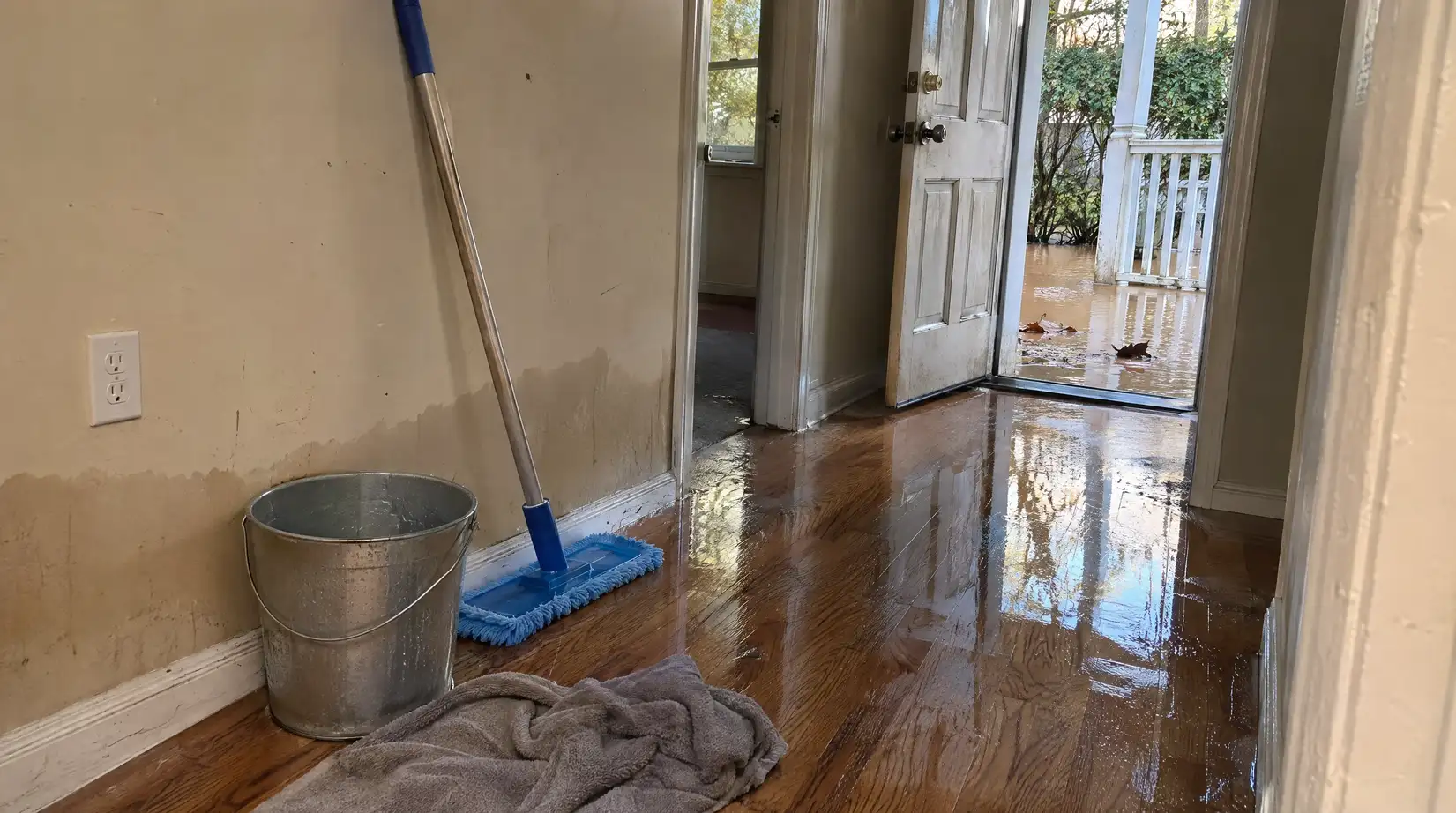
Consequential damages in a property claim are the indirect losses that follow a covered loss — lost rent, lost profit, and extra operating costs. Whether a policy pays them depends on whether it includes business income, loss of rents, or extra expense coverage, and on how its exclusions and endorsements are worded. For a commercial owner, the line between a direct loss and a consequential one often decides how much of the claim survives.
Key Takeaways
- What it is: In property insurance, consequential damages are the indirect losses that follow a direct physical loss, such as lost profit, lost rents, and added operating costs.
- Direct vs. consequential: The direct loss is the physical damage; the consequential loss is the income or extra cost that follows it.
- What pays it: Business income, extra expense, and loss of rents or rental value are the coverage parts that typically respond.
- Wording matters: Exclusions and ensuing loss clauses can decide whether an indirect loss stays covered.
- Proof: Lost profits must be shown with reasonable certainty — the standard applied in Maher — so pre-loss records and a defensible calculation carry the claim.
Consequential Damages vs. Direct Damages
Statutes sometimes use the same labels. Georgia’s code, for example, defines direct damages as those that “follow immediately upon the doing of a tortious act,” and consequential damages as those that are “the necessary and connected effect of a tortious act, even though they are to some extent dependent upon other circumstances” [1]. That is a tort statute, not an insurance statute.
Property policies draw a similar line. California’s Department of Insurance describes time element coverage as insurance that covers “other losses stemming from a direct loss by a covered peril to business property,” and lists business interruption, extra expense, and loss of rents and rental value as the most common time element coverages [2].
For a commercial owner, the fire-damaged structure is the direct loss. The rent or revenue that disappears while the structure is repaired is the consequential loss. The policy’s grants and exclusions decide whether that second category is paid. This article covers the property-insurance meaning, which is the one that matters when a building is damaged.
Property-Claim Examples: Lost Rent, Lost Profit, and Extra Expense
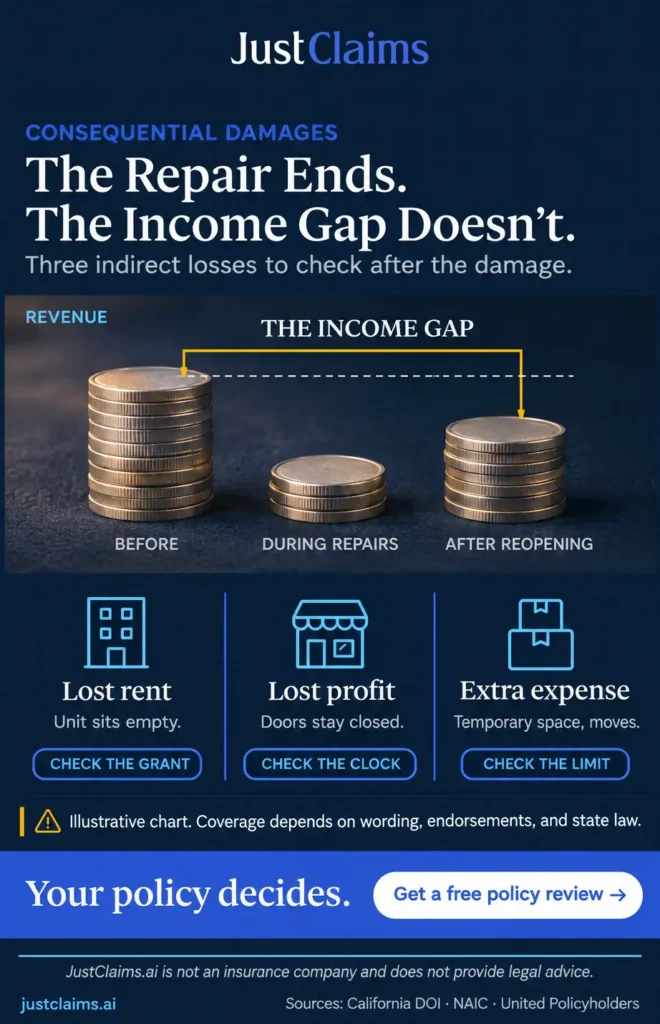
Because the consequential loss is indirect, it helps to separate the categories that appear in commercial claims.
Lost Rent and Rental Income
If a fire makes a rental unit unlivable, the landlord can lose rental income for the repair period. Loss of rents and rental value coverage responds when damage or destruction makes a building unfit for occupancy, covering the rental income the owner loses [2]. For a landlord or multi-family owner, that is the exposure loss of rents coverage is designed to address.
Lost Profit and Business Income
A business that cannot operate loses the income it would have earned. Business interruption coverage, also called business income coverage, replaces income lost when operations are disrupted by a covered physical loss such as a fire [3]. The claim is financial, which makes the records behind it central to the recovery.
Extra Expense
Extra expense is the added cost of keeping operations running during repairs. NAIC describes extra expense coverage as repayment for additional expenses incurred during the period of repairs [3]. California’s guide gives the practical examples: temporary office space, equipment rental, and advertising [2]. Those are operating costs, separate from the direct physical loss.
What Policies Pay: Business Income, Loss of Rents, Extra Expense, and Soft Costs
A first-party property policy pays a consequential loss only where a coverage part grants it. This article addresses what the policy pays, not what a court might award on a separate breach-of-contract claim. NAIC notes that business income coverage may be included in a business owners policy, commercial property coverage, or commercial multiple-peril package, and may sit in the base policy or be added by endorsement [3]. That is why the declarations and endorsements matter as much as the main form.
Business Income and Extra Expense
Business income coverage replaces income lost when operations are disrupted by a covered physical loss [3]. NAIC notes that expenses such as rent for a temporary location, payroll, taxes, and loan payments while the property cannot be used are typically covered [3]. Extra expense pays the additional cost of operating during repairs, including temporary space, equipment rental, or advertising [2][3]. For a deeper look at how these coverages interact, see our guide to business interruption, extra expense, and loss of rents.
Loss of Rents and Rental Value
Loss of rents and rental value coverage protects the income a building would have produced. It covers loss of rental income to the property owner caused by damage or destruction that renders the building unfit for occupancy [2]. The coverage is a time element grant, meaning it responds to the indirect loss rather than the physical repair [2].
Soft Costs in Builders Risk
On a construction or renovation project, the indirect exposure shifts to project costs that the base policy may not include. Soft costs coverage is added by endorsement and covers “various incidental expenses that may result from a physical loss by a covered peril to a building project” [4]. The Oregon Department of Administrative Services says builders risk coverage should be endorsed to include it, and that soft costs coverage differs among insurers [4]. A developer or general contractor should confirm the endorsement is in the policy before assuming those costs are covered.
How Exclusions and Ensuing Loss Clauses Interact
Whether an exclusion reaches an indirect loss depends on the wording. Ensuing loss clauses are one of the mechanisms that decide the outcome. They appear in the exclusions section of all-risk policies, which cover all losses except those caused by perils the policy expressly excludes [5]. The clause provides that coverage for a loss caused by an excluded peril is nonetheless covered if the loss “ensues” from a covered peril [5].
Read the exclusion and the ensuing loss clause together. The question is not just what damaged the property, but which peril the indirect loss is tied to — and the wording controls that answer.
Proving the Loss With Records and Experts
Because the consequential loss is indirect, the proof burden is different from the physical damage: the claim has to show both that the loss happened and how much of it the policy covers.
The Reasonable Certainty Standard
In Maher v. Continental Casualty Co., 76 F.3d 535 (4th Cir. 1996), the Fourth Circuit applied West Virginia law and required lost profits to be proved with reasonable certainty rather than speculation. The court explained that lost profits may be established through economic and financial data, market surveys and analyses, business records of similar enterprises, and expert testimony [6]. The insured’s evidence fell short, and the court upheld limiting the loss period to the two-and-one-half weeks after the fire [6].
Pre-Loss and Post-Loss Records
United Policyholders advises that a substantial business income claim will likely require detailed pre-loss records: income and expenses, daily or monthly revenues, payroll costs, usual hours of operation, and variable costs that can be reduced during a suspension [7]. Insurers usually want the bookkeeping records kept in the ordinary course of business and, where that documentation is viewed as incomplete or unreliable, sometimes business tax returns [7].
Be ready to prove income and expenses for at least one to two years before the loss, and track post-loss revenue and extra expenses from day one in a separate ledger [7].
Forensic Accountants
Adjusters often work with a forensic accountant, and the insured may need one to support its own calculation. United Policyholders describes the role as combining accounting and auditing with investigative expertise to produce a calculation of business income loss for the carrier [7]. The same records that support the claim give the accountant a baseline to work from.
When a Consequential Loss Dispute Escalates
Disputes over an indirect loss turn on the policy wording and the proof behind the number. Policyholders can build a record before the issue escalates:
- Ask the carrier in writing to identify the specific policy provisions behind a partial payment or denial.
- Keep a dated log of communications and decisions.
- Submit the loss calculation and supporting records described above [6][7].
Whether a carrier’s handling crosses into bad faith is a legal question for qualified counsel. The record you build now is what any later review will rely on.
Frequently Asked Questions
Are consequential damages covered automatically?
No. A first-party policy pays them only where a coverage part such as business income, loss of rents or rental value, extra expense, or an endorsed soft costs coverage applies [2][3][4]. The declarations and endorsements show which grants are in force.
Does extra expense coverage pay to repair my building?
Extra expense is an operating-cost coverage: it pays additional expenses incurred during repairs, such as temporary space or equipment rental [2][3]. The cost of repairing or replacing the property itself is addressed under the policy’s property coverage.
What records should a commercial property owner keep after a loss?
Keep pre-loss income and expense records, revenue history, payroll costs, and usual operating hours. Be ready to prove income and expenses for at least one to two years before the loss, and start a separate ledger for post-loss revenue and extra expenses from day one [7].
What if my business has limited pre-loss history?
A thin record makes the proof harder. In Maher, the insured’s lost-income evidence fell short of the reasonable certainty standard, and the court upheld a loss period limited to two-and-one-half weeks after the fire [6]. Economic and financial data, market surveys, comparable business records, and expert testimony are the categories of evidence the court identified [6].
What are soft costs in a builders risk claim?
Soft costs coverage is an endorsement that covers “various incidental expenses that may result from a physical loss by a covered peril to a building project” [4]. Builders risk coverage should be endorsed to include it, and the coverage differs among insurers [4]. Without the endorsement, confirm in writing who bears those costs.
How to Document Your Consequential Losses
Consequential damages are the indirect losses that follow a covered event. Under a first-party policy they are paid where a coverage part such as business income, loss of rents or rental value, extra expense, or an endorsed soft costs coverage applies [2][3][4]. The proof standard rewards owners who keep detailed pre-loss records, track post-loss revenue and expenses from day one, and involve financial experts when the number is contested [6][7].
Before you accept a carrier’s calculation, compare the policy’s grants and exclusions against the loss you actually suffered. Get a free commercial property policy review from Justin to see how your business income, loss of rents, extra expense, and soft costs provisions are written — and where the gaps sit before they cost you.
This content is for informational purposes only and does not constitute legal or insurance advice. Coverage decisions depend on the specific terms, conditions, and exclusions of each policy and the laws of the applicable jurisdiction; policyholders and contractors should consult with a qualified professional for advice on their particular situation.
Sources
[1] Georgia Code § 51-12-3, Direct and Consequential Damages Distinguished (2025) — Justia Law
[2] Commercial Insurance Guide — California Department of Insurance
[3] What Business Income Loss Coverages Are Out There? — NAIC
[4] Insurance Clauses – Builders Risk — Oregon Department of Administrative Services
[5] The “Ensuing Loss” Clause in Insurance Policies (Chris French, 13 Nev. L.J. 215) — Penn State Dickinson Law
[6] Maher v. Continental Casualty Co., 76 F.3d 535 (4th Cir. 1996) — U.S. Court of Appeals for the Fourth Circuit
[7] Getting (Back To) Business Interruption Insurance — United Policyholders

Collin Corcoran

Experienced Public Adjuster and Property Claims Specialist, Collin is licensed in New York (#1603393), New Jersey (#3003700204), and Connecticut (#19820270). With 20+ years of hands-on construction and property damage experience, he specializes in residential and commercial claims, complex loss inspections, policy review, detailed estimating, and strategic negotiation. Collin’s background in construction, asset management, emergency response, and claims documentation allows him to accurately identify damage, understand repair requirements, and advocate effectively for policyholders. He works with homeowners, business owners, contractors, and insurance professionals to move claims forward with clarity, accuracy, and confidence. Collin is committed to transparency, technical precision, strong communication, and securing fair outcomes for policyholders.