What Does Flood Insurance Cover? NFIP Guide

November 13, 2026
Written by Taylor Bezek
Share


A standard homeowners, renters, or commercial property policy usually does not pay for flood damage. Flood coverage has to be bought separately, either through the National Flood Insurance Program (NFIP) or a private insurer. And the NFIP pays for a narrower list of things than most owners expect: separate building and contents limits, a long exclusion list, and a 30-day wait before most new policies start. Knowing those lines before water rises is what keeps a covered loss from turning into a funding gap.
Key Takeaways
- Flood definition: A general and temporary condition of partial or complete inundation of two or more acres of normally dry land, or of two or more properties (at least one of which is yours), from overflow of inland or tidal waters, unusual and rapid accumulation or runoff of surface water, mudflow, or shore collapse from erosion.
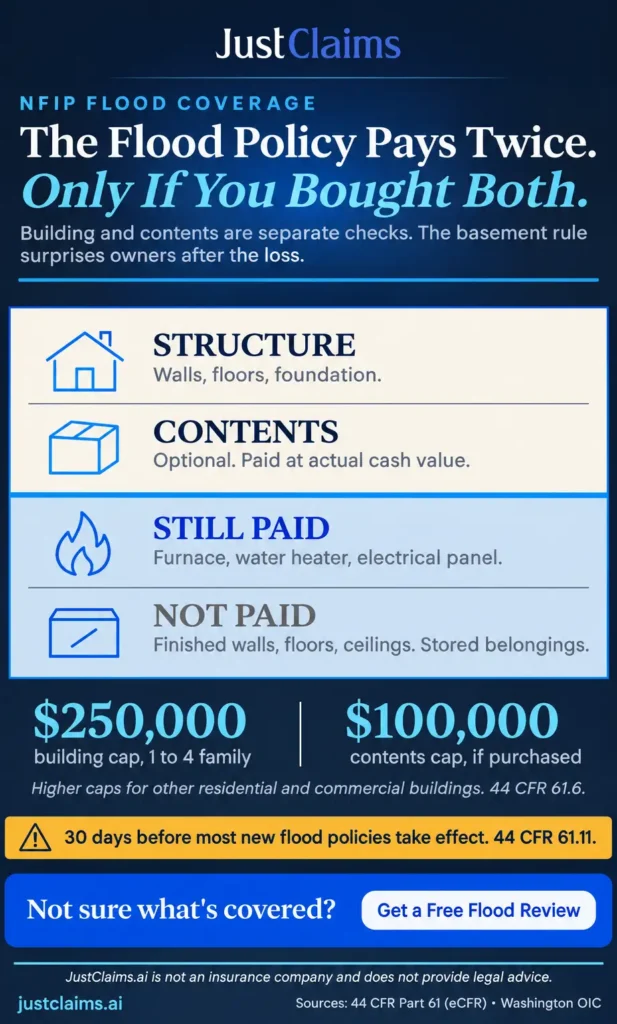
- Building limit: $250,000 for a 1–4 family home. A multifamily or other residential building, and a non-residential building, can reach $500,000.
- Contents limit: $100,000 for residential contents; $500,000 for non-residential contents.
- Standard property policies: They usually exclude flood. A separate flood policy is required.
- Basements: Coverage below the lowest elevated floor is limited to certain equipment. Finished improvements and stored belongings are generally excluded.
- Mold: Damage from mold or mildew that results primarily from a condition within your control and substantially confined to the building, or from failing to inspect and maintain the property after the flood recedes, is excluded.
- Not covered: Additional living expenses, outdoor property, and vehicles.
- Waiting period: Most new NFIP policies start 30 days after application and payment.
How the NFIP Defines a Flood
Flood coverage is narrow by design, and that narrowness is where a claim can turn into a dispute. The policy pays only when the event meets the program’s definition of a flood [1].
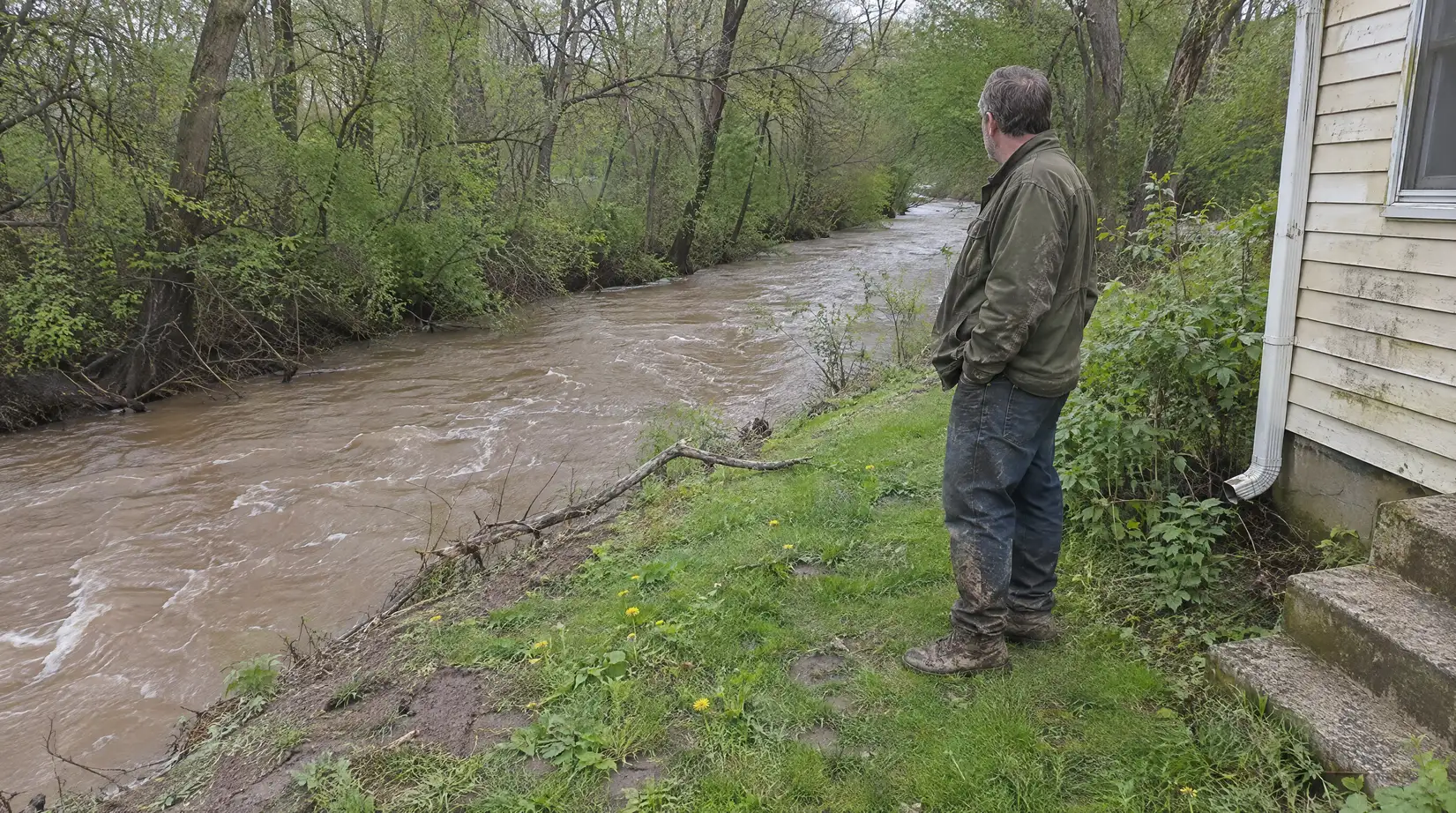
A general and temporary condition of partial or complete inundation of two or more acres of normally dry land area or of two or more properties (at least one of which is your property) from overflow of inland or tidal waters, unusual and rapid accumulation or runoff of surface waters from any source, mudflow, or collapse or subsidence of land along the shore of a lake or similar body of water caused by erosion or undermining [1].
The definition matters because the cause and extent of the water can change whether a loss is covered. A burst pipe inside one house generally does not meet the two-property or two-acre test, so it usually falls under a standard property policy rather than flood insurance [1]. When a flood loss is already underway, our guide to flood damage insurance claim assistance walks through the claim itself. If your question is how much coverage is available rather than what it covers, maximum flood insurance coverage breaks down the caps and excess options.
What NFIP Building Coverage Includes
Because a flood policy pays only for the items it names, the building coverage list is where gaps show up first. Building coverage protects the structure, not what is stored inside it [1].
In general, NFIP building coverage applies to items such as:
- The insured structure’s foundation, walls, floors, and attached structural components
- Electrical and plumbing systems
- Central air conditioning, furnaces, and water heaters
- Permanently installed cabinets, built-in appliances, and similar fixtures
Coverage depends on the form and the policy’s terms, so the declarations page and the policy form control what is actually insured [1]. Building coverage also includes up to $30,000 in Increased Cost of Compliance coverage, which helps pay to bring a flood-damaged building into compliance with state or local floodplain rules when repair or reconstruction is required [1]. Multifamily and non-residential buildings follow different rules than a single-family home, so confirm which occupancy category applies to your property [2].
Contents Coverage: What It Covers and What Sets the Amount
Contents coverage is bought separately from building coverage. A policy that lists only one part leaves the other uninsured, and without a contents selection your belongings may have no flood protection at all [1].
The NFIP caps what it will pay, and the cap depends on the occupancy category, not simply on whether the property is called residential [2].
| Occupancy | Building maximum | Contents maximum |
|---|---|---|
| 1–4 family dwelling | $250,000 | $100,000 |
| Other residential (multifamily) | $500,000 | $100,000 |
| Non-residential (commercial) | $500,000 | $500,000 |
A residential condominium building is capped at $250,000 times the number of units [2].
Those limits are separate. Unused building coverage cannot be moved over to contents, and an owner whose structure or belongings are worth more than the cap carries the difference unless excess coverage is added [2].
Contents coverage generally applies to personal property such as furniture, clothing, portable appliances, and electronics. Contents are also subject to actual cash value, so depreciation can reduce a payment below replacement cost [1].
What NFIP Excludes
Exclusions are easy to miss at purchase and expensive to discover at claim time. These four are worth checking against your own form before a loss [1].
Basements and Basement Contents
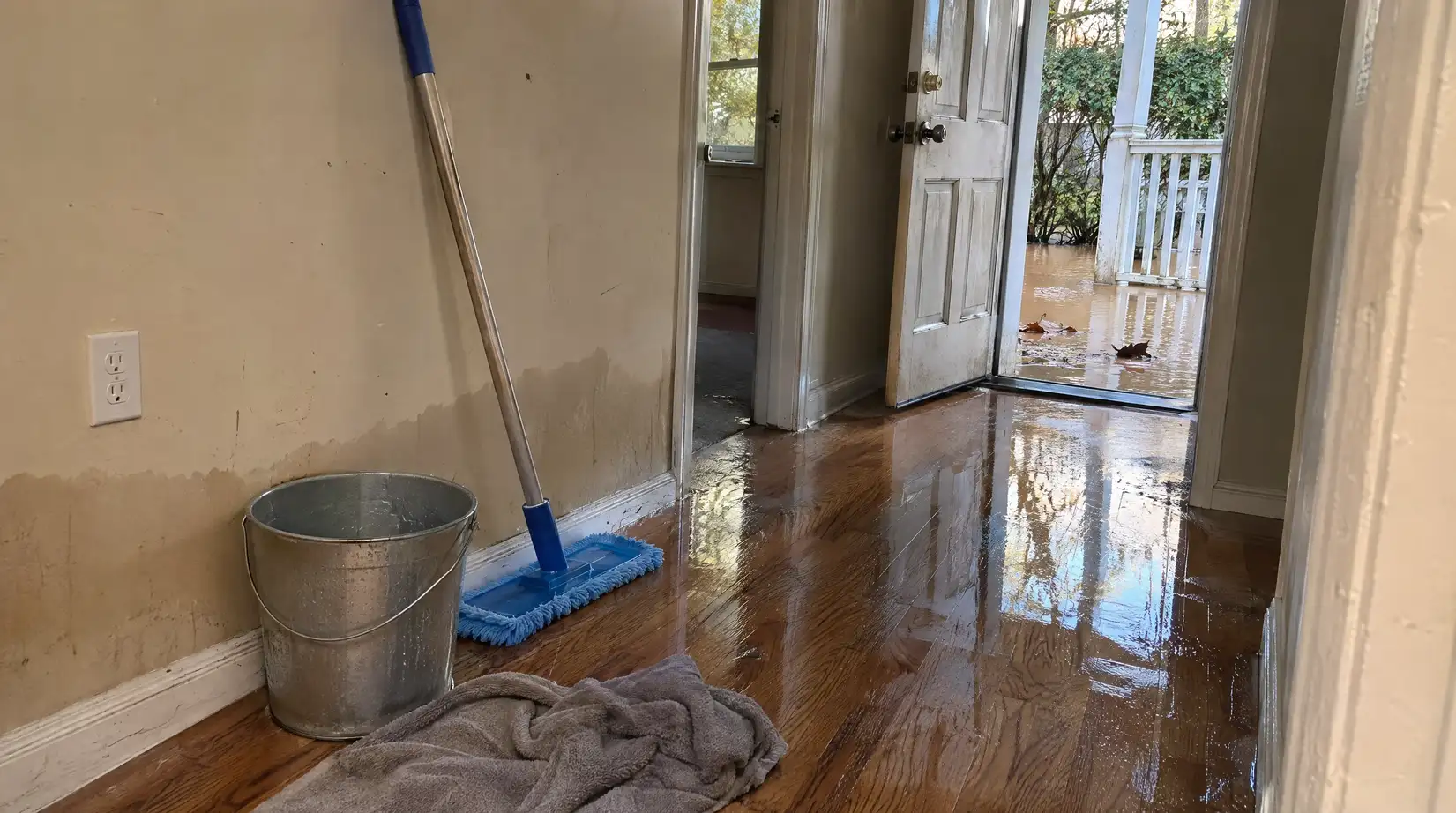
Coverage below the lowest elevated floor is limited. The NFIP pays for certain basic equipment there, such as furnaces, water heaters, air conditioners, and electrical junction boxes and switches, but finished basement improvements and personal belongings stored in a basement are generally excluded [1]. A finished basement full of furniture and electronics may therefore have little or no flood protection.
Mold That Was Not Mitigated
The exclusion turns on cause and control. Mold and mildew damage that results primarily from a condition within your control and substantially confined to the building, or from a failure to inspect and maintain the property after the flood recedes, is excluded [1]. That is why drying and mitigation records matter: they show when the moisture was addressed.
Outside Property and Vehicles
Items outside the insured structure fall largely outside NFIP coverage. The form excludes underground structures and equipment such as wells and septic systems, fences and retaining walls, and self-propelled vehicles [1]. Vehicles belong under an auto policy with comprehensive coverage, which is the coverage that responds to flood damage to a car [3].
Temporary Housing and Living Expenses
The NFIP does not pay additional living expenses. Hotel stays, rental housing, and similar costs while the building is uninhabitable are excluded [1]. Owners who need that protection have to arrange it elsewhere before a loss. For how the claim itself is handled after flooding, see our flood damage insurance claim assistance guide.
Private Flood Insurance vs. NFIP
Since the NFIP leaves gaps around caps and exclusions, many property owners ask whether a private policy fills them. Private flood coverage is sold by private insurers and surplus lines insurers rather than by the federal program, and commercial flood coverage is available through all three channels [3]. Where a private policy can differ:
- Limits: Excess flood coverage can sit above the NFIP caps for owners whose property is worth more than the federal maximum [3].
- Commercial availability: Business flood coverage is written by the NFIP, private insurers, and surplus lines insurers, and surplus lines coverage often starts immediately rather than after a waiting period [3].
- Terms: Basement treatment, contents valuation, and living expenses are set by each insurer’s form, so they have to be compared line by line.
Neither option is automatically better. The right fit depends on the property, its value, and what the lender requires, and for a commercial or multifamily building it depends on how far the NFIP cap sits below replacement cost [2][3].
How to Read Your Declarations Page
Exclusions only matter if you can confirm what your own policy lists. The declarations page is the summary of what you bought, and it is where gaps are easiest to confirm.
Look for these items:
- Building coverage amount: Check whether the figure reaches the maximum for your occupancy category — $250,000 for a 1–4 family home, up to $500,000 for other residential or non-residential buildings [2].
- Contents coverage amount: Confirm a contents limit is listed. If it is blank or zero, belongings are not insured, even if the building is.
- Deductibles: Building and contents deductibles are usually stated separately.
- Property description and occupancy: Confirm the address, building type, and use, because the occupancy category drives the amount available [2].
- Basement and lowest-floor information: Check how the policy describes the lowest floor, because that description controls what is covered below it [1].
- Policy period and mortgagee: Verify the effective dates, the 30-day waiting period, and the lender listed [4].
If any entry looks wrong or unclear, ask the agent or insurer to explain it in writing before a loss rather than after.
Frequently Asked Questions
Does homeowners insurance cover flooding?
No. A standard home, renters, or commercial property policy usually excludes flood, and coverage has to be purchased separately through the NFIP or a private insurer [3].
How much does NFIP flood insurance pay?
It depends on occupancy. A 1–4 family home is capped at $250,000 for the building and $100,000 for contents. A multifamily or non-residential building can reach $500,000 for the building, and non-residential contents can reach $500,000 [2]. For the full breakdown of caps and excess options, see maximum flood insurance coverage.
Are basements covered by flood insurance?
Only in part. The NFIP pays for certain basic equipment in a basement but generally excludes finished improvements and stored belongings [1].
Does flood insurance pay for a hotel while my property is repaired?
Not under the NFIP. Additional living expenses are excluded, so temporary housing has to come from another source [1].
Is a burst pipe treated as a flood?
Usually not. Flood coverage responds to water covering two or more acres of normally dry land or two or more properties. A plumbing failure inside one structure is generally handled under the standard property policy [1].
When does NFIP coverage start?
Most new policies take effect at 12:01 a.m. on the 30th calendar day after application and payment. Purchases tied to a mortgage closing and certain post-wildfire purchases can start sooner [4].
How to Confirm What Your Policy Covers
Flood insurance covers a defined list of items under defined limits, and the gaps tend to sit in basements, contents, outdoor property, vehicles, and living expenses. Pulling your declarations page and checking each of those against the policy form is a practical way to see where a loss would land.
The basic checks are simple: a contents limit is listed, the building and contents amounts match the value at risk, and you know which exclusions apply to your occupancy. If the amounts fall short of the caps above, or you are not sure what the form excludes, upload your flood policy for a free coverage review and we will flag the gaps before a loss instead of after one.
This content is for informational purposes only and does not constitute legal or insurance advice. Coverage decisions depend on the specific terms, conditions, and exclusions of each policy and the laws of the applicable jurisdiction; policyholders and contractors should consult with a qualified professional for advice on their particular situation.
Sources
[2] 44 CFR 61.6 — Maximum amounts of coverage available — Electronic Code of Federal Regulations
[3] Flood insurance — Washington State Office of the Insurance Commissioner

Taylor Bezek

As the General Manager at JustClaims, Taylor Bezek brings over a decade of experience managing complex residential, commercial, and large-loss claims. A licensed Public Adjuster in TX (#2125659), FL (#W455048), CO (#769172), and 10 additional states, Taylor founded his own firm before joining JustClaims to scale a tech-forward solution for the insured. He is committed to combining industry expertise with AI to enhance speed, clarity, and outcomes for every policyholder. Taylor's mission is to modernize the public adjusting profession and ensure owners get exactly what they are entitled to.