Examination Under Oath Guide: Tips for Policyholders
September 22, 2026
Written by Collin Corcoran
Share


Commercial property insurers can require policyholders to testify under oath before paying a claim, and in most states refusing to appear — or refusing to answer a material question — can allow the insurer to deny the claim entirely. For a mid-size commercial loss, that single procedural misstep can erase a payout worth millions.
Key Takeaways
- What it is: An Examination Under Oath (EUO) is a contractual condition found in virtually every commercial property policy, allowing the insurer to question the policyholder under oath with a certified shorthand reporter and notary present to record testimony.
- Legal basis: Courts in most jurisdictions treat submitting to a reasonably requested EUO as a condition precedent to the insurer’s liability — including California and Massachusetts — while some states, such as Washington, require the insurer to prove actual prejudice before denying a claim over an EUO refusal.
- Historical origin: The legal purpose of the EUO — obtaining information material to a claim and guarding against false claims — traces back to Claflin v. Commonwealth Ins. Co. (1884).
- Scope limits: An insurer may only use an EUO to obtain information that is relevant and reasonably necessary to investigate the claim (this standard is established under California law), held at a reasonably convenient time and place.
- Representation rights: The insured may be represented by counsel during the EUO and may record the proceedings in their entirety.
- Risk of refusal: Refusing to appear, or withholding required documents, can result in forfeiture of the right to recover benefits under the policy.
What Is an Examination Under Oath — and Why Insurers Request One
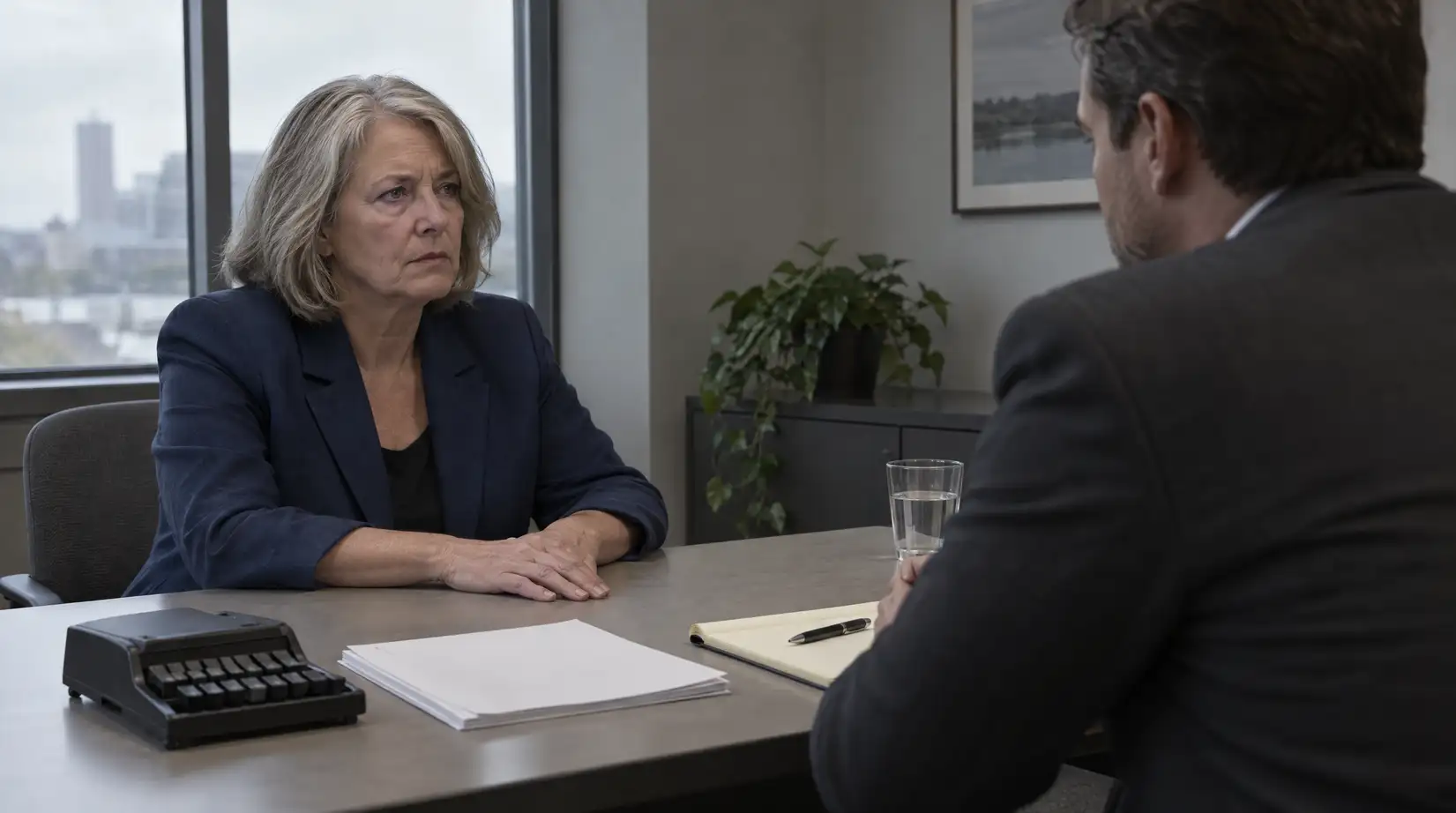
An Examination Under Oath is a formal, recorded interview conducted as part of the insurance claim process, distinct from an ordinary conversation with an adjuster. A certified shorthand reporter transcribes every question and answer, and a notary administers the oath [1].
The testimony is given under oath and recorded, but its admissibility and evidentiary weight relative to courtroom testimony can vary by jurisdiction. It also differs from a routine recorded statement, which is usually unsworn and taken earlier in the claim.
Insurers request EUOs most often on large, complex, or high-value commercial claims — losses involving business interruption calculations, multiple structures, or disputed causation, though insurers also use the procedure to screen out fraudulent claims and test a policyholder’s credibility [1].
The legal purpose of the tool, established as far back as Claflin v. Commonwealth Ins. Co. (1884), is to let the insurer gather all information material to the claim so it can evaluate its obligations and protect against false claims [2].
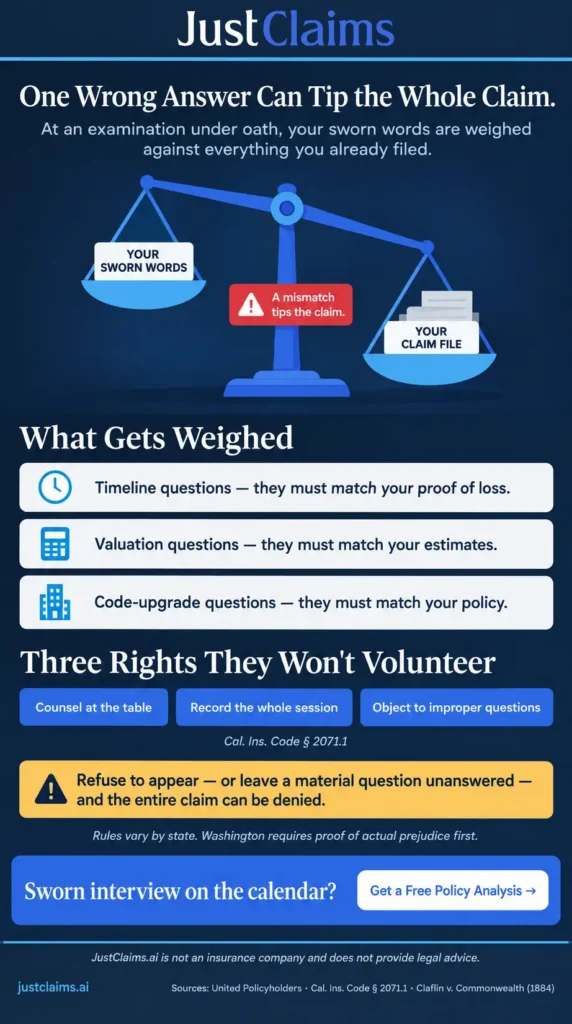
In practice, insurers may also use the EUO to surface inconsistencies between a policyholder’s spoken testimony and their written proof of loss, financial records, or prior statements — inconsistencies that can later support a denial or a reduced payout. For a commercial property owner, this makes the interview far more than a routine formality; it is an evidentiary event that can shape the outcome of the entire claim.
Legal Requirements to Attend an EUO
Because attendance at an EUO is treated as a condition precedent rather than a courtesy, understanding when you are obligated to appear matters as much as what you say once you’re there. This rule varies by jurisdiction.
In most states, courts treat compliance with a reasonably requested EUO as a condition precedent to the insurer’s liability — California and Massachusetts among them — without requiring the insurer to show prejudice [3][4]. Washington’s Supreme Court, by contrast, requires insurers to prove actual prejudice before denying a claim for an EUO refusal [5].
That obligation is not unlimited, however. An insurer may only conduct an EUO to obtain information that is relevant and reasonably necessary to processing or investigating the claim; this standard is established under California law. The examination must be scheduled on reasonable notice, held at a reasonably convenient location, and kept to a reasonable length of time [6][1]. Policyholders also retain procedural protections during the session:
- You may be represented by counsel throughout the examination [6].
- You may record the proceedings in their entirety [6].
- You may raise the same objections available in a deposition under applicable state or federal law [6].
- An unanswered material question, if it prevents the insurer from determining the extent of loss and the validity of the claim, can still affect your contractual right to recovery even where an objection was raised [6].
Given how narrow the line is between a valid objection and a refusal to answer, commercial property owners should treat every EUO notice as a legal event requiring preparation, not a scheduling formality.
Public Adjuster vs. Attorney: Who Should Sit at the Table
Since an unanswered or mishandled question at the EUO can jeopardize the entire claim, deciding who accompanies you into the room is a decision worth making early — not the week before the interview. Commercial policyholders typically choose between a public adjuster, an attorney, or both, depending on the size and complexity of the loss.
Role of a Public Adjuster
A public adjuster focuses on the valuation side of the claim: documenting the scope of damage, calculating business interruption losses, and reconciling repair or replacement cost estimates with the insurer’s own figures. Their value at an EUO is technical — they can help you speak accurately about damages, timelines, and mitigation efforts because they helped build that documentation.
Role of an Attorney
An attorney’s role is procedural and legal. Because the insured may be represented by counsel during the EUO[1] and may raise deposition-style objections to improper questions [6], an attorney present at the table can intervene when a question strays outside what is relevant and reasonably necessary to the claim [6].
Common Trap Questions During an EUO
Because minor valuation errors in testimony can compound into significant financial exposure on a commercial claim, it helps to recognize the categories of questions designed to test consistency rather than gather new facts.
Complex claims require forensic-level analysis, and EUO questioning routinely probes for gaps between what was said, what was filed, and what the documentation actually shows.
Common trap categories include:
- Timeline questions that ask you to recount the sequence of discovering and reporting the loss in granular detail, looking for discrepancies against the written proof of loss.
- Valuation questions about how business interruption losses were calculated, including revenue projections, mitigation efforts, and the basis for lost-income figures.
- Law & Ordinance questions probing whether code-upgrade costs were included in the claim and how those costs were separated from base repair costs.
- Prior claims and maintenance questions intended to establish a pre-existing condition or a pattern that could support a partial denial.
- Compound and leading questions that combine multiple facts into a single question, increasing the risk of an inaccurate or incomplete answer.
An unanswered material question, even one addressed by a valid objection, can still leave the insurer unable to determine the extent of loss and validity of the claim — which is precisely the risk an unanswered material question creates [6].
Preparing Documentation Before Your Examination
Because your EUO testimony will be measured against everything already submitted in the claim file, documentation preparation is not a separate task from testimony preparation — it is the foundation of it.
Financial and Loss Documentation
Gather the original proof of loss, repair and replacement cost estimates, and any prior correspondence describing the cause and extent of damage. Every figure you cite verbally should match a number already in the file.
Business Interruption and Law & Ordinance Records
Reviewing these figures against your policy language in advance can reveal coverage gaps or valuation inconsistencies before an insurer’s attorney does.
Communication and Correspondence Files
Compile emails, adjuster notes, and any written statements previously provided to the insurer. Reviewing this correspondence beforehand helps you recall exactly what was already represented, reducing the risk of an answer that contradicts the written record.
Policyholders preparing for a complex commercial EUO can use policy analysis tools to cross-check their planned testimony against the policy’s Business Interruption and Law & Ordinance provisions, identifying where a verbal answer might unintentionally narrow coverage already documented in the claim file.
Frequently Asked Questions
What happens if I refuse to attend an Examination Under Oath?
The consequences vary by state. In most jurisdictions — including California and Massachusetts — courts treat a reasonably requested EUO as a condition precedent to recovery, so refusing to attend can forfeit your right to policy benefits [3][4].
Some states, such as Washington, require the insurer to prove actual prejudice before denying a claim over an EUO refusal [5]. Either way, attendance is a legal obligation under the policy, not an optional step.
Can I bring an attorney to my Examination Under Oath?
Yes, policyholders may be represented by counsel throughout the EUO [1]. An attorney present during the session can also raise objections available in a deposition setting when questions exceed what is relevant and reasonably necessary to investigate the claim [6].
What documents should I bring to an EUO?
Bring the complete proof of loss, repair estimates, financial records supporting any business interruption calculation, and correspondence exchanged with the insurer to date. Reviewing these materials beforehand helps ensure spoken testimony matches what has already been filed in the claim.
Are there limits to what an insurer can ask during an EUO?
An insurer’s questioning is limited to information that is relevant and reasonably necessary to processing or investigating the claim (this standard is established under California law), and the session must be held on reasonable notice, at a convenient location, for a reasonable duration [6]. Questions that fall outside that scope may be objected to in the same manner as a deposition objection under applicable law [6].
How to Prepare Before Your EUO Date
The Examination Under Oath is not a hurdle to clear before payment — it is a legal proceeding where a single inconsistency in testimony about Business Interruption or Law & Ordinance coverage can affect the outcome of a commercial claim worth millions. Reviewing your documentation, understanding your representation rights, and knowing the scope limits an insurer must operate within all shift the balance back toward an accurate, defensible record of your loss.
Before your EUO date, get a free AI coverage analysis from Justin — upload your commercial policy and claim documentation to flag potential gaps in Business Interruption and Law & Ordinance provisions and confirm your planned testimony stays consistent with what you’ve already filed.
This content is for informational purposes only and does not constitute legal or insurance advice. Coverage decisions depend on the specific terms, conditions, and exclusions of each policy and the laws of the applicable jurisdiction; policyholders and contractors should consult with a qualified professional for advice on their particular situation.
Sources
[1] Examinations Under Oath — “EUO” — United Policyholders
[3] Brizuela v. CalFarm Ins. Co., 116 Cal. App. 4th 578 (2004) — CourtListener / Free Law Project
[4] Mello v. Hingham Mutual Fire Ins. Co., 421 Mass. 333 (1995) — CourtListener / Free Law Project
[5] Staples v. Allstate Ins. Co., 176 Wn.2d 404 (2013) — CourtListener / Free Law Project
[6] California Insurance Code § 2071.1 — California Legislative Information
Collin Corcoran

Experienced Public Adjuster and Property Claims Specialist, Collin is licensed in New York (#1603393), New Jersey (#3003700204), and Connecticut (#19820270). With 20+ years of hands-on construction and property damage experience, he specializes in residential and commercial claims, complex loss inspections, policy review, detailed estimating, and strategic negotiation. Collin’s background in construction, asset management, emergency response, and claims documentation allows him to accurately identify damage, understand repair requirements, and advocate effectively for policyholders. He works with homeowners, business owners, contractors, and insurance professionals to move claims forward with clarity, accuracy, and confidence. Collin is committed to transparency, technical precision, strong communication, and securing fair outcomes for policyholders.