Boiler Insurance Claims: Coverage & Denials Guide 2026
September 24, 2026
Written by Stephane Elias
Share


When a commercial boiler fails in the middle of a January cold snap, the first call goes to an HVAC contractor. The second call — to the insurance carrier — is where most property owners learn what their policy actually says. A standard property policy treats a boiler explosion very differently from a boiler that simply wears out, and that distinction often decides whether a claim gets paid or denied. This guide covers what standard property insurance pays for, why boiler claims get denied, and the steps that put you in the strongest position before and after a loss.
Key Takeaways
- Explosion coverage: Standard property insurance policies typically list “explosion” as a covered peril under dwelling and personal property coverage.
- Named peril language: Policy forms based on standard ISO language list coverage item 15 (sudden and accidental tearing apart, cracking, burning, or bulging of a steam or hot water heating system) as a named peril.
- Mechanical breakdown gap: Standard policies typically will not pay to repair or replace a boiler for mechanical breakdown unless an equipment breakdown endorsement has been added.
- Sudden peril coverage: A boiler that suddenly explodes or cracks is generally covered, along with resulting sudden and accidental water damage.
- Wear and tear exclusion: Routine repairs stemming from wear and tear or deferred maintenance are excluded from standard coverage unless equipment breakdown coverage is in place.
Boiler Insurance vs. Property Insurance: What Each One Actually Covers
It does not. A standard property insurance policy is built around covered perils — sudden, accidental events — not the gradual failure of mechanical equipment over time.
Most policy forms list “explosion” as a covered peril under dwelling and contents coverage, which can apply when a boiler ruptures violently [1].
Standard policy language, reflected in state insurance guidance built on nationally used ISO forms, explicitly names coverage item 15 (sudden and accidental tearing apart, cracking, burning, or bulging of a steam or hot water heating system, an air conditioning system, or an automatic fire-protective system) [2].
If a boiler cracks suddenly and floods a mechanical room, that resultant water damage is generally treated as a covered loss [3]. The automatic fire-protective systems named in the same coverage item carry their own condition: protective safeguard requirements can suspend coverage entirely if a sprinkler or alarm system is out of service at the time of the loss.
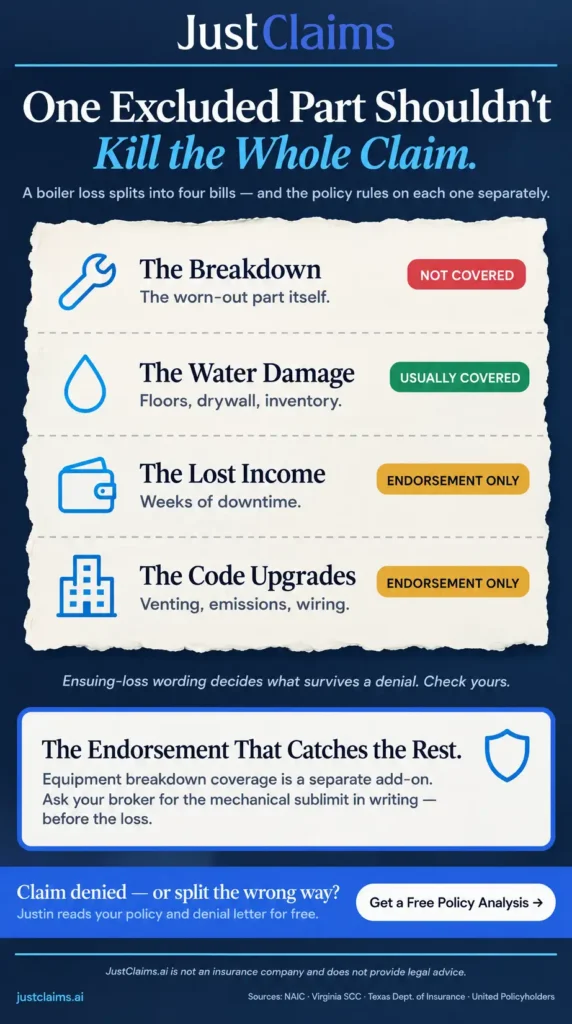
What is almost never covered under a standard policy is the mechanical breakdown itself — the internal failure of a pump, control board, or heat exchanger that simply wears out. For that exposure, property owners typically need to add an equipment breakdown endorsement, which specifically addresses unforeseen mechanical or electrical failure [4]. Without that endorsement, a claim for a burned-out circuit board or a seized pump can be denied outright, even though the same policy would pay for the water damage the failure caused downstream.
Property owners evaluating renewal terms should ask their broker directly whether an equipment breakdown endorsement is included, and request written confirmation of the sublimit that applies to mechanical equipment specifically — that number, not the headline dwelling limit, determines what a boiler failure actually recovers.
Common Reasons Boiler Claims Get Denied
Wear and tear is a commonly cited denial rationale. An insurer can deny a boiler claim when the adjuster concludes the failure resulted from age, corrosion, or lack of maintenance rather than a sudden and accidental event — standard policy forms exclude wear and tear and mechanical breakdown from coverage [5]. Boiler damage is typically covered when caused by sudden perils such as fire, lightning, explosion, or windstorm, but routine deterioration is excluded unless equipment breakdown coverage was purchased in advance [3] [5].
Property owners should request the full inspection report an adjuster relied on, not just the summary denial letter, since the underlying language often reveals whether the carrier classified the loss correctly. If it was not, the dispute becomes an underpaid insurance claim — and the inspection report is the exhibit that reframes it.
A second common denial pattern involves missing maintenance documentation. Property owners without service records, inspection logs, or prior repair invoices are far more exposed to a wear-and-tear finding — even when the actual cause was sudden. Retaining boiler service records, annual inspection certificates, and any prior repair invoices creates the documentation trail that supports a sudden-and-accidental argument if a dispute arises.
A third pattern involves resultant damage being separated from the excluded mechanical failure. Whether ensuing water damage or business interruption remains payable after an excluded mechanical breakdown depends on the specific ‘ensuing loss’ or ‘and confined to’ language in the policy — it is not automatic [3]. Property owners should ask the adjuster to itemize which portions of the loss were denied and which were approved, since a blanket denial letter frequently overstates what is actually excluded.
Uncovering Coverage Gaps in Business Interruption and Law & Ordinance Provisions
Because boiler failures at commercial properties rarely stop at the mechanical room, the same coverage split described above extends into business interruption and law and ordinance provisions that are frequently overlooked during a denial review. A burst boiler that shuts down a building for weeks can trigger lost income coverage, extra expense coverage, and code-upgrade requirements simultaneously — and minor valuation errors in any one of those provisions can compound into significant losses on a commercial claim.
Business interruption coverage replaces income lost when operations are disrupted by a covered physical loss — so if the boiler failure itself is not a covered peril under the policy, the income loss may not be triggered either [6].
Equipment breakdown coverage is typically purchased separately or added by endorsement to extend that protection to mechanical and electrical failure losses [4]. Once the trigger is met, business interruption, extra expense, and loss-of-rents coverage each pay a different part of the shutdown — income, the cost of temporary operations, and rents that stop while the building is down.
Property owners should also confirm whether law and ordinance coverage extends to code-required upgrades triggered by a boiler replacement — such as updated ventilation or emissions requirements — since older buildings can face upgrade costs the original policy limit did not anticipate.
Coordinating HVAC Contractor Repairs and Claim Funding
Because documentation gaps are one of the leading causes of denial described above, the relationship between the repair contractor and the claim file matters as much as the policy language itself. A detailed, itemized scope of work from a licensed HVAC contractor — one that separates the mechanical failure from the resultant damage — gives the adjuster a clear basis to approve the portions of the claim that are covered, even when other portions are excluded.
Property owners should request that contractors document the failure mode explicitly: whether the boiler cracked, exploded, or simply stopped functioning, and whether corrosion or sediment buildup was visible. This distinction directly determines whether the loss falls under a named peril or under the excluded wear-and-tear category.
Property owners should also request photographs of the failure point before any component is removed or discarded, since physical evidence is often the deciding factor in a sudden-versus-gradual dispute.
Frequently Asked Questions
Does home insurance cover a broken boiler?
Standard property insurance generally covers boiler damage caused by a sudden event, such as an explosion or a sudden crack, along with resulting water damage [3]. It typically does not cover a boiler that simply stops working due to age or wear, unless an equipment breakdown endorsement has been added to the policy [4].
What is the difference between boiler insurance and property insurance?
Property insurance responds to sudden, accidental perils like fire, explosion, or storm damage, while an equipment breakdown endorsement addresses internal mechanical or electrical failure that develops over time [4]. A boiler can be damaged by both types of events, but each requires different coverage to pay a claim.
Why was my boiler claim denied?
Wear and tear and lack of maintenance are commonly cited denial reasons [5]. Missing maintenance records or an incomplete contractor report can also lead an adjuster to deny a claim that might otherwise have been payable.
Can I still recover damages if my boiler failure was gradual?
The mechanical breakdown itself may not be payable without an equipment breakdown endorsement, but any resultant damage — such as flooding or fire — caused by that failure may still be covered under the base policy [3]. Separating the excluded breakdown from the covered resultant damage in the claim file is essential to recovering that portion.
What Property Owners Should Do Next
Property owners who document the failure mode, retain maintenance records, and request an itemized breakdown of what an adjuster approved versus denied are in the strongest position to challenge a partial or full denial. Commercial property owners in particular should scrutinize business interruption and law and ordinance provisions, since minor valuation errors in those sections can translate into substantial unrecovered losses.
If your boiler claim was denied or underpaid, upload your policy and denial letter to the free insurance policy analyzer from JustClaims — Justin flags the coverage language your carrier may have overlooked, in minutes.
This content is for informational purposes only and does not constitute legal or insurance advice. Coverage decisions depend on the specific terms, conditions, and exclusions of each policy and the laws of the applicable jurisdiction; policyholders and contractors should consult with a qualified professional for advice on their particular situation.
Sources
[1] My Insurance Doesn’t Cover What? — NAIC
[2] Virginia Consumer’s Guide for Homeowners Insurance — Virginia State Corporation Commission
[3] 14VAC5-341-60, Causes of Loss — Virginia Administrative Code
[4] Harvey Is a Wake-Up Call to Check Your Homeowners Insurance — United Policyholders
[5] Home Insurance Policies: All Risk or Named Peril — Texas Department of Insurance
[6] What Business Income Loss Coverages Are Out There? — NAIC

Stephane Elias

A seasoned insurance professional with nearly a decade of experience, Stephane Elias is currently serving as a Senior Claims Professional and Public Adjuster with JustClaims. Throughout his career, Stephane has represented policyholders through leading public adjusting firms and served as a loss consultant for law firms specializing in insurance litigation, giving him extensive expertise in complex property insurance claims. A licensed public adjuster in TX (#2645032), FL (#W564547), and six other states, he specializes in commercial and residential property claims, claims management, appraisals, mediation, and strategic partnerships. Stephane is passionate about helping policyholders overcome delayed, denied, and underpaid insurance claims, ensuring they receive the full recovery they’re entitled to under their policy.