Ice Dam Insurance Claims: How to Win Yours in 2026
September 21, 2026
Written by Taylor Bezek
Share


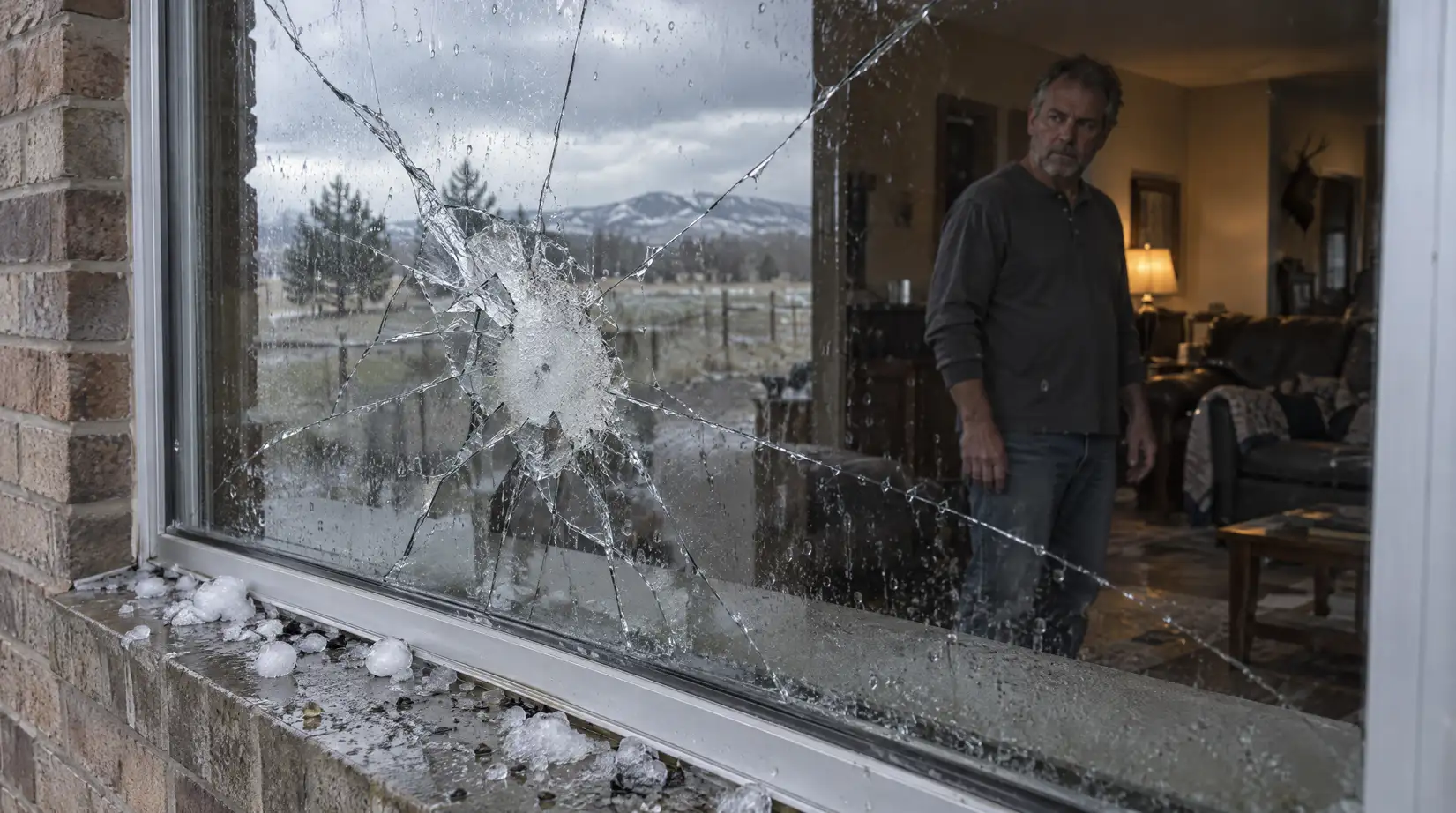
Minnesota property owners who file an ice dam claim during the February freeze-thaw peak often discover that “covered” and “paid” are two different things. Florida claims data offers a preview of the stakes: on non-catastrophe claims, represented property owners received a median payout of $9,379 compared with $1,391 for those without representation — a gap of roughly 574%. The difference almost always comes down to one thing: the evidence file behind the claim.
Key Takeaways
- Why claims get denied: Homeowners policies cover sudden, accidental losses but not maintenance — damage tied to wear and tear or a deteriorating roof generally isn’t paid, even when a storm is involved.
- What’s typically covered: Interior or exterior damage caused by an ice dam is generally covered under a standard home policy; the cost of removing the ice dam itself often is not.
- Mold coverage limits: Most policies cover mold only when it results from sudden water damage, not from gradual leaks or seepage.
- Evidence tool: NOAA’s National Centers for Environmental Information issues certified weather records that meet court authentication requirements — $180 for up to 40 pages including shipping.
- Dispute process: Insurance regulators outline a 4-step process for disputed claims: contact the insurer, invoke the appraisal clause, file a regulator complaint, then seek legal help.
- Public adjuster impact: Florida OPPAGA data show represented non-catastrophe claims received a median payout of $9,379 versus $1,391 for unrepresented claims — a difference of roughly 574%.
Why Ice Dam Claims Get Denied (The Maintenance Argument)
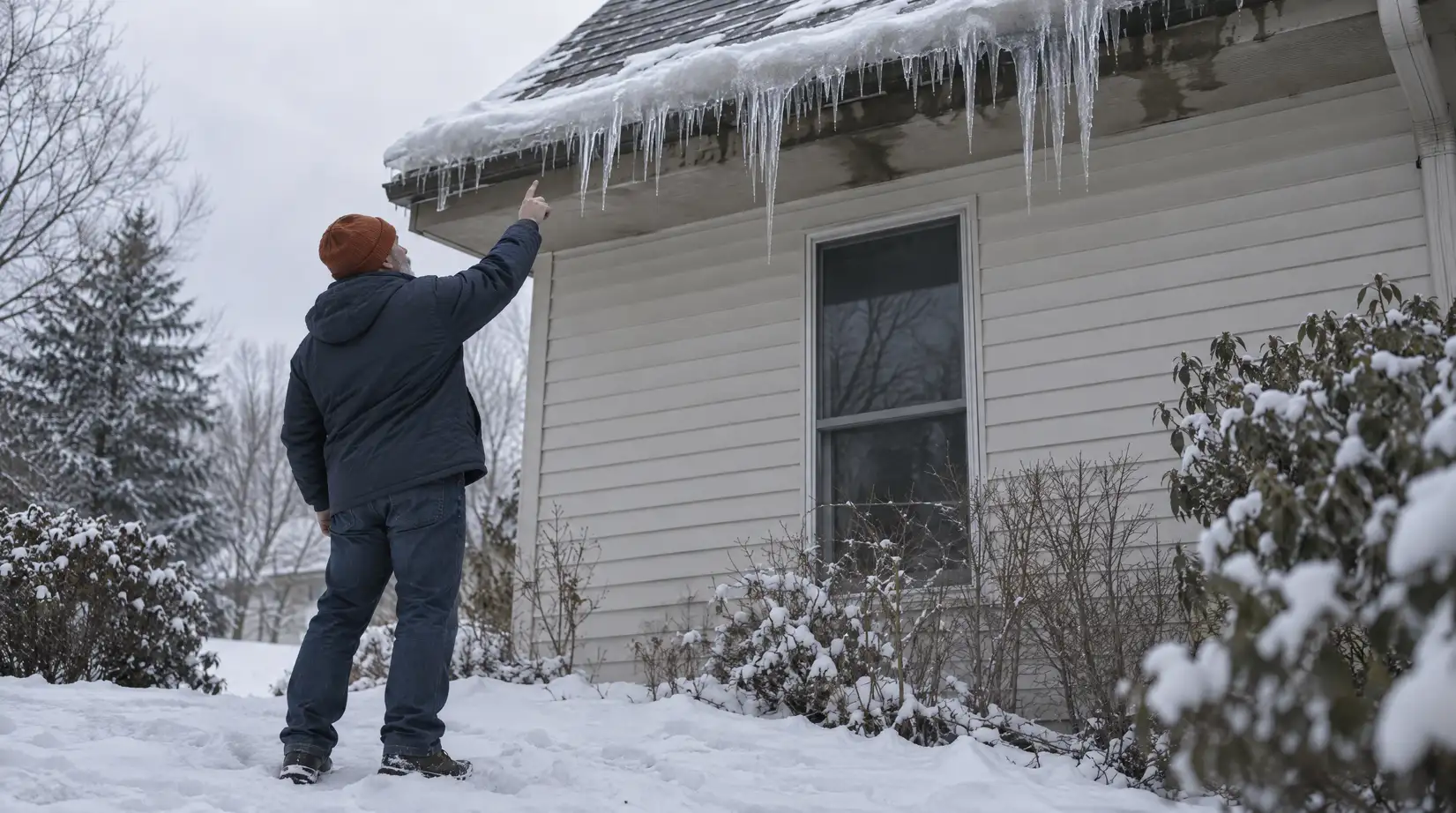
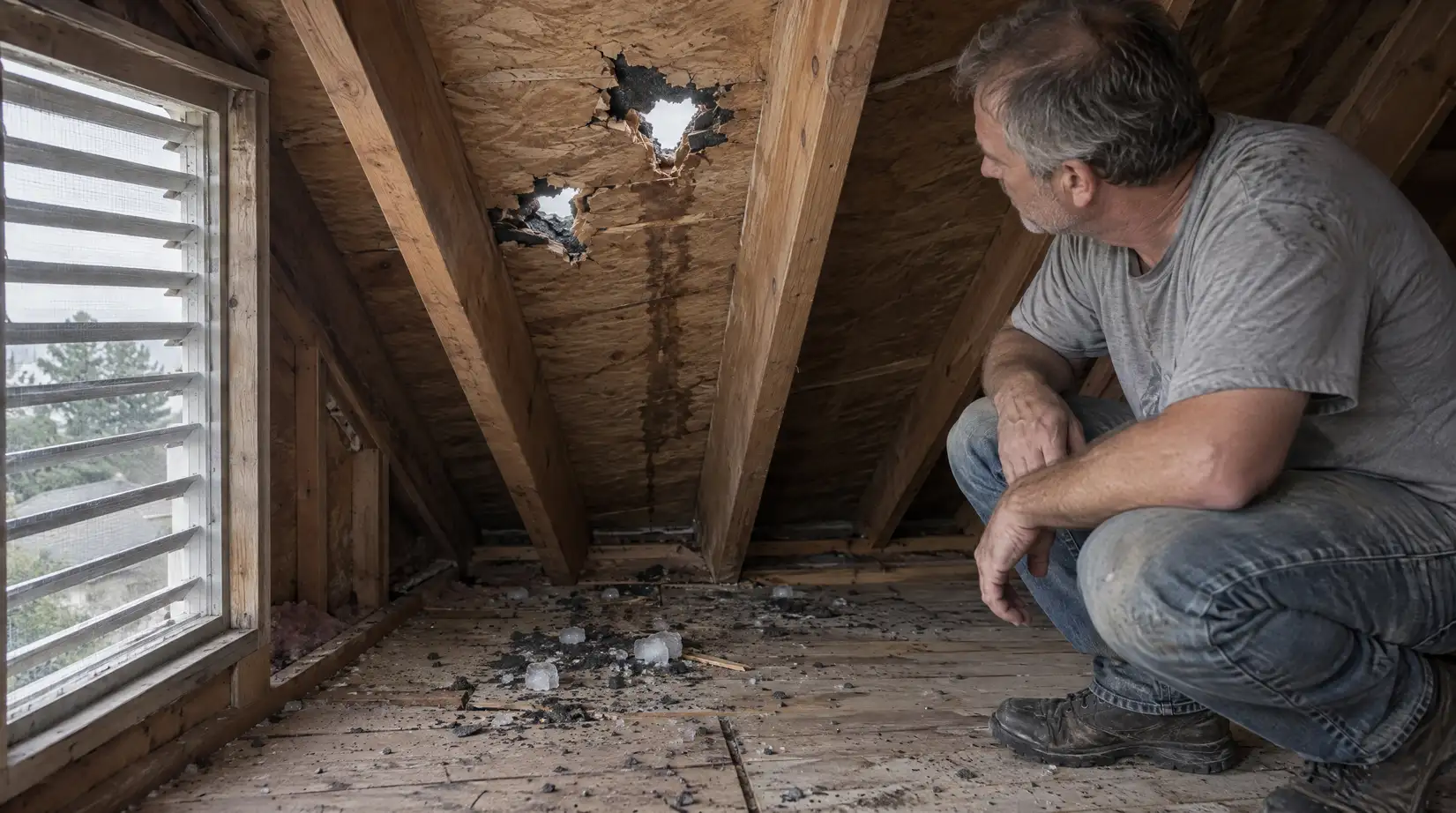
Interior or exterior damage caused by an ice dam is generally covered under a standard home insurance policy, but many policies exclude the cost of removing the ice dam itself, and carriers can deny roof collapse damage tied to age or pre-existing deterioration [1].
United Policyholders, a national consumer insurance advocacy nonprofit, notes that ice dam damage is generally covered as long as the policyholder gives timely notice and it is reasonably clear the loss was not solely caused by known, pre-existing roof damage [2].
Disputes typically center on whether the insurer can point to prior wear rather than the storm itself.
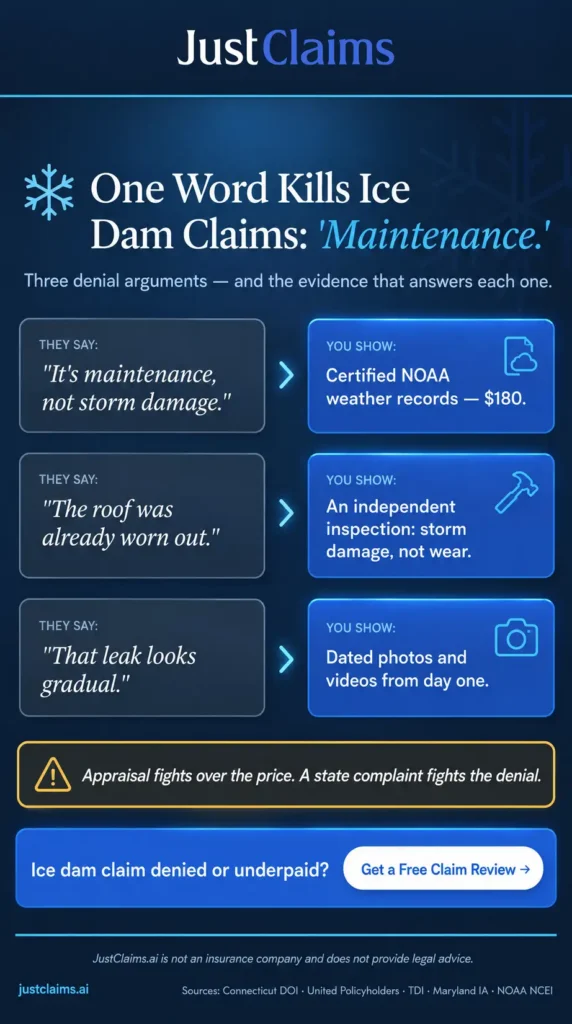
A denial usually comes down to cause. Homeowners policies typically cover losses that are sudden and accidental — including damage from the weight of ice or snow — but they do not cover maintenance, and repairing damage tied to wear and tear or a deteriorating roof generally is not paid [3].
When a covered event damages a roof that already needed maintenance, the policy may not cover all or part of the claim [3] — and United Policyholders lists arguments over pre-existing damage or construction defects among the disputes ice dam claims commonly produce [2].
Knowing this pattern in advance can help a property owner build a file that answers the maintenance question before an adjuster raises it.
The Coverage Question: Dwelling vs. Interior vs. Mold
Because insurers frame so many ice dam losses as maintenance issues, the coverage that actually applies often depends on exactly which part of the property was damaged — the structure, the interior, or any resulting mold.
Dwelling Coverage
Dwelling coverage is the part of a standard policy built for sudden, accidental losses — and state regulators list the weight of ice or snow among the perils those policies typically cover [3]. That is the coverage that pays to repair the structure itself — the roof, walls, or ceilings — when ice-dam water backs up under shingles and gets inside, subject to the policy’s limit and deductible [1].
Interior and Contents Coverage
The same sudden-and-accidental test applies inside the home: most home policies cover sudden water damage but not damage from gradual leaks or seepage [4]. Documenting the moment the water intrusion became visible — rather than describing it as an ongoing problem — can matter to how an adjuster classifies the loss.
Mold Coverage Limits
Most home insurance policies cover sudden and accidental water damage, and mold that develops on a damaged item as a direct result of that sudden event is typically covered, but policies generally exclude mold or water damage tied to gradual leaks or seepage [4].
Standard policies also typically exclude mold cleanup and testing once the damaged item has been removed, though some insurers allow a supplemental endorsement for mold cleanup tied to a covered loss [4].
Building the Evidence File — Weather Data, Photos, and Contractor Reports
Because the maintenance argument hinges on timing and cause, the strongest counter to a denial is a documented record that shows exactly when the freeze-thaw event happened and what it did.
Certified Weather Records
NOAA’s National Centers for Environmental Information issues Department of Commerce-certified weather records — temperature, precipitation, and storm data — certified to meet the authentication requirements for records submitted as evidence in court [5].
Certified paper copies start at $180 total — $168 for up to 40 pages plus a $12 shipping charge — and a property owner can request records for the specific freeze-thaw dates tied to their claim [5]. This record can directly counter an insurer’s claim that no qualifying weather event occurred.
Photo and Receipt Documentation
The NAIC tells policyholders to take photos and videos of damage, make a list of every damaged item, and keep receipts for repairs as proof when filing a claim [6]. It also suggests having your contractor meet with you and the insurance adjuster — a simple step that puts your evidence in front of the person scoping the loss [6].
Independent Contractor Inspection Reports
An independent roofing contractor’s inspection report can help draw the same line regulators draw: sudden, accidental ice damage — lifted shingle tabs, cracked sealant strips, storm-damaged decking or flashing — versus the wear, tear, and deterioration that policies do not cover [3]. That distinction matters because a covered event on a roof that was already deteriorating can reduce what the policy pays [3].
The Denial-Appeal Path and the Appraisal Clause
Because so many ice dam disputes come down to a disagreement over cause or dollar amount, knowing which recourse tool fits which disagreement can determine whether an appeal succeeds.
In Minnesota, contact the insurer, request a written explanation citing policy language, invoke the appraisal clause, or contact the Minnesota Department of Commerce Consumer Services Center [7].
| Step | Action |
|---|---|
| 1 | Contact the insurer or agent; submit a contractor’s estimate and supporting documents |
| 2 | Invoke the appraisal clause or hire a public adjuster over disagreement on the amount of loss |
| 3 | File a complaint with the state Department of Insurance |
| 4 | Seek legal help if the dispute is still unresolved |
Regulators note they cannot force an insurer to pay a claim unless the denial violates a law or the policy’s own terms [7]. Most policies include an appraisal clause: the property owner selects one appraiser, the insurer selects another | Editorial Denial-Appeal section; appraisal clause is the post’s core recourse tool and the destination’s mapped keyword, and the two jointly select a neutral third appraiser (an umpire) to determine the value of the loss [8].
The Minnesota Department of Commerce advises property owners who disagree with a denial to first request a written explanation citing specific policy language, and if unresolved, to contact the Department’s Consumer Services Center or file a complaint online [8].
Every state maintains a Department of Insurance that investigates consumer complaints — including unfair delays or denials — free of charge, and the NAIC’s national consumer portal can direct a property owner to their state’s complaint process [9].
One limit matters here: appraisal sets the dollar value of a loss — coverage disputes generally cannot be resolved through appraisal, so a denial of coverage itself goes through the state complaint process or the courts [10].
When a Public Adjuster Changes the Outcome
Because ice dam denials so often come down to unresolved evidence — sudden versus gradual damage, or how much hidden moisture went undocumented — professional representation can close exactly the gap that triggers a denial in the first place.
Florida’s Office of Program Policy Analysis and Government Accountability found that on non-catastrophe claims filed with Citizens Property Insurance, represented policyholders received a median payment of $9,379 compared with $1,391 for unrepresented policyholders — a difference of 574% [12].
A separate, frequently cited figure — a 747% payment difference — comes specifically from claims tied to the 2005 hurricane season and is not a national or all-perils statistic; both figures reflect gross amounts before any contingency fee [12].
In practice, much of what a public adjuster changes is the evidence file itself: documenting whether damage was sudden or gradual, and how much hidden damage — saturated insulation, wall-cavity moisture, mold — gets added to the claim scope. Both are documentation problems, not pure negotiation problems.
The same OPPAGA analysis found that claims represented by public adjusters took longer to settle than unrepresented claims, and that public adjusters are disproportionately hired on disputed and complex claims, which introduces selection bias into any payout comparison [11].
United Policyholders also warns that ice dam disputes can attract unqualified or unlicensed individuals posing as public adjusters through door-to-door solicitation, making it worth verifying licensure before hiring representation [2].
Frequently Asked Questions
Does home insurance cover ice dam damage in Minnesota?
Coverage generally applies when the damage is sudden and accidental and the policyholder provides timely notice, but insurers can deny claims where they believe pre-existing roof deterioration or poor attic ventilation caused the ice buildup [1][2]. Because Minnesota’s coldest stretches typically peak in January, the timing of freeze-thaw cycles relative to when the leak first appeared often becomes central to the coverage decision.
Why do insurers deny so many ice dam claims?
The usual argument is maintenance, not weather: homeowners policies do not cover maintenance, and damage tied to wear and tear or a deteriorating roof generally is not paid [3]. When a covered event hits a roof that already needed maintenance, the policy may not cover all or part of the claim — which is exactly the gap an insurer can press [3].
What is the appraisal clause and when does it apply to an ice dam dispute?
The appraisal clause lets a property owner and insurer each hire an appraiser, with a third neutral umpire settling any disagreement over the dollar value of a loss [8]. It does not apply to disputes over whether the loss is covered at all — coverage disputes generally cannot be resolved through appraisal and go through a state complaint process or the courts [10].
Is mold covered after an ice dam leak?
Mold that develops on an item damaged by a sudden, accidental water event is typically covered, but mold or water damage tied to a slow, ongoing leak is generally excluded [4]. Most standard policies also don’t cover mold cleanup and testing after the damaged item is removed unless a supplemental endorsement was purchased [4].
How much does a public adjuster cost for an ice dam claim, and is it worth it?
Public adjusters typically work on contingency, and Florida data shows represented non-catastrophe claims settling for a substantially higher median payment than unrepresented claims — though represented claims also tend to take longer and are disproportionately the more complex or disputed ones [11][12]. Because that data comes from a single state’s storm-driven claims, treat it as directional, not a predictor of any one claim’s outcome.
How to Protect Your Ice Dam Claim
Winning an ice dam claim generally comes down to which side has better documentation of when the damage happened and what caused it. A dated photo record, a certified weather report for the freeze-thaw window, and an independent contractor inspection distinguishing sudden storm damage from wear and tear together answer the maintenance question. Knowing which recourse tool fits your dispute — appraisal for a value disagreement, a state complaint for a coverage denial — can also determine how quickly it gets resolved.
Not sure what your policy actually says before you file or appeal? Upload it to Justin, JustClaims’ free insurance policy analyzer, and see in minutes whether your insurer’s denial or lowball offer overlooked coverage you’re owed.
This content is for informational purposes only and does not constitute legal or insurance advice. Coverage decisions depend on the specific terms, conditions, and exclusions of each policy and the laws of the applicable jurisdiction; policyholders and contractors should consult with a qualified professional for advice on their particular situation.
Sources
[1] Winter Damage Tips for Making Insurance Claims — Connecticut Insurance Department
[2] Ice Dams and Insurance — United Policyholders
[3] Roof Replacement Insurance Advisory (2019) — Maryland Insurance Administration
[4] When are water damage and mold covered by insurance? — Texas Department of Insurance
[5] Data Certification — NOAA National Centers for Environmental Information
[6] What You Need to Know When Filing a Homeowners Claim — NAIC
[7] How to get help with a homeowners or renters insurance complaint — Texas Department of Insurance
[8] Settling Your Claim — Minnesota Department of Commerce
[9] How to File a Complaint — NAIC
[10] Appraisal handout, NAIC Summer Meeting 2023 Consumer Liaison (Jon Wilkofsky) — NAIC
[11] Report 10-06: Public Adjuster Representation in Citizens Property Insurance Claims — Florida OPPAGA

Taylor Bezek

As the General Manager at JustClaims, Taylor Bezek brings over a decade of experience managing complex residential, commercial, and large-loss claims. A licensed Public Adjuster in TX (#2125659), FL (#W455048), CO (#769172), and 10 additional states, Taylor founded his own firm before joining JustClaims to scale a tech-forward solution for the insured. He is committed to combining industry expertise with AI to enhance speed, clarity, and outcomes for every policyholder. Taylor's mission is to modernize the public adjusting profession and ensure owners get exactly what they are entitled to.